Silver sulfide soundtracks on 16mm color reversal prints(1938–1972)
An optical soundtrack type used on the Kodachrome print stocks, before 1957, and Ektachrome print stocks, before 1972. Identifiable by its yellowish tint. It was also used on Anscochrome and Gevachrome reversal print stocks.
Film Explorer

A 16mm reversal print of Royal Road to Profit (ca. 1950). Printed on Kodachrome Duplicating Film 5265; 1950 date code; variable-area sulfide soundtrack.
Paul Ivester collection, Seattle, WA, United States.

A 16mm reversal print of Degree of Importance… (1967). Printed on Ektachrome R Print Film 7388; 1967 date code; dual variable-area sulfide soundtrack.
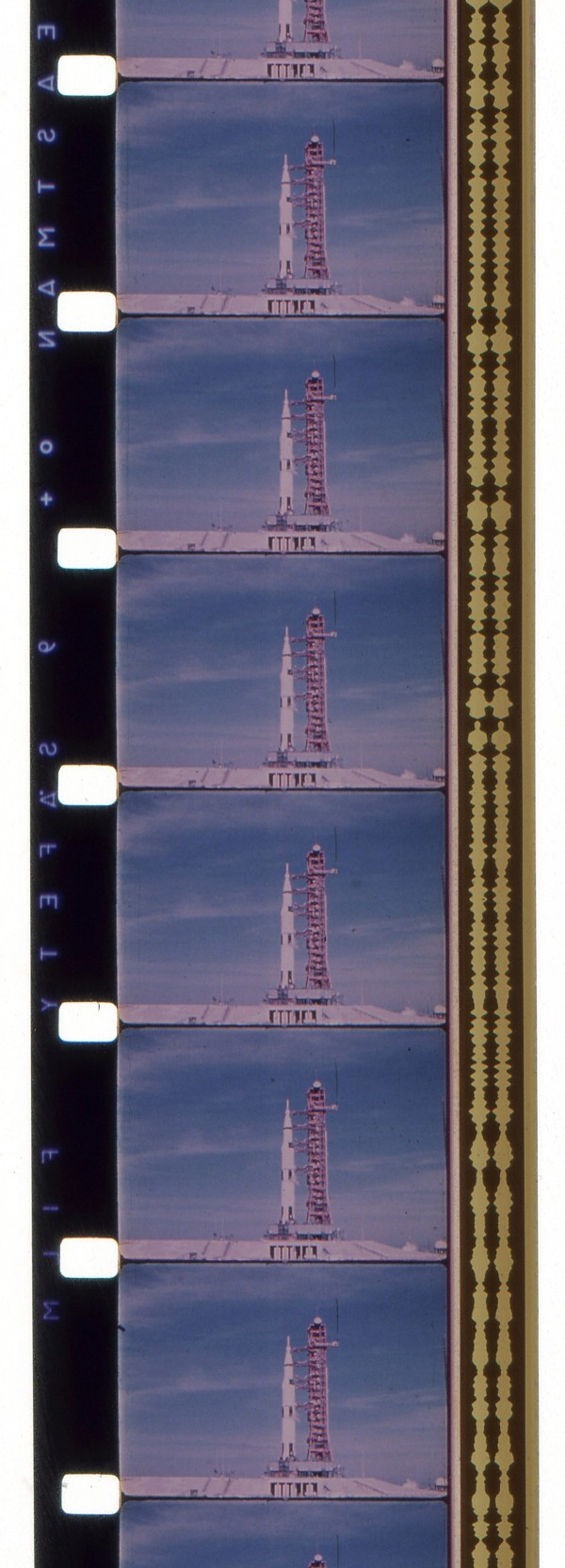
A 16mm reversal print of Apollo 15: In the Mountains of the Moon (ca. 1972). Most likely printed on Ektachrome Reversal Color Print Film 7386; 1971 date code; dual variable-area sulfide soundtrack. It is possible that it might be an early example of Print Film 7390.

A 16mm reversal print of Henry Moore (ca. 1946). Printed on Anscochrome Reversal Film; no date code; variable-area sulfide soundtrack.

A 16mm reversal print of Wildlife and the Human Touch (US Forest Service., US ca. 1950). Printed on Anscochrome Reversal Film; no date code; variable-area sulfide soundtrack.
Identification
The following stocks used silver sulfide soundtracks: 16mm Kodachrome Duplicating film, 5262 (1938–40); 16mm Kodachrome Duplicating film, 5265 (1940–56); Ektachrome Reversal Color Print film, 7386 (1960–72), Ektachrome R Print film, 7388 (1966–70). Additionally, several Anscochrome and Gevachrome emulsions were compatible with silver sulfide soundtracks.
The edges of Kodachrome film are black; the edge print text is orange. In general, the original Kodachrome stocks (5262, 5265) were marked “KODACHROME SAFETY” and use the standard Eastman Kodak dating symbols. Prints made before 1951 often have a wide space between “KODA” and “CHROME”. Ektachrome print film 7388 is marked “EKTACHROME R” or “EASTMAN EKTACHROME R”. Ektachrome Reversal Color Print Film 7386 is usually marked “EKTACHROME”, but could be marked “EASTMAN SAFETY FILM” without any marking of Ektachrome. All should use the standard Eastman Kodak dating symbols. Anscochrome is usually marked “ANSCO SAFETY”. Please see individual essays on Kodachrome, Ektachrome, Anscochrome and Gevachrome for further detail.
Generally, cellulose acetate butyrate before 1948; cellulose triacetate after 1948.
1
Reversal stocks from this era are generally considered low fade. The earlier types were prone to contrast build-up during duplication, but later low-contrast stocks reduced this problem.
None
Variable-density (Western Electric), or variable-area (RCA) optical soundtrack. The soundtrack is yellow-to-brown in appearance. The high-transmission portion is never completely clear, so the system does not have the range of modulation that later silver tracks achieved. The result is a reduced signal-to-noise ratio compared to pure silver soundtracks. As is typical of all 16mm sound prints, the track runs down the opposite edge of the film to the single row of perforations; it is displaced 26 frames in advance of the picture.
16mm double-perforated (2R) for picture master; 16mm single-perforated (1R) for soundtrack master.
16mm color reversal (Kodachrome, Ektachrome, or other), or from interpositive made by reduction from 35mm Technicolor, or Eastmancolor, negatives.
Camera stocks can have a variety of markings, as virtually any source can be used to make a reversal print. Kodachrome motion picture films used standard Eastman Kodak edge code dating symbols. The edges of Kodachrome film are black; the edge print text is orange. All Kodachrome film before 1951 is marked “KODA CHROME” – with a space between the two parts of the brand name. Between 1951 and 1961, “KODACHROME” appears on the edge without the space. Ektachrome is similarly marked. Ektachrome Commercial is usually marked “Eastman ECO”.
History
When 16mm Kodachrome film was introduced in 1935, it was initially intended for direct projection of the camera original. If a copy was made directly onto Kodachrome camera stock, the copy would tend to display excessive contrast. For this reason, special reversal duplicating stocks were produced to avoid contrast build-up. Later on, “commercial” camera stocks were introduced to provide better results when duplicating.
Printing an optical soundtrack on B/W film was relatively straightforward, as the processing of the soundtrack could be done simultaneously with the picture. When multilayer color reversal films (specifically Kodachrome) became available, certain issues were immediately evident.
The yellow and magenta emulsion layers could not be used for soundtracks, as they were essentially transparent at the wavelengths to which the photocells used in sound playback heads were most sensitive. The cyan layer was potentially usable but was unsatisfactory as it was the deepest layer, and the outer layers would disperse the light, thus reducing the resolution of the cyan image (Mannes & Godowsky, 1939). A dye track also has an inferior signal-to-noise ratio compared to a silver track (Dearing, 1941). It was also possible to produce a dye track using all three emulsion layers, but that was also found to produce inferior results (a reduced high-frequency range) (Mannes & Godowsky, 1939; Dearing, 1941). Therefore, it was deemed preferable to produce the optical soundtrack in the top (yellow) emulsion layer only – but it had to be opaque to red wavelength light. The silver sulfide soundtrack offered a practical solution to these problems.
(The term “silver sulfite” soundtrack is used in multiple sources – while incorrect, its use is widespread. From the patents, it is clearly “silver sulfide”.)
Kodachrome Duplicating Film 5262 was introduced in 1938, two years after the introduction of 16mm Kodachrome camera film. This new duplicating film was well suited for printing silver sulfide soundtracks. It could also be used as a camera stock when reduced contrast was desired. Before this time, one can assume that duplicates were made on Kodachrome camera stock, resulting in excessive contrast. 5262 was replaced with Kodachrome Duplicating Film 5265 in 1940, which was used until 1956 when Eastman Reversal Color Print Film 5269 was introduced. Print film 5269 was also based on Kodachrome technology, but was intended for producing silver soundtracks, rather than sulfide tracks. So, 1956 marks the end of sulfide tracks on Kodachrome release prints. (Eastman Kodak, 2017)
Ektachrome reversal print film 7386 used a silver sulfide track produced in the same manner as Kodachrome Duplicating Stock 5265. Reversal stock 7386 was introduced in 1960. By this time, Kodachrome type print stocks were already using silver soundtracks, but this was still not possible with Ektachrome stocks. Later Ektachrome reversal color print stocks, such as 7389 and 7390, introduced in 1970 and 1973, were suitable for silver tracks (Eastman Kodak, 2017) (Tremaine, 1969: 18.286 & 18.287). These developments signaled the end for the use of sulfide soundtracks.
Silver sulfide tracks were also used on Anscochrome and Gevachrome print stocks (Verbrugghe, 1967).
There are few well-known film titles printed on 16mm Kodachrome, or Ektachrome Duplicating stock – these stocks were used mostly for educational and industrial films, with the occasional use on TV shows. Sometimes 35mm Technicolor films were printed on Kodachrome Duplicating stock for 16mm release. Until the Eastman Color negative–positive process was introduced in 1953, all 16mm release prints were made on a reversal stock, such as Kodachrome or Agfachrome, or using a multi-strip process such as Technicolor, or Cinecolor. Technicolor and Cinecolor were only cost-effective for large print-runs, and could not be produced as quickly as reversal prints. Later, as most 16mm production continued to be on reversal camera stocks, short print-runs could still be made more quickly and economically on reversal stock, as it negated the need for the production of an internegative.
Selected Filmography
Most likely printed on Ektachrome Reversal Color Print Film 7386; 1971 date code; dual variable-area sulfide soundtrack. It is possible that it is an early example printed on 7390 stock. NASA released a film to summarize each Apollo mission. Most prints are on Eastman Color.
Most likely printed on Ektachrome Reversal Color Print Film 7386; 1971 date code; dual variable-area sulfide soundtrack. It is possible that it is an early example printed on 7390 stock. NASA released a film to summarize each Apollo mission. Most prints are on Eastman Color.
Printed on Anscochrome Reversal Film; no date code; variable-area sulfide soundtrack. An exhibition of Henry Moore's work came to MoMA in 1946 – art patrons were eager to see the influences of WWII on his work.
Printed on Anscochrome Reversal Film; no date code; variable-area sulfide soundtrack. An exhibition of Henry Moore's work came to MoMA in 1946 – art patrons were eager to see the influences of WWII on his work.
Printed on Kodachrome Duplicating Film 5265; 1948 date code (reduced from 35mm Technicolor negatives); variable-area sulfide soundtrack.
Printed on Kodachrome Duplicating Film 5265; 1948 date code (reduced from 35mm Technicolor negatives); variable-area sulfide soundtrack.
Printed on Anscochrome Reversal Film; no date code; variable-area sulfide soundtrack. We see the culture of both East and West Pakistan, and the wide variation in climate and agriculture.
Printed on Anscochrome Reversal Film; no date code; variable-area sulfide soundtrack. We see the culture of both East and West Pakistan, and the wide variation in climate and agriculture.
Printed on Kodachrome Duplicating Film 5265; 1950 date code; variable-area sulfide soundtrack. This film promoted the business of U.S. Royal tire franchises.
Printed on Kodachrome Duplicating Film 5265; 1950 date code; variable-area sulfide soundtrack. This film promoted the business of U.S. Royal tire franchises.
Printed on Anscochrome Reversal Film; no date code; showing variable-area sulfide soundtrack. Focusing on the forest management of state-owned wildlands, demonstrating the balanced approach to the needs of wildlife, grazing animals, timber and recreation taken by the US Forest Service.
Printed on Anscochrome Reversal Film; no date code; showing variable-area sulfide soundtrack. Focusing on the forest management of state-owned wildlands, demonstrating the balanced approach to the needs of wildlife, grazing animals, timber and recreation taken by the US Forest Service.
Technology
To make a 16mm Kodachrome print with an optical soundtrack, the sound was exposed onto Kodachrome Duplicating Stock, either by printing from a separate positive soundtrack master element, or by directly recording a new optical soundtrack onto the print via a process called “electroprinting”. (Tremaine, 1959: Fig 18.145A)
Soundtrack negatives or positives were printed onto a B/W fine-grain sound recording film. In the 1950s, the most common types were 5372-35/32, or 7372, for variable-area recording; and 5373-35/32, or 7373, for variable-density recording (Tremaine, 1959). 5372/7372 stock was replaced by 5375/7375 in 1958. The sound recording film was processed as a negative, though it could be used as a positive, by modifying the sound recorder so that the opposite areas were exposed.
Electroprinting (short for electronic printing) was a process in which the soundtrack was recorded directly onto the print stock in a sound recorder without printing from a master soundtrack. The source was usually magnetic film, though before magnetic recording became common in the 1950s, an optical sound recording could be used, particularly if reducing from 35mm (Tremaine, 1959).
According to Hollywood consulting engineer Howard S. Tremaine, the soundtrack on Kodachrome Duplicating Stock 5265 was processed as follows:
“In the first step the exposed silver halides are developed to a negative silver. In the second step, the remaining unexposed halides are converted to silver sulfide. In the third and final step, the white image of step one becomes the black silver sulfide image, a complete reversal from the original exposure.” (Tremaine, 1959)
For maximum resolution, the soundtrack image was exposed on the surface emulsion layer only. This was originally done by recording through a blue filter to expose only the top (yellow) layer, and subsequently flashing the soundtrack area only with yellow light to clear out the lower two layers through over-exposure (the picture area was masked and was not affected). Kodachrome inventors Leopold Mannes and Leopold Godowsky explained the processing steps:
“The soundtrack may be bleached to halide or other salts of silver, such as silver ferrocyanide, by means of an applicator roller or other device affecting the soundtrack portion only. The soundtrack image was then converted to silver sulfide which is not affected by succeeding steps in the color development process." (Mannes and Godowsky, 1939)
The silver chloride was converted to silver sulfide compound either by vapor (hydrogen sulfide), or a liquid sulfide solution, applied precisely and directly to the soundtrack area via a small nozzle:
“The soundtrack formed of silver sulfide according to our method has a number of advantages. It is easy to form by a sulfiding method such as those described above, it is opaque to the photo-electric cell used in sound reproducing, and it is not affected by successive processing steps of bleaching and color development …" (Mannes and Godowsky, 1939)
Later, LeRoy M. Dearing, also from Kodak, described an improved method in which an iodide solution was used, in addition to the sulfide solution, producing a soundtrack consisting of both silver sulfide and silver iodide. This improvement provided what was referred to as “clean highlights”, which would have likely resulted in reduced noise (Dearing, 1941).


An applicator nozzle applied the necessary chemicals to convert the soundtrack area to a silver sulfide. The image area of the film was not affected.
Mannes, Leopold D. and Godowsky, Leopold, Jr. Soundtrack for Multilayer Film. US Patent US2143787A, filed Dec. 11, 1936, and issued Jan. 10, 1939.


Diagram showing the steps in processing the picture area and soundtrack area of Kodachrome reversal print stock, in which the picture and sound were first developed as a negative, then the picture area of the top and bottom layers were re-exposed and developed to convert to a positive. Next, the sound area was treated to convert to silver sulfide. Finally, the middle layer of the picture area was reversed into a positive image.
Dearing, Le Roy M. Photographic Soundtrack. US Patent US2258976, filed May 3, 1940 and issued Oct. 14, 1941.
References
Eastman Kodak Co. (2017). Chronology of Motion Picture Films. https://web.archive.org/web/20170228015027/http://motion.kodak.com/motion/About/Chronology_Of_Film/index.htm (accessed Feb. 28, 2017).
Ivester, Paul (2016). Guide to Identifying Color Movie Film Stocks. https://www.paulivester.com/films/filmstock/guide.htm (accessed Aug. 7, 2025).
Tremaine, Howard S. (1959). Audio Cyclopedia, 1st edn. Indianapolis, IN: H. W. Sams.
Tremaine, Howard S. (1969). Audio Cyclopedia, 2nd edn. Indianapolis, IN: H. W. Sams.
Verbrugghe, R. G. L. (1967). “A Sharp Reversal Color Print Film”. Journal of the SMPTE, 76:12 (Dec.): pp 1200–01. [Gevachrome process for both silver sulfide and silver soundtracks].
Patents
Capstaff, John G. Method Of Making A Combined Sound And Picture Record. US Patent US1973463, filed Feb. 24, 1931, and issued Sept. 11, 1934. https://patents.google.com/patent/US1973463A
Mannes, Leopold D. & Leopold Godowsky Jr. Soundtrack for Multilayer Film. US Patent US2143787A, filed Dec. 11, 1936, and issued Jan. 10, 1939. https://patents.google.com/patent/US2143787A
Dearing, Le Roy M. Photographic Soundtrack. US Patent US2258976, filed May 3, 1940, and issued Oct. 14, 1941. https://patents.google.com/patent/US2258976A
Guell, Charles H. Positive Soundtrack in Multilayer Film. US Patent US2430565, filed Dec 29, 1945, and issued Nov. 11, 1947. https://patents.google.com/patent/US2430565A
Lovick, Robert C. Silver Soundtrack on Multilayer Color Films. US Patent US2763550, filed June 18, 1953, and issued Sept. 18, 1956. https://patents.google.com/patent/US2763550A
Related entries
Author
Paul Ivester is a collector of 16mm films, mostly ephemeral films such as educational and industrial films, television programs and “other people’s home movies”. He is recently retired after a career as an electronic design engineer, working for a variety of companies, mostly in medical and aerospace electronics.
Ivester, Paul (2025). “Silver sulfide soundtracks on 16mm color reversal prints”. In James Layton (ed.), Film Atlas. www.filmatlas.com. Brussels: International Federation of Film Archives / Rochester, NY: George Eastman Museum.