70mm six-track magnetic stripe(1955–2001)
The standard six-channel audio format on 70mm release prints, until the late 1990s when DTS digital tracks started to be used.
Film Explorer

A 70mm Todd-AO print of Oklahoma! (1955) with six channels of magnetic audio, visible on the film’s edges, to both sides of the frame. This magnetic striping was applied on the base side of the film. This Eastman Color original release print is now suffering from heavy color fading.
George Eastman Museum, Rochester, NY, United States.
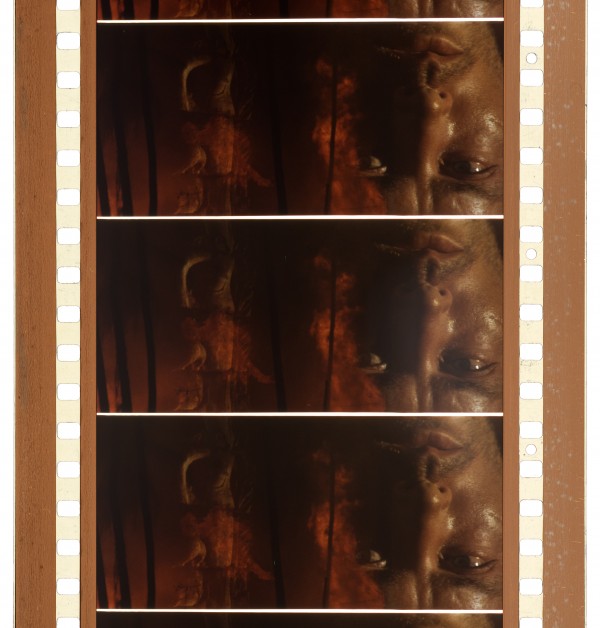
A 70mm blow-up release print of Apocalypse Now (1979) with “Split Surround” Dolby Six Track magnetic sound (visually identical to original six-track Todd-AO format).
Martin Scorsese collection, George Eastman Museum, Rochester, NY, United States. Special thanks to Martin Scorsese and Marianne Bower.
Identification
Edge markings are typically obscured by the magnetic stripes, but can be seen if prints are carefully examined.
1
Four magnetic stripes, containing six channels of audio, were “painted” onto the base side of the film on the film’s left and right edges, after the image was printed and developed.
1) Original “Todd-AO” format (1955 to mid-1970s): left, left center, center, right center, right, mono surround (L, Lc, C, Rc, R, S)
2) “Baby Boom” (1977 to 2001): left, left-boom, center, right-boom, right, surround (L, Lb, C, Rb, R, S)
3) “Split-surround” (1978 to c.1993): left, left-boom (with left-surround filtered and added above 500Hz), center, right, right-boom (with right-surround filtered and added above 500Hz), mono surround (used below 500Hz and sent to left-surround and right-surround for the “Split Surround” format. Or could remain mono surround so print was backwards compatible with standard “Baby Boom” systems).
History
The 70mm six-track magnetic-stripe format (also referred to as “mag stripe”) was the pinnacle of theatrical sound quality in the analog era. Compared to optical sound, it offered increased frequency response, lower noise, lower distortion, and six channels of audio. Only double-system, 35mm full-coat mag, interlocked with the projector could provide superior sound quality – but the interlock approach was not practical for wide theatrical use. Not until the availability of digital theatrical formats such as Dolby Digital, in the early 1990s, was there a superior composite-print sound format. However, the extreme cost of 70mm productions, and even 35mm blow-ups to 70mm, resulted in the format being restricted in use compared to 35mm releases.
Todd-AO
70mm mag-striped prints were first used by Todd-AO for Oklahoma! in 1955. Although the first screenings of the Todd-AO version of Oklahoma! utilized full-coat double-system mag synchronized to a mute 70mm print like Cinerama, they quickly shifted to the composite mag-stripe approach developed by Hazard Reeves for CinemaScope, first used for The Robe (1953). Reeves received a technical Academy Award in 1953 for this work. The 35mm CinemaScope striping system simply needed modification with 70mm rollers and wider wicks on the stripe applicators. Although there were six audio tracks used for 70mm, there were still only four physical stripes, like CinemaScope. Two of the stripes were extra wide and contained two tracks each.
In the original era of 70mm 6-track prints (before Dolby became involved in the mid-1970s), the six tracks were comprised of left, left-center, center, right-center, right, and mono surround. Similar to CinemaScope, the mono surround channel was sent to a U-shaped array of surround speakers wired together on the rear and side walls of the theater, to provide an even surround sound field. As many as 20 surround speakers were used in a large movie theater, but all driven from a single mono amplifier via a 70-volt line (Altec, 1950s). Although pioneered by Todd-AO for their specific widescreen format, this 70mm mag-stripe format became the standard sound format for all the various widescreen picture formats projected in 70mm.
Dolby
In 1976, starting with A Star is Born and Logan’s Run, 70mm mixes began to be released as “Dolby 70mm Stereo” and were encoded with Dolby Type-A noise reduction to help reduce tape hiss. However, the basic format was unchanged from the original Todd-AO format, except for the addition of the noise reduction. It was not until Star Wars in 1977 that the Dolby “Baby Boom” format began, with the original left-center and right-center tracks now used for low-frequency effects (below 200Hz). These left-boom and right-boom tracks were no longer Dolby-A encoded, in order to reduce the amount of hardware needed in a theater. Surround channels remained mono, except for occasional use of a special “Split Surround” 70mm format. Split surrounds were first used on Superman (1978), and then Apocalypse Now (1979), as well as a variety of subsequent films, which included The Wall (1982) and Top Gun (1986) (Schein, 1985).
Stereo split-surrounds were made possible by utilizing the unused upper-frequency area of the “boom” track (above 500Hz). The left-surround audio was cut off below 500hz and added to the left-boom track, while the right-surround audio was similarly filtered and added to the right-boom track. The original mono surround track was only used below 500Hz and sent to both the left-surround and right-surround speakers. Although it may have been technically better to use full-range left-surround and right-surround tracks (like a modern 5.1 channel mix), this more complicated system was chosen so that it was backwards compatible with standard “Baby Boom” playback systems.
For special venue films, the six magnetic tracks on 70mm prints could also be used in alternate ways and did not need to conform to a theatrical standard. For example, the Expo 67 film Earth Is Man’s Home (1967) was a unique vertical picture presentation (widescreen turned 90 degrees) and the 70mm audio tracks were used for upper, middle, and lower speakers only.
Along with having more tracks than CinemaScope, there was also an improvement in sound quality with 70mm mag-stripe prints. This is because the tracks are wider than on 35mm CinemaScope prints and the linear speed of the film through the projector is faster (due to the 5-perforation frame). The wider tracks produced lower noise ratio and increased immunity to stripe damage. The increased linear speed improved both frequency response and noise. Instead of the 18 in (45.7cm) per second for CinemaScope (90 ft [27.4m] per minute), 5-perforation, 24fps 70mm films run at 22.5 in (57.2cm) per second (112.5 ft [34.3m] per minute). For Oklahoma! and Around the World In 80 Days (1956), which were shot and projected at 30 fps, the film ran at just over 28 in (71.1cm) per second (140.25 ft [42.7m] per minute). For comparison, 30 in (76.2cm) per second is the fastest speed music studio tape masters were recorded at in the analog era, while 15 in (38.1cm) per second was the more common master tape recording speed.
Six track magnetic striping on 70mm prints was eventually replaced in the mid-1990s by DTS sound (which synchronized digital audio on a disc with the 70mm film print). The last 70mm release with magnetic stripe prints was a reissue of 2001: A Space Odyssey in 2001.
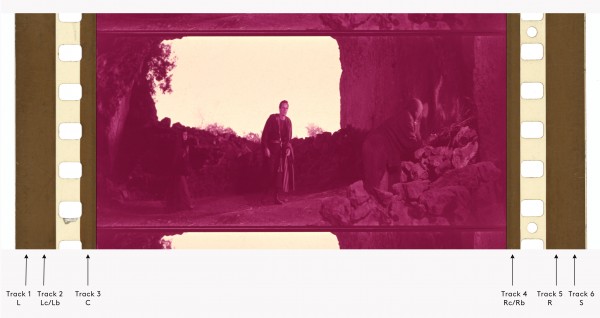
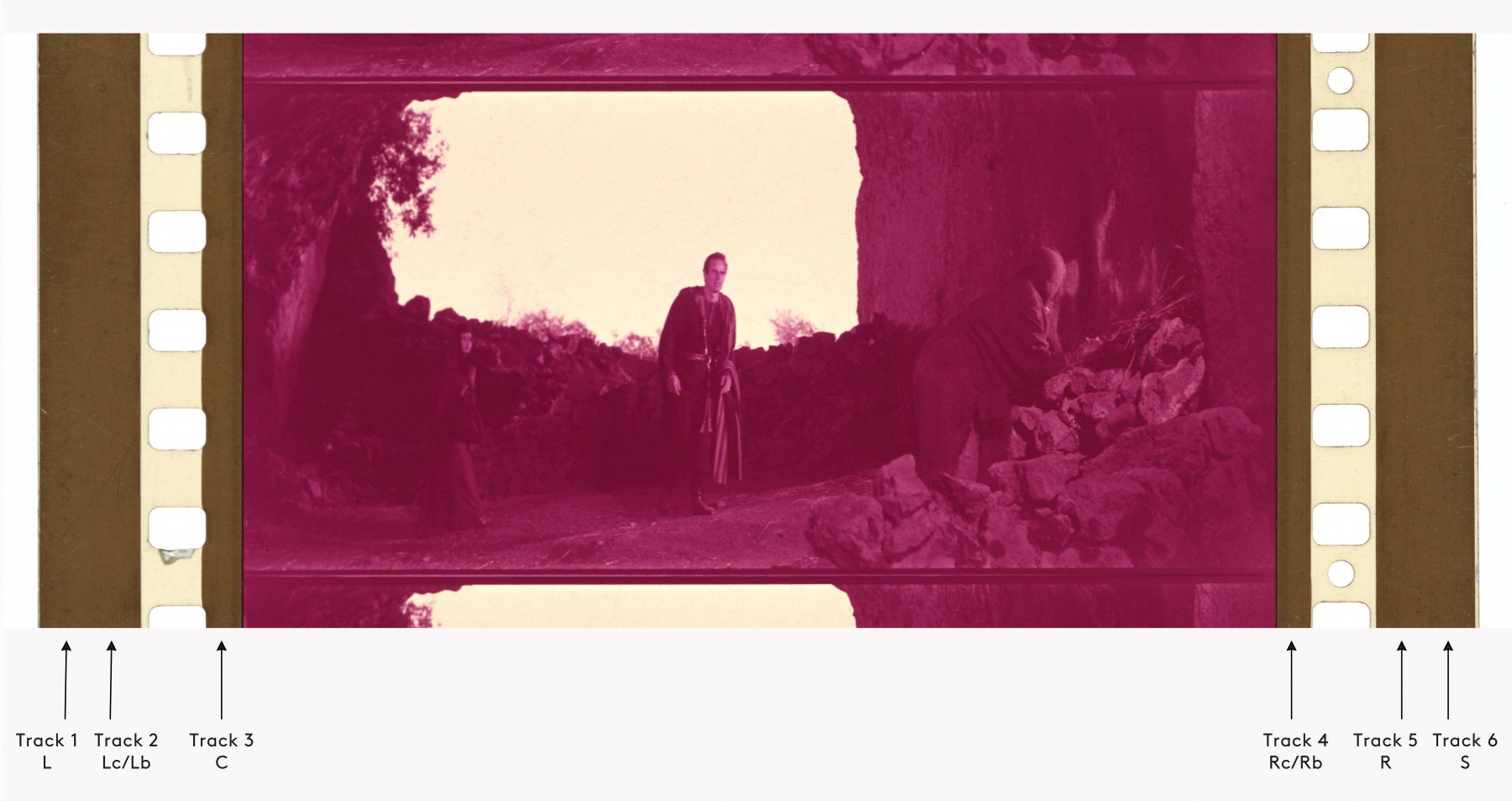
A fragment from a 70mm print of Ben-Hur (1959) showing the arrangement of six tracks of audio, across four magnetic stripes on both edges of the film. All six audio tracks are 0.060 in (1.52mm) wide, but played back with an audio head 0.050 in (1.27mm) wide.
The Museum of Modern Art, New York, NY, United States. Annotated by Crystal Kui.
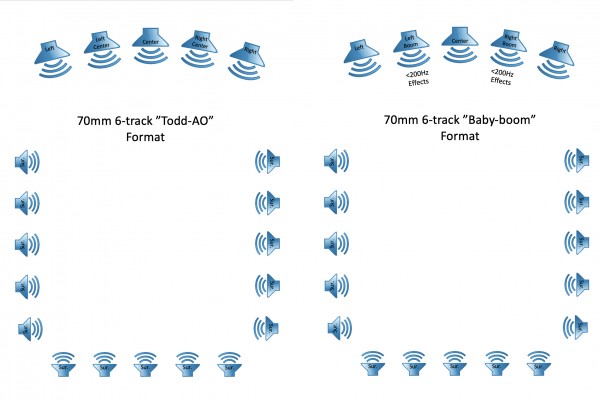
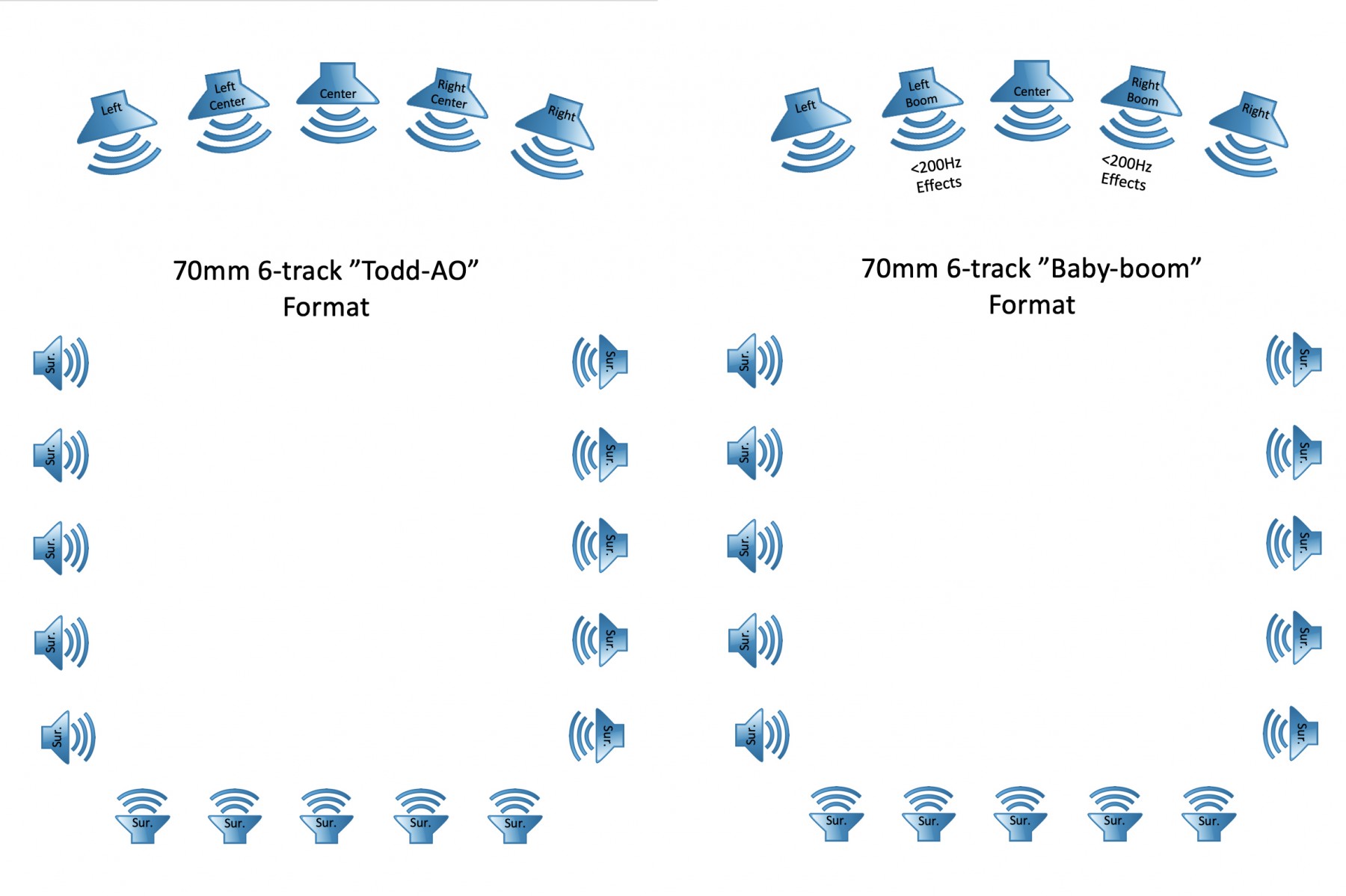
Left: Theatrical speaker layout for the original Todd-AO six-track version. The exact number of surround speakers depended on the size of the theater. Right: Theatrical speaker layout for the updated Dolby “Baby Boom” format. This was the same as the original Todd-AO format except the left-center and right-center tracks were repurposed as additional “containers” for low-frequency audio. Both of the “boom” effects tracks contain the same audio in the standard “Baby Boom” format.
Diagram by Nicholas Bergh.
Selected Filmography
The 2001 theatrical re-issue of this film was the last 70mm release made with mag-stripe prints. Any 70mm prints made after this used a synchronized DTS disc for sound.
The 2001 theatrical re-issue of this film was the last 70mm release made with mag-stripe prints. Any 70mm prints made after this used a synchronized DTS disc for sound.
70mm Dolby 6-track stereo “Split Surround” format.
70mm Dolby 6-track stereo “Split Surround” format.
Original 70mm format.
Original 70mm format.
70mm Dolby 6-track stereo “Baby Boom” format.
70mm Dolby 6-track stereo “Baby Boom” format.
Early 70mm Dolby 6-track stereo (Generated Lc/Rc tracks from LCR mix. Dolby encoded).
Early 70mm Dolby 6-track stereo (Generated Lc/Rc tracks from LCR mix. Dolby encoded).
The first 6-track mag-stripe 70mm release. 30 fps.
The first 6-track mag-stripe 70mm release. 30 fps.
Original 70mm format.
Original 70mm format.
Original 70mm format.
Original 70mm format.
Early 70mm Dolby 6-track stereo (Generated Lc/Rc tracks from LCR mix. Dolby encoded).
Early 70mm Dolby 6-track stereo (Generated Lc/Rc tracks from LCR mix. Dolby encoded).
70mm Dolby 6-track stereo “Baby Boom” format.
70mm Dolby 6-track stereo “Baby Boom” format.
Technology
Applying and recording magnetic stripes
Making 70mm magnetic-stripe prints involved significant amounts of time and money. Since the magnetic stripes were applied after the final 70mm picture print had been made, there was a high attendant risk of scratching, or otherwise damaging, the picture during the process. The mag stripes were “painted” on with a liquid magnetic fluid that dried hard as it passed through a drying rack. Since the mag is painted on in stripes, it is not as perfect a coating as with full-coat studio magnetic film, which was manufactured by coating an entire sheet and then slitting and perforating it.
After the magnetic stripes were applied to the print, the stripes were recorded via a specialized 70mm mag recorder made initially by Westrex. Between these original Westrex machines, a few Manga-Tech 70mm machines made in the 1970s, and a few custom 70mm machines made in the early 1980s, it is likely that up to only a dozen or so 70mm mag machines were ever built in total, since only a limited number of 70mm prints were ever required. The master audio source for the recording would typically be the final 35mm 6-track fullcoat magnetic master running on another interlocked mag machine.
Since various problems could occur with any of these steps, the prints were projected in a 70mm QC theater after recording to ensure the audio and picture quality were good throughout. Any problematic reels would typically need to be re-printed from scratch since the problems most often came from the mag striping process and could not be fixed.
Mixing
Before the Dolby “Baby Boom” era of 70mm sound, six-track stereo mixing was a highly specialized exercise and Westrex only ever manufactured three of their unique six-channel consoles, designed for mixing and panning across five front screen channels. Instead of each fader on the console controlling a single track, each fader controlled five screen channels simultaneously. Additionally, separate panning modules could turn mono or left-center-right (LCR) audio into five separate screen channels, which could then be adjusted for position across the screen (Templin, 1957).
In the US, these three unique Westrex consoles were installed at MGM, Todd-AO and Twentieth Century-Fox, respectively. Essentially, all major six-track Hollywood films in the early era were mixed on these three consoles, and they continued to be used into the Dolby era – the Westrex console at MGM was the last to be replaced, in 1984. Other film studios that released films in this format, typically mixed at Todd-AO. For example, My Fair Lady (1964) was a major Warner Bros. production released in six-track, but was mixed entirely at Todd-AO.
Even by the 1960s, some 70mm six-track films were being mixed as LCRS (left, center, right, and surround) and then up-mixed to six-tracks by generating left-center and right-center from the LCR mix. By the early 1970s, this simpler and less expensive approach became the standard. Not until the introduction of the SDDS (Sony Dynamic Digital Sound) digital format in 1993 was there a new resurgence in mixing across five screen channels.
Standardization
Unfortunately, the recording levels and equalization specifications for 70mm prints were never standardized within the industry, as they had been for 35mm optical sound, or the CinemaScope 35mm mag-stripe format. While the Society of Motion Picture and Television Engineers (SMPTE) released CinemaScope test film in the 1950s, it was not until the 1990s that they released standards for 70mm film. Instead, the studios would often provide a tone reel to accompany 70mm films, allowing calibration to that specific film title. SMPTE did not start to look carefully at the 70mm standardization problem until the 1980s (Mosley, 1984). A frequency response standard, issued in the 1990s, can be found in SMPTE RP-128, but should not be considered accurate with regard to earlier 70mm prints.
Playback issues
Of all the major music and film sound recording formats, none has a greater distance between the first and last track than 70mm mag-striped prints. This great distance, across the width of the film, caused significant problems in maintaining good phase alignment between the tracks. When comparing a 35mm full-coat mag master to a projected 70mm print, these phase errors are typically the most significant causes of sound-quality drop, followed by an increase in tape hiss. Problems associated with 70mm prints, after repeated use, can include: worn oxide, missing oxide, sprocket damage to the oxide, and noise/buzz caused by magnetized parts within the projector.
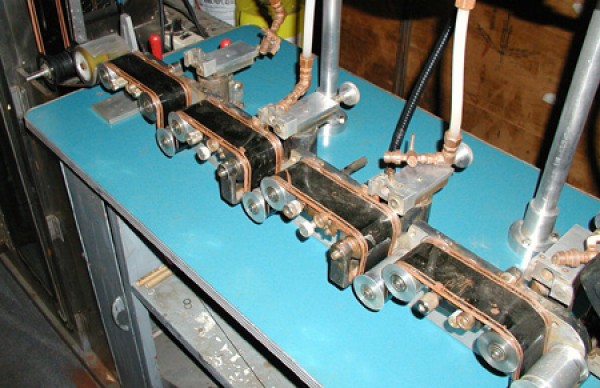
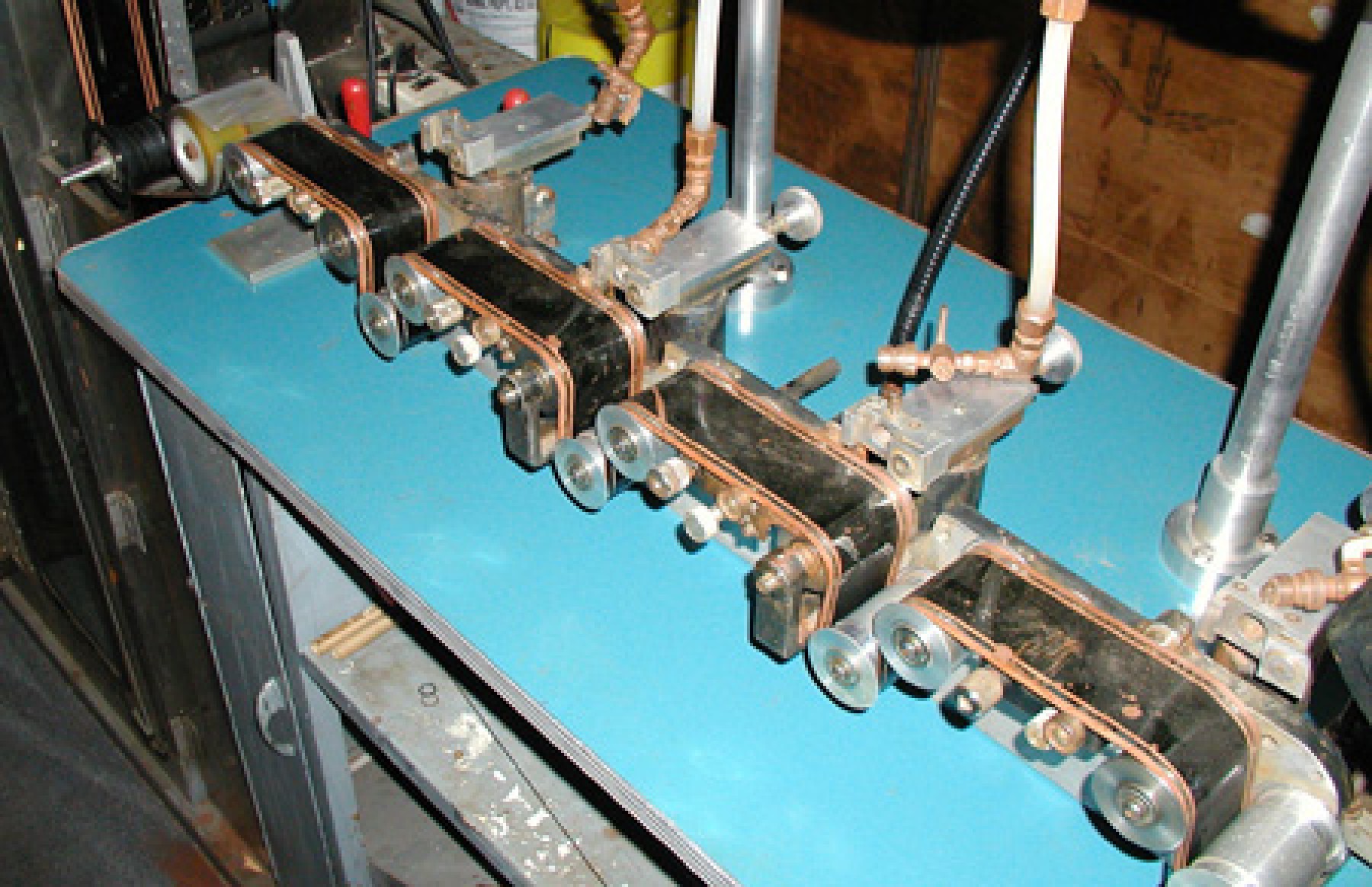
The Reeves Soundcraft system “painted” magnetic fluid onto the base side of the 70mm film print, which dried to create fixed magnetic stripes. The film’s audio could then be recorded onto these stripes.
Photograph by Nicholas Bergh.
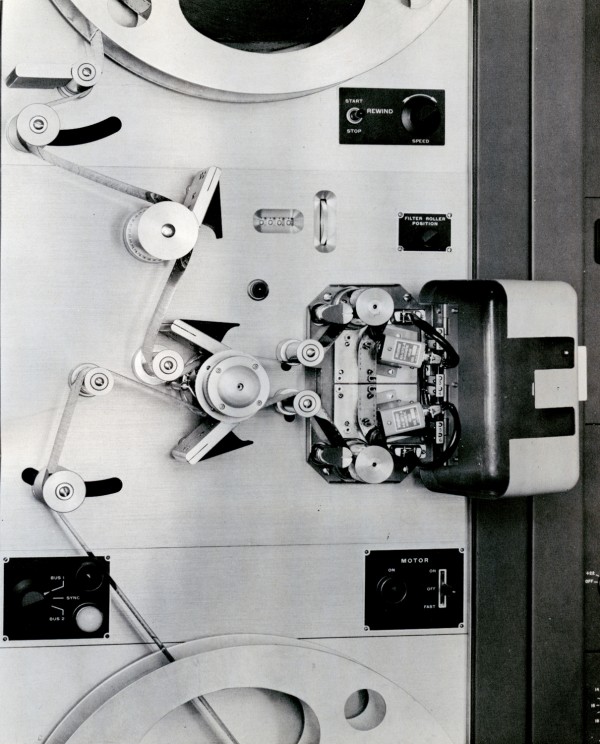
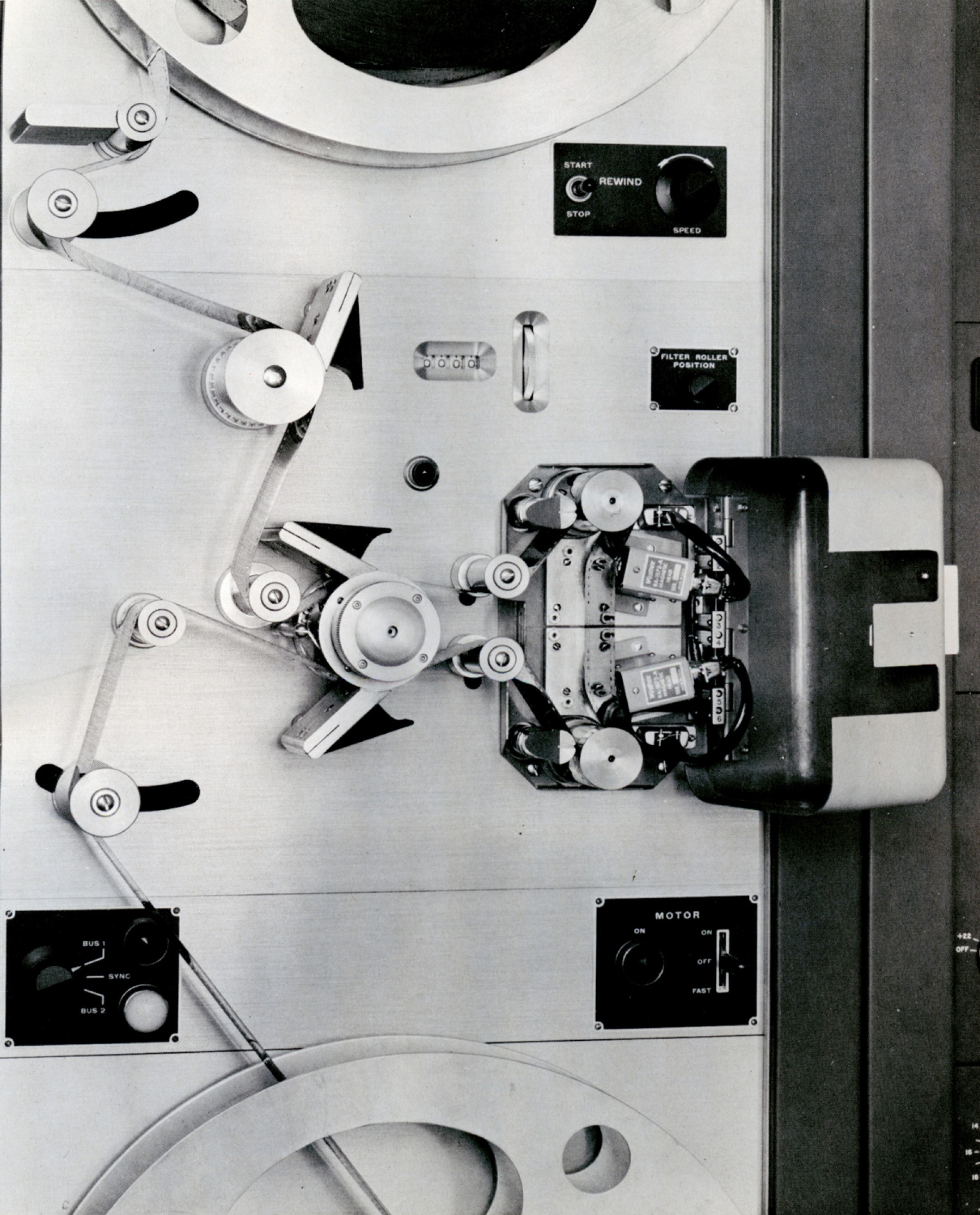
A 1950s Westrex 70mm magnetic machine for recording audio to 70mm prints, after the magnetic stripes had been applied. The machine was interlocked with a 35mm full-coat magnetic machine playing back the 35mm six-track master.
Courtesy of Nicholas Bergh.
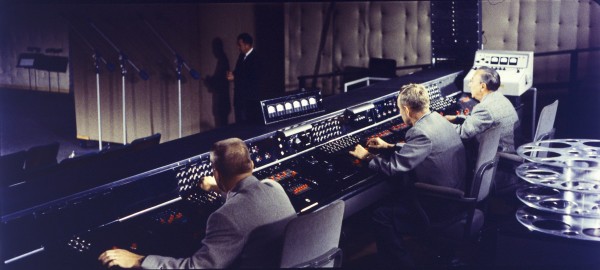
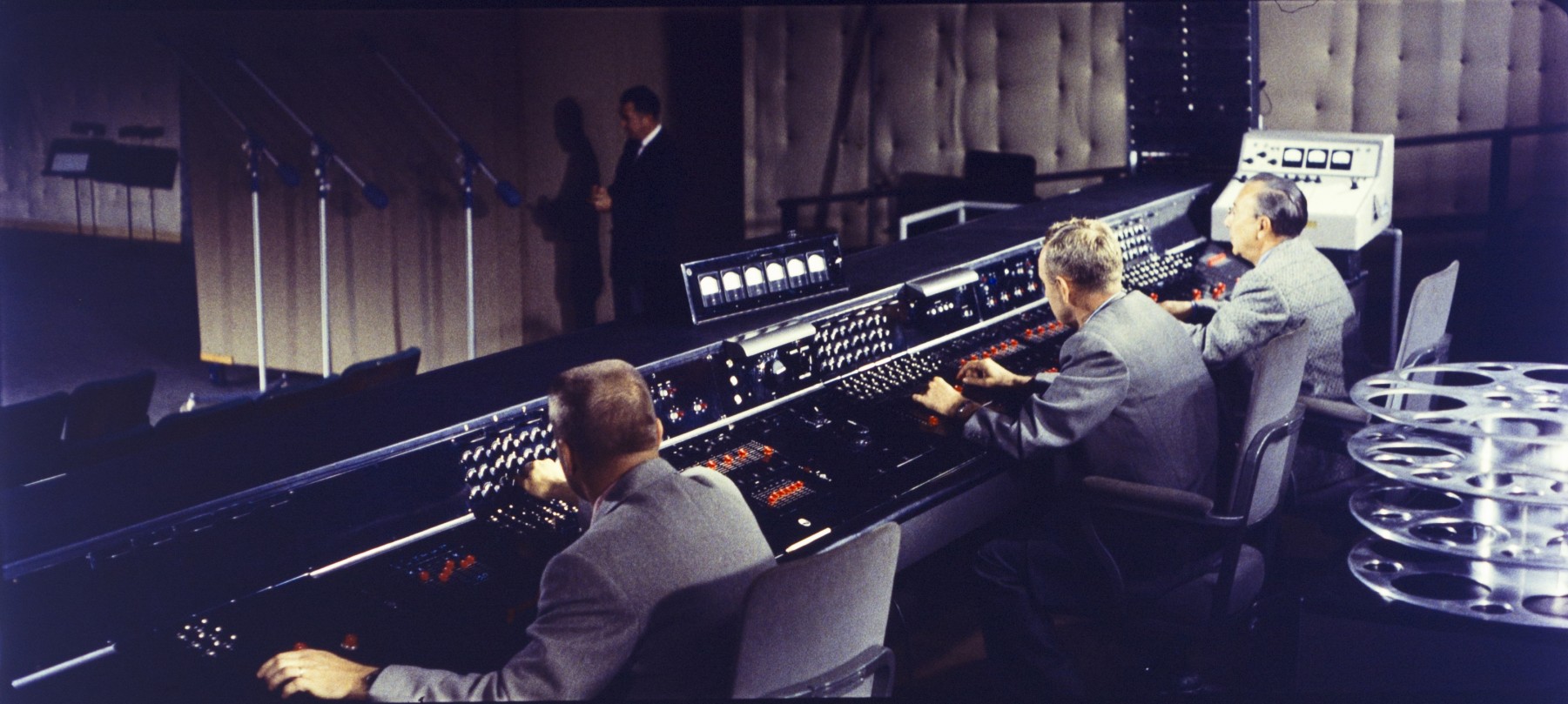
A Westrex six-track mixing console in use, c. 1956.
Frame enlargement from The Miracle of Todd-AO (1956). Courtesy of the Academy of Motion Picture Art and Sciences.
References
Altec Lansing Corporation (1950s?). Promotional brochure. Los Angeles, CA: Altec Lansing. (Nicholas Bergh collection).
Blake, Larry (1984). “The Evolution and Utilization of 70mm six-track film sound”. Recording Engineer and Producer, 14:2 (Apr.): pp. 64–78.
Mosely, John (1984). "A New Look at 70mm Sound: Proposed Revisions of Magnetic Sound Tracks for Theatrical Release Prints". Journal of the SMPTE, 93:5 (May): pp. 502–10.
Schein, Robert (1985). “70mm and Stereo Sound”. Boxoffice (Feb.): p. 271.
Templin, E. W. (1957). “Recent Developments in Multichannel Stereophonic Recording Systems”. Journal of the SMPTE, 66: 2 (Feb.): pp. 53–8.
Compare
Related entries
Author
Nicholas Bergh has been working in the field of sound preservation and restoration for nearly 30 years. He received his BA and MA in Ethnomusicology from UCLA, Los Angeles, CA, where he specialized in the history of recording technology and sound archiving. During this time, he also worked as a sound restoration engineer and was fortunate to be mentored by engineers who had worked during the earliest decades of optical sound, disc, and magnetic technologies. In 2003, he started Endpoint Audio Labs with the aim of improving the quality of sound transfers before restoration.
Endpoint has become known for both its unique transfer technologies, as well as its use of
historical research to inform transfer decisions. The company has been instrumental in the preservation of some of the most precious studio and public archive sound elements. Film projects it has been involved in range from the earliest Vitaphone discs, through nitrate push–pull optical masters, to hundreds of tent-pole film titles such as The Sound of Music (1965) and Titanic (1997). Endpoint also provides sound supervision and sound mixing expertise to present-day film documentary projects where the use of historical material is required.
In recent years, Nicholas has been actively helping other institutions improve preservation sound quality, by developing a unique range of archival audio equipment. This equipment is now being used at some of the most demanding archives around the World, including: the Library of Congress, Washington, DC; the British Library in London; and the National Film and
Sound Archive of Australia, Canberra. Nicholas is a member of the Film Academy’s Production and Technology Branch, and is active in both the Academy’s Digital Preservation initiatives, as well as being a member of the Sci-Tech Council Historical Subcommittee. He is also active in the archival technical committees of AES, ARSC, and IASA.
Ioan Allen, Brad Hohle, Larry Blake.
Bergh, Nicholas (2025). “70mm six-track magnetic stripe”. In James Layton (ed.), Film Atlas. www.filmatlas.com. Brussels: International Federation of Film Archives / Rochester, NY: George Eastman Museum.