Oko(1912–1944)
A combined film camera and projector for amateur use, designed by Kazimierz Prószyński to use 120mm-wide film with frames arranged in horizontal rows.
Film Explorer
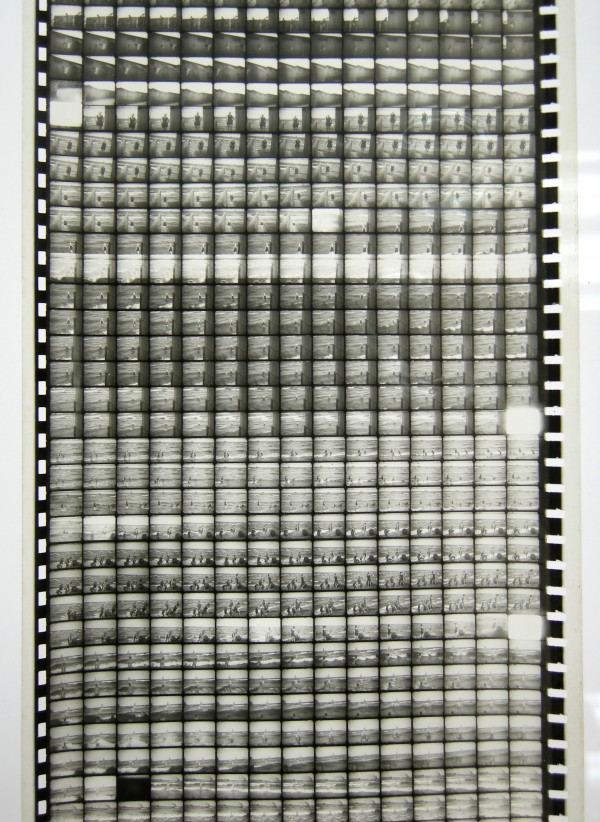
Amateur footage shot in Gdynia, Poland, in 1925 by Oko inventor Kazimierz Prószyński on 120mm-wide Oko film. Frames run in horizontal rows in a boustrophedon (serpentine) pattern.
Filmoteka Narodowa – Instytut Audiowizualny (FINA), Warsaw, Poland. Photograph by Monika Supruniuk.

Fragment of a Prószyński family home movie on Oko film, showing inventor Kazimierz Prószyński’s wife Dorothy and their daughter Irena.
National Science and Media Museum, Bradford, United Kingdom.
Identification
7mm x 5mm (0.276 in x 0.197 in).
Rectangular perforations along both edges of the 120mm-wide film: oriented horizontally along one edge and vertically along the opposite edge; one series is elongated to allow for film shrinkage (US patent 1112555). On each edge small and large holes alternate, approximately two per row of frames; the larger holes probably took the load when the film dropped to the next row, protecting it from tearing. Hole dimensions vary between surviving reels.
Typically 15 frames are captured in one horizontal row before the film is advanced by one perforation to record the next row. The film travels left to right along one row, drops by one row, then travels right to left along the next (boustrophedon pattern). The number of frames per row varied over the years: Prószyński’s 1914 description gives 15, Jewsiewicki gives a range of 7 to 15, and a later row-film model developed before 1939 used fewer, larger frames per row, which made editing possible (Jewsiewicki, 1974: pp. 115, 135, 204). The Prószyński family reel at the National Science and Media Museum, Bradford, has 12 frames per row and is probably a later variant.
B/W positive; occasionally tinted.
Approximately 10–15 fps. Prószyński gives about 10 fps, compared with the usual 16 fps (Prószyński, 1914: p. 97). Because the same hand-cranked mechanism served for both filming and projection, footage was projected at roughly the speed at which it was shot.
1
7mm x 5mm (0.276 in x 0.197 in).
Rectangular notches; oriented horizontally along one edge of the 120mm-wide film and vertically along the opposite edge.
Typically 15 frames are captured in one horizontal row before the film is advanced by one perforation to record the next row. The film travels left to right along one row, drops by one row, then travels right to left along the next (boustrophedon pattern). The number of frames per row varied over the years: Prószyński’s 1914 description gives 15, Jewsiewicki gives a range of 7 to 15, and a later row-film model developed before 1939 used fewer, larger frames per row, which made editing possible (Jewsiewicki, 1974: pp. 115, 135, 204). The Prószyński family reel at the National Science and Media Museum, Bradford, has 12 frames per row and is probably a later variant.
B/W negative.
History
The “Oko” (Polish for “Eye”) amateur cinematograph, developed by Polish inventor Kazimierz Prószyński, was a hybrid device that combined the functions of a film camera and a projector. Designed to democratize the medium, the system aimed to make filmmaking and educational screenings affordable for schools and private homes.
Prószyński began conceptualizing a simplified amateur system as early as 1904. Following an experiment with a celluloid disc carrying spirally arranged frames (c. 1911), he first demonstrated the row-film version of the Oko in 1912 (Jewsiewicki, 1974: p. 111). That year he presented the apparatus at the Stowarzyszenie Techników (Association of Technicians) in Warsaw, Poland, and filed British patents (Jewsiewicki, 1974: p. 119). In January 1914 he demonstrated the device at the Royal Photographic Society in London, where he had been living since 1911.
In 1915 development moved to the United States, where Prószyński worked in the experimental department of a New York City firm identified in Polish sources only as a “Special Factory of Machines and Instruments” (“Zakład Doświadczalny Specjalnej Fabryki Maszyn i Przyrządów”; Jewsiewicki, 1974: p. 121). During this period he collaborated with an engineer named Krużelewski, head of the department, and with the master mechanic Karol Cichocki, who, with two unnamed workers, built a functional prototype for serial production. An American joint-stock company, financed by the world-renowned pianist Ignacy Jan Paderewski, was formed to launch mass production. Why the venture failed remains unclear, although US entry into World War I in 1917 and the resulting shortages of raw materials may have contributed to its abandonment.
In 1922, after returning to Poland, Prószyński established the Central European Amateur Cinematograph Factory Oko on Zajączkowska Street in Warsaw (Jewsiewicki, 1974: p. 125). The company faced financial difficulties from the start, aggravated by the hyperinflation of the Polish mark. During talks with London manufacturers in late 1923, Prószyński, insisting on the lowest possible price, estimated the unit cost at £3; the board, in agreement with the English manufacturers, put it at £8 (Jewsiewicki, 1974: p. 127). After about 100 units had been produced – and with Prószyński himself opposing further production of a model he did not consider fully refined – the company was dissolved in 1925; its affairs ended in a lawsuit that was later discontinued (Jewsiewicki, 1974: pp. 128–29). The company’s 1922 statute provided for the sale of raw and exposed film as well as apparatus, and at least one Hollywood feature, Two Lovers (1928), was later printed in the Oko format (Jewsiewicki, 1974: p. 125).
The Oko used a distinctive “row-film” format on a 120mm-wide film strip (Jewsiewicki, 1974: p. 118). Its frames were recorded in horizontal rows along a serpentine (boustrophedon) path, allowing a single metre of stock to hold the equivalent of 100 metres (328 ft) of 35mm film (Supruniuk, 2026: p. 70).
The system was largely experimental and failed to achieve wide commercial success, owing to a combination of financial difficulties, disagreements over pricing and Prószyński’s own continual redesigns (Jewsiewicki, 1974: pp. 126–31). The Oko also suffered a fatal technical drawback: the tightly packed frames on a wide sheet made the film impossible to cut or edit (Jewsiewicki, 1974: p. 119). However, it found a niche in education, and in 1935 the Polish Ministry of Religious Affairs and Public Enlightenment officially approved the Oko as a school aid (Jewsiewicki, 1974: pp. 130–31).
The first films, made around 1912, were short scenes of “games in a garden” used for demonstrations (Jewsiewicki, 1974: p. 119). The only Oko films surviving in Poland today were shot in Gdynia in 1925, capturing rare views of the developing port (Supruniuk, 2026: p. 75). During the German occupation of Poland in World War II, Prószyński continued to refine the system: after an earlier, pre-war row-film model whose larger frames allowed editing, he planned a simpler 16mm design (Jewsiewicki, 1974: pp. 135–36). In early 1944, technician Teofil Jarosz offered to build and finance the 16mm apparatus in his workshop, but no drawings survive, and it is not known whether it used the row principle or standard 16mm film (Jewsiewicki, 1974: p. 136). In August 1944, during the Warsaw Uprising, Prószyński was deported with his wife and daughter from Mokotów to Pruszków, separated from them, and sent to the concentration camps of Gross-Rosen and Mauthausen, where he died as prisoner number 129957 on March 13, 1945 (Jewsiewicki, 1974: p. 138).


Frame enlargement from Oko footage shot by Kazimierz Prószyński on the beach in Gdynia, summer 1925.
Filmoteka Narodowa – Instytut Audiowizualny (FINA), Warsaw, Poland. Photograph by Monika Supruniuk.


Fragment of Oko film from the Prószyński family reels: Kazimierz, Dorothy and Irena Prószyński.
National Science and Media Museum, Bradford, United Kingdom.
Selected Filmography
A collection of reels containing surviving personal recordings made by the inventor, including footage of his own family. These materials are preserved at the National Science and Media Museum in Bradford, UK.
A collection of reels containing surviving personal recordings made by the inventor, including footage of his own family. These materials are preserved at the National Science and Media Museum in Bradford, UK.
Nine reels of test amateur footage documenting a private holiday and the modernization of the Gdynia port, featuring urban landscapes and a seaplane landing. These are the only known Oko films surviving in Poland and are held by Filmoteka Narodowa – Instytut Audiowizualny (FINA).
Nine reels of test amateur footage documenting a private holiday and the modernization of the Gdynia port, featuring urban landscapes and a seaplane landing. These are the only known Oko films surviving in Poland and are held by Filmoteka Narodowa – Instytut Audiowizualny (FINA).
A fragment from the Hollywood feature production printed on 120mm-wide film stock for the Oko system, indicating Prószyński’s attempts to bring professional theatrical films into domestic circulation. Two reels of this Oko print are preserved at the National Science and Media Museum in Bradford, UK.
A fragment from the Hollywood feature production printed on 120mm-wide film stock for the Oko system, indicating Prószyński’s attempts to bring professional theatrical films into domestic circulation. Two reels of this Oko print are preserved at the National Science and Media Museum in Bradford, UK.
Technology
The Oko was an amateur hybrid device that integrated the functions of a film camera and a projector into a single compact unit measuring approximately 12cm x 18cm x 24cm. Designed by Kazimierz Prószyński to democratize filmmaking, it aimed to eliminate the prohibitive costs and technical barriers of standard 35mm cinematography for schools and domestic users (Jewsiewicki, 1974: p. 113; Daily Express, 1920: p. 5). The design had its conceptual roots in Prószyński’s earlier amateur cameras: a model of c. 1904 that used ordinary long film with very small frames, and a celluloid-disc apparatus of c. 1911 with spirally arranged frames, limited to about 700 images (Jewsiewicki, 1974: pp. 112–14). In January 1914 he presented an improved version to the Royal Photographic Society: a camera that used the same mechanism for filming and projection, with only the lens and shutter exchanged, and that was already so economical that 1 ft of his stock held the equivalent of 100 ft of standard cinematograph film (Prószyński, 1914: pp. 92–93).
The core innovation was its 120mm-wide film stock, which abandoned the industry-standard vertical strip (Jewsiewicki, 1974: p. 118). Instead, the Oko used a “row-film” arrangement in which 7 to 15 frames were recorded in horizontal rows across the broad strip, rather like lines on a page but read alternately left to right and right to left (Jewsiewicki, 1974: p. 204). Each frame was smaller than a standard 16mm frame but larger than an 8mm frame. The film moved intermittently from left to right along one row, shifted down and then moved from right to left along the next, alternating in a continuous boustrophedon (serpentine) pattern across the strip. This winding back-and-forth path allowed the broad film to be fully used without rewinding between rows, maximizing the number of frames captured on each metre of stock. The format was exceptionally economical in both film consumption and cost. A single metre of Oko stock held the equivalent of 100 to 150 metres of standard 35mm film, allowing up to 20 minutes of projection per roll, and where a 35mm load cost 20 rubles, an Oko load of equal running time cost 35 kopecks (Jewsiewicki, 1974: pp. 117, 205).
To make the system self-sufficient for amateurs, Prószyński simplified the entire laboratory cycle. Prints were made by contact printing on a separate device, the podręczna kopiarka (“handy printer”), which sped up the process by printing a whole row of frames in a single exposure rather than frame by frame (Supruniuk, 2026: p. 71). Prószyński described it as a wooden box holding negative and positive together, in which “by turning a handle the lines of pictures are printed one after another”, using an ordinary petrol lamp or another light source (Prószyński, 1914: p. 96). Developing did not require professional facilities; short sections could be processed in standard photographic trays, while longer rolls were developed in simple domestic containers such as jars or glasses. After processing, the user perforated the film using specialized tools supplied with the apparatus. This workflow allowed individuals to shoot, copy and project moving images without institutional support.
The projection system featured Prószyński’s patented incandescent lamp (US patent 1,357,621), a 50W bulb designed to light the tiny frames as intensely as a 450W lamp (Jewsiewicki, 1974: p. 116; Prószyński, 1920: p. 1). It used a distinctive filament geometry and a parabolic reflector system to direct nearly all the light toward the screen (Prószyński, 1920: p. 1). The bulb was enclosed between two reflectors – a larger, substantially spherical front casing and a smaller parabolic back cover – with the filament positioned to one side of the bulb rather than along its axis (Prószyński, 1920: pp. 1–2). Rays directed backward were focused by the parabolic reflector onto the lens, while rays radiating sideways were returned past the filament by the spherical wall, so that nearly all the emitted light ultimately converged on a single point (Prószyński, 1920: p. 3).
A distinctive feature was an optional water-cooling system: the reflector could be built with double walls forming a water chamber (water jacket) to subdue heat rays and protect the flammable film (Prószyński, 1920: p. 2). This chamber was filled through a dedicated throat closed by a stopper. As a further safety measure, the reflector’s hinge was fitted with a spring that automatically swung the reflector away from the light source whenever the operator released their grip, preventing the film from burning if projection was interrupted.
Technically, the Oko grew out of Prószyński’s research into flicker reduction, applying his theory of the three-bladed shutter (obturator) to give steady images on screens of up to 100cm x 75cm for private screenings (Jewsiewicki, 1974: pp. 46–47). The projector used all three blades of the shutter, whereas only one was used when filming (Prószyński, 1914: p. 96). A three-bladed shutter cuts out a large share of the light, which was one reason Prószyński devoted so much effort to developing a small, intense lamp. The lamp’s fragility also caused practical problems. At the January 1914 Royal Photographic Society demonstration it nearly burned out before the presentation could begin, prompting the chairman to remark that, while the device was “a really ingenious piece of apparatus,” its delicate construction made it liable to fail even under careful handling (Prószyński, 1914: p. 97).
The Oko projector in operation, driven by its hand crank.
Filmoteka Narodowa – Instytut Audiowizualny (FINA), Warsaw, Poland. Video by Mykyta Platonov.


The Oko apparatus from the FINA collection, showing the film drum and the three-bladed shutter.
Filmoteka Narodowa – Instytut Audiowizualny (FINA), Warsaw, Poland. Photograph by Mykyta Platonov.


Fragment of an Oko camera negative. At the end of the roll the final rows are exposed on top of one another, probably because the camera slowed down and the tightly coiled film did not unroll properly; slight buckling also tilts the rows.
Filmoteka Narodowa – Instytut Audiowizualny (FINA), Warsaw, Poland. Photograph by Monika Supruniuk.


Drawing from Prószyński’s US patent 1,357,621 (Projecting apparatus), showing the lamp with spherical and parabolic reflectors.
Prószyński, Casimir de. Projecting apparatus. US patent 1,357,621, filed November 4, 1916, and issued November 2, 1920.


Drawing from Prószyński’s US patent 1,112,555 (Kinematograph camera and projecting apparatus), showing the mechanism and the row film.
Prószyński, Casimir de. Kinematograph camera and projecting apparatus. US patent 1,112,555, filed July 19, 1912, and issued October 6, 1914.
References
Bioscope (1914). “The Polish Edison”. The Bioscope, 22:381 (Jan. 29): p. 483.
Dąbrowski, Marian (1913). “Kazimierz Prószyński”. Tygodnik Ilustrowany, 54:23 (Jun. 7): p. 448.23.
Daily Express (1920). “A Cinema for Every Home”. Daily Express (Jan. 15): p. 5.
Jewsiewicki, Władysław (1974). Kazimierz Prószyński. Warsaw: Wydawnictwo Interpress.
Prószyński, Kasimir de (1914). “The amateur cinema camera”. The Photographic Journal, 54:2 (Feb.): pp. 91–97.
Prószyński, Casimir de. Projecting apparatus. US patent 1,357,621, filed November 4, 1916, and issued November 2, 1920.
Prószyński, Kazimierz (1936). Kinematograf dydaktyczny: Trudności dotychczasowe i nowa zasada kinematografii. Praca Kazimierza Prószyńskiego w dziedzinie kinematografii (Didactic Cinematography: Past Difficulties and a New Principle of Cinematography. The Work of Kazimierz Prószyński in the Field of Cinematography). Privately published.
Supruniuk, Monika (2021). “Inżynier Kazimierz Prószyński – historia wizjonera i jego niespełnionych ambicji”. Ekrany, Mar. 29, 2021. https://ekrany.org.pl/historia_kina/inzynier-kazimierz-proszynski-historia-wizjonera-i-jego-niespelnionych-ambicji/.
Supruniuk, Monika (2026). “We’ve got our eye on you: The legacy of Polish cinematography pioneer Kazimierz Prószyński and his Oko camera”. Journal of Film Preservation, 114 (Apr.): pp. 67–77.
Patents
Prószyński, Casimir de. Kinematograph camera and projecting apparatus. US patent 1,112,555, filed July 19, 1912, and issued October 6, 1914.
Prószyński, Casimir de. Improvements in cinematograph cameras and projecting apparatus. GB patent 191229478A, filed December 21, 1912, and issued June 26, 1913.
Prószyński, Casimir de. Projecting apparatus. US patent 1,357,621, filed November 4, 1916, and issued November 2, 1920.
Compare
Related entries
Author
Monika Supruniuk is an art conservator specializing in paper, photography and film. A graduate of the Faculty of Conservation and Restoration of Works of Art at the Academy of Fine Arts in Warsaw, she earned her doctorate there and now teaches photograph identification, preservation and conservation. Since 2009 she has worked with Filmoteka Narodowa – Instytut Audiowizualny, and she collaborates with public institutions and non-governmental organizations. She initiated the Warsaw edition of Home Movie Day and, as one of the Archeo Sisters, co-organizes the Sounds of Silents film festival. Her work focuses on the preservation of analog audiovisual media and on the history of photographic processes and film technology. She comes from the Polesie region.
My thanks go to Elżbieta Wysocka-Koerber for our inspiring conversations, and to my colleagues at the Filmoteka Narodowa – Instytut Audiowizualny.
Supruniuk, Monika (2026). “Oko”. In James Layton (ed.), Film Atlas. www.filmatlas.com. Brussels: International Federation of Film Archives / Rochester, NY: George Eastman Museum.