Nikitin's system(1930–c.1939)
A 35mm variable-area sound system that was developed at the Kyiv Film Studios in the Ukrainian Soviet Socialist Republic.
Film Explorer
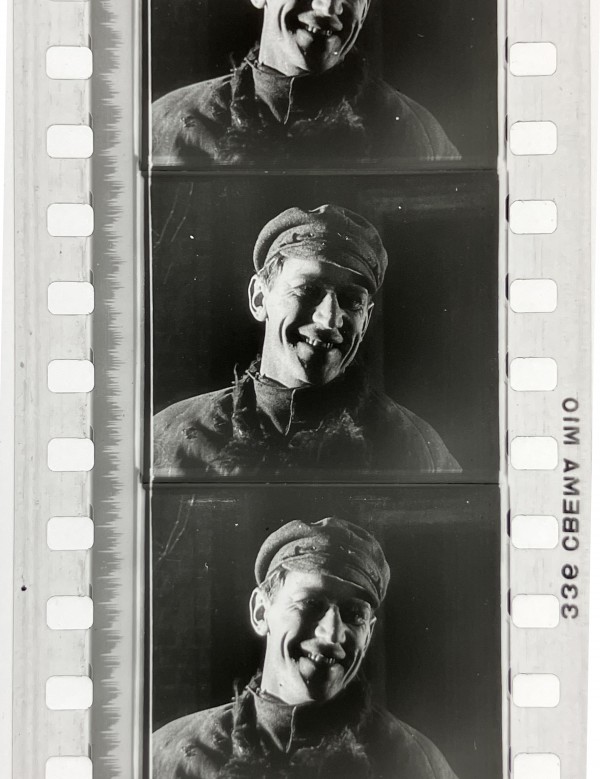
Identification
Variable
Variable, from 1.2:1 to 1.37:1
B/W
Unknown
1
Unknown
Unilateral (and later bilateral) variable-area optical sound.
Variable
B/W, panchromatic.
Unknown
History
In the USSR, the emergence and use of sound film was enforced as part of the first Soviet five-year plan, implemented by the Communist Party to develop and expand a planned economy. The origins of domestic Soviet sound film technology are generally traced to two prominent inventions of sound-on-film from Pavel Tager and Aleksandr Shorin, respectively.
Tager worked at the Physical Research Institute of Moscow University, starting in 1926, and later on at the All-Soviet Electrotechnical Institute (VEI). Using the Kerr cell shutter technology (https://en.wikipedia.org/wiki/Kerr_cell_shutter), he developed an electro-optical sound recorder to record an “intensive” or “vertical” (variable-density) soundtrack on 35mm film. Tager’s method and its accompanying technology, the Tagefon, was presented experimentally in 1928, and implemented at an industry level by the Mezhrabpomfilm studios in Moscow during the early 1930s – following tests, the studios had rejected Axel Petersen and Arnold Poulsen’s experimental system (O.F., 1929; Anon, 1929).
Shorin led a group of engineers at the Central Laboratory of Wire Connection (TsLPS) to develop an oscilloscope system for recording a “transversal” or “lateral” (variable-area) soundtrack. The completed system was announced to the public in 1928 – by the early 1930s it was being used by the majority of Soviet film studios. Shorin went on to create several iterations of his recorder, the best known of which were the ShU-7 and the portable Mikst.
However, contemporaneously, there were several less widely used competing systems, such as Vadim Okhotnikov & Andrei Mashkovich’s system at Belarusfilm Studios (Veiting, 1930; Shorin, 1949; Okhotnikov, 1951), Oleksii Ball’s system at Kyiv Film Institute (Tseitlin, 1931a), Chernyshev’s neon lamp recorder, Yurev & Rzhevkin’s phonograph recorder (Mikh, 1931), and Ivan Nikitin’s invention at Kyiv Film Studios (Makushok, 1931; Murin, 1932).
In the Ukrainian Soviet Republic (Ukrainian SSR), the importance of sound movies was recognized by the late 1920s, so, in the final phase of the construction of the Kyiv Film Factory in 1929, it was decided to set up an in-house sound laboratory, informed by the experience of the new Leningrad laboratory (Anon., 1929b). However, even at the end of 1930, when Dziga Vertov was shooting Enthusiiasm (Symfoniia Donbasu) (Enthusiasm (Symphony of the Donbas), 1931) in the Ukrainian SSR, the sound laboratory at Kyiv still wasn’t up and running. So, although the film was produced by Ukrainfilm, all the sound recording, on location in Kharkiv and the Luhansk region, was done using a borrowed Mikst recorder from Aleksandr Shorin, under the direct supervision of Shorin’s assistants Pavel Shtro, Konstantin Chibisov and Nikolai Timartsev. Additionally, all the sound was mixed and mastered at Shorin’s laboratory in Leningrad (Vertov, 1966).
Subsequently, after Vertov had finished his film, the Kyiv Film Factory acquired this Mikst recorder. By the end of 1931, the studios were operating with three sound recording devices from Shorin, using them on several other new sound productions (Belza, 1931), even though all of the recorders required regular repairs and the need to find an in-house alternative was deemed a priority (Makushok, 1931). In 1930, the first sound cinema in the Ukrainian SSR had opened in Kharkiv (Anon., 1930), followed by two more in 1931 (Tseitlin, 1931b). Thus, the local market for the distribution of sound films continued to grow, demanding the production of new sound films.
The sound laboratory launched at the Kyiv Film Factory in 1929 was led by engineer Ivan Nikitin. He worked there together with several other inventors and technicians such as Lazar Rozenberh and Hryhorii Hryhoriev, alongside the composer Ihor Belza. In the laboratory, the engineers tested such locally developed devices as a theater amplifier, a sound mixer, and a tuning fork generator (Nikitin, 1931). However, the most renowned invention of these Kyiv engineers became an air oscilloscope recorder invented by Nikitin, based in part upon Shorin’s apparatus. Nikitin’s device and the new Ukrainfilm sound studio were used for the first time for the experimental film Shturmova nich (A Stormy Night, 1932) by Yuzef Murin (Anon., 1932). Later, the studio used the Nikitin apparatus to record soundtracks for sound re-releases of old silent films, such as Dva dni (Two Days, 1927), or for new productions including Oleksandr Dovzhenko’s Ivan (1932). By 1933, three similar Nikitin recorders were ready for use (Yatko, 1933).
Nikitin continued to improve his oscillograph recorder and created a series of models across a number of iterations, including the N-3, N-6 and N-7 models. By 1935, fourteen N-7 recorders were reportedly in use at the sound laboratory of the Kyiv Film Studios (Nikitin, 1935). It was reported that the N-7 model was also being used for sound recording at the Leningrad and Odesa film studios (Nikitin, 1935; Rozenberh, 1936). In 1937, Nikitin, along with Oleksii Ball and other engineers, were assigned to travel overseas for six months to study the new sound techniques and equipment being developed in the United States. In particular, Nikitin examined the RCA offices in Camden, NJ, and the Twentieth Century-Fox Film Corporation studios in Hollywood, CA (Case No 148517). Nevertheless, his career was abruptly intercepted after the Second World War, when Nikitin was accused by the Soviet authorities of collaborating with the Nazis during the occupation of Kyiv, and was subsequently imprisoned for 10 years (SBU Archive, 1937).


Portrait of Ukrainian engineer Ivan Nikitin.
Nikitin, I. I. (1935). “Novyi zvukozapysuiuchyi apparat”. Radianske kino, 5 (Dec.): pp. 41–4.
Selected Filmography
A film about a father and son relationship, influenced by the German Kammerspielfilm (chamber drama) genre. The film was very popular in the silent era and even became the first Ukrainian film to enter the US market. It was re-released in 1932 with a special musical soundtrack written by Borys Liatoshynskyi.
A film about a father and son relationship, influenced by the German Kammerspielfilm (chamber drama) genre. The film was very popular in the silent era and even became the first Ukrainian film to enter the US market. It was re-released in 1932 with a special musical soundtrack written by Borys Liatoshynskyi.
Oleksandr Dovzhenko was supposed to make his previous film Zemlia (Earth, 1930) as a sound film, but the lack of necessary recording and playback equipment in the film studio kept the film silent. Thus, this film, about the construction of the Dnipro hydroelectric power station created together with composer Ihor Belza, became his first talkie.
Oleksandr Dovzhenko was supposed to make his previous film Zemlia (Earth, 1930) as a sound film, but the lack of necessary recording and playback equipment in the film studio kept the film silent. Thus, this film, about the construction of the Dnipro hydroelectric power station created together with composer Ihor Belza, became his first talkie.
This heroic film about the “Ukrainian Robin Hood” was originally shot as a silent film. However, it was modified and re-edited into a sound version by Yuzef Murin, which was re-released in 1936.
This heroic film about the “Ukrainian Robin Hood” was originally shot as a silent film. However, it was modified and re-edited into a sound version by Yuzef Murin, which was re-released in 1936.
An historical film about the hard life of a working-class teenager in the nineteenth century. This was one of the first sound films from the Odesa Film Studios and a rare example where the titles credit Nikitin’s sound system.
An historical film about the hard life of a working-class teenager in the nineteenth century. This was one of the first sound films from the Odesa Film Studios and a rare example where the titles credit Nikitin’s sound system.
A sound children’s film made shortly after the success of Putiovka v zhyzn (Road to Life, 1931), the first Soviet sound feature, which was produced with Tagefon. The director and cinematographer began as amateur filmmakers in the 1920s, but were subsequently hired by film studios in Kyiv.
A sound children’s film made shortly after the success of Putiovka v zhyzn (Road to Life, 1931), the first Soviet sound feature, which was produced with Tagefon. The director and cinematographer began as amateur filmmakers in the 1920s, but were subsequently hired by film studios in Kyiv.
The plot of the film was built around the launch of the Kharkiv tractor plant. The film was introduced as a “radio-film”, or a film without any image but only sound. Even though it was produced by the film studio, it was to be broadcast on the radio. It was also positioned as the first film to use only Soviet film stock for sound recording (Murin, 1932). It is not known to survive.
The plot of the film was built around the launch of the Kharkiv tractor plant. The film was introduced as a “radio-film”, or a film without any image but only sound. Even though it was produced by the film studio, it was to be broadcast on the radio. It was also positioned as the first film to use only Soviet film stock for sound recording (Murin, 1932). It is not known to survive.
Technology
Following Aleksandr Shorin’s system, and many other similar devices of the same period, Nikitin’s recorder captured sound optically, directly onto 35mm film, forming a unilateral, and later bilateral, variable-area soundtrack. While the sound was recorded on a negative using the sound recorder, the image was captured simultaneously on a separate negative using a standard motion picture camera. The separate image and sound negatives were then printed onto the same 35mm print for exhibition. The system’s similarity to other competing systems makes visual identification of soundtracks made with Nikitin’s recorder difficult.
Nikitin’s oscilloscope recorder used a lens (manufactured by the Leningrad Optical Mechanical Association) and a 30W lamp, to record sound as a variable-area track on 35mm film (Nikitin, 1935). Besides the oscilloscope, other parts of the sound recording chain were typical of other similar systems, employing an amplifier and microphone (Soviet studios used Reis carbon microphones, or Western Electric condenser microphones) (Tseitlin, 1931a). In Soviet theaters of the early 1930s, the sound was reproduced with the help of an additional synchronizer unit connected to a standard silent film projector. This technology was invented by Oleksii Ball (presumably in cooperation with Hungarian–German engineer Dénes Mihály) and was manufactured by the Cinema Apparatus plants (KinAp) in Odesa and Samara (Snezhko-Blotskii, 1931).
The problem with the early versions of Tager and Shorin’s recorders was their inability to record medium or high frequencies – as a result, the recorded human voice sounded like a “croaking frog” (Sokolov, 1930). Nikitin tried to solve this problem by repeatedly refining his sound recorder. He started by upgrading an early iteration of Shorin’s recorder, replacing a one-string copper-wire oil oscilloscope with a new two-thread aluminum-wire air oscilloscope.
Around the same time, Shorin also upgraded his oil oscilloscope to an air one (Snezhko-Blotskii, 1931) – however, Nikitin’s version was praised as being more advanced. For instance, it drew only 0.2W of power, compared to the 2.5–3W required to run Shorin’s apparatus (Makushok, 1931). Also, it transported the film more accurately and consistently during recording. Finally, because of its shape, Nikitin’s device created a stronger magnetic field to achieve resonance, which reduced the loss of sensitivity at high frequencies (Nikitin, 1935). This allowed sound to be recorded on film up to a frequency of 6–8KHz (capturing the sibilants of human speech and bird song), instead of the previous upper limit of 2–3KHz (Murin, 1932; Yatko, 1933).
However, the Shorin and Nikitin series of devices were subsequently criticized for their unsatisfactory frequency and amplitude transmission; relatively large size and weight; poor performance in low or high temperatures; unreliability; and for the low signal-to-noise ratio of their recordings. The invention of the push–pull soundtrack and the mirror oscilloscope overseas during the mid-1930s caused both systems to be considered obsolete (Natarov, 1937).


Nikitin oscilloscope sound recorder, model N-7.
Nikitin, I. I. (1935). “Novyi zvukozapysuiuchyi apparat”. Radianske kino, 5 (Dec.), pp. 41–4.
References
Anon. (1929a). “Po kinofabrykakh svitu [At the Film Studios of the World]”. Kino, 7:54 (Apr.): pp. 14–15.
Anon. (1929b). “Po kinofabrykakh svitu [At the Film Studios of the World]”. Kino, 12:59 (Jun.): pp. 14–15.
Anon. (1929c). “Po kinofabrykakh svitu [At the Film Studios of the World]”. Kino, 16:62 (Aug.): pp. 10–11.
Anon. (1930). “Tonove kino na sluzhbi sotsialistychnomu budivnytstvu [Sound Film in the Service of Socialism Construction]”. Kinohazeta, 19:49 (Jul. 10): p. 1.
Anon. (1932). “Robota ton-atelie [A Work of Sound Studio]”. Kino, 3–4:111–12: p. 24.
Anon. (1935). “Vystavka kinoaparatury kyivskoi fabryky [An Exhibition of Equipment of the Kyiv Factory]”. Radianske kino, 3–4 (Oct.–Nov.): p. 54.
Bagrov, Peter (2022). “Preliminary Notes on Soviet Nitrate Film Stock and Other Aids to Identification of Russian and Soviet Films”. In Camille Blot-Wellens, Physical Characteristics of Early Films as Aids to Identification. Bloomington, IN: Indiana University Press: p. 289.
Ball, O. (1930). “Ohliad robit zvukovoi laboratorii kino-tekhnikumu 1929–1930 rr [An Overview of the Sound Laboratory of the Film School 1929–1930]”. Kino, 20:92 (Oct.): p. 16.
Ball, O. (1931). “Sensytometrychna analiza zvukovoho zapysu [Sensometric Analysis of Sound Recordings]”. Kino, 1:97 (Jan.): p. 13.
Belza, I. (1931). “Orhanizatsiia zvukovoho kabinetu [Arrangement of the Sound Office]”. Kino, 3:99 (Feb.): pp. 12–16.
Harber, I. (1929). “Tonfilm Ukrainy [Ukrainian Sound Film]”. Kino, 19:67 (Oct.): pp. 10–11.
Harber, I. (1930). “Tonfilm i tonkino [Sound Film and Sound Cinema]”. Kino, 12:84 (Jun.): p. 4.
Khomyk, O. (1929). “Peremozhnyi zvuk [Victory Sound]”. Kino, 18:64 (Sep.): p. 2.
L. (1929). “Tonfilm na Ukraini [Sound Film in Ukraine]”. Kinohazeta, 18:24 (Oct. 15): p. 5.
Layda, Jay (1960). Kino: The History of the Russian and Soviet Film. London: George Allen & Unwin Ltd.: p. 178.
Makushok (1931). “Zvukove kino na Ukraini [Sound Film in Ukriane]”. Kino, 11–12:107–8: p. 24.
Mikh, B. (1931). “Problemy zvukovogo kino [Problems of Sound Film]”. Proletarskoe kino, 5–6: pp. 59–62.
Murin, Yu (1932). “Radiomovlennia z plivky [Radio Broadcasting from the Film]”. Kino, 5–6:113–14: p. 22.
Natarov, B. (1937). “Novi metody zvukozapysu [New Methods of Sound Recording]”. Radianske kino, 1–2 (Jan.–Feb.): pp. 73–6.
Nikitin, I. (1930). “Do orhanizatsii laboratorii tonfilmiv [To the Arrangement of the Sound Film Laboratory]”. Kino, 20:92 (Oct.): pp. 17–28.
Nikitin, I. (1931a). “Nasha aparatura [Our Equipment]”. Kino, 1:97 (Jan.): p. 14.
Nikitin, I. (1931b). “Vplyv fotohrafichnykh protsesiv na yakist zvukovoho zapysu [Influence of Photographic Processes on the Quality of Sound Recordings]”. Kino, 4:100 (Feb.): p. 15.
Nikitin, I. (1931c). “Zvukovyi shchyt [Sound Screen]”. Kino, 11–12:107–8: p. 19.
Nikitin, I. (1935). “Novyi zvukozapysuiuchyi aparat [New Sound Recorder]”. Radianske kino, 5 (Dec.): pp. 41–4.
Nikitin, I. (1938a). “K voprosu o vybore tipa galvanometra dlia zapisi zvuka [How to Choose a Galvanometer for sound Recording]”. Kinofotokhim promyshlennost, 3: pp. 3–7.
Nikitin, I. (1938b). “Sovremennye paviliony dlia zvukozapisi [Modern Sound Recording Pavilions]”. Kinofotokhim promyshlennost, 10: pp. 13–23.
Nikitin, I. (1939a). “Kontrol laboratornoi obrabotki fonogramy peremennoi shyriny [Control of Laboratory Treatment of Variable Area Soundtrack]”. Kinofotokhim promyshlennost, 6: pp. 32–6.
Nikitin, I. (1939b). “Maloemkostnyi kabel dlia fotoelementa [Small Gauge Wire for a Photographic Element]”. Kinofotokhim promyshlennost, 7: pp. 48–50.
Nikitin, I. (1940). “Metodika opredeleniia norm obrabotki fonogramy peremennoi shyriny [Metods of Indicating of Standards of Variable Area Soundtrack Treatment]”. Kinofotokhim promyshlennost, 7: pp. 12–13.
N.S.L. (1929). “Ton-film v radianskomu Soiuzi [Sound Film in the Soviet Union]”. Kinohazeta, 17:23 (Oct. 7): p. 3.
O.F. (1929). “Zvukove kino problema sohodnishnoho dnia [Sound Film is a Problem of Today]”. Kinohazeta, 8:14 (May 7): p. 4.
Okhotnikov, Vadim (1951). V mire zastyvshykh zvukov [In the World of Solidified Sounds]. Moscow/Leningrad: Gosudarstvennoe izdatelstvo tekhnicheski-teoreticheskoi literatury: pp. 39–62.
Rozenberh, L. D. (1936). “Druha vsesoiuzna akustychna konferentsiia [The Second All-Soviet Conference on Acoustics]”. Radianske kino, 1 (Jan.): pp. 53–4.
SBU Archive (1937). Case No 148517, Nikitin I. I. Sectoral State Archive of the Security Service of Ukraine, Fund 5, File 68539.
Shorin, A. F. (1946). Kak ekran stal govoriashchim [How the Screen Became Talking]. Moscow: Goskinoizdat: p. 80.
Snezhko-Blotskii, N. (1931). “O puti razvitiia konstruktorskoi mysli [On the Way of Engineering Ideas Development]”. Proletarskoe kino, 5–6: pp. 37–41.
Sokolov, Ippolit (1930). “Na zvukovom fronte bez peremen [All Quiet on the Sound Front]”. Kino i zhyzn, 32/33: pp. 10–14.
Tager, P. (1949). “Velikaia rol otechestvnnoi nauki v sozdanii nemogo i zvukovogo kino [Huge Impact of Domectic Science in Creating of Silent and Sound Film]”. Iskusstvo kino, 2: pp. 17–22.
Tseitlin, B. (1930). “Dokumentalnaia zvukovaia [Sound Documentary Film]”. Kino i zhyzn, 25: p. 16.
Tseitlin, B. (1931a). “Zvukovaia bestolkovshchina [Sound Nonsense]”. Proletarskoie kino, 2–3: p. 57.
Tseitlin, B. (1931b). “O rabote professora A.N. Balla [On the Work of Professor Ball]”. Proletarskoe kino, 5–6: pp. 55.
Tseitlin, B. (1931c). “Perspektyvy zvukofikatsii SRSR [Perspectives of Sound Distribution in the USSR]”. Kino, 7–8:103–4: pp. 15–16.
Veiting (1930). “Na zvukovii konferentsii [At the Sound Conference]”. Kino, 17:89 (Sep.): p. 11.
Vertov, D. (1930). “Mart radioglaza [March of the Radio-Eye]”. Kino i zhyzn, 20: p. 14.
Vertov, D. (1966). “Pervye shagi” [“The First Steps”]. In S. Drobashenko (ed.), Dziga Vertov. Stati. Dnevniki. Zamysly [Dziga Vertov. Articles. Dayries. Projects]. Moscow: Iskusstvo: pp. 127–9.
Vorobiov, I. (1930). “Spravy tonfilmu [Enterprice of Sound Film]”. Kino, 1:73 (Jan.): p. 2.
Yatko, M. (1933). “Mitsna baza rozvytku kinipromyslovosti [A Solid Basis of Film Industry Development]”. Kino, 4:134: pp. 1–4.
Related entries
Author
Oleksandr Teliuk is a film scholar, archivist and artist. As a film archivist and programmer, he worked at the Dovzhenko Center, Ukrainian State Film Archive. He was co-curator of film programmes and exhibitions at the Film Museum of Dovzhenko Center, including “VUFKU: Lost & Found” (2019); co-editor of books (Cinematographic Revision of Donbas [2017, 2018], Chornobyl (In)Visible [2017] and Ukrainian Film Critic Anthology of the 1920s [2018—2022]); curator of numerous film programmes of Ukrainian archival cinema at international film festivals. He is a graduate of the L. Jeffrey Selznick School of Film Preservation (2024).
Peter Bagrov.
Teliuk, Oleksandr (2026). “Nikitin's system”. In James Layton (ed.), Film Atlas. www.filmatlas.com. Brussels: International Federation of Film Archives / Rochester, NY: George Eastman Museum.