Technicolor prints from color negatives(1952–1978)
35mm and 16mm dye-transfer Technicolor prints derived from chromogenic color negatives.
Film Explorer
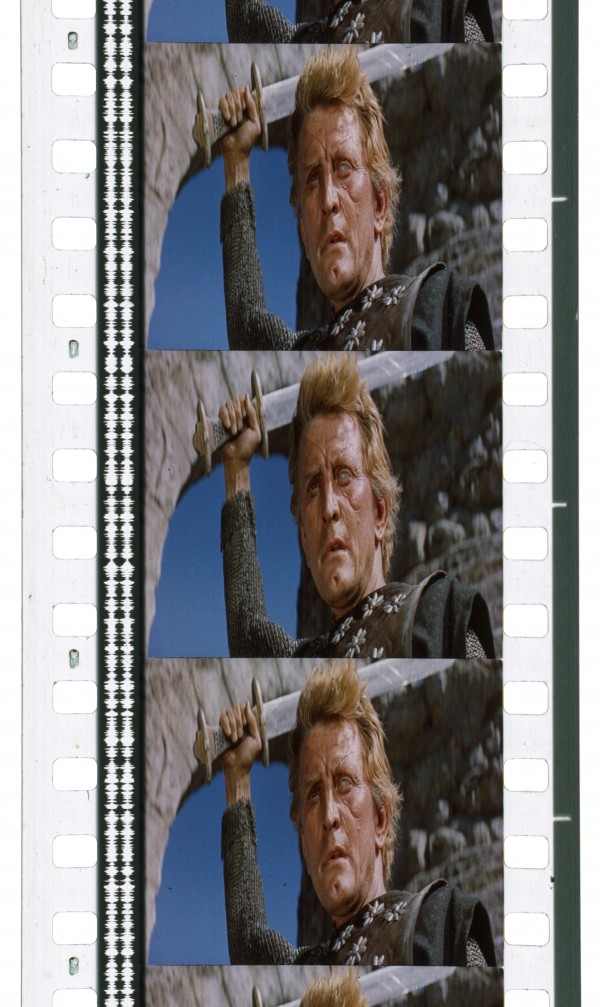
A 35mm dye-transfer print of The Vikings (1958), photographed in Technirama by Jack Cardiff. Technicolor’s dye-transfer printing process was highly adaptable. In this case, the image captured on horizontal 35mm 8-perforation Eastman Color negative, was optically printed to create reduced matrices for printing.
George Eastman Museum, Rochester, NY, United States.
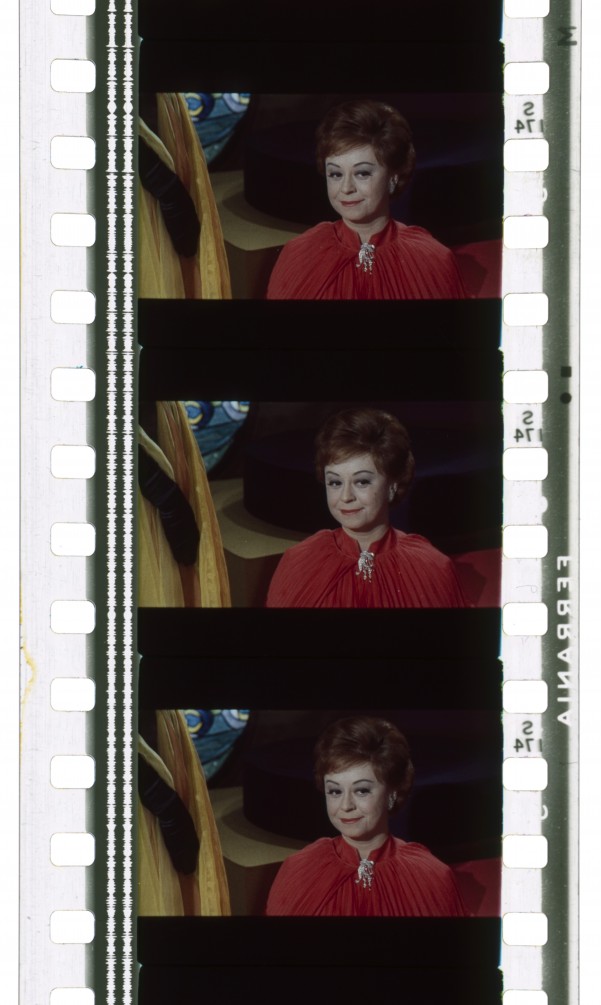
A 35mm dye-transfer print of Federico Fellini’s Giulietta degli spiriti (Juliet of the Spirits, 1965). The Italian Technicolor lab in Rome frequently used Ferrania matrix and blank stocks for its dye-transfer prints.
Identification
Technicolor prints were used with a range of widescreen formats. As such, multiple different frame dimensions and aspect ratios were used.
Kodak Standard (KS) perforations on most prints, CinemaScope (CS) perforations on 4-track magnetic stereo prints.
4-perforation, vertical for 35mm prints; 6-perforation, vertical for Cinerama prints; 1-perforation, vertical for 16mm.
Technicolor dye-transfer.
Standard Eastman Kodak edge markings.
1 (3 for Cinerama).
Technicolor’s matrix printer derived the three color records from a 35mm single strip color negative (Eastman Color or other color processes), which utilized dye couplers for the emulsion.
Color by Technicolor, Print by Technicolor.
Optical mono silver track; Optical Perspecta sound-track; four track magnetic stereo; mag-opt format, with four-track magnetic stereo and a back-up silver optical track. Optical tracks on dye-transfer prints have a distinctive silver appearance compared to the black, or purple-ish, optical tracks on Eastman Color prints.
4-perforation, vertical for standard 35mm productions; 2-perforation, vertical for Techniscope productions; 1-perforation, vertical for 16mm prints, 6-perforation, vertical for Cinerama; 8-perforation, horizontal for VistaVision and Technirama productions; 5-perforation, vertical for 70mm productions.
Eastman Color, Ferrania Color, Ansco Color, Gevacolor, Fujicolor or Agfacolor.
History
“Glorious Technicolor” reached its peak of popularity in the post-war era. However, in the next decade, the film industry faced competition from the developing television industry, which inspired the studios to increase the number of three-strip features to compete with the new encroaching medium. While there were experiments in color television broadcasts, with two incompatible proprietary systems offered by NBC and CBS, the majority of TV sets sold were still B/W, as was the production of most TV shows.
Simultaneously, Kodak introduced a new system for color photography known as Eastman Color, in 1950. It was a photo-chemical dye-coupler system that could be used with standard 35mm cameras. The same system’s adoption by the moving-image industry was dramatic and directly led to the retirement of Technicolor’s cumbersome three-strip camera. Among the first uses of Eastman Color was the National Film Board of Canada documentary Royal Journey, released in 1951.
Technicolor realized the future of principal photography lay with the new single-strip color negative and adapted their system to use it to make their dye-transfer release prints (known as “Technicolor Process 5”).
The 1950s was a decade of technological innovation as new formats and processes were introduced to compete with television, and combat the resulting fall in audience numbers at theaters. Technicolor adapted its process for this proliferation of different systems, including: CinemaScope, VistaVision (optically reducing a large, horizontal 8-perforation frame for standard 35mm prints), SuperScope, 35mm reduction prints of Todd-AO features (70mm prints were on Eastman Color stock), Cinerama (for 1960s features and reissues), and 3-D. Dye-transfer prints were also made for in-house formats Technirama and Techniscope.
By 1970, the industry had abandoned many of the spectacular formats of the 1950s. Only Panavision, spherical 65mm, and flat cropped 1.85:1 release prints, were exhibited in cinemas. Technicolor continued to offer superior quality with their dye-transfer system, the equivalent of mass-produced first-generation prints, since the matrices were derived directly from the camera negative. Competing labs using Eastman Color still made first-generation showprints directly from the camera negative, but the bulk of the general-release copies were made from duplicate elements like Color Reversal Intermediates (second-generation prints), or internegatives derived from a interpositive (third-generation prints). In both cases, the “generation loss” resulted in inferior resolution and more grain than Technicolor's dye-transfer format, which, in terms of image quality, remained the ultimate choice for producers and distributors who could afford it.
However, by 1968, shifting demographics had led to significant changes in the number of release prints required for features. The film industry abandoned the Production Code in 1968, which kept most releases in the “general audience” category. The existing code was replaced with a ratings system that allowed complete screen freedom, but also restricted the number of pictures that were rated for general release to audiences of all ages, G or PG (originally classified as M or GP). An increase in adult-oriented movies in the R and X category followed. Many movie palaces and large-screen single cinemas folded, since they couldn't fill their seats with restricted product. The “targeted” demographics required fewer prints of specific films, and the dye-transfer process was only cost effective when mass producing release copies.
Technicolor continued to offer the best quality, but by 1975, the company executives assumed the future was in limited-release print runs, so they shut down their famous process and switched to Eastman Color like the competing labs (e.g. Metrocolor, DeLuxe, Movielab, Guffanti). Among the last features printed in the dye-transfer process were The Godfather Part II (1974) and a re-print of Swiss Family Robinson (1960). It wasn't until 1979 that the industry began to realize what a mistake this had been. In several magazines, the “color fading crisis” was discussed. Only dye-transfer theatrical release prints were chemically stable. Eastman Color prints and negatives faded.
In American Film and Film Comment, articles detailed the controversy. Director, Martin Scorsese, started a petition, signed by many industry personnel, to demand that Kodak developed more-stable dye-coupler stocks. In 1982, Kodak introduced “low fade” Eastman Color negative and print stock (Kodak LPP). Low fade wasn't “no fade”, like dye-transfer, but it did represent a major improvement
The British dye-transfer plant in West Drayton, near London, shut down in 1978: as a result Technicolor prints of One Flew Over the Cuckoo's Nest (1975), Jaws (1975) and Star Wars (1977) were printed there, while all the US prints of the same films were made on the quick-fade Eastman Color stock. The Italian Technicolor plant also shut down its dye-transfer process in 1978.
The UK lab went on to oversee the installation of newly constructed dye-transfer equipment at a plant in Beijing, China, which became the only facility in the world to offer the original process, up until 1993. Technicolor in the US, revived its dye-transfer process in 1997, but using Kodak’s “Estar” (polyester) film base, rather than triacetate. The process was shut down again in 2001.
Technicolor Process 5 was the best method of mass producing first-generation positive prints in 35mm derived from Eastman Color negatives. Release copies had superior color, contrast and sharpness, especially when reduction printed from large-format negatives in the VistaVision, Technirama and 65mm formats. The dyes were of archival quality and had no dark storage fading. The loss of this process resulted in a decline in the exhibition of the pre-digital motion-picture medium, from which it never recovered.
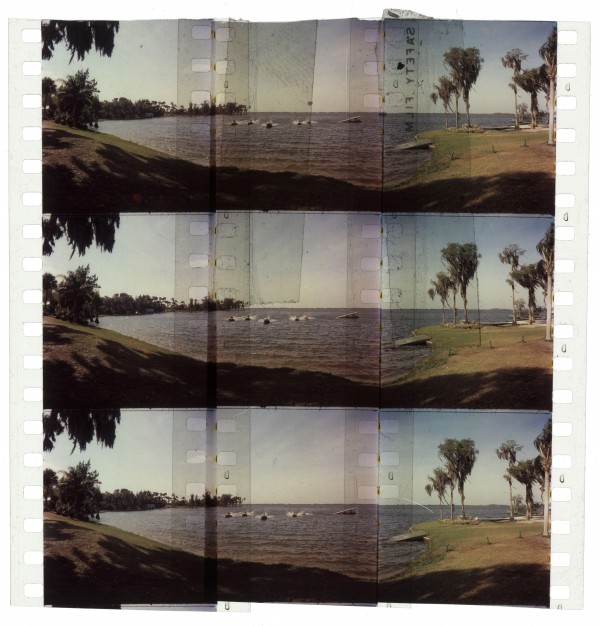
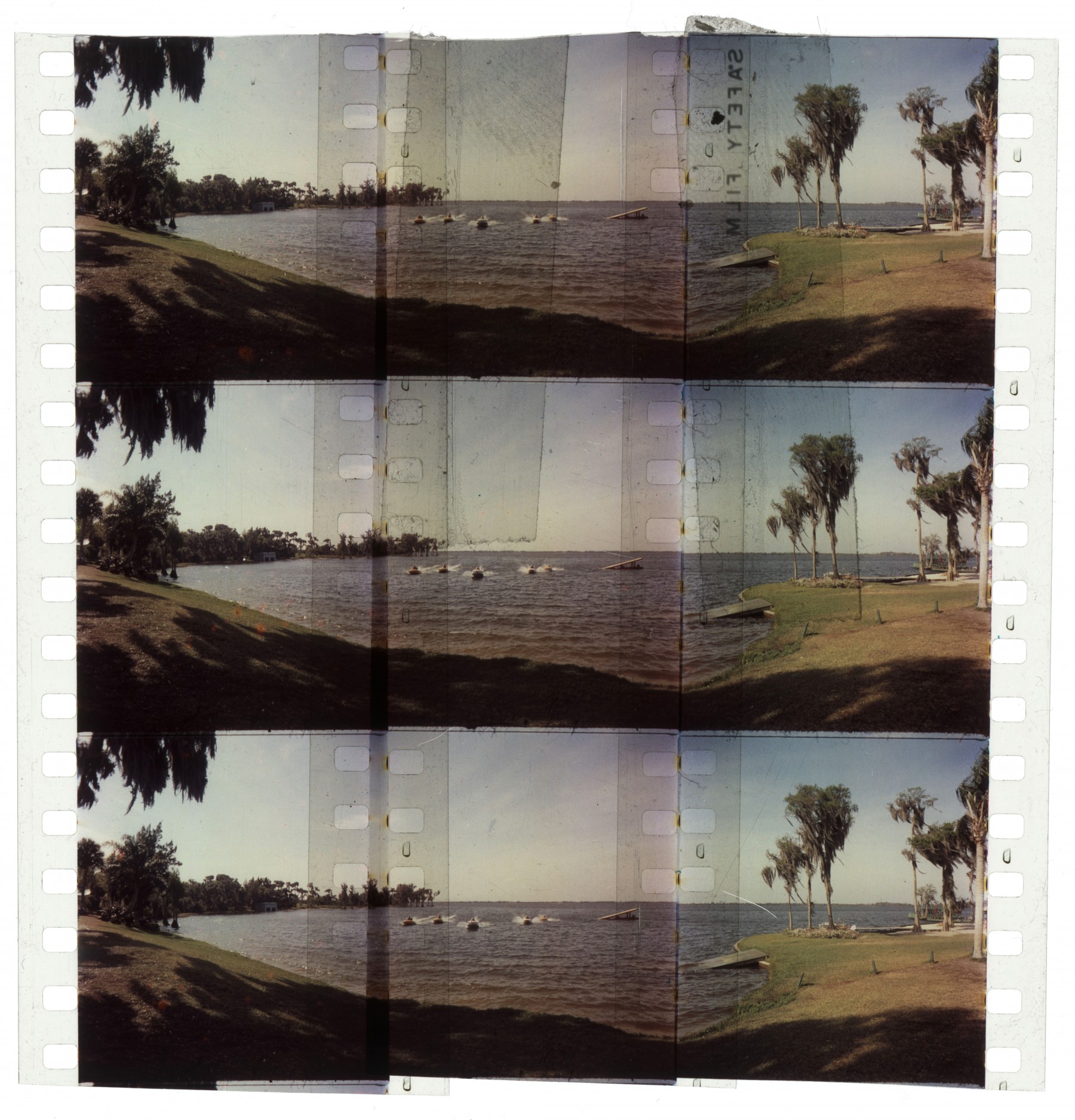
This is Cinerama (1952) 35mm dye transfer three-panel re-issue prints from 1962 derived from 35mm Eastman Color negatives. In this example, the three strips of film have been overlapped and taped together, to simulate the effect of the ultra-wide image.
Karl Thiede Collection, Burbank, CA, United States
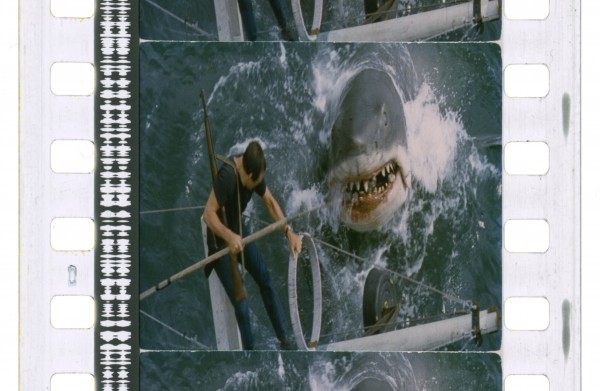
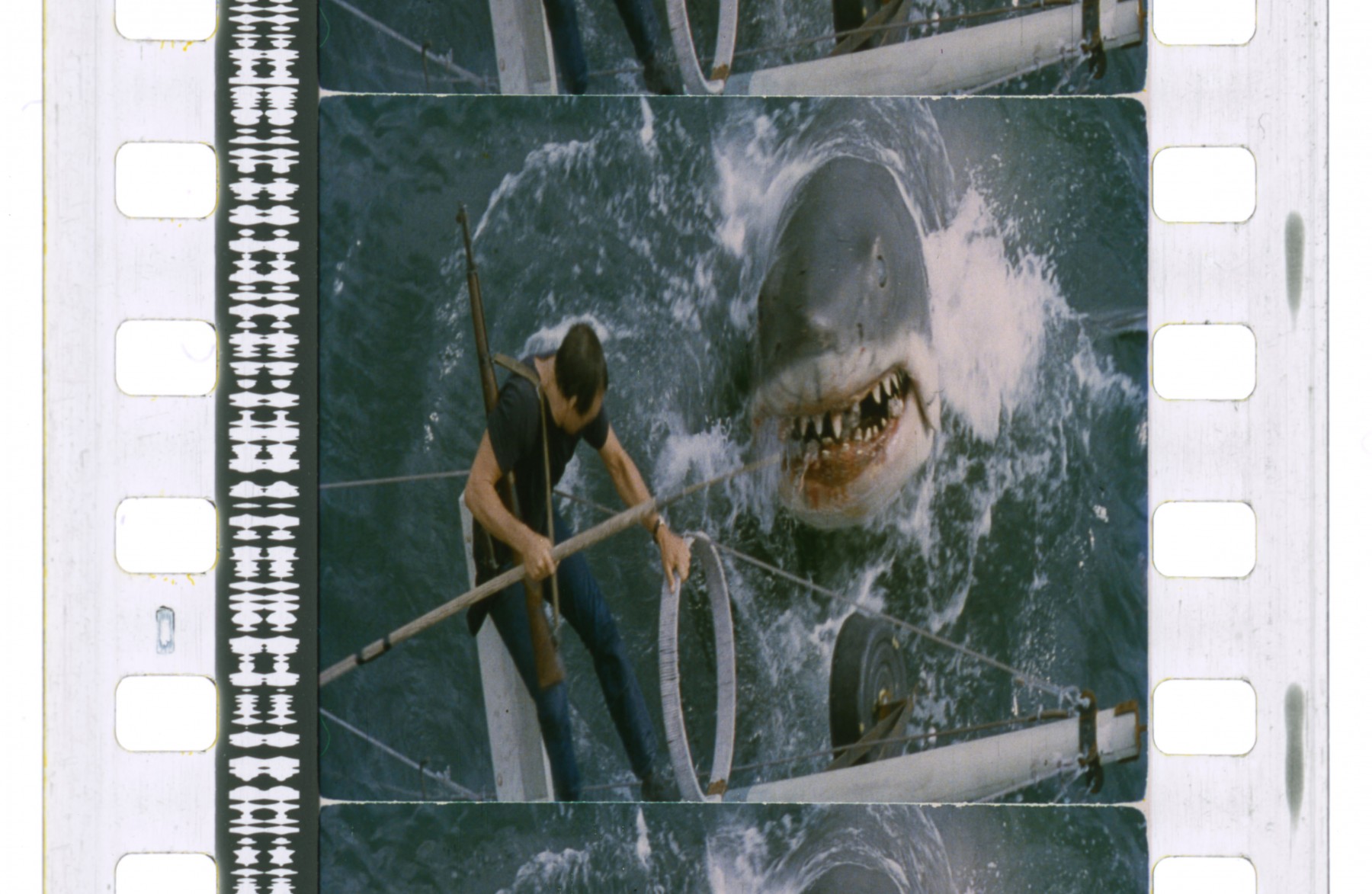
A 35mm British dye-transfer anamorphic print of Jaws (1975), derived from 35mm Eastman Color negative.
George Eastman Museum, Rochester, NY, United States.
Selected Filmography
Ultra Panavision 70. Ben Hur was released in 70mm but also created a unique 35mm reduction print. Slight black borders were printed on top and bottom of the 35mm anamorphic frame in the dye-transfer prints to retain most of the 2.76:1 ratio in the sub-format.
Ultra Panavision 70. Ben Hur was released in 70mm but also created a unique 35mm reduction print. Slight black borders were printed on top and bottom of the 35mm anamorphic frame in the dye-transfer prints to retain most of the 2.76:1 ratio in the sub-format.
Technicolor delayed the decommissioning of its dye-transfer printers to accommodate the release of The Godfather Part II.
Technicolor delayed the decommissioning of its dye-transfer printers to accommodate the release of The Godfather Part II.
CinemaScope. Developed by Fox, it originally involved shooting through an anamorphic attachment, developed by the French optical expert, Henri Chretien, placed in front of the prime lens, which would create a 2x anamorphic squeeze on the negative. For projection a comparable lens would expand it to a wide 2.55:1 aspect ratio. Technicolor made dye-transfer Technicolor prints of their early films including The Robe (1953) and How to Marry a Millionaire.
CinemaScope. Developed by Fox, it originally involved shooting through an anamorphic attachment, developed by the French optical expert, Henri Chretien, placed in front of the prime lens, which would create a 2x anamorphic squeeze on the negative. For projection a comparable lens would expand it to a wide 2.55:1 aspect ratio. Technicolor made dye-transfer Technicolor prints of their early films including The Robe (1953) and How to Marry a Millionaire.
3-D. Most 3-D releases were Eastman Color prints, although Technicolor did make some dual-projection 35mm dye-transfer prints like Kiss Me Kate (1953), derived from an Ansco Color negative, Jivaro (1954) and Gun Fury (1953). They even developed a 3-D rig that used synchronized three-strip cameras on Flight to Tangier (1953) and Money from Home.
3-D. Most 3-D releases were Eastman Color prints, although Technicolor did make some dual-projection 35mm dye-transfer prints like Kiss Me Kate (1953), derived from an Ansco Color negative, Jivaro (1954) and Gun Fury (1953). They even developed a 3-D rig that used synchronized three-strip cameras on Flight to Tangier (1953) and Money from Home.
Technirama. This format combined VistaVision and CinemaScope. A 1.5x anamorphic compression created with curved mirror optics in front of the lens was added to a horizontal VistaVision negative. This allowed both 70mm Eastman Color prints to be derived from it with six-track magnetic stereo in a 2.21:1 ratio, and 35mm anamorphic dye-transfer reduction prints in either four-track mag, or optical mono, with the standard 2x compression and a 2.35:1 aspect ratio.
Technirama. This format combined VistaVision and CinemaScope. A 1.5x anamorphic compression created with curved mirror optics in front of the lens was added to a horizontal VistaVision negative. This allowed both 70mm Eastman Color prints to be derived from it with six-track magnetic stereo in a 2.21:1 ratio, and 35mm anamorphic dye-transfer reduction prints in either four-track mag, or optical mono, with the standard 2x compression and a 2.35:1 aspect ratio.
Released in standard Eastman Color prints throughout the world, except in the UK, where Technicolor made dye-transfer release prints.
Released in standard Eastman Color prints throughout the world, except in the UK, where Technicolor made dye-transfer release prints.
Among the last dye-transfer releases made by Technicolor’s Italian lab in Rome. The film is notable for its extreme color design.
Among the last dye-transfer releases made by Technicolor’s Italian lab in Rome. The film is notable for its extreme color design.
SuperScope. The movie was shot flat in Eastman Color using the full frame. For release prints, Technicolor derived an anamorphic image by severely cropping the top and bottom of the image and enlarging it to create an anamorphic widescreen print with a 2:1 aspect ratio and black borders at the sides. While the color remained good, grain was clearly visible. Vera Cruz was the first of nine movies to use the format before it was abandoned.
SuperScope. The movie was shot flat in Eastman Color using the full frame. For release prints, Technicolor derived an anamorphic image by severely cropping the top and bottom of the image and enlarging it to create an anamorphic widescreen print with a 2:1 aspect ratio and black borders at the sides. While the color remained good, grain was clearly visible. Vera Cruz was the first of nine movies to use the format before it was abandoned.
VistaVision. For conventional vertical 35mm release prints with a four-perforation-tall image, Technicolor reduction printed the horizontal large format VistaVision negative to standard matrices, which could be played back in either 1.66:1 or 1.85:1. The reduction printing combined with A&B-roll camera negatives resulted in a superior masked widescreen image that was fine grain and first-generation for the optical effects.
VistaVision. For conventional vertical 35mm release prints with a four-perforation-tall image, Technicolor reduction printed the horizontal large format VistaVision negative to standard matrices, which could be played back in either 1.66:1 or 1.85:1. The reduction printing combined with A&B-roll camera negatives resulted in a superior masked widescreen image that was fine grain and first-generation for the optical effects.
Cinerama. The initial travelogue films were released in Eastman Color prints. In 1961, Technicolor adapted a matrix printer in their Hollywood lab so the re-issue of This is Cinerama (1952) as well as the two narrative features, How the West Was Won (1962) and The Wonderful World of the Brothers Grimm were in the dye-transfer process.
Cinerama. The initial travelogue films were released in Eastman Color prints. In 1961, Technicolor adapted a matrix printer in their Hollywood lab so the re-issue of This is Cinerama (1952) as well as the two narrative features, How the West Was Won (1962) and The Wonderful World of the Brothers Grimm were in the dye-transfer process.
Shot in standard 35mm and cropped in projection to a 2:1 aspect ratio. One of numerous Douglas Sirk films shot on Eastman Color negative and printed by Technicolo
Shot in standard 35mm and cropped in projection to a 2:1 aspect ratio. One of numerous Douglas Sirk films shot on Eastman Color negative and printed by Technicolo
Lineage
Technology
Technicolor dye-transfer prints could be made from Eastman Color, Ferraniacolor, Gevacolor, Ansco Color, and other compatible chromogenic negatives. The printing process was also adaptable – allowing printing from multiple different formats.
The color negative used a special printer with filters to derive the three matrices, and dye-transfer prints were then made in the same manner as those derived from Technicolor’s three-strip camera.
However, there were problems with the Eastman Color negatives. While the dye-coupler format allowed a wider exposure range and required less light than the three-strip camera, Kodak didn't offer quality color duplicating stock at the time (interpositive and internegative film). The fades, dissolves and superimpositions for titles were grainy and contrasty. Distributors used “short opticals” for a number of years to compensate for this. They would use the camera negative footage until the image was going to dissolve to the next shot, splice in the grainy duplicate footage for the effect only, then cut back the camera negative footage all within continuous action. This created a visual “pop” on screen which was very distracting. The Technicolor research department got to work creating a solution to this problem.
Initially the quality of dye-transfer prints derived from the early Eastman Color negatives wasn't as good as those derived from the three-strip Technicolor camera. However, by 1954 they were able to create quality matrices from color negatives that were fine-grain, with excellent resolution. They also developed a remedy to avoid the “short opticals”. The lab A&B-rolled the camera negatives. Each reel contained continuous action until a fade or dissolve was required. They left in camera negative footage without the effect. What followed was black film on the same roll until the effect was over. Then they cut back to successive shots on the Eastman Color. Their matrix printer was programmed to mechanically fade out the shot in the A-roll. Afterwards, the B-roll was utilized which contained the next shot on that reel and it was mechanically faded in. By using two reels of negative and creating the effects directly onto the three printing matrices, they avoided the grainy Eastman Color duplicating stock, so the final dye-transfer release print retained a first-generation quality throughout.
In the early 1960s, Technicolor offered an alternate method of the same concept which was “auto select printing”. The entire negative, without opticals, would be on a single reel of film. Then the matrix printer was programmed to mechanically fade in and out the negative or rewind it to create dissolves. In both formats, there was no duplicating stock in the original negative and the effects were created on the matrices only.
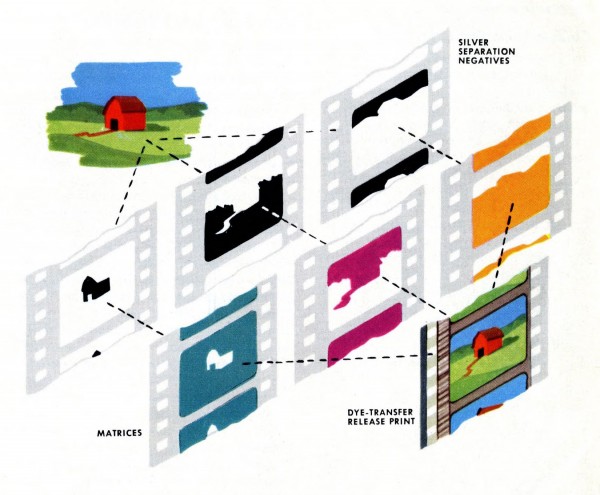
Technicolor’s matrices could be made directly from a standard color negative. This yielded fine-grained, first-generation quality release prints.
“Current Techniques of 35mm Color Motion Picture Printing”, Technicolor News and Views, 1955, 17:1 (Apr.): pp. 4–5. https://archive.org/details/technewsviews1955-04/page/n3/mode/2up
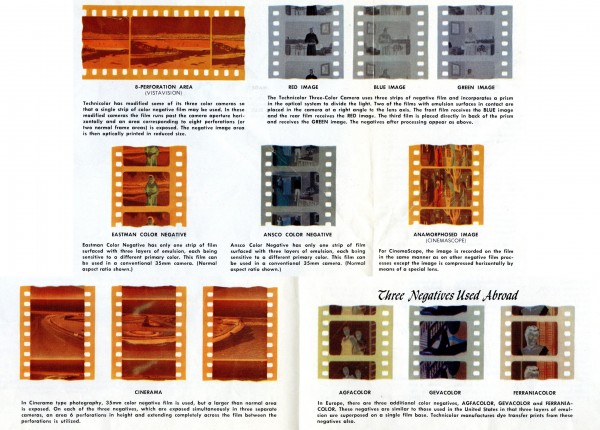
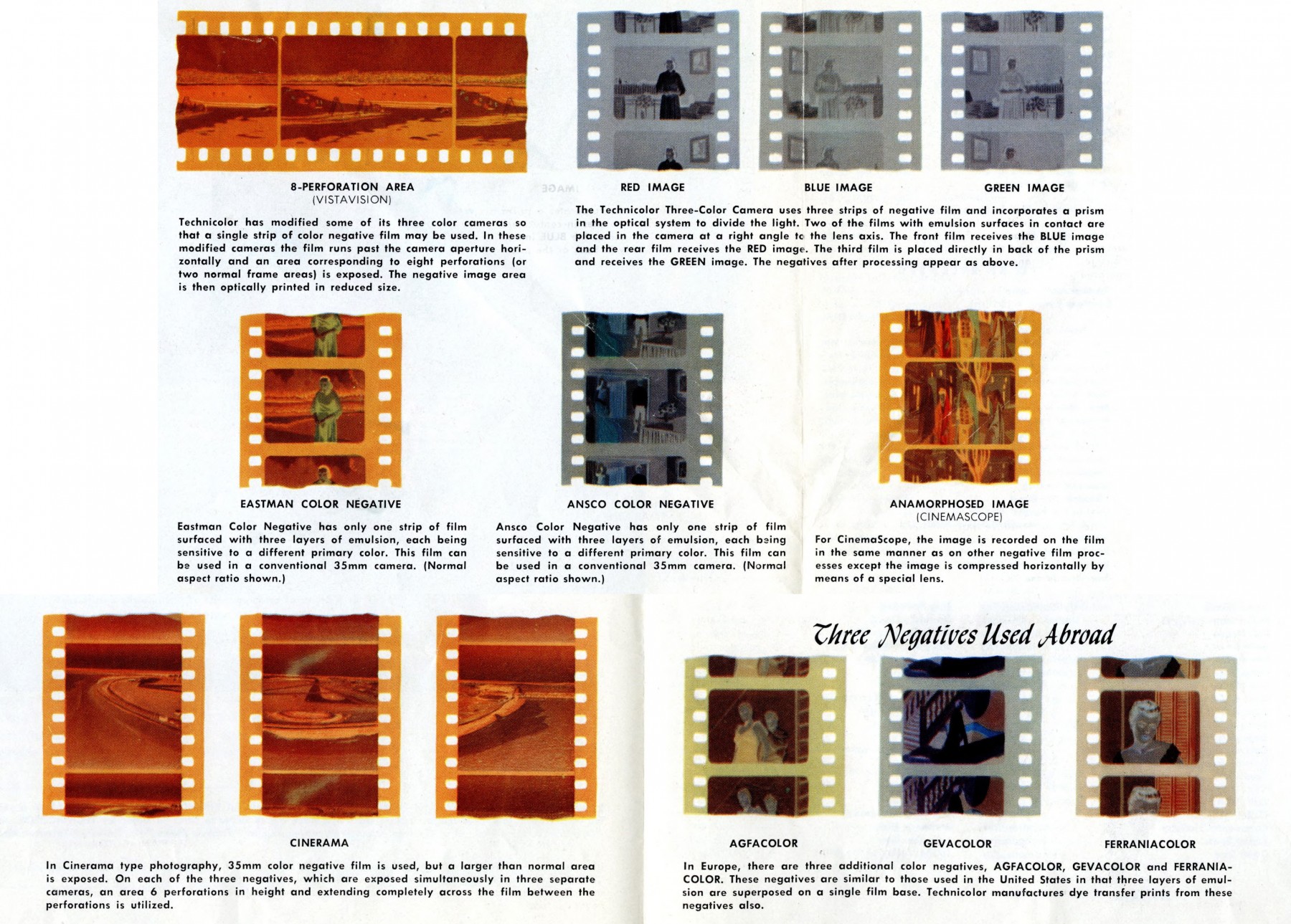
Technicolor dye-transfer prints could be made from a wide variety of negatives and film formats.
“Current Techniques of Color Motion Picture Technology”, Technicolor News and Views, 1954, 16:1 (Sep.): pp. 4–5. https://archive.org/details/technewsviews1954-09/page/n3/mode/2up
References
Coe. Brian (1981). The History of Movie Photography
Fielding, Raymond (1983). A Technological History of Motion Pictures and Television. Berkeley, CA: University of California Press.
Gomery, J. Douglas (1975). The Coming of Sound to the American Cinema. Madison, WI: University of Wisconsin Press.
Happé, L. Bernard (1984). 80 Years of Color Cinematography. London: British Kinematograph Sound & Television Society.
Happé, L. Bernard (1975). Basic Motion Picture Technology. London: Focal Press
O'Connell Bill (1979). “Fade Out”. Film Comment, 15:5 (Sep.–Oct.): pp. 11–18.
Rose, Jackson J. (1956). American Cinematographer Hand Book (9th edn). Hollywood, CA: American Society of Cinematographers.
Ryan, Roderick T. (1977). A History of Motion Picture Color Technology. London: Focal Press.
Spehr, Paul C. (1975). “The Color Film Crisis”. American Film, 1:2 (Nov.): p. 56.
Compare
Related entries
Author
Richard W. Haines is a filmmaker, film historian, novelist and illustrator. His seven feature films are Splatter University (1984), Space Avenger (1989, printed in dye-transfer in Beijing), Run for Cover (1995, in StereoVision 3D), Head Games (1996), Unsavory Characters (2001), Soft Money (2005) and What Really Frightens You (2009). His film history texts are Technicolor Movies: The History of Dye Transfer Printing and The Moviegoing Experience 1968–2001. His novels are Production Value, Reel Danger, The Anastasia Killer, What Really Frightens You Too and What Really Frightens You III. He did the illustrations for Animal Kingdumb children’s book and has written articles for The Perfect Vision and Film History.
Haines, Richard W. (2026). “Technicolor prints from color negatives”. In James Layton (ed.), Film Atlas. www.filmatlas.com. Brussels: International Federation of Film Archives / Rochester, NY: George Eastman Museum.