Cine Skob(1942–c.1960)
A paper-print film format and toy projector, developed by the Catalan animation pioneer, and renowned cartoonist, Josep Escobar.
Film Explorer
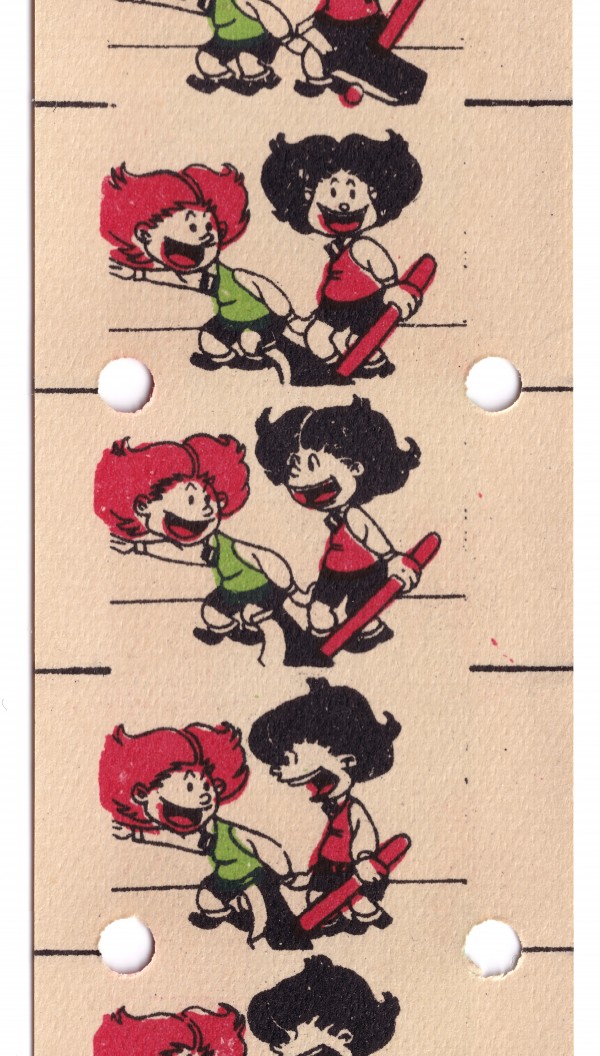
A 38mm Cine Skob paper print of Zipi y Zape y Tío Federico (Zipi & Zape and Uncle Federico) (c. 1950) intended for home viewing. Twin brothers Zipi y Zape, created by Josep Escobar, are widely popular comic book characters who have enjoyed a long existence across various media, up to and including video games. They were first published in the comic book Pulgarcito in 1948. Pulgarcito gave its permission for Zipi y Zape to appear on Cine Skob films.
El Grifilm Collection, Urueña, Spain.
Identification
30mm x 20mm (1.181 in x 0.787 in).
Single circular perforation (every two frames, one inset from each edge).
B/W or color. Lithographically printed on both sides of the paper.
Numbers (e.g. “4”, “20 bis”) on the top corner of the frame and, generally, after a splice where two paper strips have been glued together.
1
B/W or three-color prints (red, green, black). There is some color fringing.
Prints open with “Cine Skob presenta” (“Cine Skob presents”), followed by the film’s title and Escobar’s credits. Prints end with “Fin de la primera parte” (“End of the first part”), on one side of the print, and “Fin” (“The End”), on the other side of the print.
History
Cine Skob was named after its inventor, the renowned cartoonist Josep Escobar – his work was simply signed “Escobar” – who was born in Barcelona in 1908. The Cine Skob projector was a hand-cranked device that projected perforated opaque paper prints. It became widely used as a toy projector in Spain, during the 1950s.
Escobar built his prototype using Meccano parts and the subsequent commercially available projector was manufactured by Marcelo Fernández at Industria Street, in Barcelona (Mallol, 1992: p. 200; MNACTEC, n.d.). Created in 1942, the patent was filed in 1943 (Artigas, 2021: p. 70). The patent description differs slightly from the actual manufactured projector and paper prints.
The projector had a metal body, finished in grey. It had a wooden base, a wooden cap (over the lamphouse), and the crank was finished with wood. Its distinctive trademark was printed in red above the lens, on the front of the projector body. The original model seems to have been available in green at a later date (Artigas, 2021: p. 71).
The paper-print reels were typically marketed at 20m (65.62 ft) and 30m (98.43 ft) lengths, containing a total of either 1,000, or 1,400, drawings [frames] (Quirino, 2018: p. 92), however, the film Los Pastorcillos del Belén (The Little Shepherds of Bethlehem) (c. 1950) was 40m (131.23 ft) long, and contained 2,000 drawings. Films came in rolls and were housed in small, labelled cardboard boxes.
Some of the paper prints included popular characters from the long-running Spanish comic books TBO (1917–98) and Pulgarcito (1921–87): Carpanta (by Escobar), Zipi y Zape (by Escobar), Eustaquio Morcillón and Babali (by Joaquim Buigas & Benejam) and La Familia Pepe (by Juan García Iranzo). Other prints included popular stories and folktales (Aladdin, Snow White, The Tortoise and the Hare, among others). Two Cine Skob titles were released as unfinished prints so that children could draw their own frames, completing them for themselves. And two were released as series, in multiple parts. All paper prints were designed and drawn by Escobar himself (Artigas, 2021: pp. 70–1).
Cine Skob released a series of small 16-page booklets that included the stories of some of their films. They were illustrated by Escobar and were wrapped in five-color covers. Cinema tickets were also provided to be used at home screenings. All Cine Skob adverts were drawn by Escobar too (Soldevilla, 2014: p. 61).
Escobar’s full name was Josep Escobar i Saliente (José Escobar Saliente). He played an important role in the field of animation and became well-known as a cartoonist. He published his first drawings as a teenager, and in 1934, with the assistance of the photographer Josep Bosch, he completed a B/W amateur animated short film: La Rateta que Escombrava l´Escaleta (The Little Rat that Swept the Stairs/The Vain Little Mouse), inked by his sister, Teresa Escobar. It was unfortunately lost during the Spanish Civil War (Candel, 1993: p. 74).
Escobar worked at most of the animation studios of the time (Hispano Grafic Films, CEIDA, Dibujos Animados Chamartín, Baguñà Hermanos, and Estela Films) and some of the animated series he worked on in the 1940s were based around his creations: Civilón (a friendly bull), Zapirón (an adventurous cat), Pituco (a precocious baby). He also directed animated commercials (Pagès, 2019: pp. 180–2). He worked as technical director on the animated feature Érase Una Vez… (Once Upon a Time…) (1950), an adaptation of Perrault’s Cinderella that was co-directed by Alexandre Cirici Pellicer and was filmed in the Spanish color process Cinefotocolor.
The prolific and versatile Escobar was also a playwright and actor. His play Assaig General (“General Rehearsal”) opened in 1957 (with him playing onstage) and was widely performed. His distance-learning animation course became very popular too.
Escobar was also involved in the creation of Cine Stuk, a plastic toy projector that launched in 1952, which employed a translucent paper strip, with a single perforation between frames. Three patents were filed for Cine Stuk in the 1960s, twice under the name of Escobar’s eldest son, Carles Escobar Roura (Artigas, 2021: p. 73).
Josep Escobar invented three other devices (unrelated to cinema) under the Skob name: Petaca Skob (a tobacco container), Chapó Skob (a billiards game) and Bolos Skob (bowling pins).
Carpanta en el Parque Zoológico (Carpanta at the Zoo), by Escobar (c. 1950).
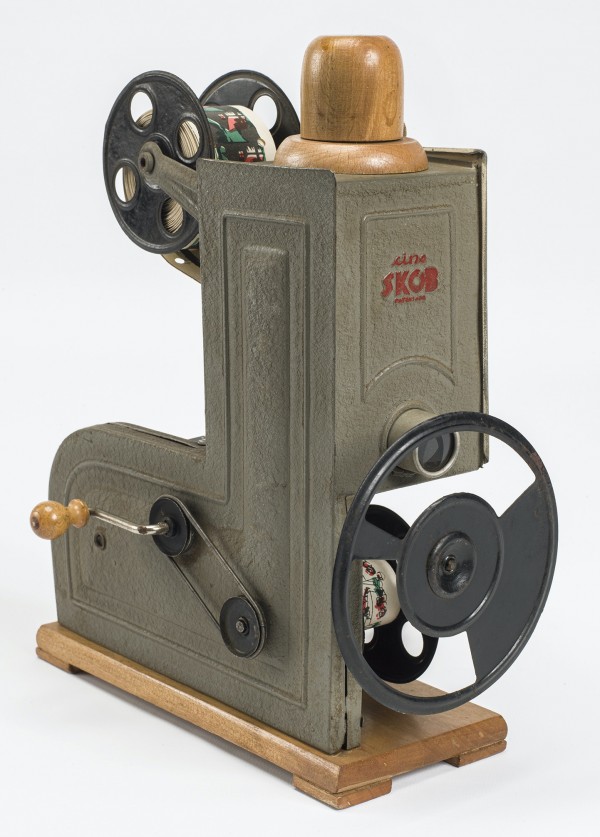
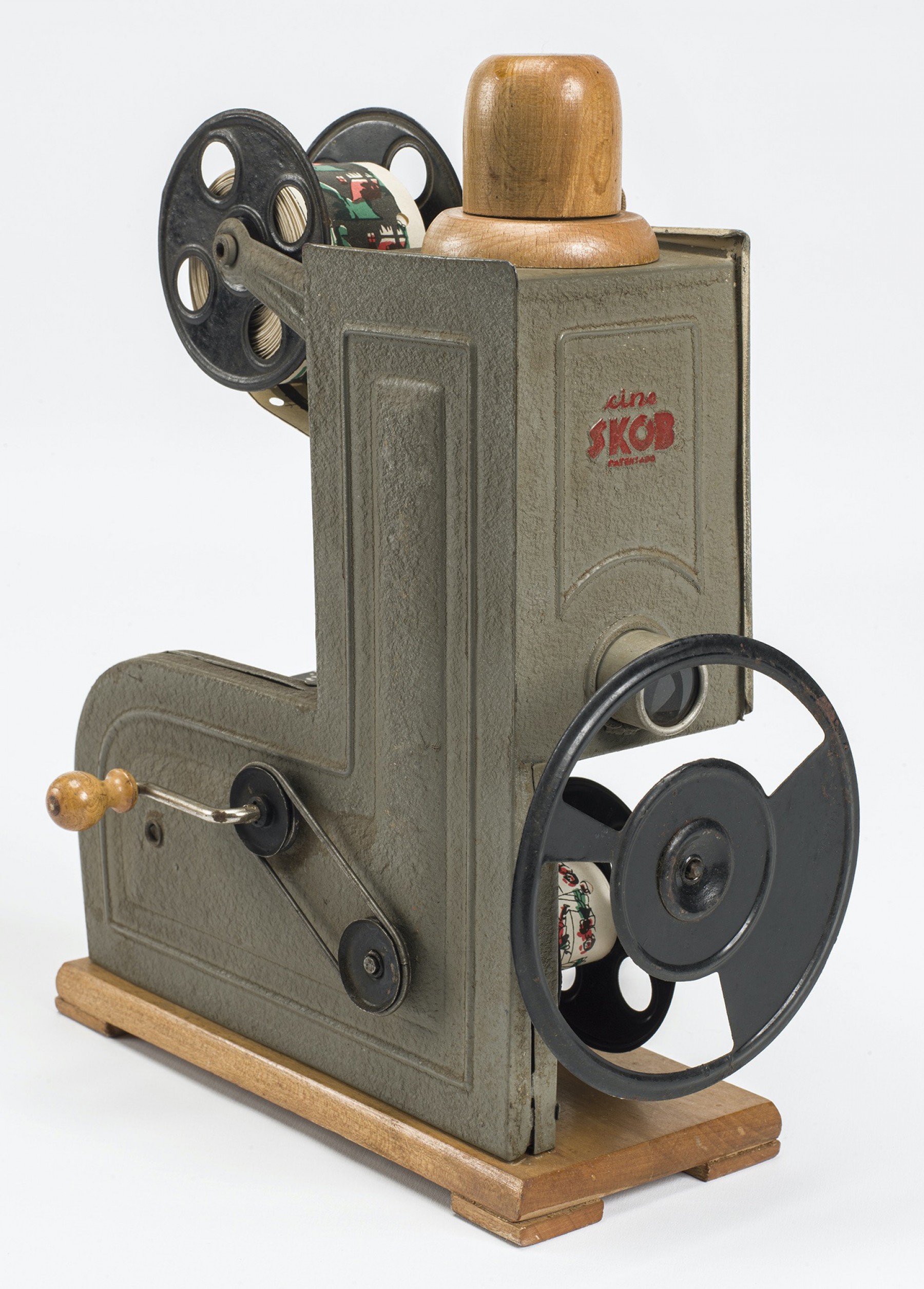
The original Cine Skob projector.
Museu del Cinema, Girona, Spain.
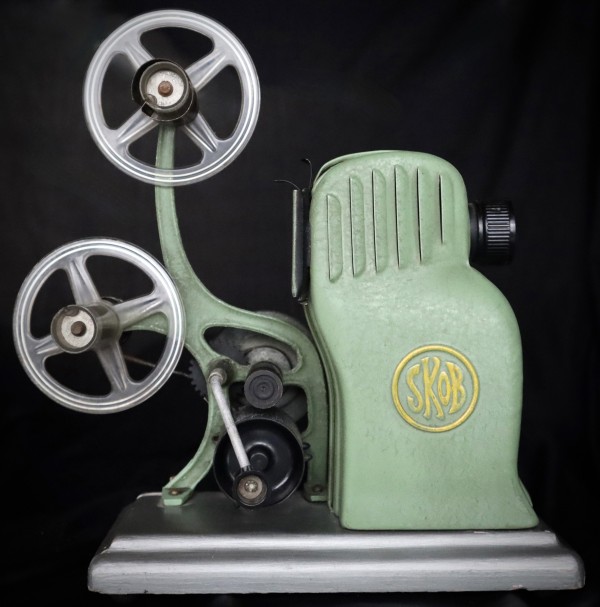
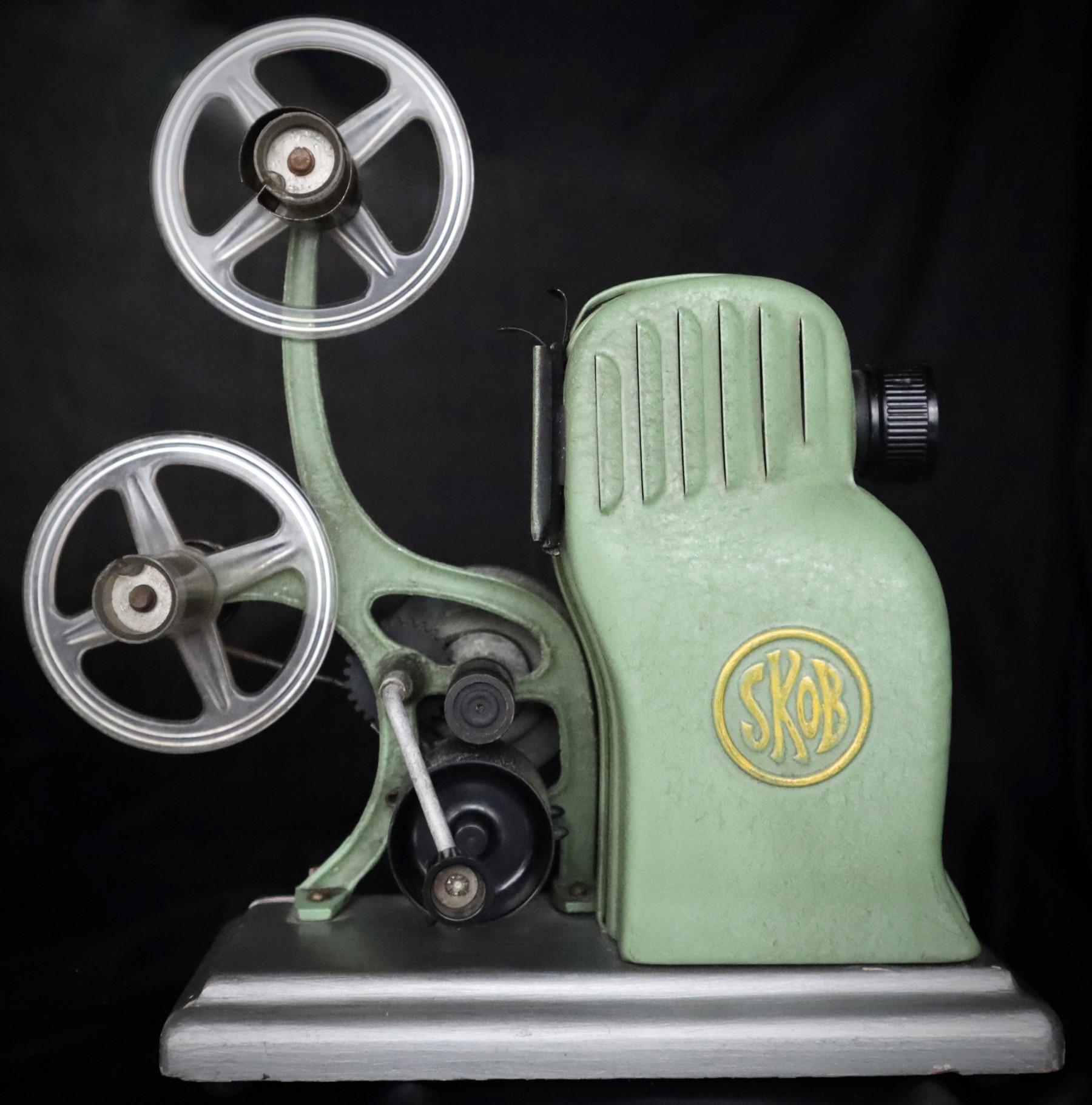
A rarer Cine Skob projector in green, with a yellow Maltese cross. It has no shutter and “SKOB” is embossed on the projector’s side in yellow. This particular projector belonged to the Spanish filmmaker Basilio Martín Patino.
Filmoteca de Castilla y León, Salamanca, Spain.
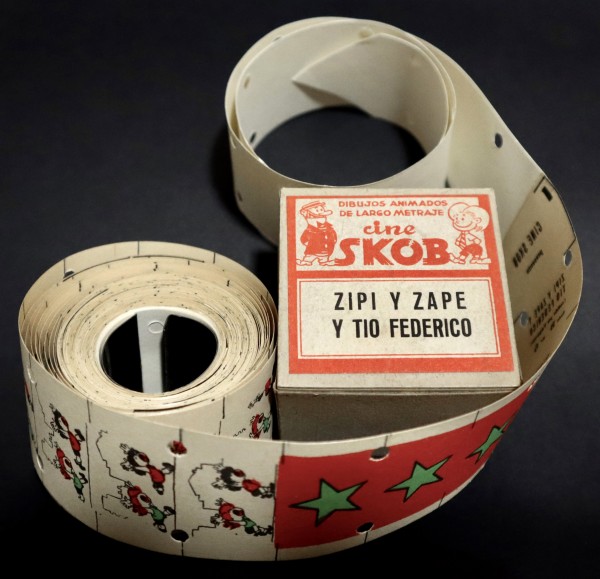
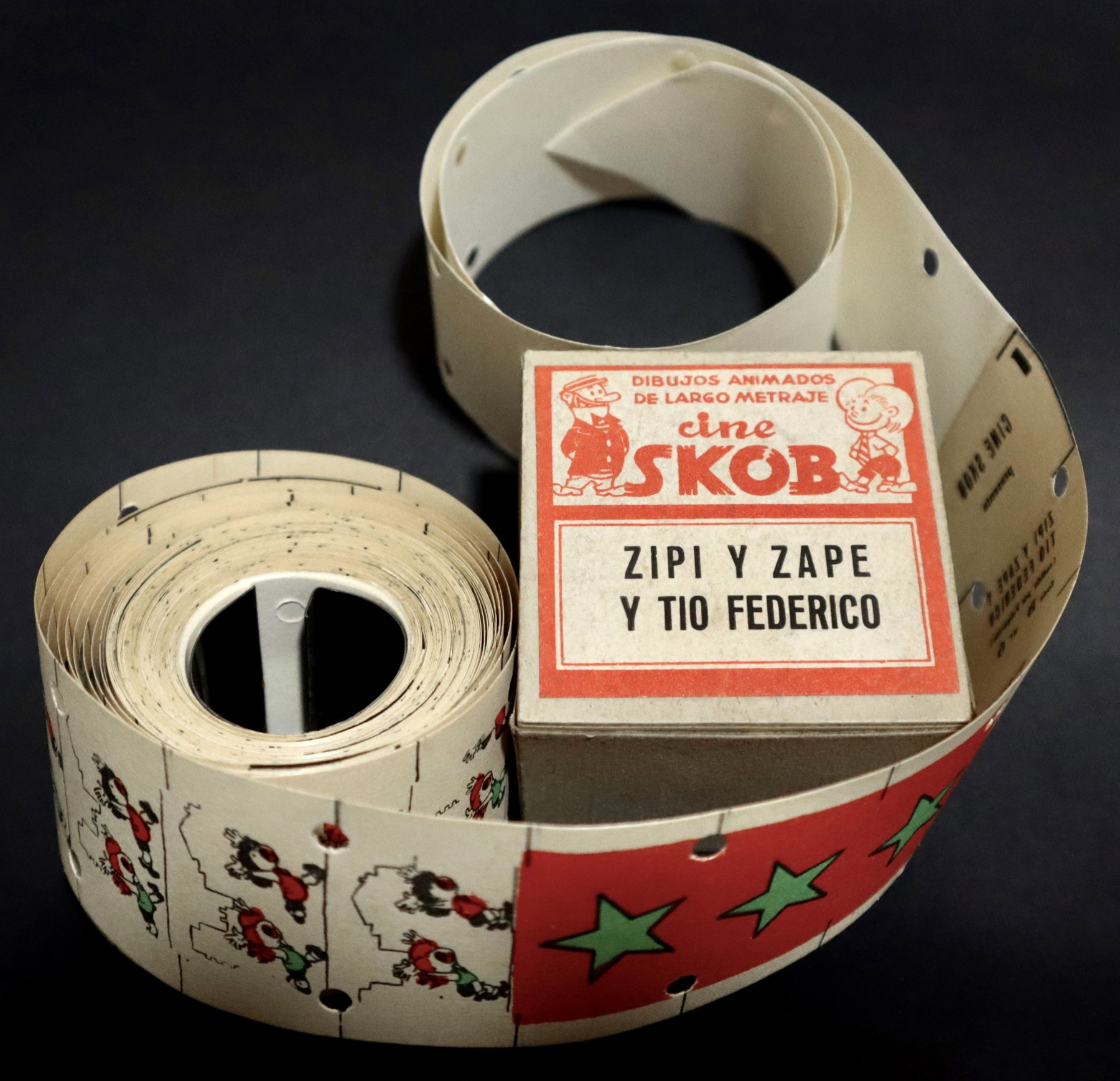
Cine Skob paper print, with original packaging.
El Grifilm Collection, Urueña, Spain.
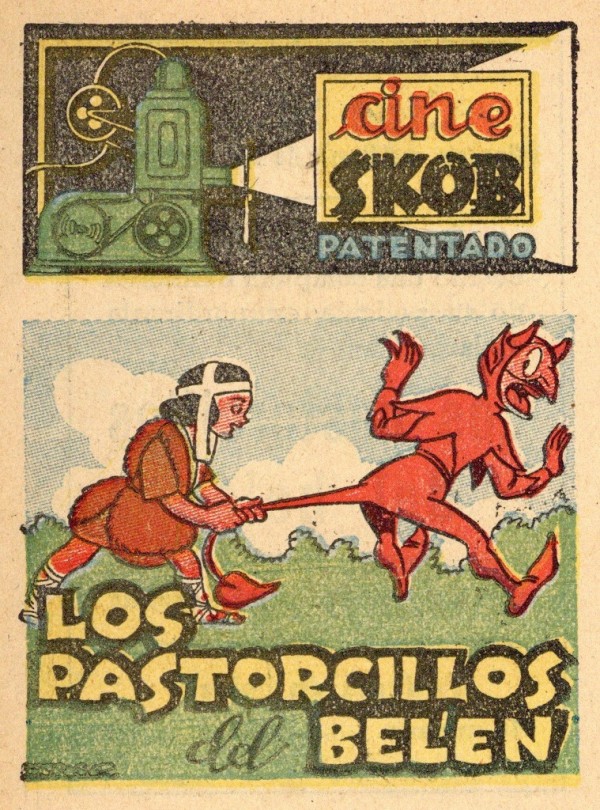
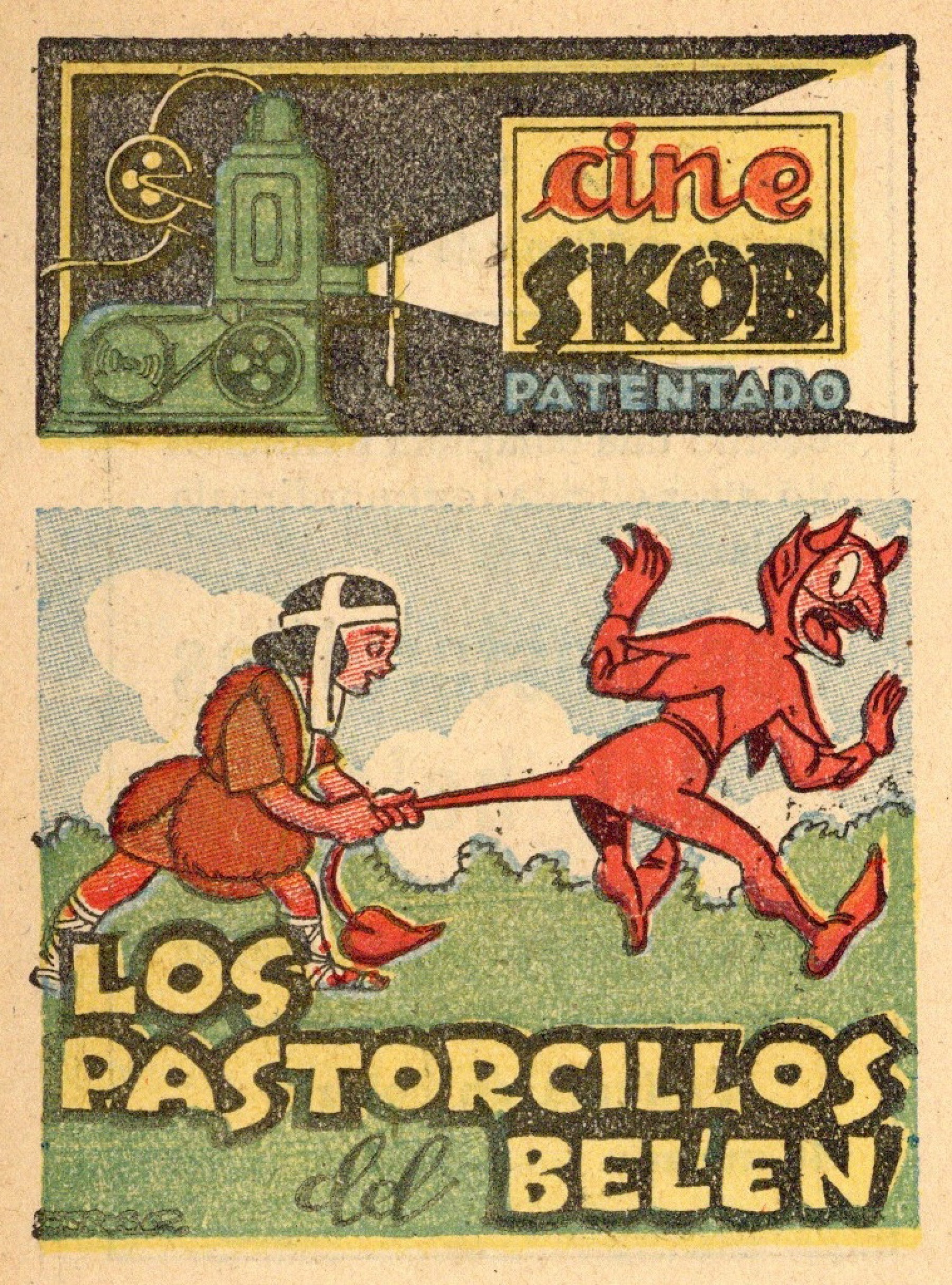
A Cine Skob booklet.
Museu del Cinema, Girona.
Selected Filmography
By permission of Pulgarcito. This paper print was designed with an “interactive” element, being left unfinished, so that children could complete the film with their own drawings.
By permission of Pulgarcito. This paper print was designed with an “interactive” element, being left unfinished, so that children could complete the film with their own drawings.
By permission of Pulgarcito.
By permission of Pulgarcito.
Western series, released in two parts.
Western series, released in two parts.
By permission of TBO. This paper print was left unfinished, so that children could complete the film with their own drawings.
By permission of TBO. This paper print was left unfinished, so that children could complete the film with their own drawings.
Science fiction series, released in three parts.
Science fiction series, released in three parts.
Based on the character who featured in an animated short film, made at Dibujos Animados Chamartín, by Jaume Baguñá and Josep Escobar in 1943-4.
Based on the character who featured in an animated short film, made at Dibujos Animados Chamartín, by Jaume Baguñá and Josep Escobar in 1943-4.
By permission of Pulgarcito.
By permission of Pulgarcito.
Technology
Cine Skob was a paper-print film format created for a toy projector designed for home viewing. The paper strips were printed on both sides in three-color lithography (using red, green and black inks), with the exception of Caperucita Roja (Little Red Riding Hood) which was in B/W and was supplied free with the projector. Drawings and texts were printed in reverse, as the image was flipped during projection. Prints are fully opaque, perforated, and have some color fringing.
The Cine Skob projector used a light bulb in the lamphouse and was powered by mains electricity. Projection was achieved by the reflection of light off the opaque paper print, as the supporting paper medium was not transparent, like traditional film. It worked as an opaque projector, or episcope – an indirect viewing device, suitable for non-translucent prints. The recommended light bulb was 40W (or 60W, if a brighter image was required). Images were transported upside down but were inverted, to the right way up on the screen, passing through the lens.
The projector was hand-cranked. It needed to be approximately 2m (6.5 ft) away from the screen (or wall), and focus could be adjusted by moving the lens tube in and out. The rotating shutter was external and located in front of the lens. By turning the crank, the shutter wheel rotated, and the paper print advanced: from the film supply reel, through the projector window, around the cylinder (or drum), to the take-up reel. The drum contained pins that engaged with the strip’s perforations to help advance the film. As Cine Skob films were printed on both sides, once the first part of the film was projected, the same paper print was flipped and projected again, screening the second part of the film.
When Cine Skob came out, Cine Nic (first introduced in 1931) was currently the most successful toy projector in Spain. Escobar intended to move away from Cine Nic’s simple two-stage animation process, which alternately projected two images back and forth. He also intended to create longer film strips (Quirino, 2018: p. 92). Cine Skob’s decline in the 1960s might have been due to the introduction of photochemical film projectors in Spain that were designed for home use (Candel, 1993: p. 75). For example, the Cinexin toy projector (8mm) was introduced in 1971 and quickly became very successful in Spain, followed by the Cinexin Super 8, introduced in 1983.
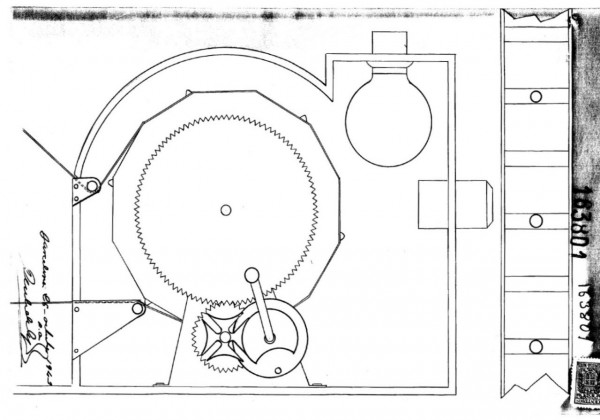
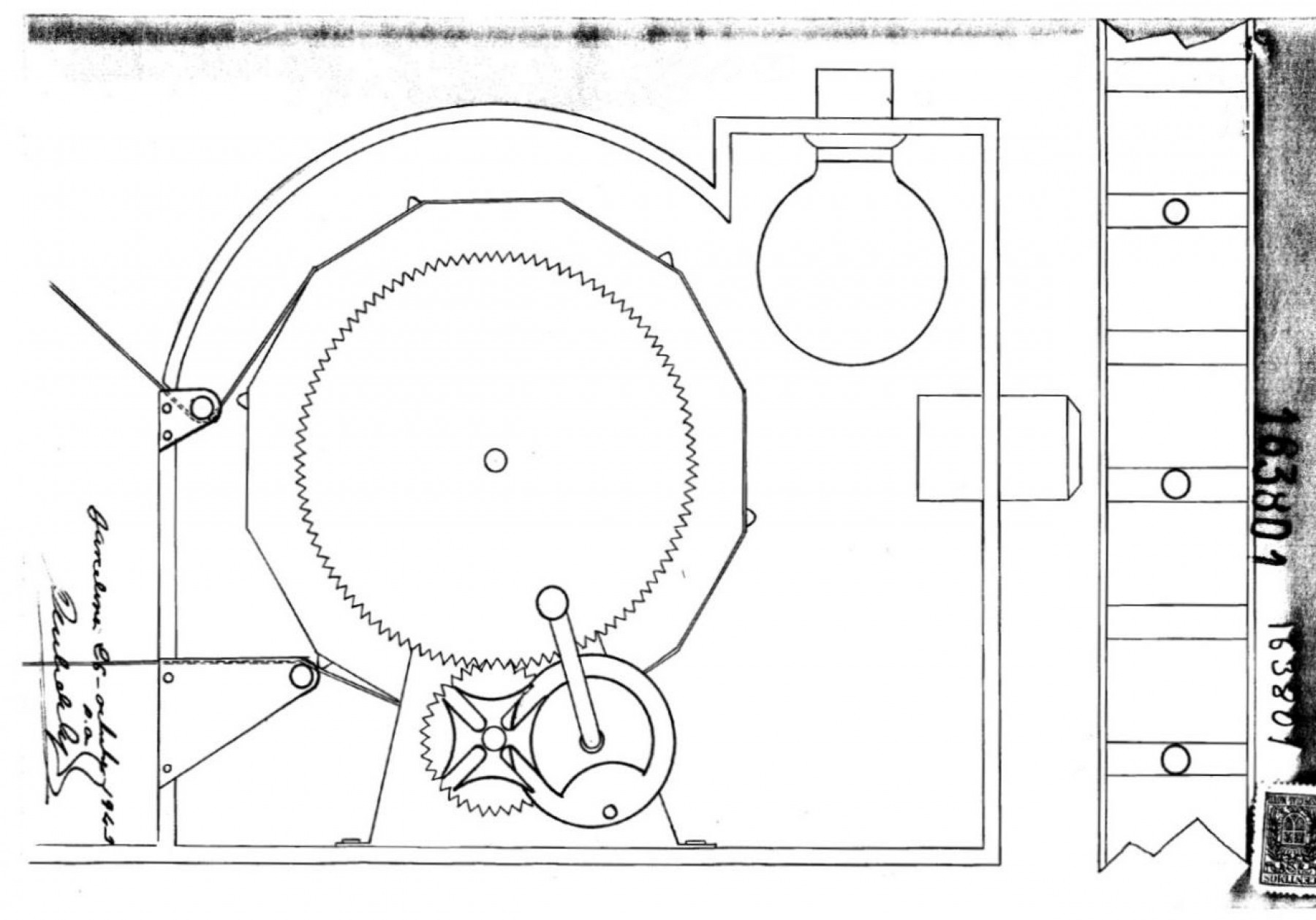
The patent diagram shows a film strip with single circular perforations every two frames and between framelines, while the final manufactured paper prints have circular perforations along both edges. The projector’s drum in the marketed model also has two parallel pivots or pins (instead of one, as here) and is cylindrical, while the patent illustrates the drum as a dodecagonal prism. These modifications were probably improvements to avoid tightness and damage on the paper strips.
Escobar Saliente, José. Un cine juguete o aparato proyector de película de papel, apto para rollos de gran longitud a base de combinar el mecanismo conocido por cruz de malta con un tambor prismático con pivotes para el arrastre de la cinta. Spanish patent 163801 (ES0163801), filed October 26, 1943, and issued May 1, 1945.
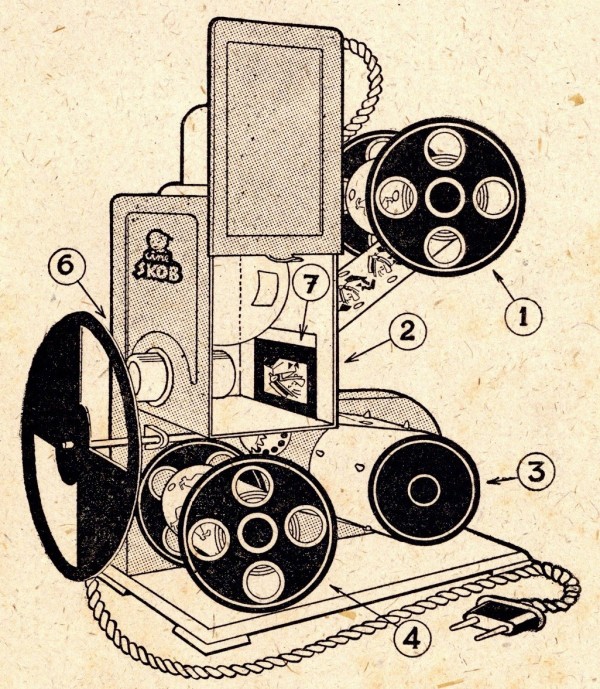
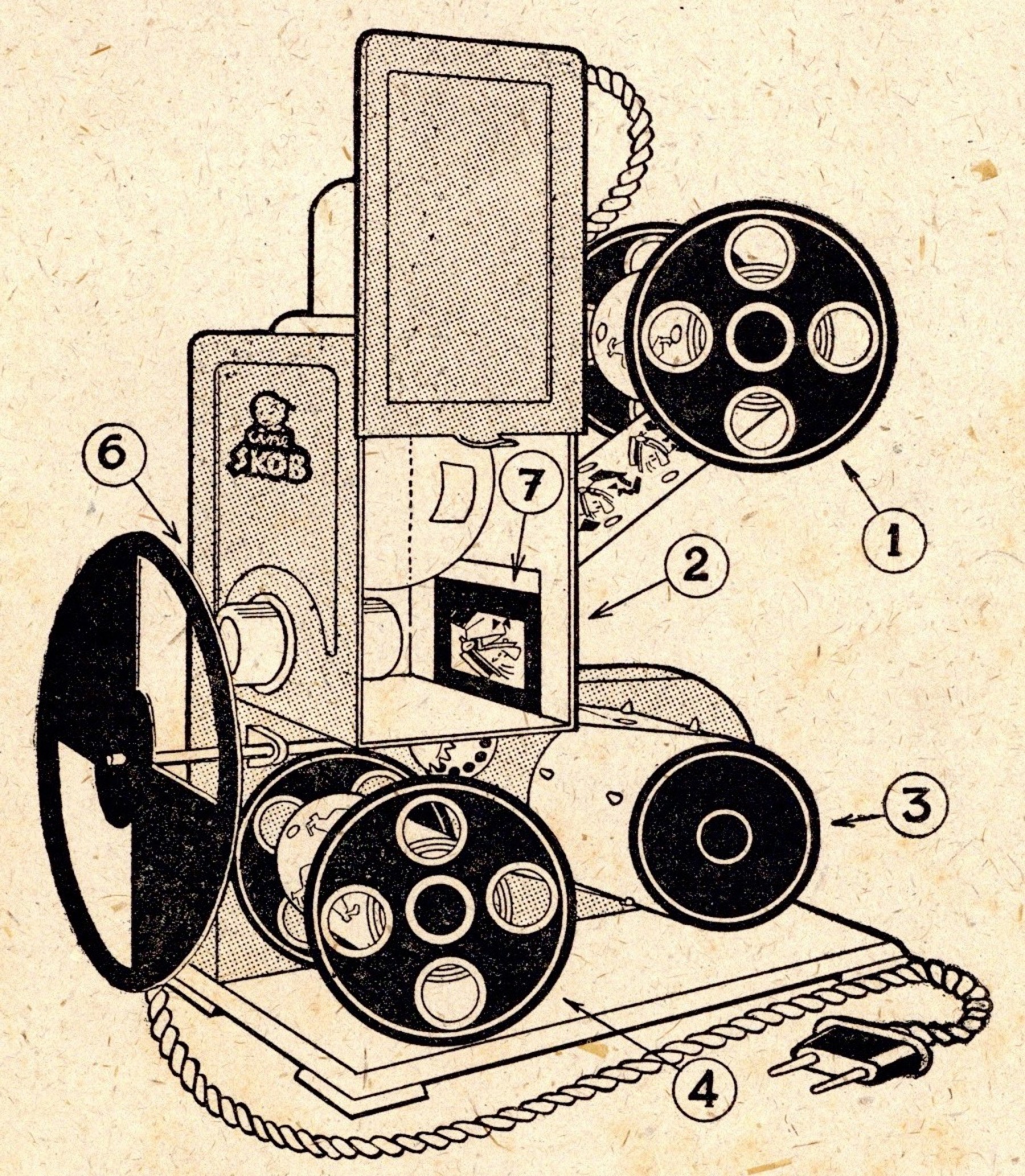
Cine Skob projector diagram – from the instruction manual included with the projector.
Museu del Cinema, Girona, Spain.
References
Alcázar, Javier & Félix López (2008). “Josep Escobar Saliente”. Tebeosfera (website). https://www.tebeosfera.com/autores/escobar_saliente_josep.html (accessed 4 Nov., 2024).
Artigas Candela, Jordi (2021). El Cine Nic y otros juguetes cinematográficos. Barcelona: Trilita.
Candel, José María (1993). Historia del dibujo animado español. Murcia: Filmoteca Regional de Murcia.
Congreso Quirino (2018). Actas del Congreso de Premios Quirino de la Animación Iberoamericana: 6–7 de abril, 2018. Santa Cruz de Tenerife, España. San Cristóbal de La Laguna, Tenerife: Servicio de Publicaciones de la Universidad de La Laguna. Available at: https://riull.ull.es/xmlui/bitstream/handle/915/11978/Congreso_Premios_Quirino.pdf (accessed Feb. 15, 2026).
Escobar, Josep (c. 1950). Carpanta en el Parque Zoológico, Cine Skob film, (length: 5.42). Available at: https://www.youtube.com/watch?v=QJYaA_oy4Wg (posted 2/3/08, by Salvi Jacomet) (accessed Feb. 15, 2026).
Frutos Esteban, Francisco Javier (1999). Artilugios para fascinar. Colección Basilio Martín Patino. Salamanca: Junta de Castilla y León.
Guiral, Antoni & Joan Manuel Soldevilla (2008). El mundo de Escobar. Barcelona: Ediciones B.
Fundación Gin (n.d.). “Escobar”. Humoristán, el museo digital del humor gráfico (website). https://humoristan.org/es/autor/escobar (accessed Feb. 15, 2026).
Mallol, Tomàs (1992). “La inventiva catalana en la joguina cinematográfica”. Cinematògraf, 1:2: pp. 193–201.
Manzanares, Jordi (2024). “Morcillón va de caza (1950, Skob)”. Tebeosfera (website). https://www.tebeosfera.com/audiovisual/morcillon_1950_skob_-va_de_caza-.html (accessed Feb. 15, 2026).
Museu Nacional de la Ciència i la Tècnica de Catalunya (n.d.). “Skob. Ciència i tècnica” (MNACTEC website). https://mnactec.cat/es/objeto-detalle/HeritageObject/MNACTEC_874369 (accessed Feb. 15, 2026).
Pagès, Maria (2017). “Els personatges femenins en l’animació a Espanya. L’imaginari femení en el cinema d’animació: dels pioners a l’actualitat”. In II Forum d’Animació. Dones i Cinema d’Animació: la Indústria des dels Marges, Teresa Martínez Figuerola & Maria Pagès (eds). Barcelona: Gredits, BAU.
Pagès, Maria (2019). “Josep Escobar: la imaginación desbordante de un pionero de la animación”. Con A de Animación, 9: pp. 174–89.
Soldevilla, Joan Manuel (2005). El pare de Carpanta i Zipi y Zape. Josep Escobar o la lluita contra el silenci. Lleida: Pagès Editors.
Soldevilla, Joan Manuel (2014). “Josep Escobar: la pervivència d’un clàssic”. Lauro: Revista del Museu de Granollers, 26–7: pp. 51–72.
Visual 12 and Vicenç Asensio i Rovira (2008). Rebels amb causa. Josep Escobar i els seus personatges (DVD). Barcelona: Granollers: Museu de Granollers/Diputació de Barcelona.
Patents
Escobar Saliente, José. Un cine juguete o aparato proyector de película de papel, apto para rollos de gran longitud a base de combinar el mecanismo conocido por cruz de malta con un tambor prismático con pivotes para el arrastre de la cinta. Spanish patent 163801 (ES0163801), filed October 26, 1943, and issued May 1, 1945. Available at: https://patentscope.wipo.int/search/en/detail.jsf?docId=ES4920923
Compare
Related entries
Author
Inés Toharia Terán is an independent researcher, film archivist and filmmaker. Her interest in film history and technology grew substantially after working with the Film Technology Collections at George Eastman Museum (GEM). It owes much to GEM’s wonderful staff. Inés has worked at film archives and in film and photo preservation projects. She teaches and writes about film history and preservation. And has co-curated an exhibition on Spanish film magazines: Papel, Tinta y Acción: Las Revistas de Cine Españolas (1910–2015). She works with films, books and music.
Escobar License; Sergi Escobar; Museu del Cinema (Girona); Filmoteca de Castilla y León; Arxiu Nacional de Catalunya: Arxiu Pere Català; El Grifilm; Maite Conesa Navarro; Montse Puigdevall Noguer; Laura Bueno González; Isaac Garcia Llombart; Optical Toys: A Virtual Museum; Museu Nacional de la Ciència i la Tècnica de Catalunya (MNACTEC).
Toharia Terán, Inés (2026). “Cine Skob”. In James Layton (ed.), Film Atlas. www.filmatlas.com. Brussels: International Federation of Film Archives / Rochester, NY: George Eastman Museum.