Smell-O-Vision(c.1938–1960)
A process developed by Hans E. Laube to synchronize the injection of scents into the auditorium to correspond with specific scenes, or sequences, in a film in order to enhance the viewer experience.
Film Explorer
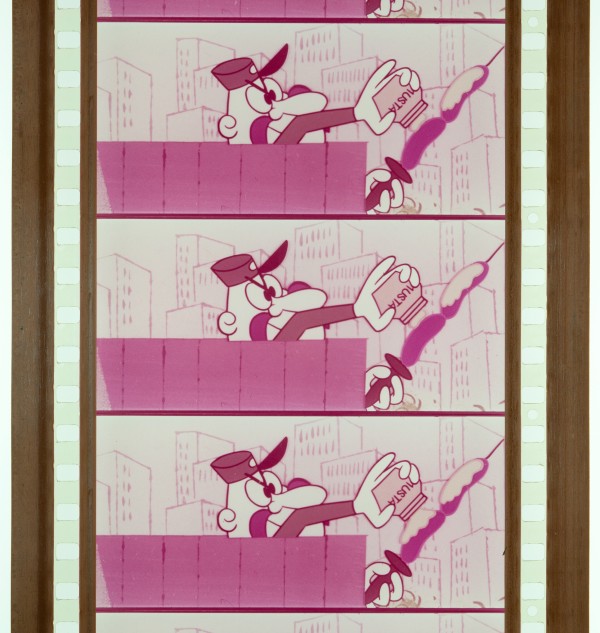
This 70mm print of A Tale of Old Whiff (1960) is the only known extant material with the original trigger tones on the magnetic stripe soundtrack used to cue the release of scents in Smell-O-Vision.
Academy Film Archive, Hollywood, CA, United States.
Identification
48.56mm x 22.01mm (1.912 in x 0.867 in).
Eastman Color print.
Obscured by magnetic soundtrack.
1
Eastman Color prints processed by Technicolor. Surviving prints now suffer from heavy color fading.
“Smell-O-Vision”; “Hans Laube, Osmologist”: seen on original Scent of Mystery prints.
The magnetic soundtracks on the 70mm print used trigger tones, embedded above the program audio, to signal the release of scents from the separate smell “brain machine”.
52.63mm x 23.01mm (2.07 in x 0.906 in).
Eastman Color negative.
Unknown
History
Created by Hans E. Laube (1900–1976), a Swiss inventor, engineer, and osmologist (a specialist in the scientific study of smells and odors), Smell-O-Vision was designed to give the film viewer the most personal, immersive “life-like” cinema experience possible by synchronizing the release of scents into the theater to correspond with selected actions on screen. His daughter Carmen Laube recalled: “He believed everything on this earth, even emotions, have a scent… Hans loved cars and loved to race. It was a challenge. He loved challenges. He outworked people half his age – his passion for whatever was in front of his workspace drove him to the max” (Laube, 2016). Laube envisioned scents for use not only for films, but in broadcast TV, closed circuit television, department stores, train and bus stations, hotel lobbies, and personal home use.
Laube spent over 40 years trying to realize his greatest passion: bringing scents to cinema.
His first attempt at melding the olfactory with the visual in cinema was the film Mein Traum (My Dream, 1939), the name of a popular perfume at that time. Laube, collaborating with engineer Robert Barth, coordinated the use of scents for this hour-long film. It was produced by Pro Film and commissioned by the Swiss National Tourist Office for the Swiss Pavilion at the 1939 New York World's Fair. Released first in Bern, Switzerland on December 2, 1939, as the first “Odorated Talking Picture”, it was shot in 35mm (B/W, sound with English dialogue) and screened in New York in 1940 under the banner of “Scentovision”. Considered a novelty, the system did not secure funding to continue development and Laube, who accompanied the film and set up the Scentovision equipment, returned to Switzerland in 1946. Laube worked alone on a second attempt to bring scents to cinema in 1955 in partnership with the Stanley Warner Corporation, an American theater circuit formed in 1952. A 15-minute test film, The Language of Nature (1955), screened at the Cinerama-Warner Theatre in New York City on May 12, 1955, for prospective investors:
The Scentovison film to be used for the demonstration is 16mm, approximately 400 feet in length and about 15 minutes duration. The 17 scent scenes are not arranged in any particular order, but rather to show the contrast of the different scents …The Master generating Unit is located about 200 feet away from the projector and works fully automatic from Impulses on the film …The 25 seats marked with tape and spread over 5 rows have been equipped for Scentovision. The seats have been selected in the orchestra for the following reasons:
- The seats must be relatively close to the screen, because of the size of the 16mm picture.
- The master feedline being on the left side of the house, the left section of the orchestra has been used. All of our tests have had to be conducted between shows and therefore the easiest and fastest installation had to be considered. (Hans E. Laube Collection)
This demonstration failed to generate the financial backing required to put Scentovision in movie theaters across America. However, Laube’s efforts were noticed by theater and film producers Michael Todd, Sr. (Around the World in Eighty Days, 1956), and his equally talented son, Michael Todd, Jr. (who directed the rollercoaster sequence for This is Cinerama, 1952). Todd, Jr.’s daughter Susan Jane Todd has said that her father (at age 9) and her grandfather witnessed the Mein Traum presentation at the New York World’s Fair in 1940 (Todd, Sr. produced six different stage programs for the midway). They may also have been present for The Language of Nature demonstration film in 1955. According to Bill Doll, Todd, Sr.’s longtime publicist, the producer had toyed with the idea of adding scents to film for over 15 years. By 1950, “the Todds were actively conducting experiments, along with a crew of technicians, in a deserted Long Island theatre” (“Scent of Mystery”, Souvenir Program, 1960). Todd had considered using it for both the first Cinerama feature, This is Cinerama, and then for Around the World in Eighty Days, but the system was not ready for either film. Todd, Sr. had contacted Hans Laube for his (now rebranded) Smell-O-Vision technology and was apparently planning what became Scent of Mystery (1960), when he died in a plane crash on March 22, 1958. Todd, Jr. inherited leadership of The Todd Company, and signed an agreement with Laube on October 10, 1958, in which they partnered to create what became the only feature film made with the Smell-O-Vision process: Scent of Mystery. Scent of Mystery ran 125 minutes with an intermission, and was followed by A Tale of Old Whiff (1960), a 70mm cartoon that also employed the Smell-O-Vision process.
Todd, Jr, was aiming for the premiere of Scent of Mystery at his Chicago Cinestage Theatre not later than December 22, 1959. He was keenly aware that the competitor company Aromarama was also planning to release its system at approximately the same time. A second agreement with Laube dated October 24, 1959, states:
You are also aware of our numerous oral and written complaints to Scentovision, Inc. about its failures to meet scheduled dates, to perfect the Scentovision process and process apparatus and, in general, to perform its obligations in accordance with the terms of our agreement of October 10, 1958, which have been due, you have informed us, to the lack of adequate cooperation and assistance by Scentovision, Inc. to you. (Hans E. Laube Collection).
The contract re-set financial terms between Laube and Todd and the work continued.
Scent of Mystery met all of Todd, Jr.’s desired criteria for a cinematic event: foreign locations, name actors, and especially, the introduction of aromas at pivotal moments in the story to enhance the viewing experience and cue the audience to various characters and plot points. It was filmed in his father’s 70mm Todd-AO widescreen format, the patent of which was now owned by Todd, Sr.’s widow, Elizabeth Taylor. He also persuaded his stepmother to make an uncredited cameo appearance, and the title song was sung by Taylor’s new husband, Eddie Fisher, also uncredited.
Scent of Mystery is a colorful, funny, action-filled adventure, directed by Jack Cardiff, and featuring a cast of international actors led by Denholm Elliott, Peter Lorre, Paul Lucas, Diana Dors and Leo McKern. Elliott and Lorre are inadvertently drawn together trying to protect a mysterious young woman. They proceed to crisscross the majestic Spanish countryside, visiting just about every major historic city and locale. No sets were built for this production; Todd and his creative staff utilized only actual locations. Thus, when passing a bakery, or barrels of wine mysteriously crash down a street, or the characters pass a garden of roses, the theater filled with the scents of baking bread, the cool pungency of a wine cellar, the faint smell of a yellow rose, or tobacco smoke (a clue to the villain’s identity). Scent of Mystery’s accompanying program (it included a record of the title song) listed the 30 scents used throughout the film. These correspond almost perfectly with a list of 35 scents prepared by Laube and located in the Hans E. Laube Collection at the George Eastman Museum.
There were only three known commercial runs of the complete Smell-O-Vision version of Scent of Mystery: the film opened at Todd’s own Cinestage Theatre in Chicago on January 6, 1960, with subsequent openings at the Fox Ritz Theatre in Los Angeles on January 25, and at the Warner Theatre in New York City on February 18, 1960. In each case, reviews were mixed. Bosley Crowther’s review in the New York Times of February 19, 1960, called the film: “…an artless, loose-jointed ‘chase’ picture set against some of the scenic beauties of Spain, which indeed, are the most attractive and rewarding compensations of the show” (Crowther, 1960). He lamented that when he saw the film at a press screening, the “Smell-O-Vision squirters weren’t at full blast, or his nasal apparatus was on the fritz.” With the exception of the scenery and an electric scene in a bull ring, he found the whole endeavor less than satisfying. In stark contrast, Variety’s review of January 13, 1960, from the Cinestage Theatre in Chicago, was overwhelmingly positive, praising the actors, the production values of the Todd-AO process, and reporting a split decision on the smell technology. Most enjoyed the experience. Some balcony viewers heard a hissing sound that accompanied each new aroma; some scents were mis-timed and often lingered in the air as the next one was released. But nonetheless, to that reviewer, and to much of the audience, Scent of Mystery was an enjoyable experience in the theater. The film received better reviews than those for the competing Aromarama system, used in Behind the Great Wall (1959). It premiered two months before Scent of Mystery debuted. However, the negative overwhelmed the positive, and investors lost interest. Scent of Mystery was soon sold to Cinerama, re-edited and re-packaged as Holiday in Spain and released later that year.
According to David Strohmaier whose restoration of Holiday in Spain received wide praise in 2012, Scent of Mystery was cut from its original 125-minute running time (with one intermission) to 107 minutes and screened without the scents (Strohmaier, 2026). Strohmaier located only one scene from the original Scent of Mystery in the Todd-AO archives. No other footage of the film is believed to exist. That single scene was lost when the Todd-AO sound company emptied all the elements in its vaults after the facility was bought by Chace Audio and it needed the vault space.
Producing the intimate experience of Smell-O-Vision was expensive and cumbersome. At $25,000 for the fragrance machine and piping installation, and theater tickets then costing one dollar, Smell-O-Vision was financially unmarketable. The failure of Scent of Mystery and Smell-O-Vision to secure wide release left both Todd and Laube in severe debt. Their daughters tell similar stories that the wealth of art, jewels and other belongings purchased during better times disappeared from their respective homes. Laube turned his interest to developing other technology for releasing scents through controlled means. His major project was Bestair, a small electronic device that released both fragrances and deodorizers into the air. It also failed and did not make it to commercial production. However, Bestair can claim to be the forerunner of today’s diverse air freshener systems that are available in stores worldwide. Laube’s groundbreaking research is cited today by osmologists and artists who are integrating scents into various interactive art exhibitions and online platforms.
On October 31, 1986, the re-edited Holiday in Spain was presented as Scent of Mystery and broadcast on MTV as an interactive evening for the whole family. It screened in conjunction with a promotion for the 7 Eleven chain of convenience stores. Official Clue Cards for Scent of Mystery in Scent-Sational Smell-O-Vision were available at $1.49 at 7 Elevens throughout the country. Cued with numbers for each scent, the viewer received a colorful numbered map, with scratch-n-sniff adhesive dots to attach along the numbered trail.
Renewed interest in Smell-O-Vision led to the restoration of Holiday in Spain. It was restored and digitally reconstructed in 2012 by film editor and Cinerama restoration specialist David Strohmaier. However, not enough footage from the original Scent of Mystery edit remained and therefore it was not restored. In 2015, Australian film producer Tammy Burnstock joined with artist and scent creator Saskia Wilson-Brown and worked with Strohmaier to add scents to his restoration of Holiday in Spain. This version – a highly praised and hugely successful audience participation endeavor – screened at venues in Copenhagen, Denmark, Bradford, England and finally at the Cinerama Dome in Los Angeles. This grand finale was produced under the auspices of TCM (Turner Classic Movies). The only information about the scents used in Scent of Mystery is a list in the original book program that accompanied the film. Lacking knowledge of the original ingredients or chemical formulas, Wilson-Brown took an artistic leap and created the film's smells from scratch. Popcorn buckets containing programs, numbered atomizers, and folding fans were given to each audience member. Cueing the scents to numbers on the screen, audience members would spray their numbered atomizer scent to waft over sections of the cinema. Strohmaier, Burnstock and Wilson-Brown succeeded in creating a unique and highly enjoyable cinema experience honoring Hans Laube’s original conception for Smell-O-Vision. (Institute for Art and Olfaction, 2015).
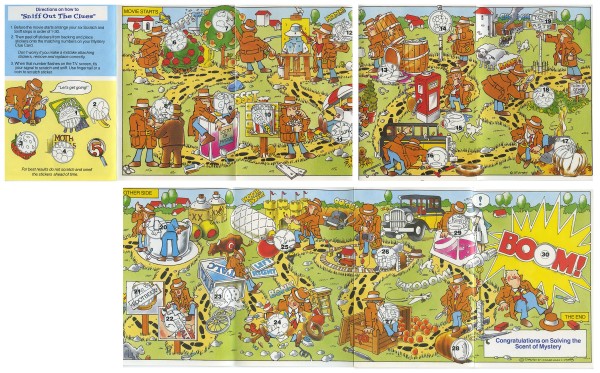
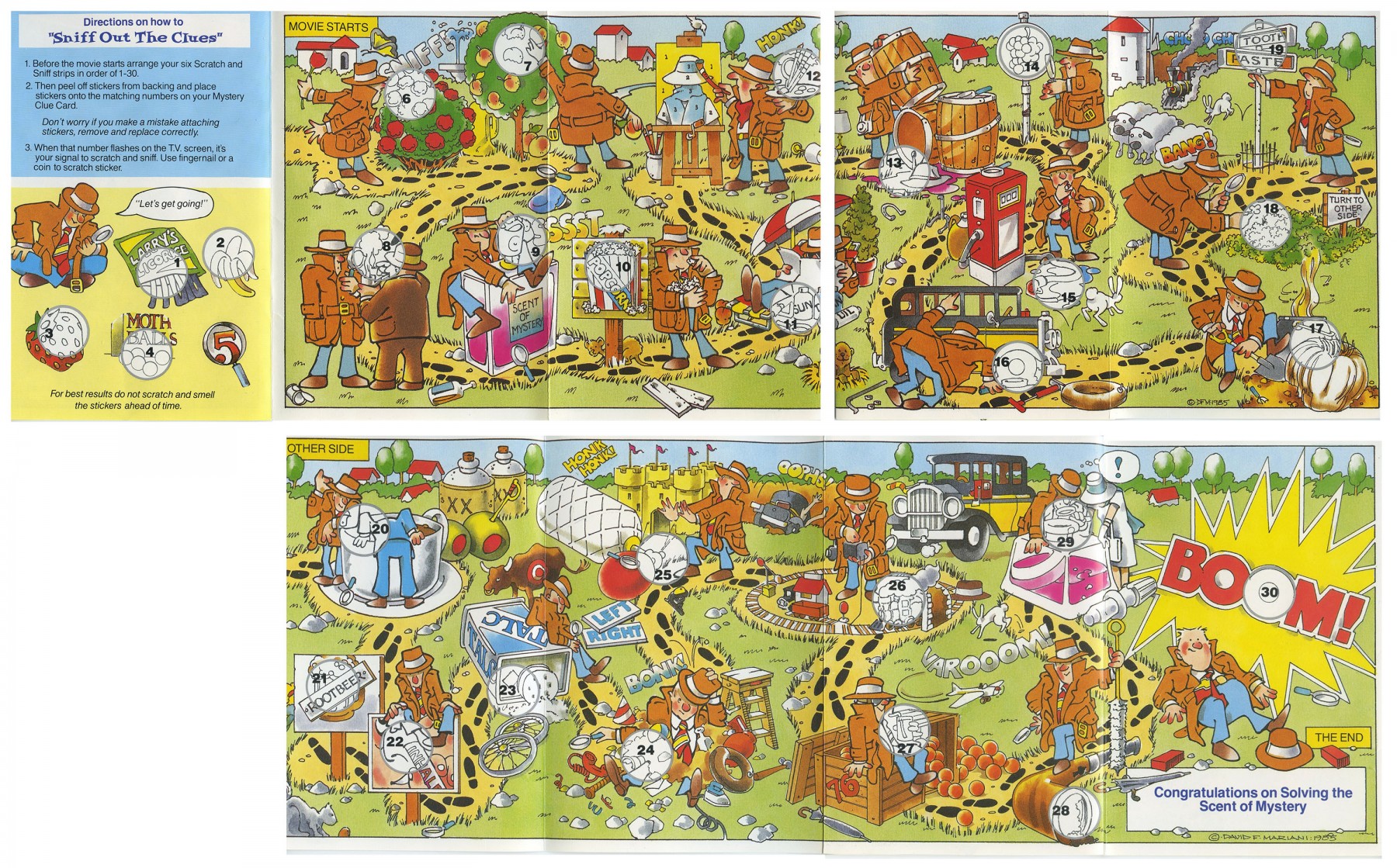
The Official Clue Card sold at 7 Eleven stores for the MTV screening of Scent of Mystery (Holiday in Spain) on Oct. 31, 1986.
Technology Department, George Eastman Museum, Rochester, NY, United States.
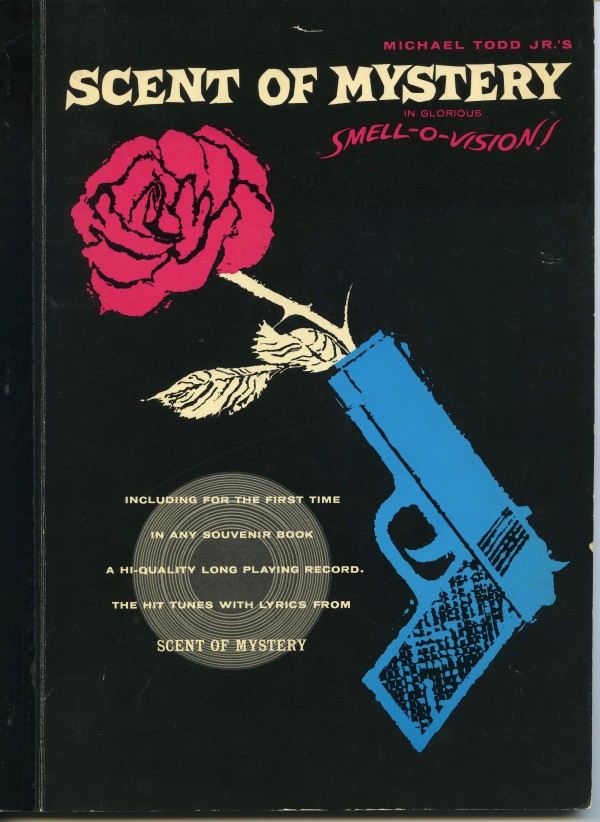
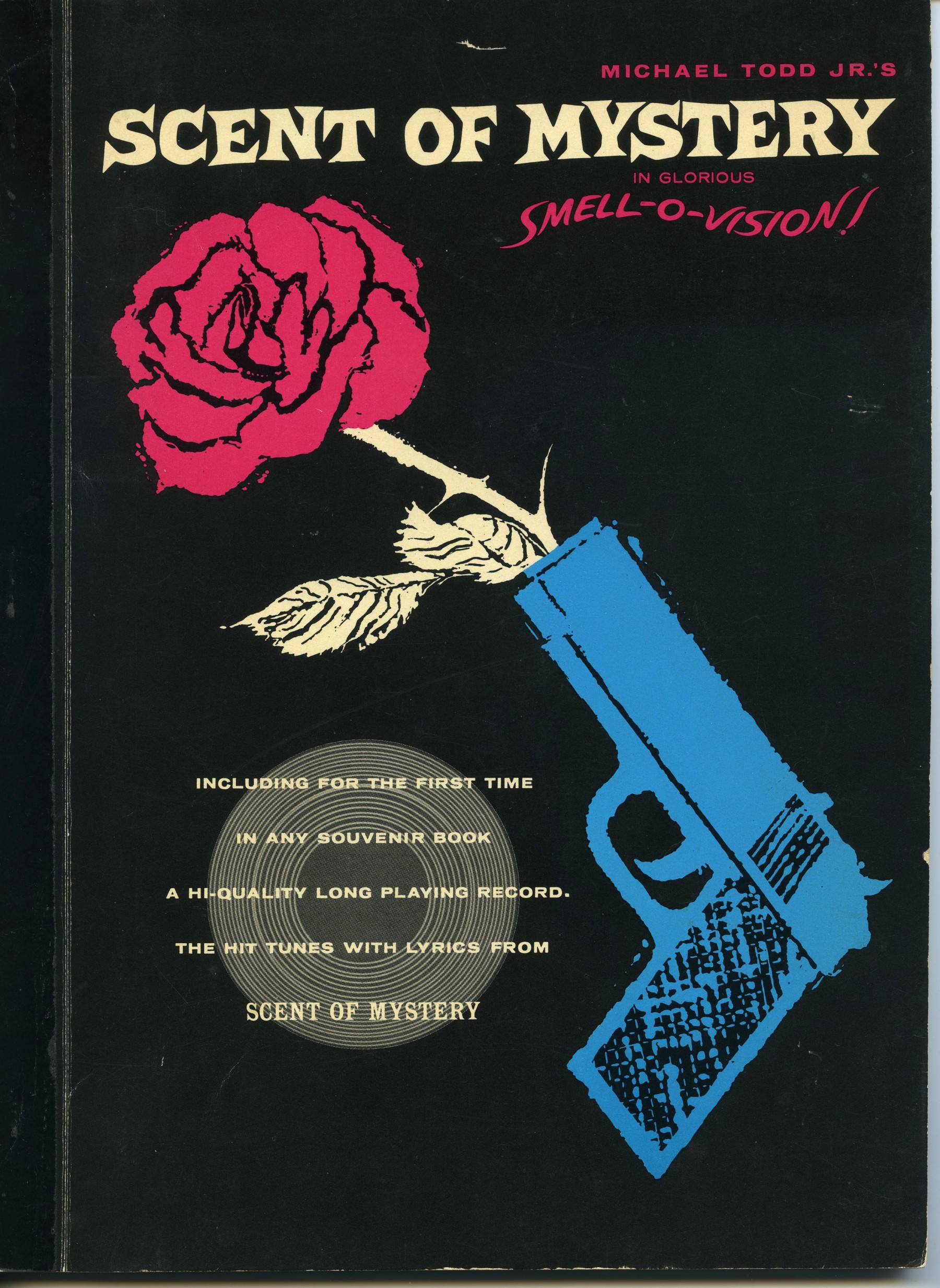
Cover of the original souvenir program for Scent of Mystery (1960).
Hans E. Laube Collection, George Eastman Museum, Rochester, NY, United States.
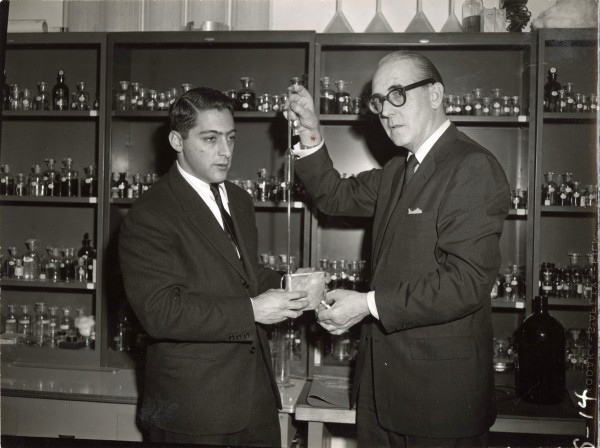
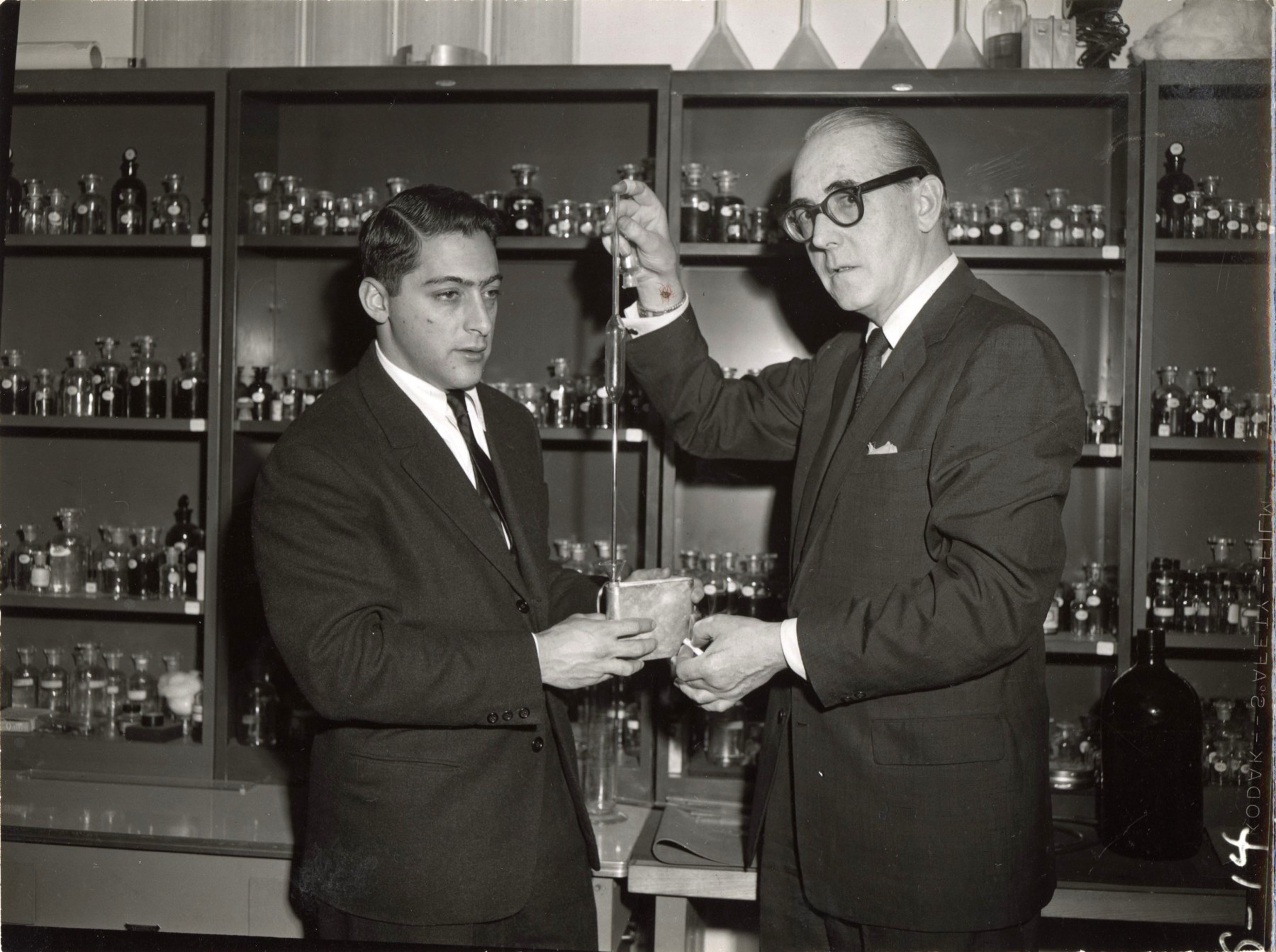
Scent of Mystery (1960) producer Michael Todd, Jr. (left) and osmologist Hans E. Laube (right) preparing a scent, c. 1959.
Hans E. Laube Collection, George Eastman Museum, Rochester, NY, United States.
Selected Filmography
A fifteen-minute film that demonstrated the Scent-O-Vision technology. Actual content of the film is unknown.
A fifteen-minute film that demonstrated the Scent-O-Vision technology. Actual content of the film is unknown.
A “boy meets girl, boy loses girl, boy finds girl again” plot created ample opportunities for scents to be employed as the boy chases the girl across Switzerland. Marketed as Scentovision.
A “boy meets girl, boy loses girl, boy finds girl again” plot created ample opportunities for scents to be employed as the boy chases the girl across Switzerland. Marketed as Scentovision.
A light-hearted mystery of attempted murder and mistaken identities played out across the Spanish countryside and historic Spanish sites with Denholm Elliott, Peter Lorre and Paul Lucas.
A light-hearted mystery of attempted murder and mistaken identities played out across the Spanish countryside and historic Spanish sites with Denholm Elliott, Peter Lorre and Paul Lucas.
A cartoon short created to accompany Scent of Mystery in theaters, utilizing the Smell-O-Vision technology. Featuring the voice of Bert Lahr.
A cartoon short created to accompany Scent of Mystery in theaters, utilizing the Smell-O-Vision technology. Featuring the voice of Bert Lahr.
Technology
The Smell-O-Vision system used for Scent of Mystery (1960) is detailed in Laube’s augmented US patent no. 2,905,049 of September 22, 1959. It expanded the coverage of the original design patented under no. 2,813,452 of November 19, 1957. The Scent of Mystery version of the process was intended to odorize theaters 100 ft-long by 45-ft wide by 40-ft high (30.48m x 13.72m x 12.19m), but as an intimate, personal experience for each audience member.
Essentially, the process relied on three major components: a central unit or “smell brain” consisting of a battery containing a circular train of cell tubes each holding a different fragrance; a pump unit; and the tubing system connected to individual cylinders that released the odors in the theater. Unlike normal perfume scents which contained a chemical fixer (stabilizer) that allowed the scent to remain fresh for hours – the scents in Laube’s smell brain were de-fixed so they could be removed quickly from the air. Neutralizers were used to clear one scent before another was released. The pump unit was connected to the smell brain and this drew the scents out and into the theater through the over one mile of piping that connected to “dull-black perforated cylinders, about 0.75 in (1.91mm) in diameter and 18 in (45.7cm) long, mounted securely to the seats just in back of and below the arm rests” (Lightman, 1960).
The “smell brain” unit contained a large-sized pump operated by a motor of several horsepower; a large manifold connected to a central conduit; individual conduits connected to distributing fans; the fragrance cell tubes with openings at the bottom covered with a resealable membrane; a needle tube connected to the hose system; nozzles, coils, and valves. The unit was located in the projection booth and was controlled by the projectionist. Scent of Mystery, shot in 70mm Todd-AO with six magnetic stripe tracks, more than likely used the same CinemaScope trigger tones system (12kHz) that was used for A Tale of Old Whiff (1960), the 70mm cartoon created to accompany the main feature. Signals were embedded in the mag-stripe track above the program audio to perform tasks during playback. The 12kHz control tone was recorded with the Surround audio similar to CinemaScope. However, unlike CinemaScope, it used a one-second pulse of the tone as a trigger instead of leaving the tone running for the duration of the surround audio. The signals cued the “smell brain” to release the selected scent to correspond with the onscreen visual. That cueing signal would activate the motor to bring the selected cell into registry with a needle tube that would puncture the membrane (that would reseal when the needle was withdrawn). A diaphragm pump engaged to lower the pressure and extract the gas from the cell, drawing off the fragrance and injecting it into flexible hose tubes. These connected to horizontal spray nozzles in mixing chambers. Blowers then engaged to drive air and mix it with the fragrance which was pushed into the manifold. From there the mixture was blasted at the distributing fans and ultimately was pumped through the tubing that stretched to vents on each seat in the theater. At the end of the movie, the smell brain cylinder was rewound, the containers refilled and the process was re-set for the next screening. (Lightman, 1960).
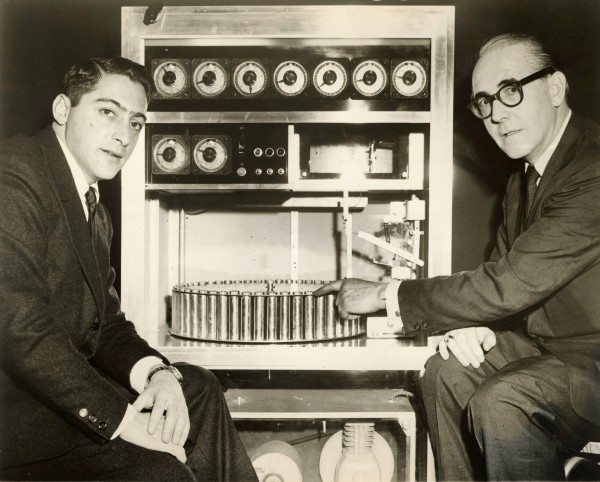
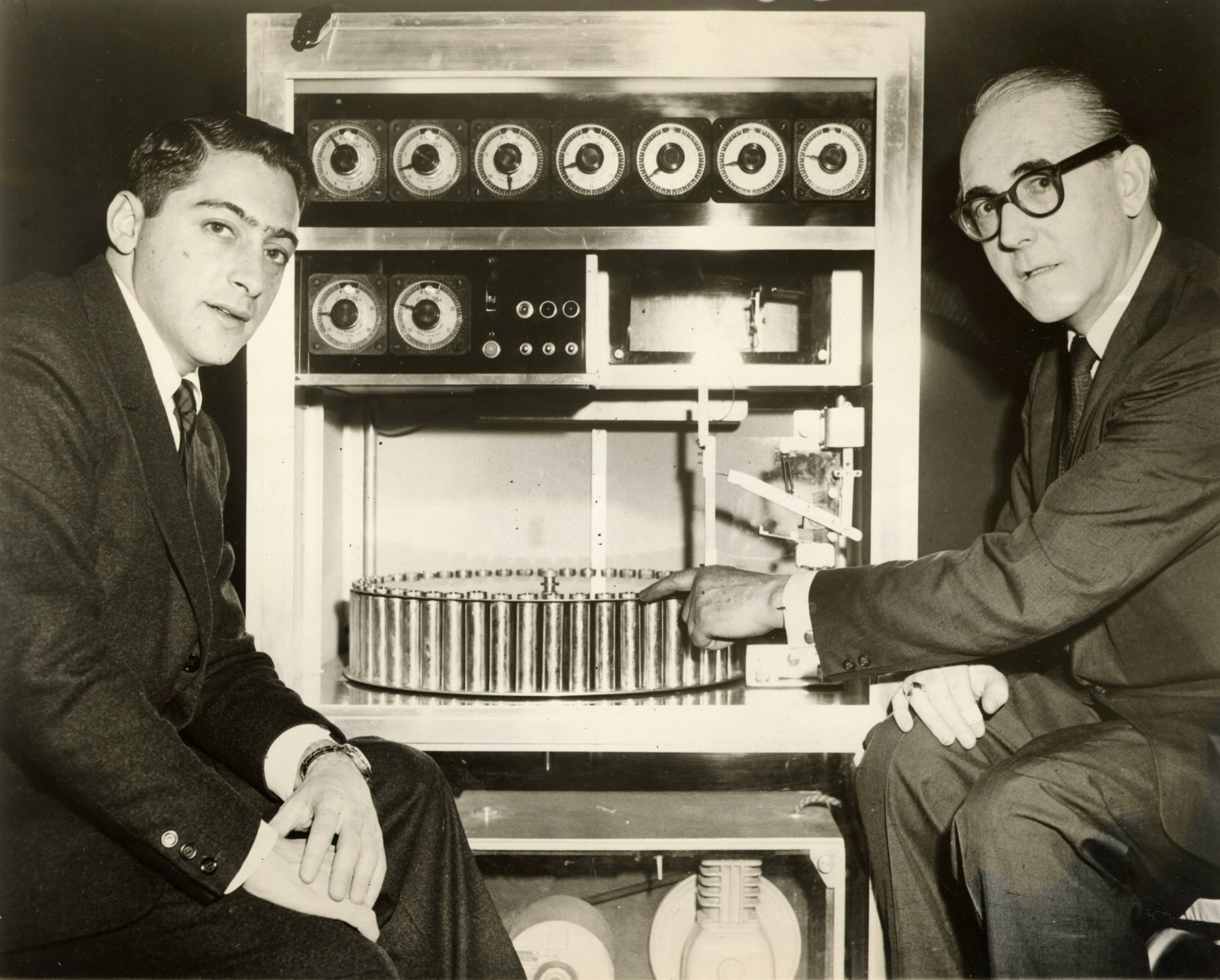
Michael Todd, Jr. producer, (left) and Hans E. Laube, inventor of Smell-O-Vision (right). Laube is pointing to the “smell brains” carousel holding the cell tubes that contained the individual scents, c. 1959.
Hans E. Laube Collection, George Eastman Museum, Rochester, NY, United States.
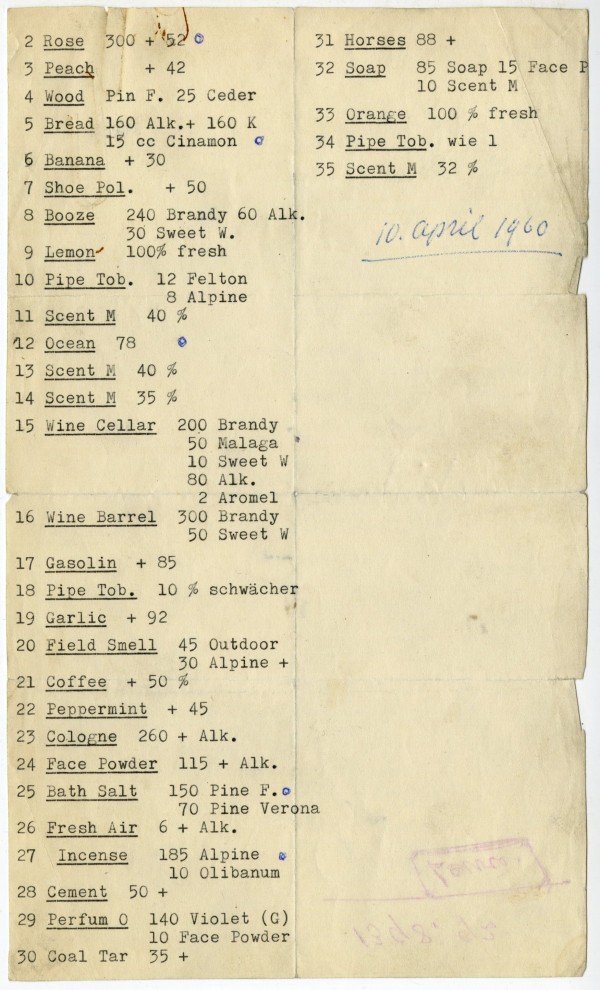
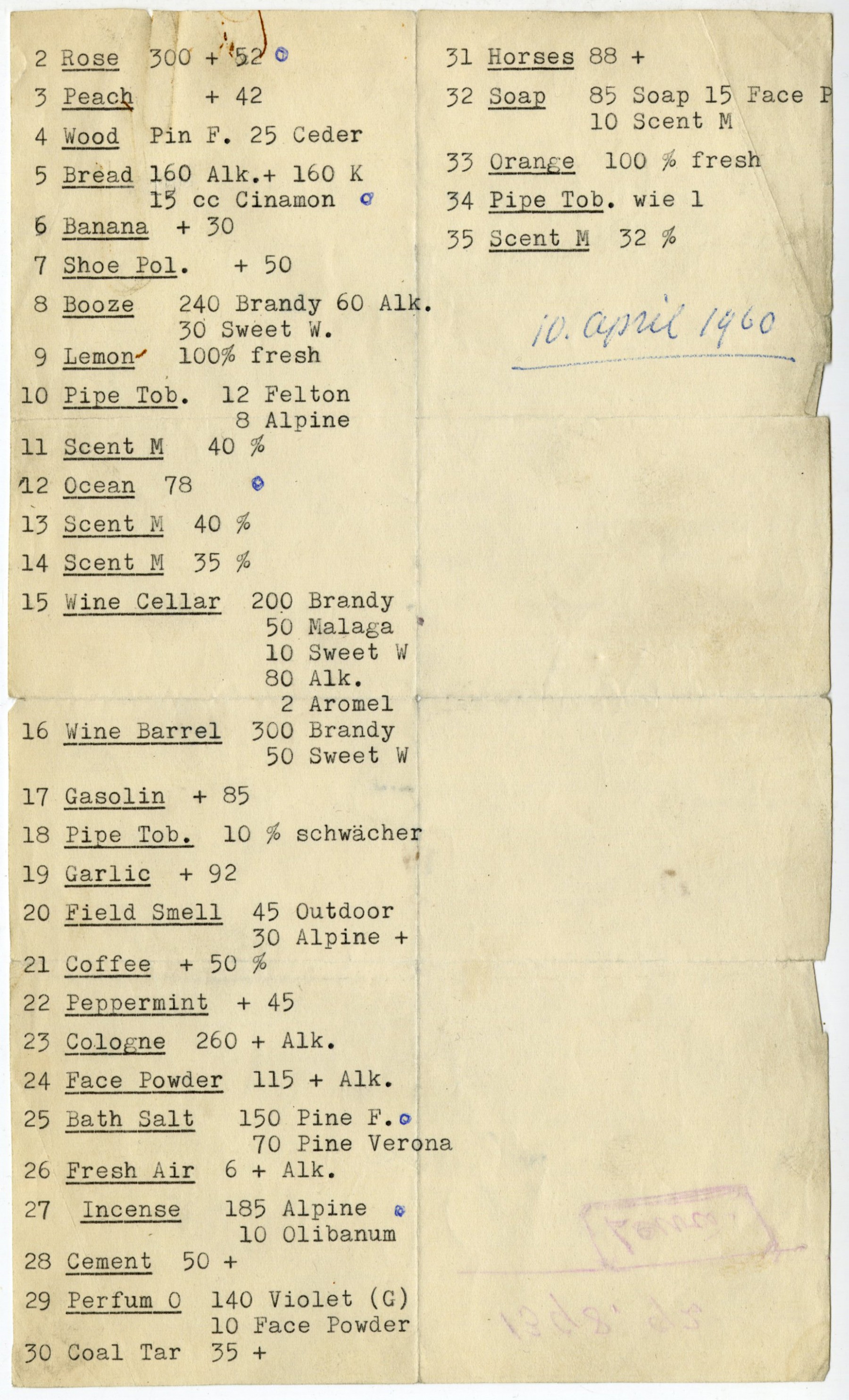
List of scents scheduled for use in Scent of Mystery (1960).
Hans E. Laube Collection, George Eastman Museum, Rochester, NY, United States.
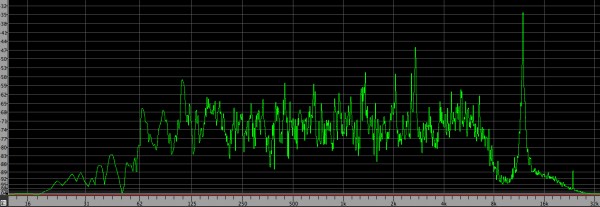
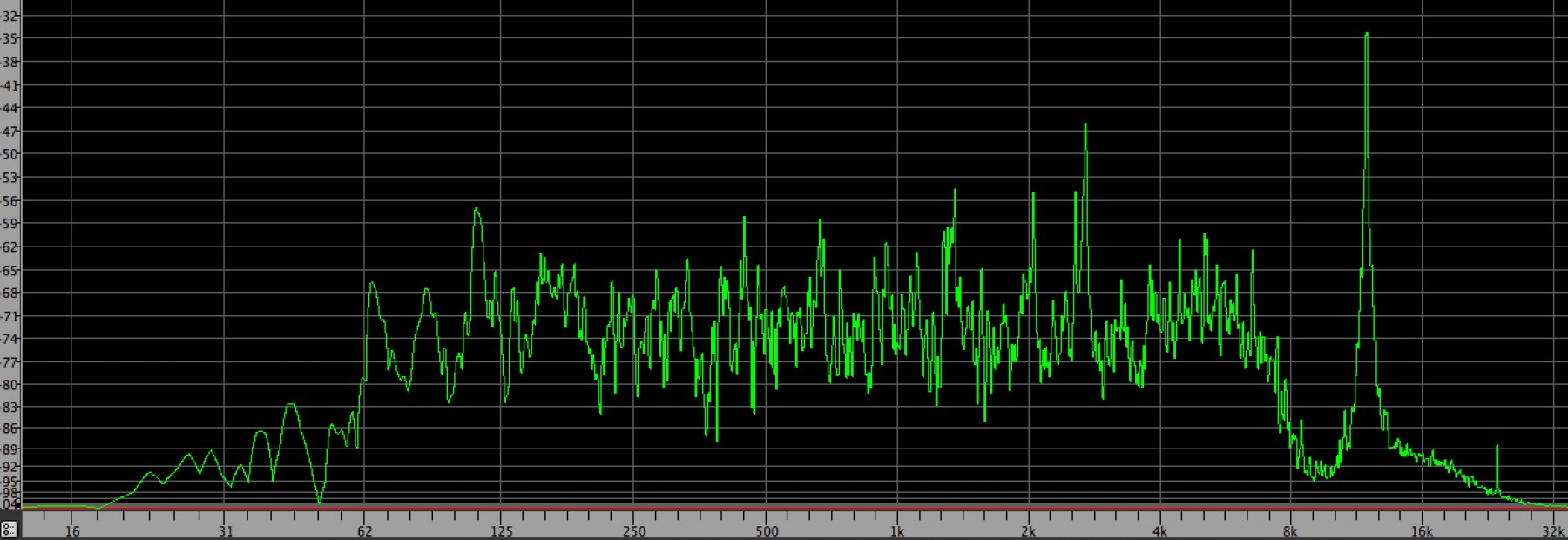
Audio image of track 6 from the 70mm Smell-O-Vision surround track of A Tale of Old Whiff (1960), showing trigger tone for scent release as a sharp peak at 12kHz for 1 second.
Courtesy of Nicholas Bergh and Endpoint Audio.
References
American Film Institute (n.d.). Scent of Mystery (1960). American Film Institute Catalog of Films (website). https://catalog.afi.com/Film/53276-SCENT-OFMYSTERY (accessed 24 Jul., 2026).
Air-Scent (2019). “How Ambient Scent Branding Is Enhancing Theater Experience”. Air-Scent (website). https://www.airscent.com/ambient-scenting-theaters/ (Jan. 17) (accessed 24 Jul., 2026).
Al-Heeti, Abrar (2024). “This Device Sprays Scents From Movies, TV Shows and Video Games”. CNET (Aug. 20). https://www.cnet.com/tech/home-entertainment/this-device-sprays-scents-from-movies-tv-shows-and-video-games/ (accessed 24 Jul., 2026).
Burnstock, Tammy & John Anderson (2019). In Glorious Smell-O-Vision! The True Story of the Godfather of Scented Cinema. Details available at: https://www.in70mm.com/news/2020/glorious/index.htm (accessed 24 Jul., 2026).
Crowther, Bosley (1960). “Screen: Olfactory Debut: Scent of Mystery' Opens at Warner”. New York Times, (Feb. 19): p. 23. https://www.nytimes.com/1960/02/19/archives/screen-olfactory-debut-scent-of-mystery-opens-at-warner.html (accessed 24 Jul., 2026).
Hart, Henry (1960). “Aromarama”. Films in Review, 11:1 (Jan.): pp. 35–6.
Institute for Art and Olfaction (2015). “Scent of Mystery”. Institute for Art and Olfaction (website). https://artandolfaction.com/projects/scent-of-mystery/ (accessed 24 Jul., 2026).
Kahn, E.J., Jr. & Harold Ross (1940). “The Talk of the Town: Step Forward”. The New Yorker, 16:41 (Nov. 23): p. 13. Available at: https://www.newyorker.com/magazine/1940/11/23/step-forward (accessed 24 Jul., 2026).
Laube, Carmen (2016). “A Brief History about Hans Laube: A Personal Reflection on the ‘Osmologist’ Responsible for Smell-O-Vision”. In70mm.com: The 70mm Newsletter(website). https://www.in70mm.com/presents/1960_smell_o_vision/library/hans_laube/index.htm (accessed 24 Jul., 2026).
Laube, Hans E. Collection. George Eastman Museum, Rochester, NY, United States.
Lightman, Herb A. (1960). “This Movie Has Scents!”. American Cinematographer, 41:2 (Feb.): pp. 92–3 & 120.
Moellhausen Magazine (2020). “Scent in the World of Cinema”. Moellhausen Magazine (website). https://magazine.moellhausen.com/scent-in-the-world-of-cinema (accessed 24 Jul., 2026).
Priscill, B. Jebina & M. Anandhavalli (2018). “Digital Smell Technology”. International Journal of Emerging Technology in Computer Science & Electronics, 25:5 (Apr): pp. 451–4. Available at https://www.ijetcse.com/admin/uploads/DIGITAL%20SMELL%20TECHNOLOGY_1604655961.pdf (accessed 24 Jul., 2026).
“Scent of Mystery” Souvenir Program (1960). pp. 8, 9 & 10. Hans E. Laube Collection. George Eastman Museum, Rochester, NY, United States.
Strohmaier, David (2026). Personal email correspondence between David Strohmaier and Caroline Yeager.
Variety (1960). “Scent of Mystery [review]”. Variety, 217: 7 (Jan. 13): p. 6.
Patents
Laube, Hans. Motion Pictures with Synchronized Odor Emission. US patent 2,905,049, filed June 25, 1956, and issued September 9, 1959. https://patentimages.storage.googleapis.com/b4/4e/8f/69726e144ee310/US2905049.pdf (accessed 24 Jul., 2026).
Laube, Hans. Motion Pictures with Synchronized Odor Emission. US patent 2,813,452, filed June 24, 1954, and issued November 19, 1957. https://patentimages.storage.googleapis.com/29/21/b8/b8a67379c6bf56/US2813452.pdf (accessed 24 Jul., 2026).
Related entries
Author
Caroline Yeager is Associate Curator for Special Projects in the Moving Image Department at the George Eastman Museum. During her 26-year tenure, she taught Curatorial Administration in the Selznick School, developed and managed grants for the Moving Image Department and supervised special projects in the department such as the renovation of the Museum’s Dryden Theatre and the 15th Domitor Conference held at the Museum in 2018. She curated the exhibitions Hollywood Lost: The Power of Louise Brooks (2006), Reel Histories: Motion Pictures and the Civil War (2011) and Americana: Hollywood and the American Way of Life (2011). She acted as interim Dryden Theatre programmer for six months in 2014 and was an Assistant Director of the Nitrate Picture Show (2022–24). She is a member of the Association of Moving Image Archivists and was co-chair of the Advocacy Committee for eleven years. She is a graduate of The L. Jeffrey Selznick School of Film Preservation (1998), Temple University (MFA 1975) and SUNY Brockport (BS 1972).
Nicholas Bergh, Tammy Burnstock, Christopher Crouse, Adam Foster, Todd Gustafson, Nancy Kauffman, Edda Manriquez, Damien Randolph-Spader, David Strohmaier, Dan Wagner.
Yeager, Caroline (2026). “Smell-O-Vision”. In James Layton (ed.), Film Atlas. www.filmatlas.com. Brussels: International Federation of Film Archives / Rochester, NY: George Eastman Museum.