Magnafilm (56mm)(1927–1929)
A wide film format developed by Paramount in the late 1920s.
Film Explorer
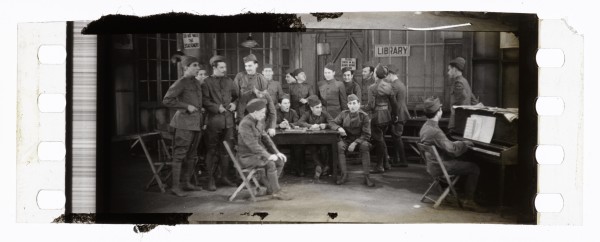
A 56mm-wide Magnafilm print of You’re in the Army Now (1929). Magnafilm prints contained a frame approximately the same height as a 35mm frame, but it was twice as wide.
Kodak Museum Collection, National Science & Media Museum, Bradford, United Kingdom.
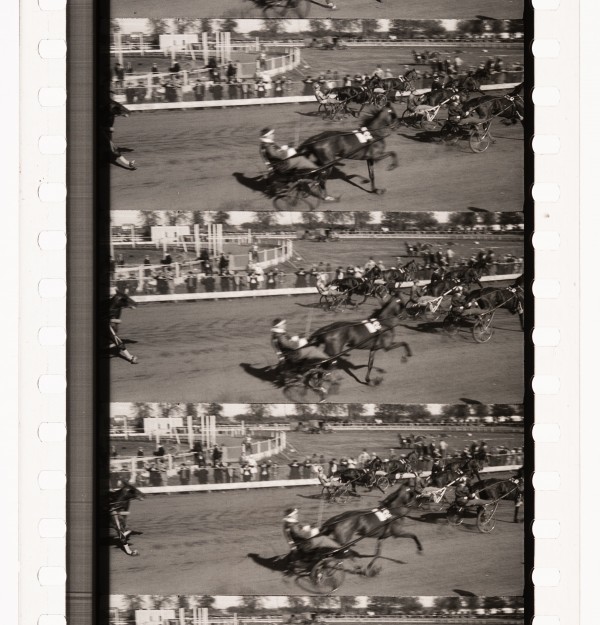
An unidentified frame clipping of 56mm-wide Magnafilm. It is likely test footage shot for demonstration purposes, c. 1929.
George Eastman Museum, Rochester, NY, United States.
Identification
Unknown
(Sherlock, 2004)
B/W
None
1
A variable-density optical soundtrack was printed inside the perforations to the left of the image. This track measured approximately 2.54mm wide, the same as on 35mm prints.
Approximately 41.15mm x 18.80mm (1.62 in x 0.74 in).
B/W
Unknown
History
Magnafilm was a 56mm-wide film format developed by Lorenzo del Riccio for Paramount Pictures that debuted in 1929. Paramount gave one exhibition featuring subjects filmed on 56mm Magnafilm in the summer of 1929, but despite publicity claims that this format would be used for an unspecified number of titles in its 1930–31 slate, Paramount abandoned Magnafilm by the end of 1929.
Del Riccio and Paramount, in conjunction with Publix Theatres in New York City, had previously introduced a process of enlarging the standard 35mm film image in select theatrical exhibitions by employing mechanically controlled masking around a large screen that could be expanded to increase the area covered by the projection to 40 ft x 30 ft (12.19m x 9.14m) (Belton, 1992: pp. 37–8; Rubin, 1928: p. 404). Marketed under the name Magnascope, this effect was widely publicized, especially in its use for selected scenes from the exhibition of Old Ironsides (1926) at the Rivoli Theater (Rubin, 1928: p. 403). In early 1927, industry publications announced that Paramount, following the success of Magnascope, put del Riccio in charge of an experimental lab at the old Realart studio in Hollywood and gave him the title of “cinemaengineer” (Film Daily, 1927). Del Riccio, in an interview with the Exhibitors Herald, promised “ideas in projection which will make the magnascope [sic] slide into insignificance” (Exhibitors Herald, 1927a). However, that same publication later reported that del Riccio spent six months in this lab working on Magnascope effects for Paramount’s Wings (1927), using the effect to “intensify dramatic action” through a screen expanded to triple its size (Exhibitors Herald, 1927b).
Following his work on Wings, del Riccio came back to the East Coast to shift his work from novelties at the point of projection (magnification and altering the size of the screen) to a new film format. According to industry sources, del Riccio “equip[ped] a new laboratory across the street from the Paramount Studio in Astoria, Long Island, and there for the last two years” worked on a new process dubbed Magnafilm (Film Daily, 1929). Magnafilm had an image size of “about 1.62 [in] x 0.74 [in]” giving it a printed aspect ratio of 2.18:1, but “shown on a 2 x 1 aspect ratio screen” (Sherlock, 2004: p. 5). One contemporary source noted that Magnafilm was intended for screens that measured 40 ft wide by 20 ft high (12.19m x 6.10m) (Motion Picture Projectionist, 1929b), though the exact size of the screen could vary depending on the nature of the exhibition venue.
The first demonstration of 56mm Magnafilm took place at an invitation-only event at the Rivoli Theater in New York on July 18, 1929. According to Paramount’s in-house publication, the audience of “publishers, editors, bankers, scientists, and motion picture executives” were treated to “scenes of the seashore and a country road, as well as a four reel talking and singing feature” (Paramount Around the World, 1929). The “feature” was You’re in the Army Now (1929) which, according to Motion Picture News, ran for 36 minutes and consisted of excerpts from a successful stage production of that title filmed using 56mm Magnafilm in Paramount’s Astoria Studios (Motion Picture News, 1929a).
The unveiling of 56mm Magnafilm at the Rivoli initially received widespread positive coverage in film industry publications. The Hollywood Filmograph, for instance, ran its article on Magnafilm with the large headline “Third Dimension Films Shown in New York” furthering the frequent (and soon discredited) claim that the larger pictures gave a stereoscopic effect (Hollywood Filmograph, 1929a). Motion Picture News, enthusiastically reporting on the movement toward wide film more generally, provided an illustration of Magnafilm’s 56mm width next to a standard 35mm film under a headline that insists that wider film “Will Aid Realism of Talkies” (Motion Picture News, 1929b).
Following the initial demonstration at the Rivoli Theater, industry sources reported that Paramount planned to roll out public screenings of Magnafilm on Broadway and beyond. The Hollywood Filmograph, describing You’re in the Army Now as a “four-reel talking and singing feature,” declares that “it is now ready to be shown in theaters” (Hollywood Filmograph, 1929b). In early 1930, the Film Daily’s page one feature about Paramount’s 1930–31 season notes that studio head Jesse Lasky said that the studio “has not yet decided how much of its new program will be made on Magnafilm” (Film Daily, 1930a), which teases the possibility that several Magnafilm productions would soon be available.
However, technical issues with the Magnafilm process and a reluctance of Paramount to commit to the 56mm format in the face of competition from wide formats in development with other studios put a halt to these plans. Not long after the breathless reporting of Magnafilm’s debut, coverage shifted to a more critical and skeptical view of the future of Paramount’s efforts to expand its wide film offerings. The Motion Picture Projectionist reported in September, just two months after the Rivoli event, that del Riccio was “on the West Coast seeking further data on production methods with an eye to improving his process” (Motion Picture Projectionist, 1929b), addressing in particular problems with the lack of sharpness across the entire picture. By the end of 1929, the same publication noted that after the initial showing of 56mm Magnafilm, “the uproar that was occasioned by it seems to have died away to a whisper” (Motion Picture Projectionist, 1929c).
There is no evidence that Paramount shot any additional films on 56mm Magnafilm that were made available for exhibition. Instead, Paramount and del Riccio began to experiment in 1930 with a 65mm wide film format that would also go by the name “Magnafilm.” (Film Daily, 1930b). As for the films exhibited at the Rivoli in 56mm Magnafilm, examination of industry publications indicates no further screenings of the four-reel You’re in the Army Now or any other Magnafilm production.
56mm Magnafilm was one of several efforts to develop larger-format films by Hollywood studios in the late 1920s, including Widescope, Fox Grandeur, RKO’s Natural Vision, MGM’s Realife and Warner Bros.’ Vitascope (Rogers, 2024; Belton, 1992). The hype surrounding this possible alteration of standard film practices often far exceeded the actual production, distribution and exhibition of wide-format films.
The adoption of wider format film at this time was further hindered by the fact that exhibitors had to determine how to juggle – if at all – competing formats with often incompatible technical features. Film technicians and exhibitors led a charge against any conversion to wide film unless one single standard could be established. In the words of James R. Cameron, an editor for Projection Engineering, the advent of wide film “threatens to throw the whole motion picture industry into a state of chaos, unless something is done immediately with respect to standardization of the film width” (Cameron, 1929). The impetus to make another major conversion in film exhibition by adopting a wider film, even with one uniform standard, eventually ground to a halt when the Academy of Motion Picture Arts and Sciences stepped in and mandated a 1.37:1 aperture (the so-called “Academy ratio”) that would correct the more “square” picture created by the addition of a soundtrack to 35mm film in the previous standard 1.33:1 aperture (Arnold, 1931; Academy of Motion Picture Arts and Sciences, 1932).
56mm Magnafilm had a short and limited history as a format for producing or exhibiting motion pictures seen by audiences. But the flurry of attention it received, however brief, reveals that seemingly stable elements of commercial film production and exhibition in the major Hollywood studios experienced frequent challenges and disruptions.
Selected Filmography
A 36-minute (four-reel) short featuring Johnny Burke.
A 36-minute (four-reel) short featuring Johnny Burke.
Lineage
Technology
The first iteration of Paramount’s Magnafilm used film 56mm wide, with a four-perforation-tall frame, which when projected produced an image comparable in height to 35mm, but approximately twice as wide. Inventor Lorenzo del Riccio referred to a “specially built camera” that he used to capture images using Magnafilm which required new lenses “to cover an area greater than the standard film.” Del Riccio claimed that other efforts to create lenses to expand the size of the image, such as “special prisms, revolving lenses, and [other] auxiliary elements” had failed to achieve the “same quality” as the Magnafilm camera (Exhibitors Herald-World, 1929). Paramount and del Riccio took pains, with these details, to distinguish Magnafilm from competing wide film efforts by other studios that Paramount was claiming to surpass. Following the 1929 demonstration at the Rivoli, Film Daily reported that “[Paramount head] Jesse L. Lasky has already ordered the organization of a force of mechanics for the purpose of building new cameras and equipment” (Film Daily, 1929), suggesting a financial commitment to this new format that never came to pass.
Specific technical and logistical challenges were outlined in publicity for Magnafilm, offering a blunt assessment of the potential for disruption and economic risk that came with any deviation from standard film practice. According to The Film Daily, Paramount studio head Adolph Zukor gave del Riccio three specific “points” that his experiments with Magnafilm must address: “First…no change in sound equipment; second the screen must not be so high that the balcony in the average theater would cut off the view of the top of the screen; and third, the change in projection equipment should be kept to a minimum [to avoid] an expensive burden on the exhibitor” (Film Daily, 1929). Another industry publication reports that del Riccio, responding to Paramount’s insistence that Magnafilm must minimally alter current theater projection equipment, claims that “only eight slight changes were necessary” (Motion Picture Projectionist, 1929b), suggesting rather more elaborate technical demands. Indeed, del Riccio admits to The Motion Picture Projectionist that “The wide film will necessitate a new size film, new camera, new screens in the theaters, the eight slight changes mentioned in the projection machines, new printing machines in the laboratories, and alterations of other existing equipment” (Motion Picture Projectionist, 1929b). He goes on to tout its “manifold” advantages over standard film, but this lengthy list of alterations shows the considerable cost and disruption a full conversion to any wider film standard would cause across all stages of film production and exhibition. The potential disruption is also put bluntly in an article on wide film formats like Magnafilm by Motion Picture News, which insists that “answers” will be needed to the technical “problems” caused by a new format that will “confound studio men, lighting engineers, cameramen, laboratory men, sound engineers, theater architects, theater owners, and theater projectionists” (Motion Picture News, 1929c). Acknowledging that smaller theaters would face even more technical challenges in a conversion to wider film, del Riccio told the New York Times that “with an attachment called an anamorphosa, which costs only $30, [the exhibitor] could produce on the present standard size film a picture which would give wide screen results” (Hall, 1929). But it seems unlikely that del Riccio ever successfully created a mechanical means to convert existing 35mm equipment to 56mm Magnafilm, given complaints within industry publications and the rapid cessation, after 1929, of any additional demonstrations.
The technical and economic advantages of retaining standard film size in the late 1920s outweighed lofty technological ambitions for innovation and improvement (Marzola, 2024; Hovet, 2017). However, the dream of the projected image becoming larger and ever more life-like persistently haunts the technical history of film, and emerges overtly with any technological change from the eventual adoption of wide film in the 1950s to experiments with AI and virtual reality today.
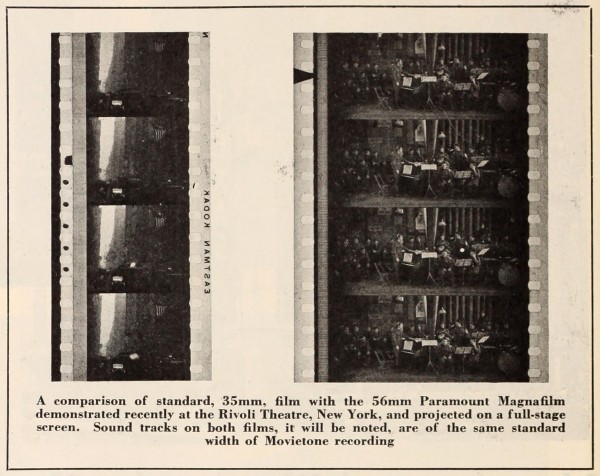
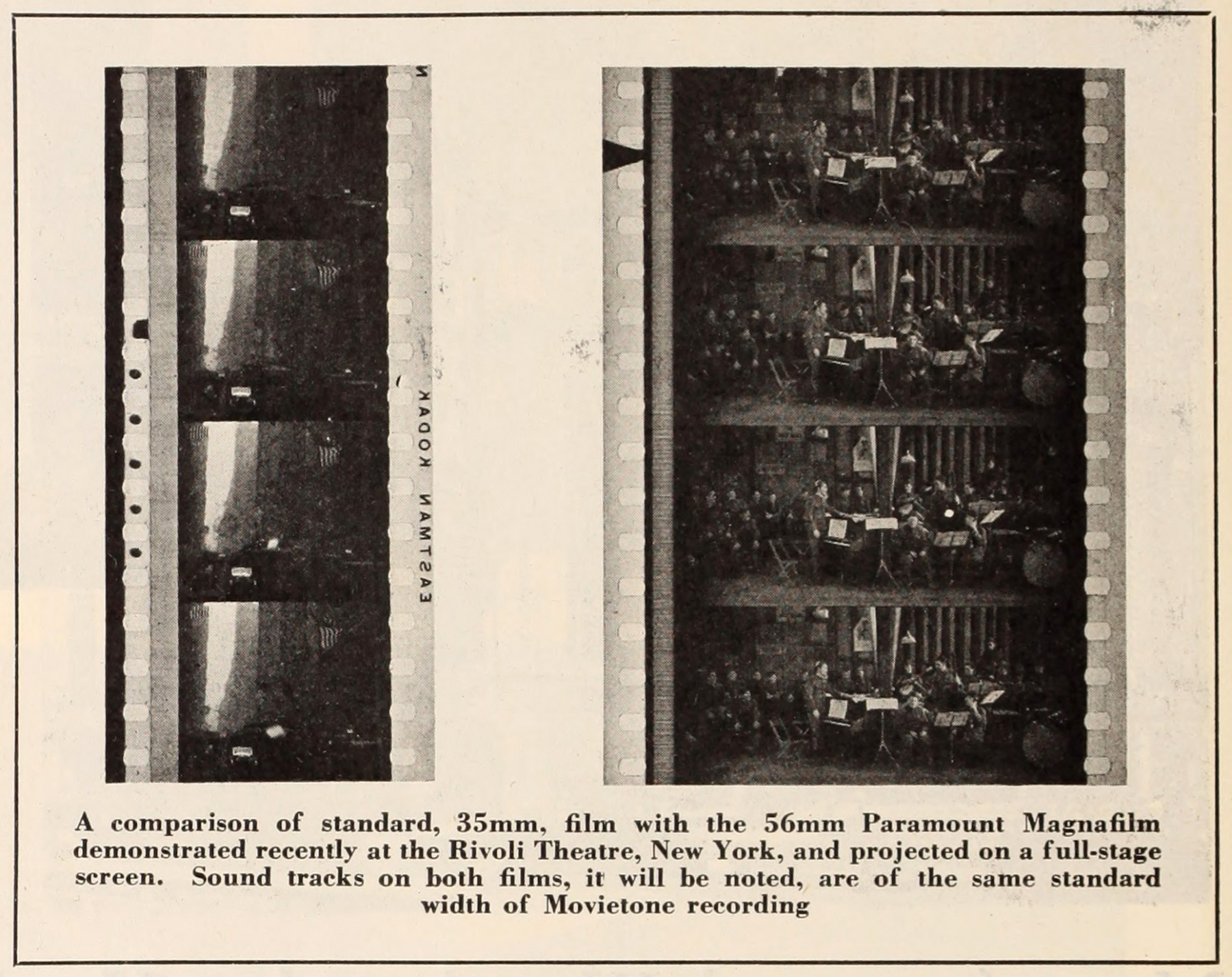
A comparison of Movietone aperture 35mm film (1.19:1 aspect ratio) with 56mm Magnafilm (2.18:1 aspect ratio).
Motion Picture News (1929b). “The Big Screen – Next Development to Find Application in the Theater”. Motion Picture News (Aug. 3): p. 428.
References
Academy of Motion Picture Arts and Sciences (1932). “Uniform aperture specifications: Recommendations of the Academy for dimensions of picture image frame for use on 35mm film”. Academy of Motion Picture Arts & Sciences Technical Bulletin, Supplement No. 6 (Jul.): p. 1.
AFI (2026). “You’re in the Army Now”. AFI Catalog of Feature Films: The First 100 Years 1893–1993 (website). https://catalog.afi.com/Film/111644-YOUREINTHEARMYNOW (accessed 15 Jun., 2026).
Alicoate, Jack (1930). “The ‘wide-ies’ Present a Problem”. The Film Daily, 51:4 (Jan. 7): p. 1.
Arnold, John (1931). “A standard aperture for sound films”. American Cinematographer, 12:8 (Nov.): p. 42.
Belton, John (1992). Widescreen Cinema. Cambridge, MA: Harvard University Press.
Belton, John (2024). “50mm”. In Film Atlas, James Layton (ed.). www.filmatlas.com/entry/111. Brussels: International Federation of Film Archives / Rochester, NY: George Eastman Museum.
Cameron, James R. (1929). “The New Wide Film Arrives”. Projection Engineering, 1:2 (Oct.): p. 26.
Carr, Robert E. & R. M. Hayes (1988). Wide Screen Movies: A History and Filmography of Wide Gauge Filmmaking. Jefferson, NC: McFarland, p. 6.
Coles, David (n.d.). “Magnified Grandeur: The Big Screen 1926–1931”. In70mm.com: Large Format Film History (website). https://www.in70mm.com/presents/1929_grandeur/magnified/index.htm (updated 21 Dec., 2025) (accessed Aug. 27, 2026).
Exhibitors Herald (1927a). “The new third dimension effect”. Exhibitors Herald, 29:6 (Apr. 23): p. 31.
Exhibitors Herald (1927b). “‘Wings,’ Paramount epic of air, opens Aug. 8 at Criterion”. Exhibitors Herald, 30:6 (Jul. 30): p. 16.
Exhibitors Herald-World (1929). “Paramount has new full stage projection; wide film is used”. Exhibitors Herald-World, 96:4 (Jul. 27): pp. 19 & 26.
Film Daily (1927). “Paramount sponsors projection ‘lab’”. The Film Daily, 39:51 (Mar. 3): p. 1.
Film Daily (1929). “Paramount ready to produce wide pictures via Magnafilm”. The Film Daily, 49:14 (Jul. 19): p. 3.
Film Daily (1930a). “Paramount to offer 65 features on ’30–31 program”. The Film Daily, 51:70 (Mar. 25): pp. 1 & 11.
Film Daily (1930b). “65mm for Paramount”. The Film Daily, 52:9 (May 9): p. 1.
Hall, Mordaunt (1929). “An inventor speaks; Lorenzo del Riccio tells of the enlarged screen and wide film”. The New York Times (Aug. 4): Section X, p. 5.
Hollywood Filmograph (1929a). “Third dimension films shown in New York”. Hollywood Filmograph, 9:30 (Jul. 27): p. 33.
Hollywood Filmograph (1929b). “The Broadway Screen”. Hollywood Filmograph, 9:31 (Aug. 3): p. 34.
Hovet, Ted (2017). “The persistence of the rectangle”. Film History, 29:3 (Fall): pp. 136–68.
Layton, James (2024). “Natural Vision”. In Film Atlas, James Layton (ed.). www.filmatlas.com/entry/87. Brussels: International Federation of Film Archives / Rochester, NY: George Eastman Museum.
Marzola, Luci (2024). “Academy ratio”. In Film Atlas, James Layton (ed.). www.filmatlas.com/entry/114. Brussels: International Federation of Film Archives / Rochester, NY: George Eastman Museum.
Motion Picture News (1929a). “Paramount Magnafilm showing complete surprise to industry”. Motion Picture News, 40:1 (Jul. 20): p. 278.
Motion Picture News (1929b). “The Big Screen – Next Development to Find Application in the theater”. Motion Picture News, 40:5 (Aug. 3): pp. 428–30 & 454.
Motion Picture News (1929c). “When will the ‘new era of greater films on bigger screens’ arrive?”. Motion Picture News, 40:14 (Oct. 5): pp. 1210, 1245 & 1250.
Motion Picture News (1930). “A new page in picture entertainment”. Motion Picture News, 41:21 (May 24): p. 128.
Motion Picture Projectionist (1929a). “Paramount demonstrates wide film process – Magnafilm”. The Motion Picture Projectionist, 2:10 (Jul.): p. 32.
Motion Picture Projectionist (1929b). “Paramount now ready to show wide film”. The Motion Picture Projectionist, 2:11 (Sep.): pp. 30–31.
Motion Picture Projectionist (1929c). “More on wide film”. The Motion Picture Projectionist, 3:1 (Dec.): p. 24.
Paramount Around the World (1929). “Magnafilm, introduced by Paramount, hailed as revolutionary film development”. Paramount Around the World, 2:8 (Aug. 1): p. 4.
Rogers, Ariel (2024). “Fox Grandeur”. In Film Atlas, James Layton (ed.). www.filmatlas.com. Brussels: International Federation of Film Archives / Rochester, NY: George Eastman Museum.
Rubin, Harry (1928). “The Magnascope”. Transactions of the Society of Motion Picture Engineers, 12:34: pp. 403–05.
Sherlock, Dan (2004). “Wide Screen Movies corrections”. In70mm.com(website). https://www.in70mm.com/news/2014/mitchell_book/_images/WSMC20.pdf (accessed August 28, 2026).
Sherlock, Dan (2024). “Realife”. In Film Atlas, James Layton (ed.). www.filmatlas.com/entry/110. Brussels: International Federation of Film Archives / Rochester, NY: George Eastman Museum.
Variety (1930a). “‘Magnafilm’ in Illinois”. Variety, 97:12 (Jan. 29): p. 32.
Variety (1930b). “Stoll’s wide screen”. Variety, 98:6 (Feb. 19): p. 5.
Patents
None found.
Compare
Related entries
Author
Ted Hovet is a Professor Emeritus of Film Studies and English at Western Kentucky University. Relocated to Minneapolis, he regularly offers film courses through the Osher Lifelong Learning Institute at the University of Minnesota.
Hovet, Ted (2026). “Magnafilm (56mm)”. In James Layton (ed.), Film Atlas. www.filmatlas.com. Brussels: International Federation of Film Archives / Rochester, NY: George Eastman Museum.