Fearless Super Pictures(1928–1929)
An early widescreen experiment, similar in principle to VistaVision, in which the image was arranged horizontally on the film.
Film Explorer
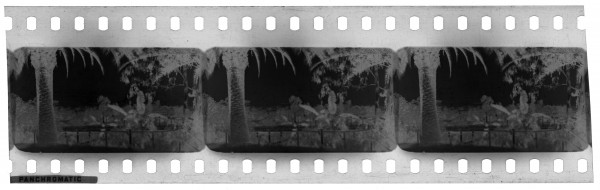
A 35mm B/W panchromatic negative shot using the Fearless Super Pictures process. The image was captured horizontally on the film and was eight perforations wide – approximately twice the size of a standard film frame.
Film Frame Collection (P-074), Seaver Center for Western History Research, Natural History Museum of Los Angeles County, Los Angeles, CA, United States.
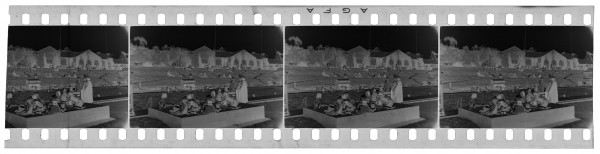
A 35mm negative of footage shot by Edgar Rogers for Mary Pickford, c. 1929. Although not identified as such, this may be a Fearless Super Pictures test.
Film Frame Collection (P-074), Seaver Center for Western History Research, Natural History Museum of Los Angeles County, Los Angeles, CA, United States.
Identification
Unknown
per frame dimensions listed in contemporary articles in International Photographer and American Cinematographer. 2.14:1 or 1.94:1 per alternate dimensions listed in Motion Picture News.
B/W
Unknown
1
Unknown
The soundtrack is approximately 0.2 in (5.08mm) wide and was situated inboard of the perforations, above the image.
46.05mm x 20.32mm (1.813 in x 0.800 in) per articles in International Photographer and American Cinematographer, but this detail does not match the surviving frames. Motion Picture News gives an intended sound aperture of 47.63mm x 22.23mm (1.875 in x 0.875 in) and a silent aperture of 47.63mm x 24.59mm (1.875 in x 0.968 in).
B/W panchromatic negative.
The surviving examples of this format are on DuPont and Agfa stock.
History
[Little is currently known about this obscure process outside of the surviving film frame and the sources listed in the References section. We welcome any leads readers may be able to provide.]
Attempts to develop widescreen processes in the 1920s by the major Hollywood film studios resulted in various formats such as Fox Grandeur, Natural Vision or 65mm Magnafilm, which used larger film widths and specialized equipment. At the same time, several independent inventors and tradesmen conducted their own widescreen experiments with more modest means. Ralph G. Fear, a camera manufacturer from Hollywood, devised a method of photographing an image twice as wide as normal using standard 35mm film. His Fearless Super Pictures did not require 70mm film or special cameras or projectors. Several sources claim that the film ran horizontally in the camera but was projected vertically through an optical unit or lens attachment that rotated the image from vertical to horizontal; others claim that the camera also ran the film vertically, using the same optical attachment to rotate the image 90 degrees on the film. Adjustments to the gears and sprockets of the camera and projector were required as the film had to run at twice normal speed. The process promised a larger, more naturalistic image with enhanced resolution (often confusingly claimed at the time to have three-dimensional qualities) and, because the soundtrack was twice as long, greater sensitivity in sound recording. Its main selling points were that it used standard film and developing machines and could be shown on a standard projector. The Fearless Super Pictures format was effectively a precursor of VistaVision, but it survives only as an experiment that never became commercially viable.
Fear summarized his invention in the following announcement (Fear, 1929):
- It gives a larger picture on standard film.
- Gives a more natural picture on the screen because it more nearly approaches the normal angles seen by the human eye.
- Gives a wider sound track for recording sound photographically on film, which improves sound record.
- Gives a sound track approximately twice as long as the present sound track, therefore giving greater sensitivity in recording, because with present light valves the sound record for each vibration is twice as long.
- Broadens the sound recording scope by giving increased length for recording, thus allowing recording of twice the present frequencies now recorded.
- Can be projected through standard projectors now in use.
- Can be printed on standard printers.
- Standard reels used, also standard developing machines, waxing machines, polishing machines, speed and footage indicators and standard camera magazines.
- Can be projected in any theatre having present equipment when only a slight alteration is made to the projector, and standard cameras can be used with slight alteration.
- Does not require alteration of present sound equipment.
- Eliminates so-called “grain” in film, and no trouble with curling, together with comparative freedom from scratches.
- All of the equipment now in use in studios, laboratories and theatres can be used with only slight alterations to cameras and projectors.
Fearless Super Pictures was presented as a practical, cost-saving way of enlarging the frame while keeping standard-width film. Double-width (70mm) film, by comparison, required new cameras with larger magazines and reels, special slitting and perforating machines, larger film cans, and special developing machines and printers – in effect, a complete overhaul of motion-picture equipment. Wide film also tended to buckle or curl in the camera, causing scratches, and was hard to keep flat in the aperture so that the whole picture stayed in focus (Motion Picture News, 1929). Because Fear’s method needed only a simple optical unit and small changes to camera and projector speed, it was claimed that studios and laboratories would not have to wait months for new equipment before going into production.
Captain Ralph G. Fear, an American aviator, was president of the Cinema Equipment Co. in Hollywood and patented several motion-picture devices. In the early 1930s he worked with Earl I. Sponable on camera modifications for 50mm film. He does not appear to have patented the optical system or any other aspect of the process, but a segment of test film survives, indicating that a working camera was completed.
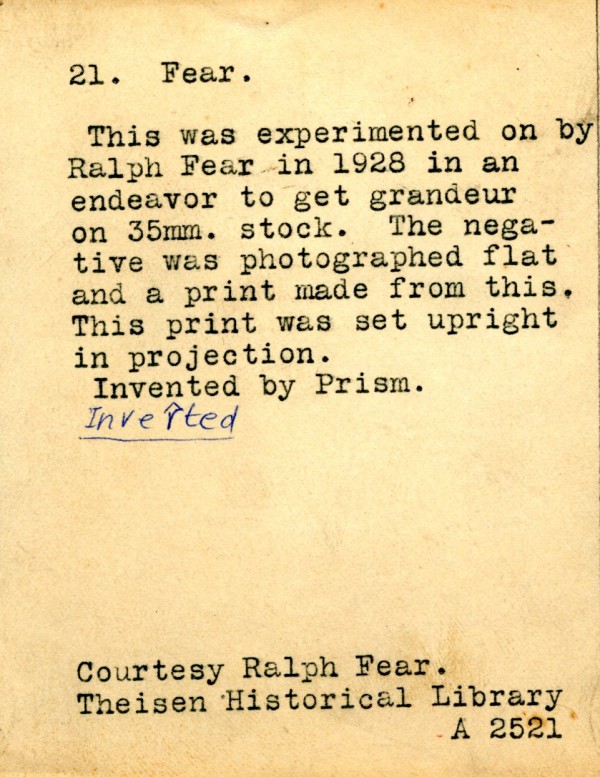
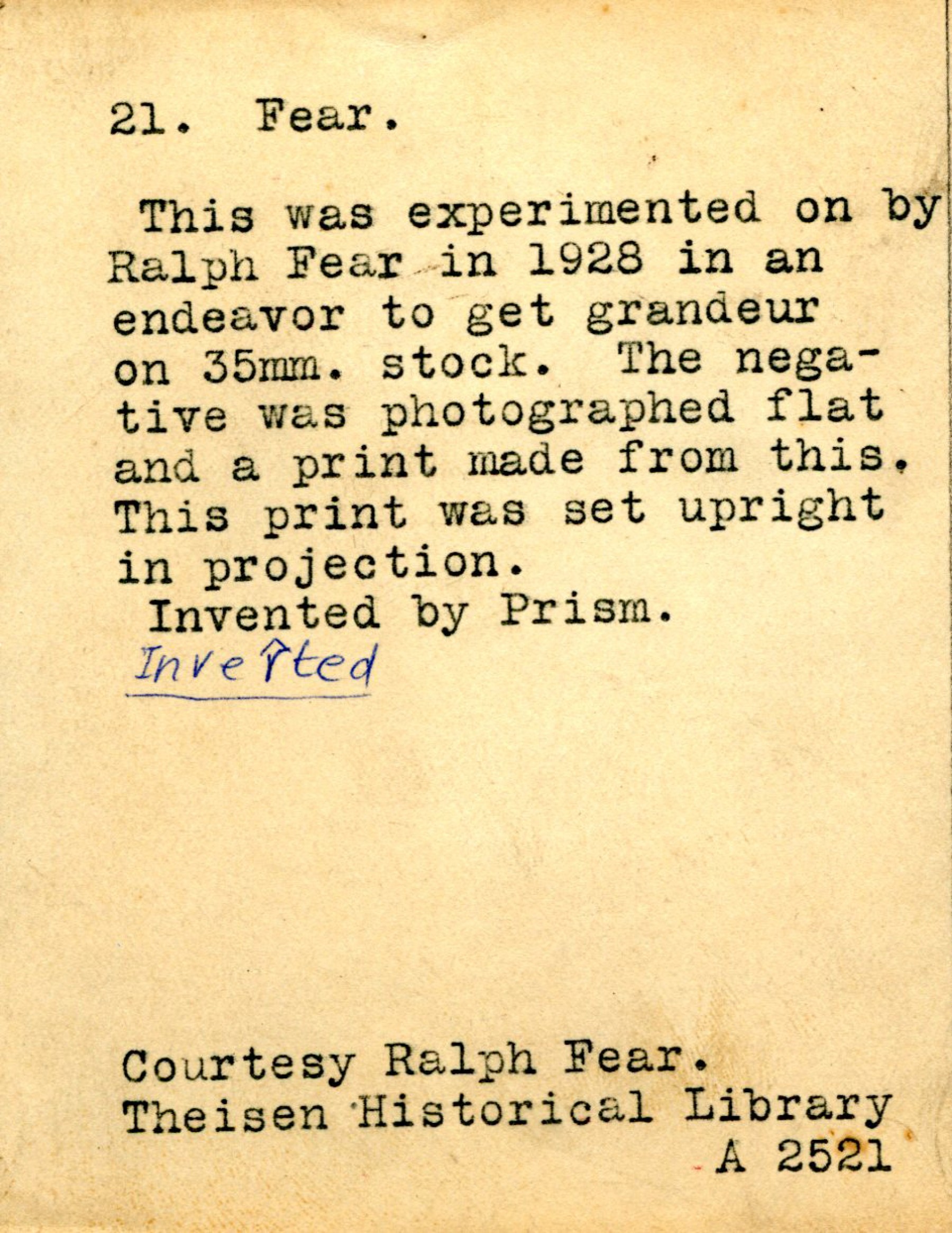
The summary on this catalog index card for the surviving Fearless Super Pictures frame clippings is in places inconsistent with the process as announced in trade publications of the time.
Film Frame Collection (P-074), Seaver Center for Western History Research, Natural History Museum of Los Angeles County, Los Angeles, CA, United States.
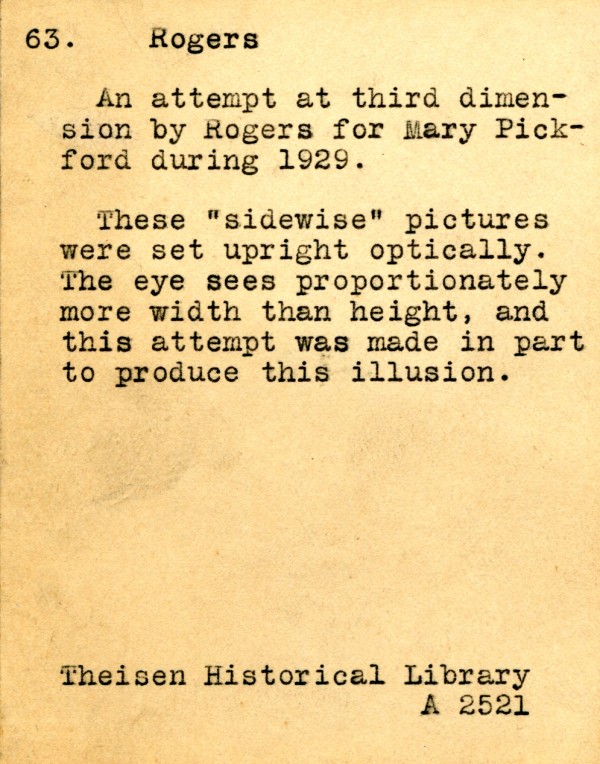
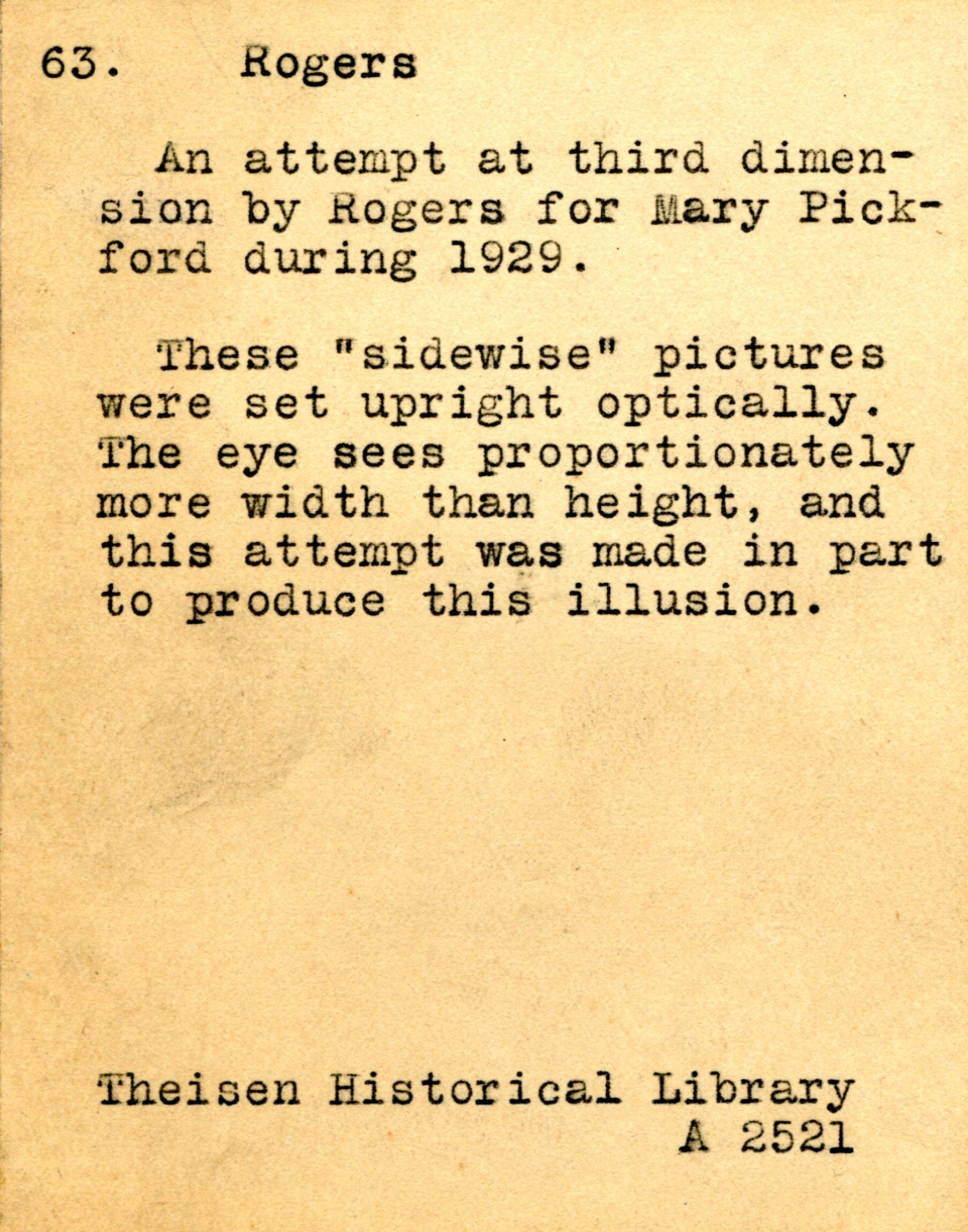
The catalog index card for the surviving silent frames. The samples were probably donated by Irving Millard, who worked at the Consolidated Film Industries laboratory.
Technology
[Little is currently known about this obscure film format outside of the surviving film frames preserved at the Seaver Center for Western History Research (Natural History Museum of Los Angeles County), and the few sources listed in the References section. The Editors would welcome any leads readers may be able to provide.]
According to the index card accompanying the surviving samples preserved at the Seaver Center for Western History Research (Natural History Museum of Los Angeles County), this process was invented by Ralph G. Fear around 1929.
Fear achieved the larger image with an optical lens attachment that rotated the camera’s image from vertical to horizontal, so that the length of the film gave the picture its added width. The same optical unit could be fitted in reverse to a projector to show the image in a theater. Fear also claimed that the system could work without an optical unit, photographing the picture directly onto film running horizontally.
Fear described his process in the following way:
“The picture is photographed, either in a vertical plane by use of an optical system that turns the image through an arc of 90 degrees and places it in a position on the film with the top of the picture parallel to the edge of the film, or it may be photographed directly upon the film without the use of any optical system. In the latter case the film runs horizontally past the aperture plate.” (Motion Picture News, 1929)
In addition to the optical unit, slight adjustments to the camera’s gears and sprockets were needed. The projector likewise needed an optical unit and a change of gears to show the wider image. No precise details on these adjustments are documented.
Fear also described a wider soundtrack, with each vibration recorded twice as long, but published concept diagrams show the soundtrack sometimes above and sometimes below the horizontal image, which is nine or ten perforations wide. The only surviving film samples, preserved in the Theisen collection at the Seaver Center for Western History Research (Natural History Museum of Los Angeles County), present a wide horizontal image that is eight perforations wide. One sample has room for a soundtrack above the frame; the other has a taller frame with no room for a soundtrack.
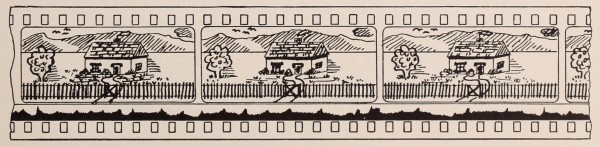
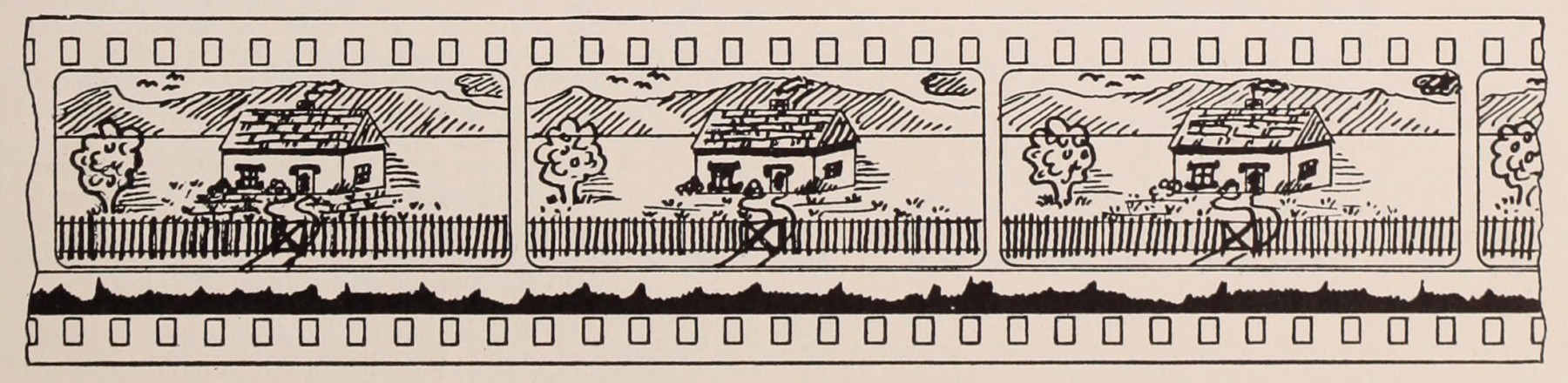
A concept diagram for Fearless Super Pictures showing a ten-perforation-wide image with a soundtrack below it. This image arrangement differs from the surviving example, which has a frame eight perforations wide with the soundtrack on the top.
Fear, Captain Ralph G. (1929). “Wide Image on Standard Film”. American Cinematographer (Aug.): p. 17.
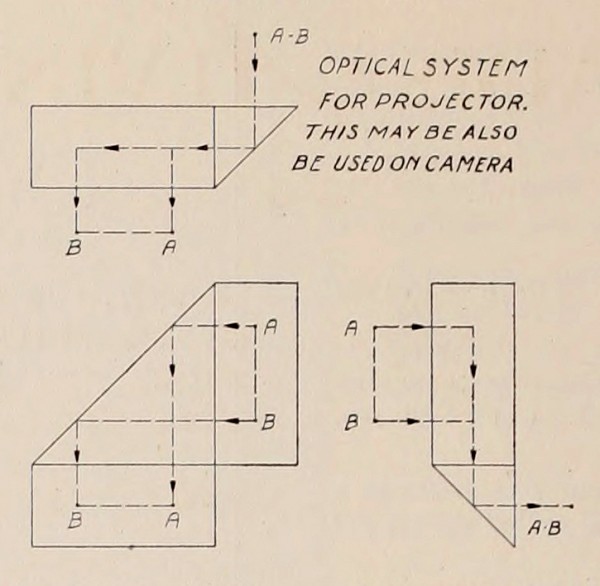
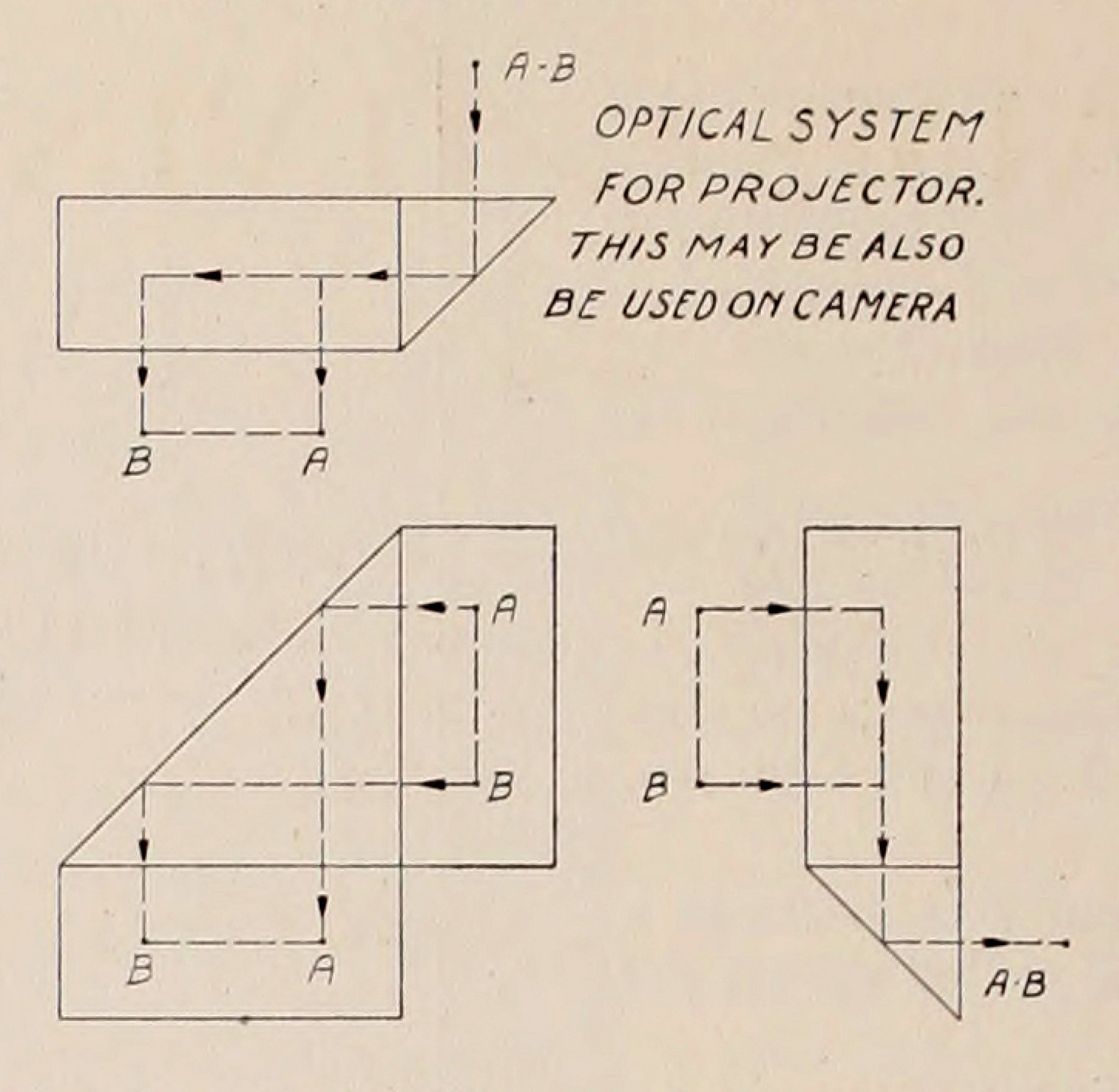
Diagram of the prism attachment for the projector and camera that rotated the widescreen image 90 degrees.
Fear, Captain Ralph G. (1929). “Wide Image on Standard Film”. American Cinematographer (Aug.): p. 44.
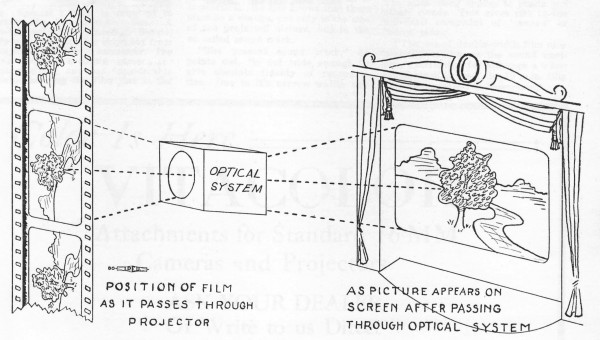
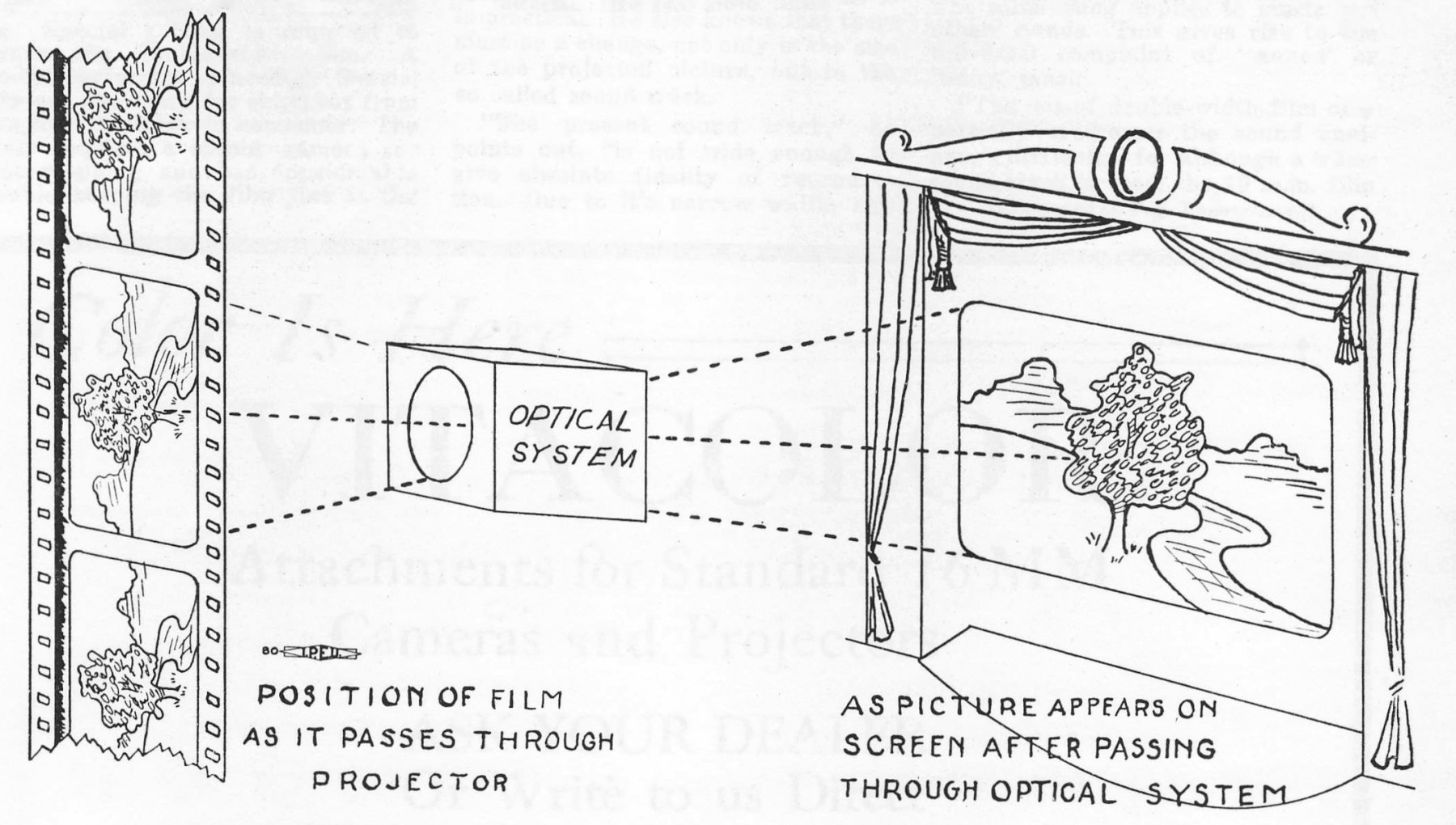
This concept diagram shows the soundtrack on the top and a film frame nine perforations wide with thick frame lines. The optical system rotates the image 90 degrees during projection.
Williamson, Charles L. (1929). “Double Width Pictures”. The International Photographer (Aug.): p. 4.
References
Fear, Ralph G. (1929). “Wide Image on Standard Film”. American Cinematographer, 10:5 (Aug.): pp. 17 & 44.
Motion Picture News (1929). “The Big Screen – Next Development to Find Application in the Theatre”. Motion Picture News, 40:5 (Aug. 3): pp. 428, 430 & 454.
Seaver Center for Western History Research (2018). Index Card. SCWHR-P-074-1-21. Film Frame Collection (P-074), Seaver Center for Western History Research, Natural History Museum of Los Angeles County, Los Angeles, CA, United States.
Seaver Center for Western History Research (2018). Index Card. SCWHR-P-074-1-22. Film Frame Collection (P-074), Seaver Center for Western History Research, Natural History Museum of Los Angeles County, Los Angeles, CA, United States.
Williamson, Charles L. (1929). “Double Width Pictures”. The International Photographer, 1:7 (Aug.): pp. 4–6.
Patents
None found.
Compare
Related entries
Author
Crystal Kui is a film archivist and researcher. She has a master’s degree in Art Education from Teachers College, Columbia University, and is a graduate of The L. Jeffrey Selznick School of Film Preservation. She co-authored the filmography for The Dawn of Technicolor, 1915–1935 (2015) and was project manager for King of Jazz: Paul Whiteman’s Technicolor Revue (2016). She is currently the Associate Producer of Undercrank Productions, a home video label specializing in silent films, and the Project Coordinator of Film Atlas.
Kui, Crystal (2026). “Fearless Super Pictures”. In James Layton (ed.), Film Atlas. www.filmatlas.com. Brussels: International Federation of Film Archives / Rochester, NY: George Eastman Museum.