VistaVision(1954–1961)
An 8-perforation horizontal widescreen format developed by Paramount Pictures in the 1950s, mainly used for production with occasional use in projection.
Film Explorer
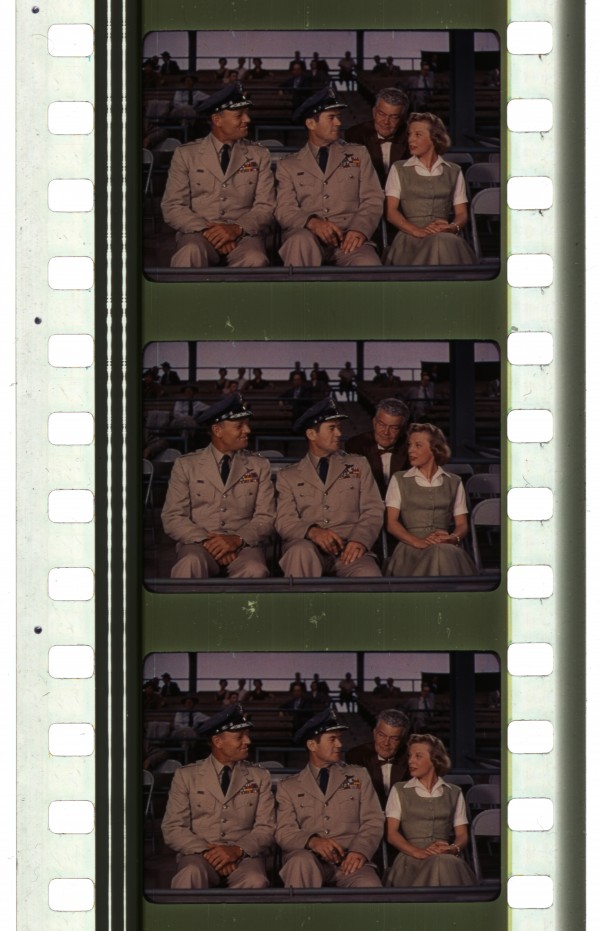
An original 4-perforation-tall 35mm VistaVision release print of Strategic Air Command (1955), printed by Technicolor. This is how most people saw this film.
National Audio-Visual Conservation Center, Library of Congress, Culpeper, VA, United States.
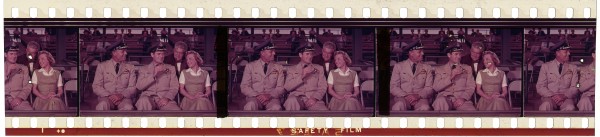
A surviving fragment of an original 8-perforation horizontal VistaVision print of Strategic Air Command (1955). These prints were made on Eastman Color stock (now faded) and were only screened at a limited number of theaters equipped for horizontal projection in the United States, Toronto and London.
Cinémathèque française, Paris, France.
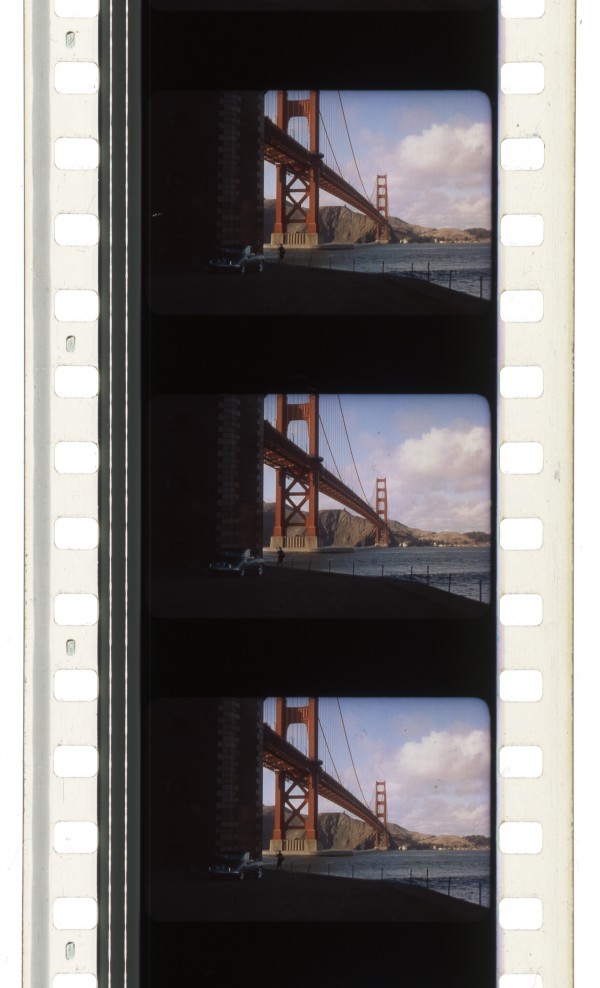
Alfred Hitchcock made five features using Paramount’s “high-fidelity” VistaVision format, including Vertigo (1958). Conventional VistaVision release prints were compatible with standard 35mm projection. The image from the 8-perforation horizontal negative was reduced and reformatted to a 4-perforation vertical print made by Technicolor. These prints featured standard mono sound on a variable area optical soundtrack.
Film Atlas collection, George Eastman Museum, Rochester, NY, United States. Special thanks to Robert Harris.
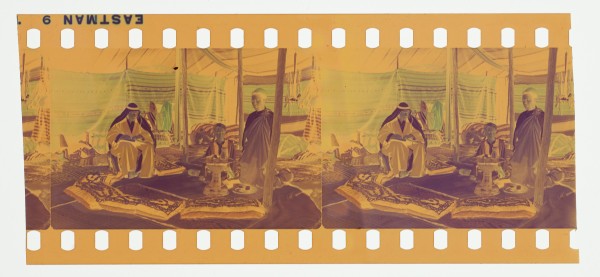
A clipping of outtakes from the 35mm 8-perforation original VistaVision negative of The Black Tent (1956). In the United Kingdom, the Rank Organisation used the VistaVision format for several of its releases.
Kodak collection, National Science and Media Museum, Bradford, United Kingdom.
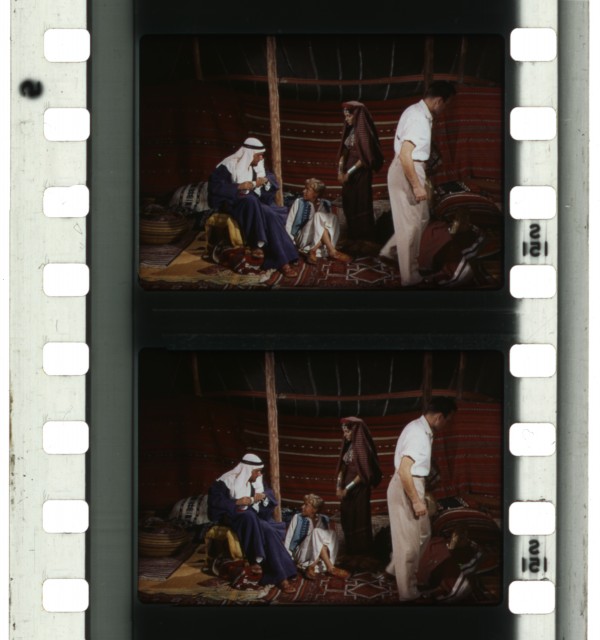
An original 35mm 4-perforation VistaVision print of The Black Tent (1956), made by Technicolor London.
National Audio-Visual Conservation Center, Library of Congress, Culpeper, VA, United States.
Identification
1.66:1 4-perforation prints: 20.96mm x 12.62mm (0.825 in x 0.497 in); 1.85:1 4-perforation prints: 20.96mm x 11.33mm (0.825 in x 0.446 in); 1.85:1 8-perforation prints: 33.95mm x 18.35mm (1.337 in x 0.723 in).
1.85:1 (US, recommended); 1.66:1 (UK).
(CS used for Williamsburg: The Story of a Patriot)
4-perforation, vertical for standard 35mm release prints; 8-perforation, horizontal for horizontal VistaVision release prints.
Technicolor imbibition for standard vertical release prints; Eastman Color contact prints for horizontal 8-perforation VistaVision prints.
Standard Eastman Kodak edge markings.
1
Standard 4-perforation VistaVision prints used Technicolor’s IB dye-transfer process and have typically not faded. 8-perforation VistaVision prints were made as Eastman Color contact prints and suffer from heavy color fading today.
A Paramount Picture in VistaVision
Select release prints from 1954–56 carried Perspecta 3.0 audio on a mono track; prints from 1957–61 carried 1.0 mono. Williamsburg: The Story of a Patriot (1957) short was released with 6-track stereo on magnetic stripe.
Mono or 3-channel Perspecta.
37.38mm x 25.32mm (1.472 in x 0.997 in).
B/W or color.
Standard Eastman Kodak edge markings.
History
VistaVision was an 8-perforation horizontal widescreen film production format developed at Paramount Pictures in the early 1950s. In the wake of a 1948 antitrust ruling by the US Department of Justice and Supreme Court that forced major Hollywood studios to divest their theater chains and ended many of the industry’s vertically integrated business practices, the American film industry entered a state of profound upheaval. With studios no longer controlling both film production and exhibition, increased competition from television, and the debut of new widescreen systems such as Cinerama and CinemaScope, studios sought technological innovations to help stabilize declining attendance and reinforce cinema’s advantage over television. Paramount, the lead defendant in the antitrust case that became known as the Paramount Decrees, was among the studios most affected by the ruling. The company was required to separate into distinct production and exhibition businesses, relinquishing ownership of the nation's largest theater chain and therefore losing the profits it generated. Without control over exhibition, Paramount turned to production improvements, developing a widescreen system that could improve image quality while remaining compatible with existing projection equipment. This emphasis on photographic quality shaped the studio’s engineering efforts, resulting in VistaVision.
Development of VistaVision began on Paramount’s Hollywood lot in 1952 under the direction of John R. Bishop, head of the studio’s Camera Department, and Chief Engineer Loren L. Ryder. While most major Hollywood studios adopted 20th Century Fox’s CinemaScope process in 1953, Paramount declined to use its anamorphic lenses, arguing that they added too much grain and introduced optical distortions. Instead, the studio searched for a way to improve image quality without relying on anamorphic compression. Engineers revisited experiments with 56mm and 65mm negative stock, first conducted in the late 1920s. Although the larger formats produced superior image quality to CinemaScope, their cost – three to four times that of standard 35mm film – made both processes economically impractical.
In the late spring of 1953, Ryder rediscovered a long-forgotten patent by E.W. Clark for an 8-perforation horizontal 35mm photographic system. Paramount had purchased the patent in 1926 but never put it into production. The design included a method for reduction-printing the larger negative onto conventional 4-perforation vertical 35mm release prints, allowing the system to remain compatible with existing projection equipment. Working with Bishop and Paramount engineer Charles Daly, Ryder confirmed that the process produced higher image quality than CinemaScope without the expense of larger-format film stock. Because it used standard 35mm film running horizontally through the camera, it also retained the economy of conventional film while nearly doubling the image area.
With the process chosen, the Paramount engineering team searched the studio's inventory for a camera capable of horizontal film transport, or one that could be modified for it. When no suitable camera could be found on the lot, Bishop went to Morgan’s Camera Shop on Sunset Boulevard in Hollywood, where he found two cameras built for William Fox's two-color Nature Color process in the late 1920s. With a few modifications, these cameras could closely replicate the image dimensions and exposure characteristics described in Clark’s 1921 patent. Paramount purchased both cameras from Morgan’s shop, and on July 9, 1953 Bishop wrote a notice of invention, documenting the details of the process development for what was then called the Lazy-8 camera.
The first production test of the Lazy-8 camera system took place in September 1953 during the filming of White Christmas (1954). Given that the format was still unproven, Paramount photographed the production simultaneously with a conventional 35mm 4-perforation camera and the new 8-perforation horizontal Lazy-8 camera. The standard camera served as a safeguard against potential technical failures, allowing the studio to compare results and ensure that production could continue if problems arose. After three days of successful testing, Paramount felt confident enough to shoot exclusively with their new widescreen system.
By March 1954, Paramount abandoned the Lazy-8 name in favor of the more marketable VistaVision. Unlike 20th Century Fox's CinemaScope, which was sold as both a production and exhibition package, Paramount made VistaVision available as an open photographic production process that could be used by any studio or independent producer for free. The company did not rent complete VistaVision camera packages; instead, it provided design specifications that allowed manufacturers such as Mitchell to build cameras to order. A limited number of VistaVision cameras were made available for rental from Technicolor, after the company converted several retired three-strip color cameras to shoot in the format. Although interest was high, during the debut year VistaVision’s expansion faced a practical obstacle: there were not enough cameras available. The limited supply of equipment restricted the number of productions that could adopt the format. This problem was also felt internationally. Even after several European studios, most notably the Rank Organisation in the United Kingdom, acquired VistaVision cameras for production, the system struggled to gain significant international traction.
Although Paramount allowed outside filmmakers to use the process, the studio retained control of the VistaVision name as a trademark. Productions wishing to advertise that their films were shot in VistaVision were required to meet Paramount's quality standards and had to receive approval before using the name. The distinctive zooming VistaVision logo was reserved exclusively for Paramount productions.
To compete with CinemaScope's stereophonic sound capabilities, Paramount introduced Perspecta sound as an optional companion audio technology for VistaVision exhibition. Unlike true stereo systems, Perspecta did not use separate audio channels; it employed a single monaural soundtrack containing control signals that adjusted volume levels between the left, center and right speakers to create the impression of directional sound.
In September 1954, Paramount executives made an unprecedented request of the studio’s engineering department: they wanted audiences at New York City’s Radio City Music Hall to see White Christmas in native 8-perforation VistaVision. The format was not designed as an exhibition medium, and this request sent the engineering department into a race against the premiere date. Working with the Century Projector Corporation, the team custom-built horizontal projectors in under four weeks. With no time for a conventional development cycle, the machines were assembled as working prototypes. Technicolor faced a similar challenge, rushing to produce an 8-perforation horizontal release print. The compressed schedule left no time to incorporate a soundtrack on the print, forcing Paramount to devise a separate solution to synchronize audio with the picture. To solve the problem before the premiere, Paramount used an interlocking system in which a separate standard projector ran alongside the newly built horizontal projector. The conventional projector provided synchronized sound while the newly built projector handled the image.
Despite the short timeline, everything was completed in time for the October 14, 1954 premiere of White Christmas at Radio City Music Hall, marking both the first VistaVision release and the first presentation of the horizontal format. Similar installations followed for the film’s West Coast premiere at the Stanley-Warner Theater in Beverly Hills and on the Paramount lot.
By the time Strategic Air Command (1955) premiered, Paramount had refined the horizontal projection system, improving it for wider use. Projectors were built in a more conventional design, and a method for incorporating synchronized sound into the horizontal prints had been developed. Screenings using the new system were held in the United States, Toronto and London, where a limited number of theaters were equipped with 8-perforation horizontal projectors. However, the cost and technical demands of outfitting theaters with new projectors, larger screens, and Perspecta audio systems prevented widespread adoption. Horizontal prints were reserved for select prestige productions rather than the standard method of exhibiting all VistaVision films. By the fall of 1956, Paramount had abandoned horizontal prints in favor of exclusive distribution in 35mm vertical reduction prints.
Between 1954 and 1961, VistaVision was used on a wide range of productions, with Paramount releasing such notable films as Vertigo (1958), Funny Face (1957), and Gunfight at the O.K. Corral (1957) in the format. Alfred Hitchcock became the filmmaker most closely associated with the process, shooting five VistaVision productions. Directors such as John Ford, Michael Curtiz, Frank Tashlin and Anthony Mann also adopted the format for its superior image stability and for the advantages it offered in optical printing, dissolves and visual-effects work. While filmmakers valued VistaVision for its technical advantages, audiences experienced those benefits as increased clarity, scale and visual impact. The qualities sought by cinematographers and directors became part of the immersive theatrical experience that distinguished widescreen cinema from television.
By the late 1950s, Paramount executives began to question whether VistaVision still offered significant economic and technical advantages to remain the studio’s premier production format. Despite its superior image quality, VistaVision never achieved the commercial adoption of CinemaScope, and Paramount declined either to pursue a licensing strategy or to market it as a premium exhibition package with standardized requirements for sound and projection. As a result, exhibitors controlled the final presentation, leaving audiences with no consistent understanding of what it meant to see a film “in VistaVision.”
The production process itself also remained more expensive than conventional 35mm photography. VistaVision required specialized horizontal cameras, consumed twice the negative film stock and yielded reduction release prints that were more costly. Meanwhile, advances in Eastman Kodak's film stocks reduced grain in standard 35mm photography, narrowing one of the format's key visible advantages. Panavision's improved anamorphic lenses, which eliminated many of the optical shortcomings associated with early CinemaScope lenses, further eroded VistaVision's competitive position. The studio quietly discontinued its internal support for VistaVision in the late 1950s and One-Eyed Jacks (1961) became the final theatrical release shot in the format during its initial run.
Although VistaVision ceased to be a primary production format by the early 1960s, it continued to find specialized applications. It remained in use for background photography and visual effects, where its large negative area offered advantages over conventional 35mm film. It was the production of Star Wars (1977), however, that brought about VistaVision's official resurgence, marking a dramatic second chapter in the format’s history. Industrial Light & Magic (ILM) refurbished surviving VistaVision cameras and integrated the format into motion-control rigs (Dykstraflex) for the film’s extensive visual-effects work. After Star Wars, VistaVision became one of the leading visual-effects formats for decades, used in productions ranging from Jurassic Park (1993) to The Dark Knight (2008) and beyond. Its distinctive image quality has continued to attract filmmakers. Recent productions such as The Brutalist (2024), One Battle After Another (2025), Bugonia (2025) and Digger (2026) demonstrate VistaVision's continued relevance in modern filmmaking.
More than seventy years after Paramount engineers developed VistaVision, the format endures because it continues to embody the same philosophy that inspired its creation: that exceptional image quality can make the theatrical experience feel unique. Originally developed to distinguish cinema from television by offering audiences an image they could not experience at home, VistaVision has returned in much the same role today, its rarity now part of its appeal.
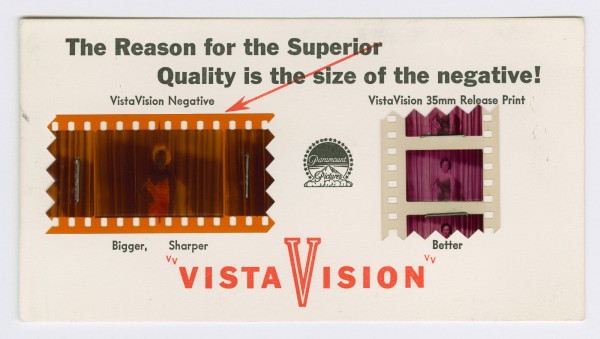
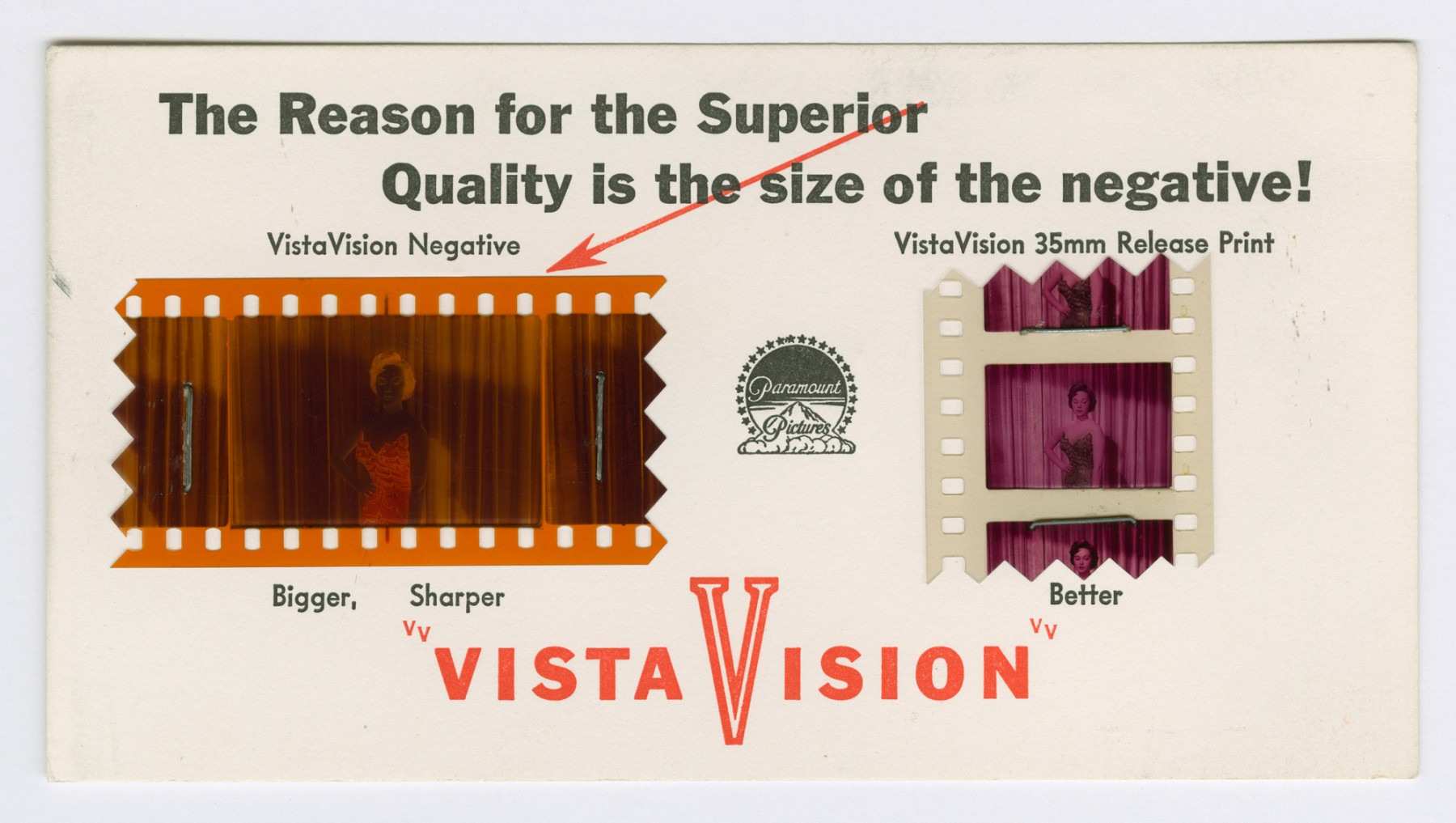
The frame on the VistaVision negative was twice the size of a conventional 35mm frame. The increased resolution on the negative directly improved the image quality on resulting film prints.
Earl I. Sponable papers, Rare Book & Manuscript Library, Columbia University Libraries, New York, NY, United States.
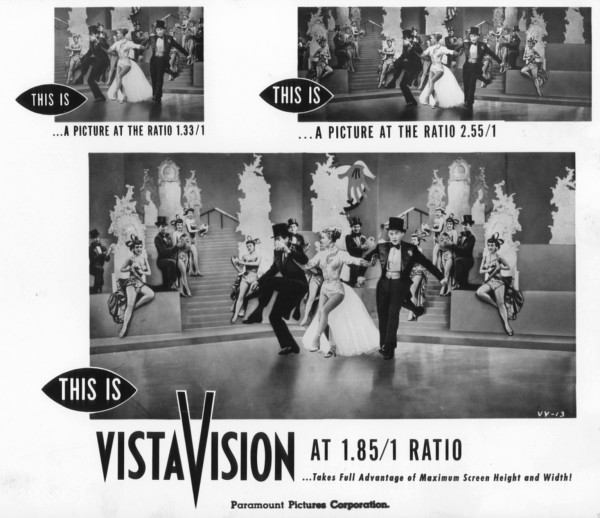
The VistaVision frame was promoted as being more expansive and detailed than other widescreen formats on the market.
Charlotte Barker collection.
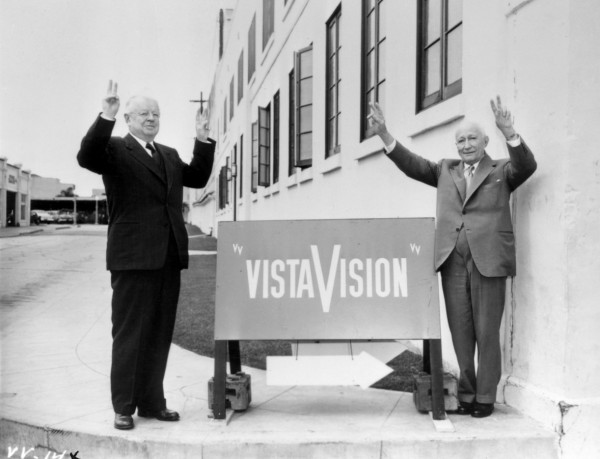
Y. Frank Freeman and Adolph Zukor, respectively vice president and president of Paramount Pictures, promoting the new VistaVision format with a double-V hand gesture, c. 1954.
Charlotte Barker collection.


An 8-perforation VistaVision contact print made by film restorer Robert Harris in 1997 from the original negative of The Man Who Knew Too Much (1956). This print was made to test the condition of the surviving negative and does not feature a soundtrack as it was never intended for projection.
Film Atlas collection, George Eastman Museum, Rochester, NY, United States. Special thanks to Robert Harris.
Selected Filmography
The first of Alfred Hitchcock’s five VistaVision films. Released with a horizontal 8-perforation print at select locations during its initial theatrical run.
The first of Alfred Hitchcock’s five VistaVision films. Released with a horizontal 8-perforation print at select locations during its initial theatrical run.
This comedy starring Tom Cruise is one of the new films released during the revival of the VistaVision format for production use.
This comedy starring Tom Cruise is one of the new films released during the revival of the VistaVision format for production use.
The first VistaVision film released by the J. Arthur Rank Organisation. This film used a 1.66:1 aspect ratio, instead of Paramount’s preferred 1.85:1.
The first VistaVision film released by the J. Arthur Rank Organisation. This film used a 1.66:1 aspect ratio, instead of Paramount’s preferred 1.85:1.
An industrial trade film made for General Motors’ annual “Motorama” show to highlight new vehicles.
An industrial trade film made for General Motors’ annual “Motorama” show to highlight new vehicles.
The first film of the VistaVision revival era to win Best Picture. 8-perforation horizontal prints were struck and screened in four theaters worldwide (Los Angeles, Boston, New York and London), making it the first film to receive a theatrical release in the horizontal VistaVision format since the mid-1950s.
The first film of the VistaVision revival era to win Best Picture. 8-perforation horizontal prints were struck and screened in four theaters worldwide (Los Angeles, Boston, New York and London), making it the first film to receive a theatrical release in the horizontal VistaVision format since the mid-1950s.
The last film shot in VistaVision to be released in the format during its initial run of 1954–61.
The last film shot in VistaVision to be released in the format during its initial run of 1954–61.
Often cited as one of the best VistaVision films, this is the only VistaVision film released through Warner Bros. during the initial run.
Often cited as one of the best VistaVision films, this is the only VistaVision film released through Warner Bros. during the initial run.
A short film that played before White Christmas (1954) at the Radio City Music Hall premiere on October 14, 1954. The first in a series of travelogues to highlight the VistaVision format.
A short film that played before White Christmas (1954) at the Radio City Music Hall premiere on October 14, 1954. The first in a series of travelogues to highlight the VistaVision format.
The first film to be shot and released in the VistaVision format, premiered at Radio City Music Hall on October 14, 1954 in a horizontal 8-perforation VistaVision print. The only VistaVision film to carry the opening text “Paramount Proudly Presents the picture in VistaVision.”
The first film to be shot and released in the VistaVision format, premiered at Radio City Music Hall on October 14, 1954 in a horizontal 8-perforation VistaVision print. The only VistaVision film to carry the opening text “Paramount Proudly Presents the picture in VistaVision.”
A 37-minute orientation film for visitors to historic Colonial Williamsburg. Released in 6-track stereo, it is often cited as the longest-running theatrical film, having been shown daily at Colonial Williamsburg since 1957.
A 37-minute orientation film for visitors to historic Colonial Williamsburg. Released in 6-track stereo, it is often cited as the longest-running theatrical film, having been shown daily at Colonial Williamsburg since 1957.
Lineage
Technology
Although the concept of horizontal 35mm photography dated back decades, VistaVision represented a practical application of the idea within the modern studio system. The first VistaVision cameras were not purpose-built systems, but modified equipment adapted from earlier technology. In the summer of 1953, Paramount purchased two cameras from Morgan’s Camera Shop in Hollywood that had been manufactured by the William P. Stein Camera Company in the 1920s for William Fox's Nature Color process. The cameras were well suited for conversion because their original design already advanced eight perforations at a time. In their original configuration, the cameras recorded two separate 35mm 4-perforation images simultaneously, one through a red filter, the other through a green filter, which were later combined to create a color image. Before Paramount purchased the cameras, Gilbert Morgan, owner of Morgan’s Camera Shop, had modified the Stein cameras by removing the divider that separated the red and green images, creating a camera that could, when laid on its side, capture a wide 8-perforation horizontal image.
Paramount tested several lens systems before selecting Leica lenses for their sharpness and image quality. The combination of high-quality spherical lenses and the larger VistaVision negative gave what the engineers felt was a sharper and more natural-looking widescreen image than many early anamorphic systems could achieve. The additional negative area also provided flexibility in composition, allowing Paramount to recommend exhibition ratios ranging from approximately 1.66:1 to 2:1 depending on theater screen dimensions and masking systems. By August 1953, Paramount owned three prototype converted Stein cameras, first used on White Christmas (1954), then Three Ring Circus (1954) and Strategic Air Command (1955), among others.
As Paramount unveiled VistaVision at a special industry event in March 1954, purpose-built cameras were already being developed. While the converted Stein cameras established the basic operating principle for VistaVision photography, Paramount engineers immediately began work on additional modifications that would all be employed on the Mitchell camera models. To prevent film buckling during transport, the cameras used buckle trips on both sides of the film movement, together with vertically mounted 2,000-ft film magazines (designed by John Bishop) served by power-driven take-up systems rather than traditional belt-driven mechanisms. The Mitchell Camera Corporation produced more than thirty purpose-built VistaVision cameras, which became the primary production cameras for many films shot in the format, including The Ten Commandments (1956), War and Peace (1956), and Alfred Hitchcock’s Vertigo (1958). Mitchell later expanded the system by developing a high-speed model and a lightweight 17-pound camera, first employed for Alpine location photography on The Mountain (1956). Technicolor modified six retired three-strip cameras for VistaVision use, expanding access to more productions. These modified cameras were used on films including To Catch a Thief (1955) and The Girl Rush (1955).
The industry's recognition of VistaVision's technical significance culminated in Bishop, Ryder and the Paramount engineering staff receiving an Academy Award for "Developing the Method of Producing and Exhibiting Motion Pictures known as VistaVision" at the 1955 Oscar ceremony.
VistaVision was originally conceived as an image capture system and the 8-perforation horizontal prints were not part of the original design. Technicolor's Hollywood laboratory collaborated with Paramount to develop the optical printing process that reduced and rotated the horizontal VistaVision image into the standard 35mm release format. Combined with Technicolor’s dye-transfer (imbibition) process, the large-format negative produced release prints with exceptional color, finer detail and reduced grain compared to standard 35mm production methods of the era.
VistaVision's technical advantages came with practical tradeoffs. The format consumed twice as much negative stock as conventional 35mm photography, doubling raw film costs. Producing standard release prints also required an optical reduction and 90-degree rotation of the negative, making laboratory work more complex and expensive than conventional release printing. Although Paramount briefly promoted horizontal 8-perforation projection, only a limited number of theaters ever installed the specialized projectors required to exhibit the format in its native form. Operating at 180 feet per minute, twice the speed of standard 35mm projection, and requiring a larger screen installation, these systems proved too costly and impractical for widespread adoption. As a result, most audiences experienced VistaVision only through conventional 35mm reduction prints rather than a native 8-perforation horizontal image.
Several of the Technicolor VistaVision cameras were later adapted for the Technirama format, which combined the 8-perf horizontal negative with a 1.5x anamorphic lens. Technirama saw modest international use and helped extend the operational life of several VistaVision-derived components.
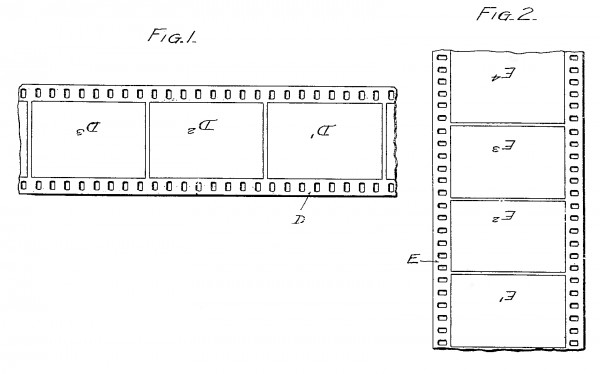
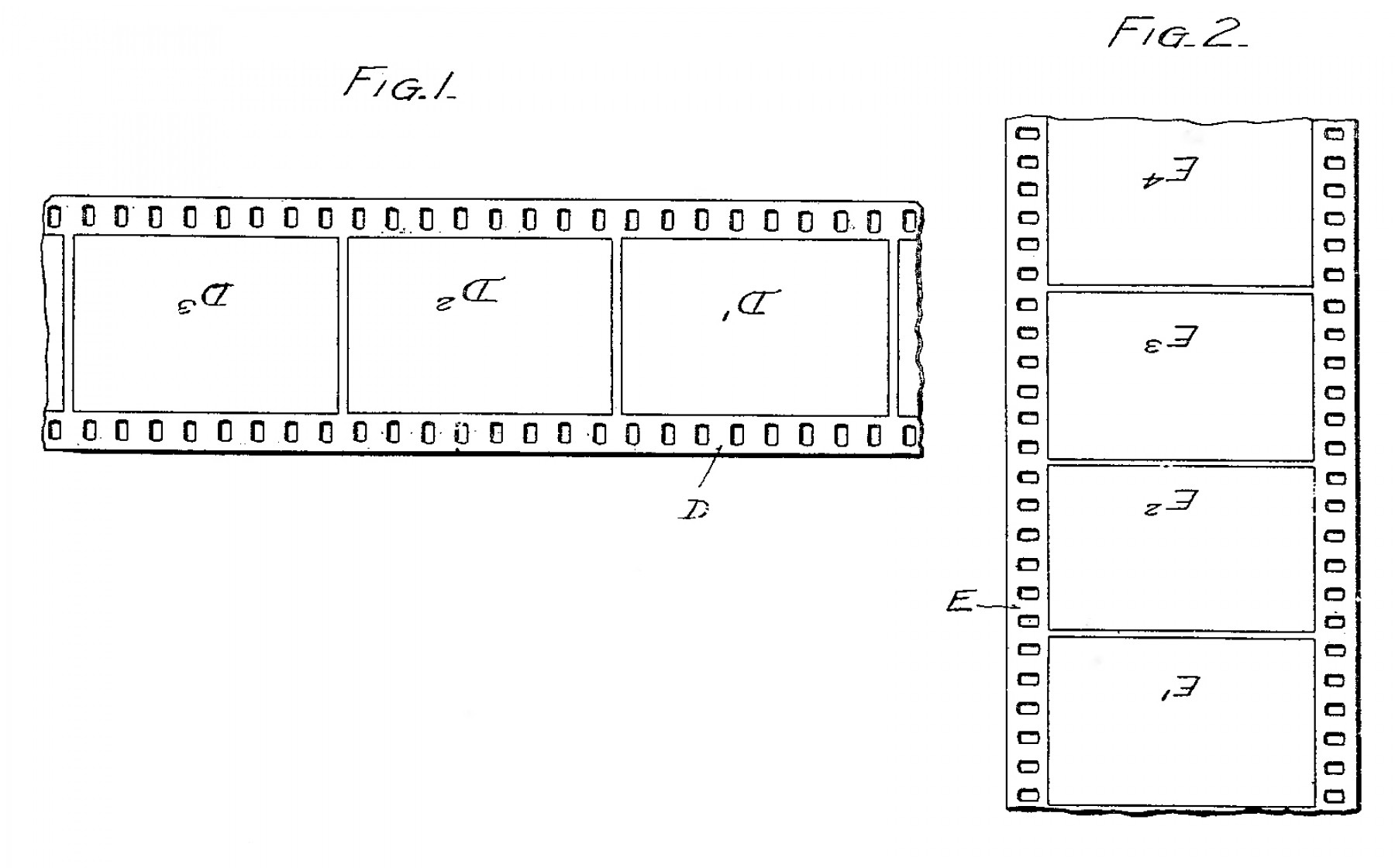
Edwin W. Clark’s 1921 patent introduced some of the principal ideas that inspired VistaVision three decades later, namely the photographing of a large-frame image on a horizontal negative and the printing of this image onto standard film for presentation.
Clark, Edwin W. Motion Picture Camera. US patent 1372936, filed February 17, 1921, and issued March 29, 1921. https://patents.google.com/patent/US1372936A
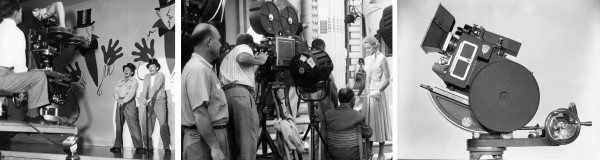
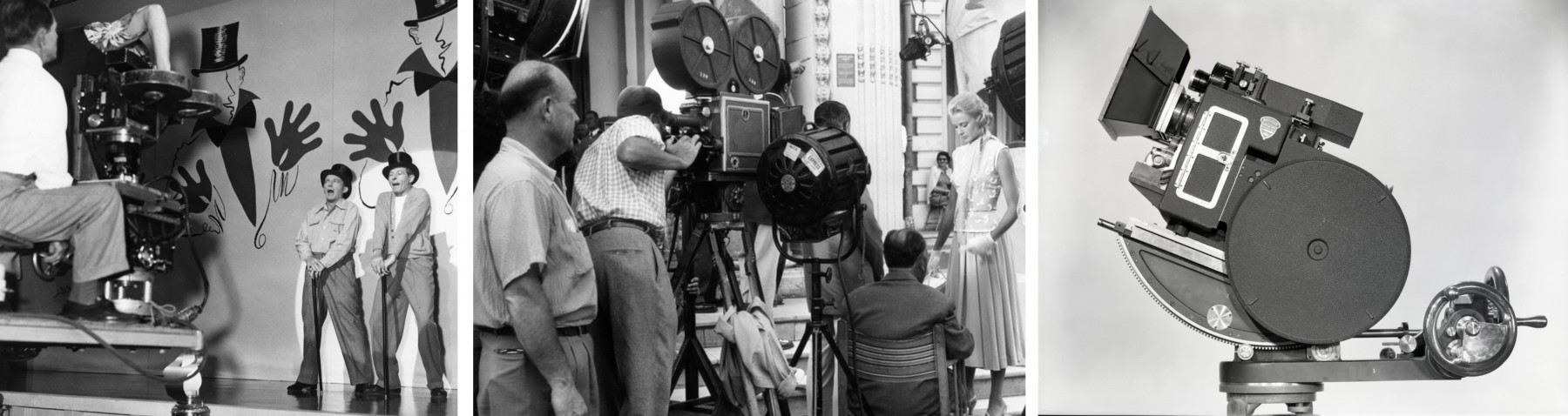
The evolution of VistaVision cameras. Left: The converted 1920s camera made by William P. Stein used to film White Christmas (1954). Middle: A modified three-strip Technicolor camera on the set of To Catch a Thief (1955). Right: A later “elephant ear” VistaVision camera built by the Mitchell Camera Corporation.
Charlotte Barker collection.
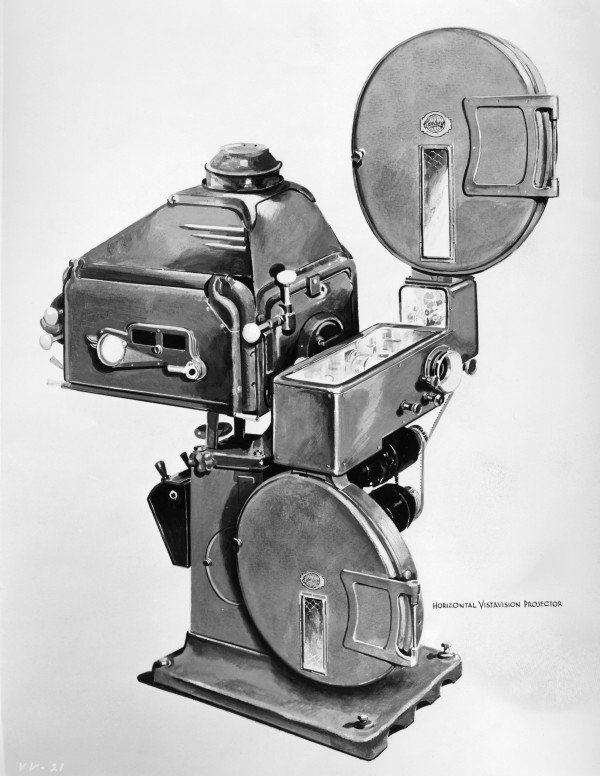
An artist’s impression of a 35mm 8-perforation horizontal VistaVision projector made by the Century Projector Corporation.
Charlotte Barker collection.
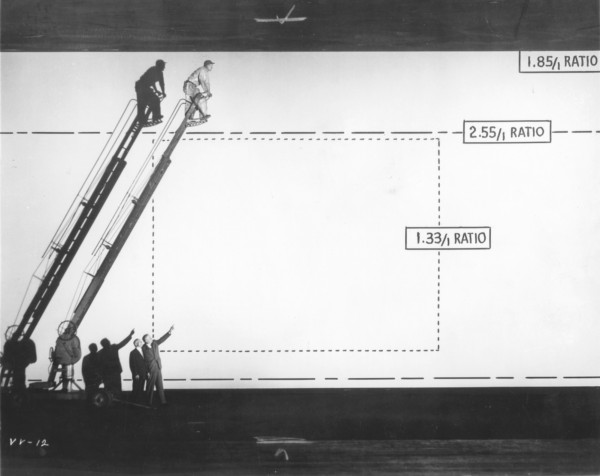
The 1.85:1 aspect ratio of VistaVision was not as wide as CinemaScope’s initial 2.55:1 aspect ratio, but the extra resolution obtained from its large negative allowed the image to be projected on a much taller screen.
Charlotte Barker collection.
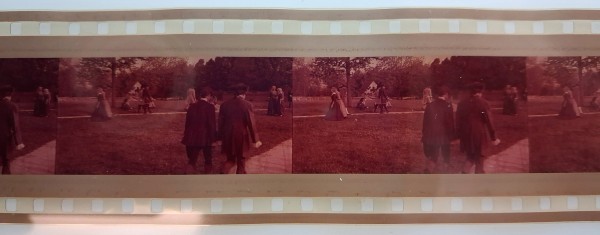
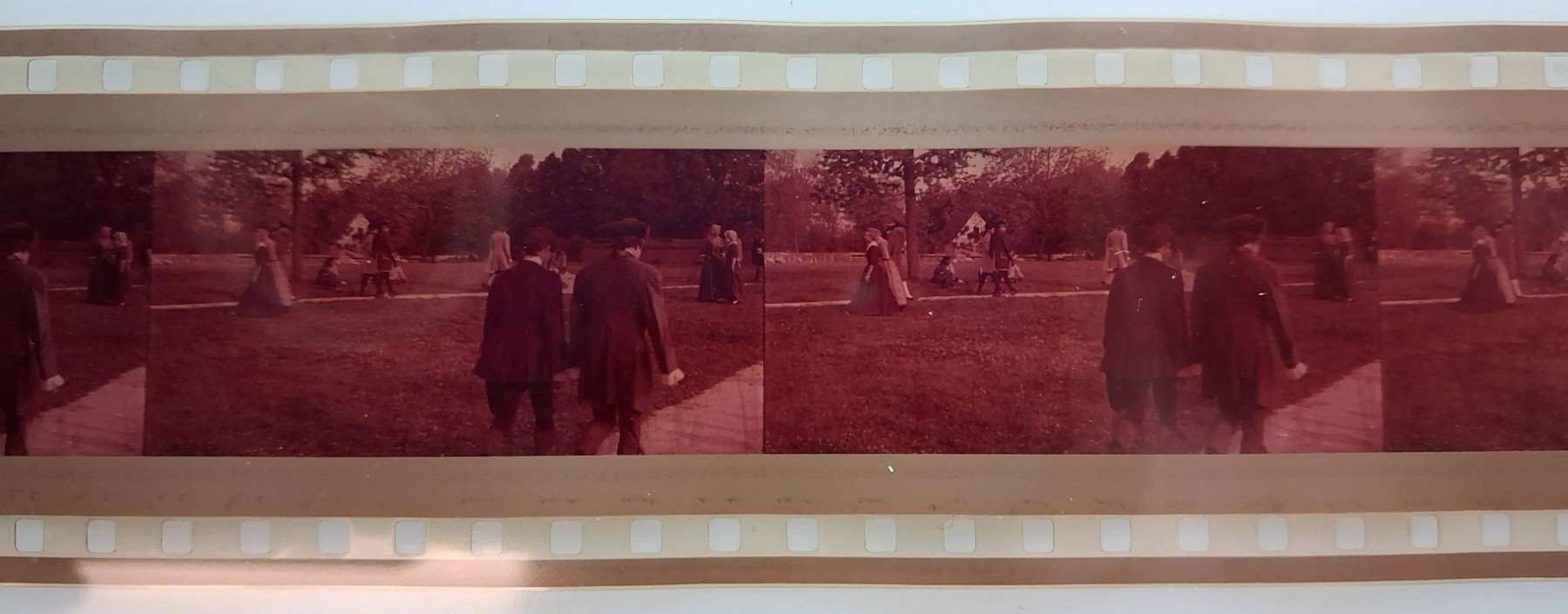
An original 35mm 8-perforation VistaVision print of Williamsburg: The Story of a Patriot (1957) in faded Eastman Color. This film was presented in horizontal VistaVision projection for decades at Colonial Williamsburg in Virginia. Uniquely for 8-perf VistaVision prints, the film’s six channels of sound were played back from magnetic stripes on the edges of the 35mm print.
George Eastman Museum, Rochester, NY, United States. Special thanks to Robert Harris.
References
Belton, John (1992). Widescreen Cinema. Cambridge, MA: Harvard University Press.
Bishop, John R. & Loren L. Ryder (1953). “Paramount’s Lazy-8 Double-Frame Camera”. American Cinematographer, 34:12 (Dec.): pp. 588–9.
MacGowan, Kenneth (1954). Widescreen of Yesterday and Tomorrow. Los Angeles, CA: University of California.
Ryder, Loren L. (1954). VistaVision (A Comprehensive Treatise). Hollywood, CA: Paramount Pictures.
Ryder, Loren L. (c. 1954). A Statement from Paramount about … VistaVision. Pamphlet. Hollywood, CA: Paramount Pictures.
Ryder, Loren L. & John R. Bishop (1954). “VistaVision moves forward”. American Cinematographer, 35:11 (Nov.): pp. 552–3.
Patents
Clark, Edwin W. Motion picture camera. US patent 1372936, filed February 17, 1921, and issued March 29, 1921. https://patents.google.com/patent/US1372936A
Followed by
Compare
Related entries
Author
Charlotte Barker is the Senior Director of Film Restoration and Preservation at Paramount Pictures, where she has worked since 2005 and has led the studio’s restoration program since 2019. She oversees a team dedicated to safeguarding and revitalizing Paramount’s motion picture legacy, with major projects including White Christmas, To Catch a Thief, Sunset Boulevard, and Dragonslayer. Under her leadership, Paramount’s restoration of Sunset Boulevard received the first DEG EnTech Award for Technology Innovation in Film Restoration in 2025 and in 2023, her team earned the inaugural Hollywood Professional Association Award for Best Restoration for The Godfather. She continues to champion innovative approaches to film restoration, ensuring Paramount’s archive is preserved with exceptional technical fidelity. Charlotte is one of the leading historians on the VistaVision widescreen process, having spent more than a decade researching its history, verifying technical details, and uncovering long-lost documentation. She is currently writing the definitive book on the subject and frequently presents her work at major film festivals and industry conferences.
James Layton, Robert Harris, Mark Pollio, David Morrell, Bob Furmanek, Kevin Ackerman.
Barker, Charlotte (2026). “VistaVision”. In James Layton (ed.), Film Atlas. www.filmatlas.com. Brussels: International Federation of Film Archives / Rochester, NY: George Eastman Museum.