Technirama(1956–1985)
An anamorphic, horizontal-transport 35mm widescreen process, developed by Technicolor.
Film Explorer
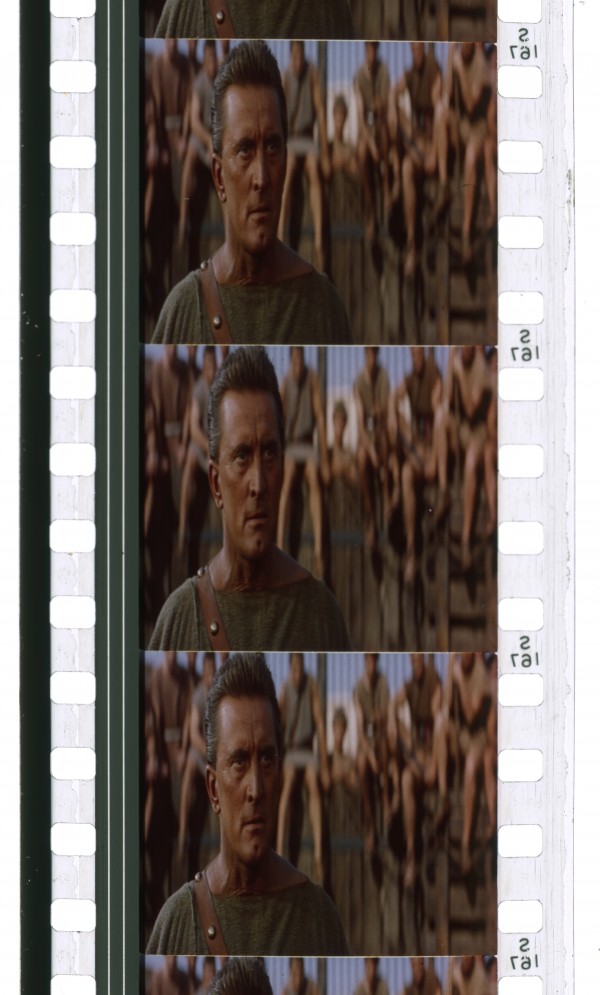
A 35mm British dye-transfer print of Spartacus (1960). Technirama productions were photographed onto a large 8-perforation-wide frame on 35mm Eastman Color film running horizontally in the camera. Release prints, however, reformatted this frame for standard 35mm projection, squeezing the wide image into a narrower frame.
George Eastman Museum, Rochester, NY, United States.
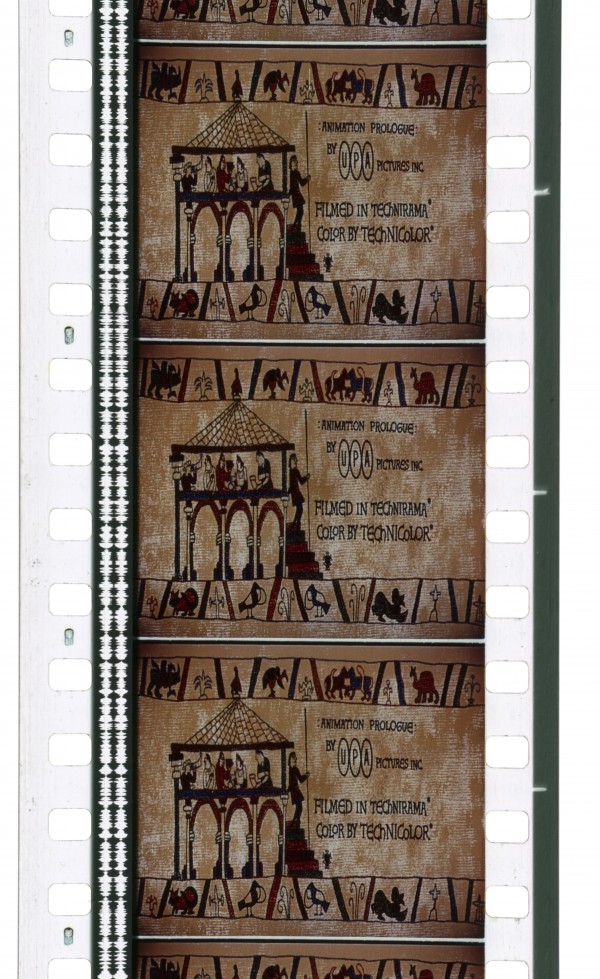
A 35mm dye-transfer print of The Vikings (1958). The Technirama format was devised by Technicolor, so most original 35mm release prints were made using the company’s dye-transfer printing process.
George Eastman Museum, Rochester, NY, United States.
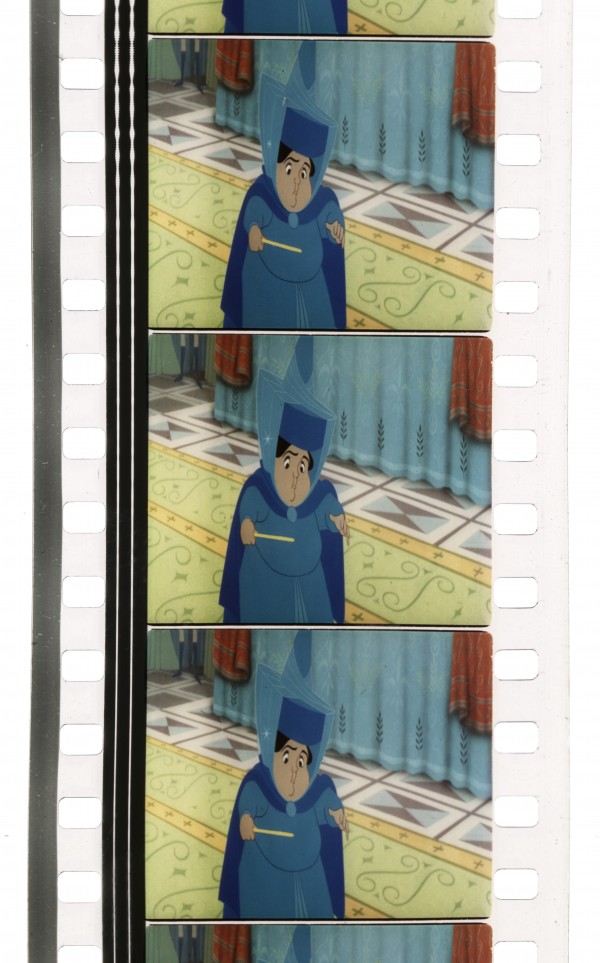
A 35mm dye-transfer print of Sleeping Beauty (1959), which was also released in Super Technirama 70.
Film Atlas Collection, George Eastman Museum, Rochester, NY, United States.
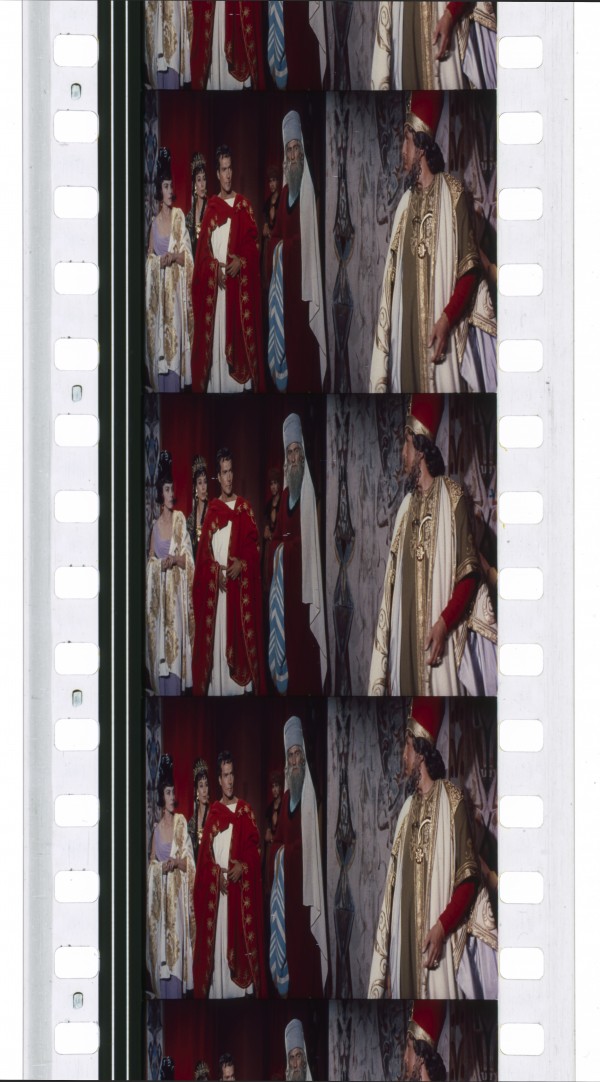
A 35mm dye-transfer print of the Biblical epic King of Kings (1961), also released in 70mm. Technicolor dye-transfer prints are known for their color saturation and stability.
George Eastman Museum, Rochester, NY, United States.
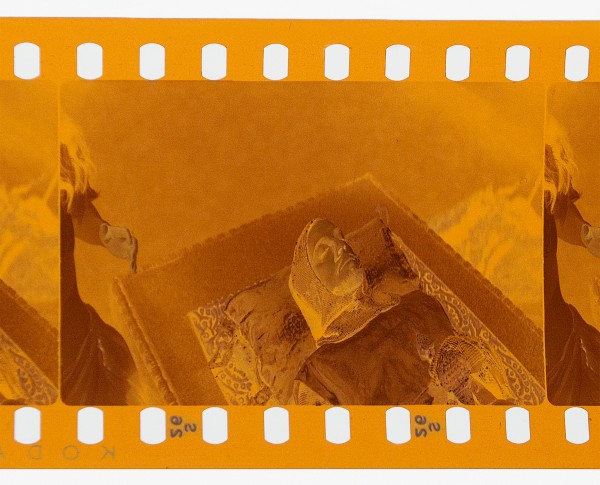
The 35mm original Eastman Color negative for Luna de miel (Honeymoon, 1959). The Technirama negative ran horizontally in the camera and was eight perforations wide. The wide image was further anamorphically compressed by a factor of 1.5x. The Technirama negative frame area was approximately 1.5 times the area of a standard 35mm frame, so captured significantly more resolution.
BFI National Archive, Berkhamsted, United Kingdom.
Identification
29.31mm x 18.16mm (0.839 in x 0.715 in) (35mm anamorphic, vertical); 35.81mm x 22.38mm (1.410 in x 0.881 in) (35mm anamorphic, double-frame, horizontal).
2.35:1 (vertical); 2.42:1 (horizontal).
Technicolor dye-transfer (imbibition) for standard 35mm prints; Eastman Color for horizontal prints.
Standard Eastman Kodak edge markings.
1
Standard 4-perforation Technirama prints used Technicolor’s dye-transfer process and retain their original colors.
Technirama; Filmed in Technirama.
Most Technirama prints featured mono optical soundtracks printed in B/W. Select releases had three- or four-channel magnetic stripe sound.
US: 37.74mm x 25.19mm (1.486 in x 0.992 in); Europe: 37.59mm x 23.24mm (1.480 in x 0.915 in).
Eastman Color.
Standard Eastman Kodak edge markings.
History
Following the successful innovation and diffusion of widescreen processes such as CinemaScope and VistaVision, both sponsored by major Hollywood studios (Twentieth Century-Fox and Paramount, respectively), other companies looked to develop rival processes that would build on and improve upon them. One such company was the Technicolor Corporation, which had seen its business affected by the availability of alternative color processes, such as Eastman Color, which gave better results when used with CinemaScope. Technicolor innovated a widescreen process that combined the key features of CinemaScope (anamorphic compression and a wide aspect ratio) and VistaVision (horizontal film transport and a larger negative area), with a consequent increase in sharpness and depth of field and a reduction of grain by comparison with CinemaScope.
Technirama made use of both Technicolor’s own cameras, converted from three-strip and VistaVision use, and its unique dye-transfer color printing process for the manufacture of high-quality exhibition prints. It had the additional virtue of versatility: prints could be struck from Technirama negatives in any gauge and any aspect ratio, allowing producers and distributors increased flexibility in how to shoot and release their pictures. According to Technicolor, using Technirama added about $20,000 to the budget of a motion picture (Variety, 1957a). However, prints from the negatives could also be made by other laboratories and Technicolor reportedly lost out to other companies that offered financing for this (Variety, 1958).
Appropriately, given its genesis at Technicolor’s British and European plants (see below), most of the films produced in Technirama were set and/or filmed in Europe, or even further afield, and were often premiered there. The first Technirama release was The Monte Carlo Story, an Italian production shot in Monaco, which in December 1956 premiered at the Reposi theater in Turin, Italy, in the double-frame, horizontal-feed format matching its photographic origination. This was followed in 1957 by three more Italian pictures and the western Night Passage, as well as American films shot on location in Japan (Escapade in Japan, Sayonara) and Libya (Legend of the Lost). These were among only a relative handful of Technirama films made by or for major Hollywood studios. Sayonara was released by Warner Bros., which subsequently used Technirama for four or five other features – sources disagree on whether Merrill’s Marauders (1962) was photographed in Technirama, CinemaScope or WarnerScope, as no process is credited on screen. Universal, which made Night Passage, used it for two more releases, Spartacus (1960) and The Grass Is Greener (1960). However, these films were independently produced, and it was independent and overseas producers who predominantly made use of the process, often on films that had limited distribution in anglophone markets.
From 1958 to 1962, Technirama was used for an average of ten productions annually, including those films earmarked for 70mm exhibition under the trade name Super Technirama 70. But as other, cheaper widescreen processes took hold, only ten Technirama films in total were made over the next five years. After 1967, the process was rested for nearly two decades until being used by Walt Disney Productions during the post-production of Tron (1982) and for the traditionally animated feature The Black Cauldron (1985). Technirama cameras were subsequently employed for visual-effects shots on Sam Raimi’s Army of Darkness (1992).
[This essay is followed by Super Technirama 70.]
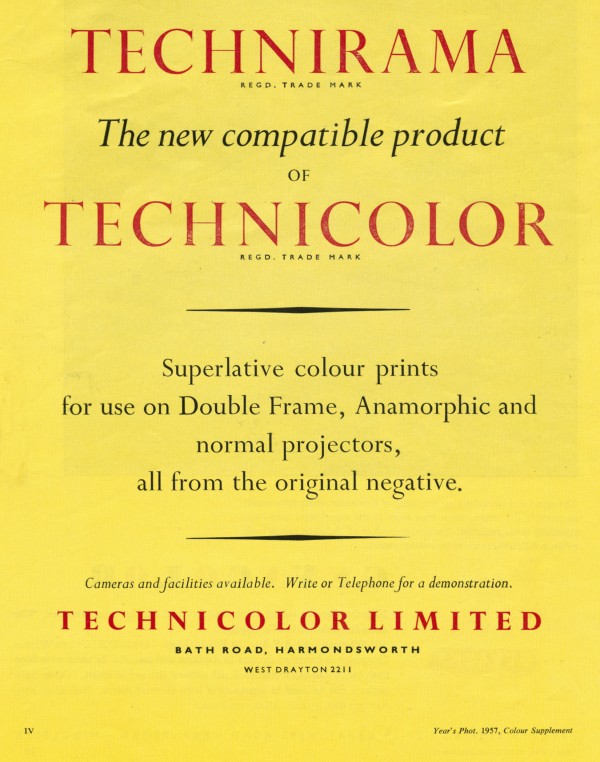
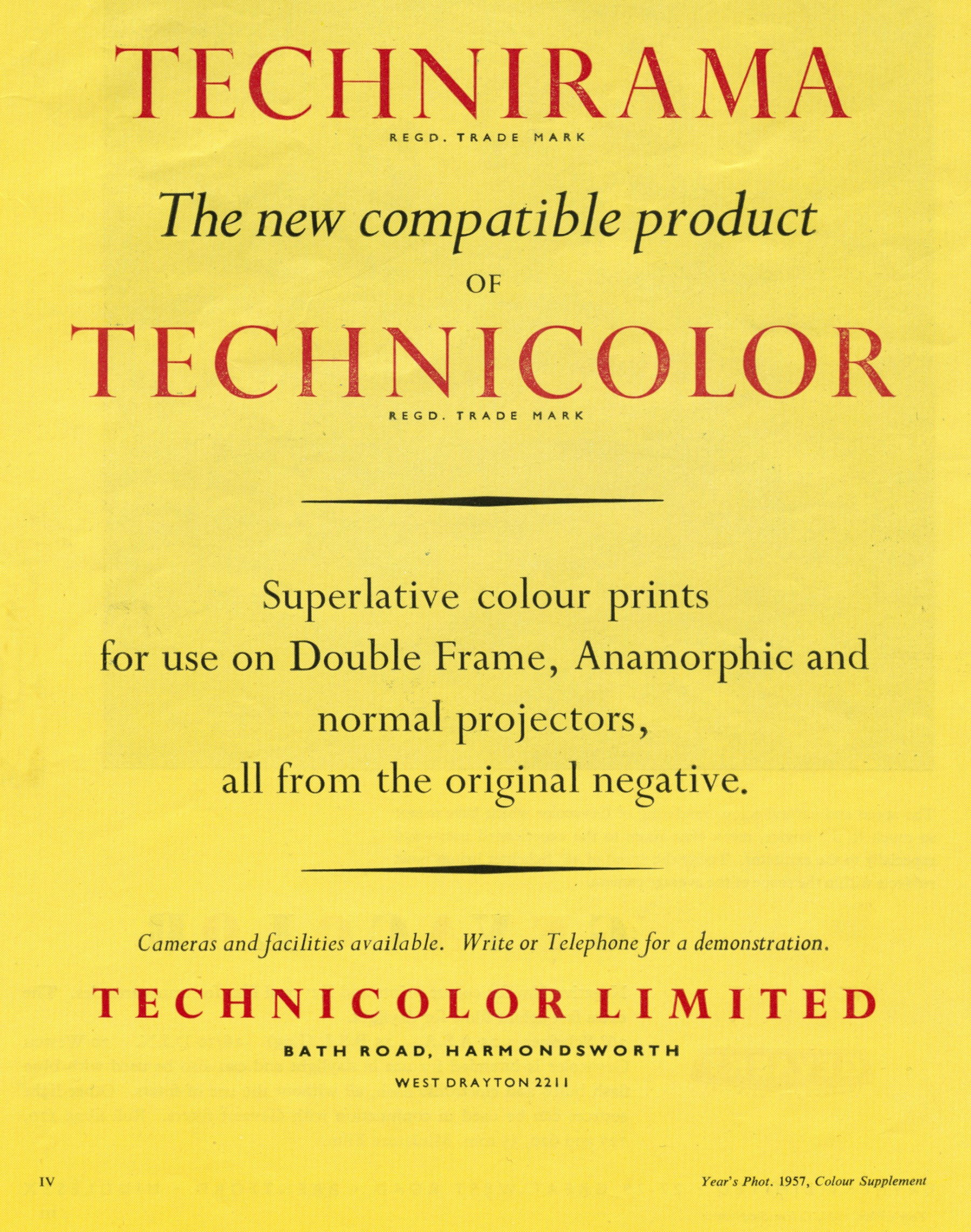
Trade advertisement. The Technirama format was devised by Technicolor’s London plant and was predominantly used on European productions.
Technicolor Corporate Archive, George Eastman Museum, Rochester, NY, United States.
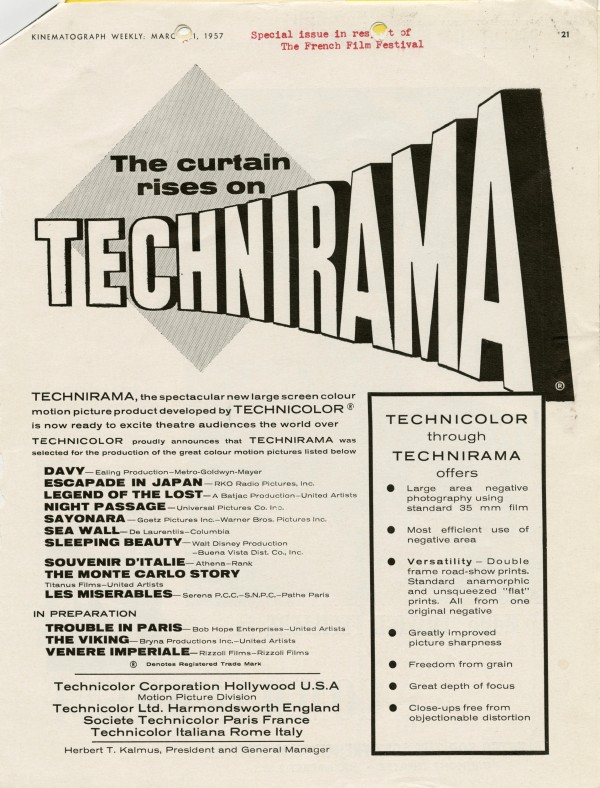
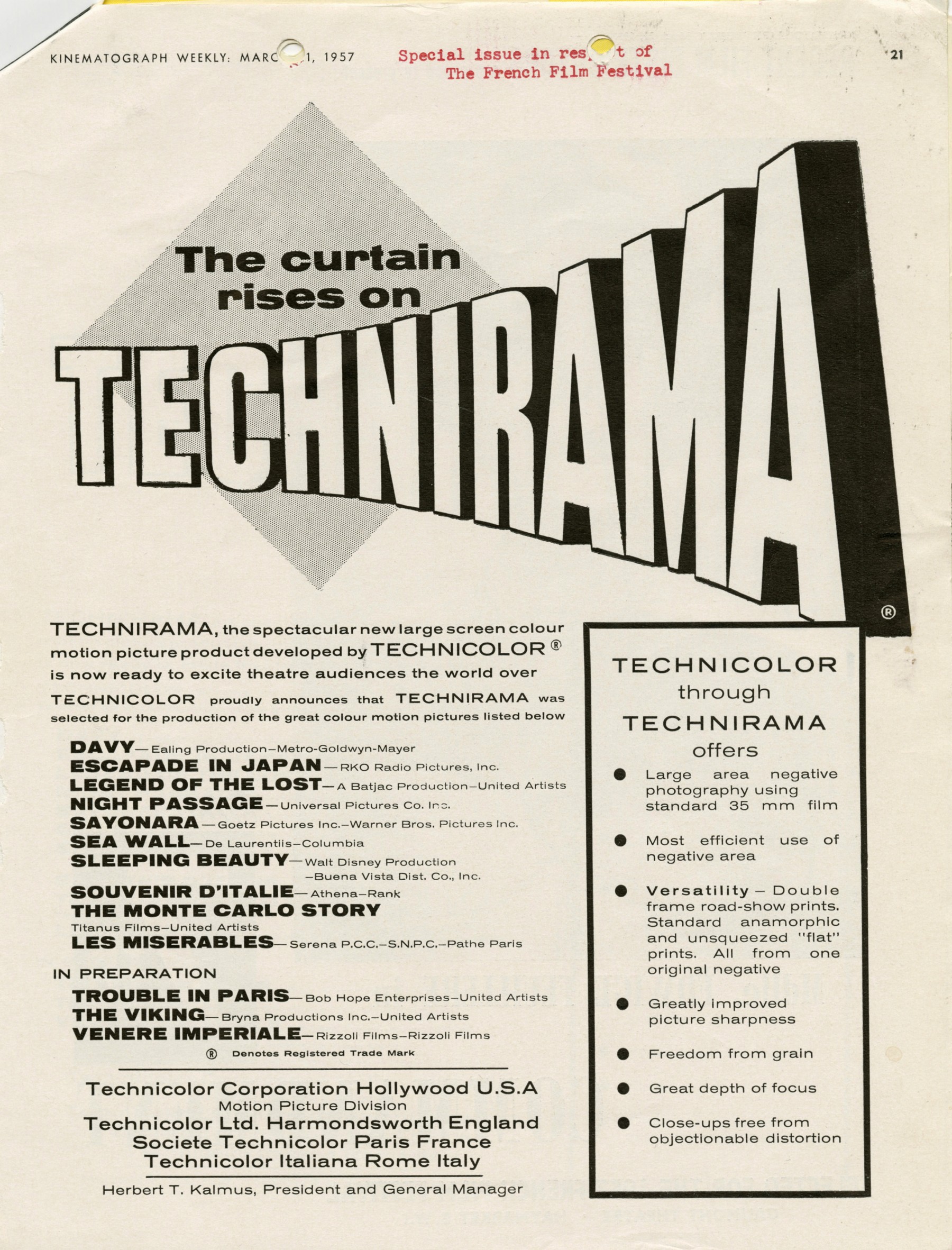
Trade advertisement, 1957. Due to the format’s increased clarity and resolution, Technirama was primarily used on big-budget productions, often featuring stunning location photography and epic crowd scenes.
Technicolor Corporate Archive, George Eastman Museum, Rochester, NY, United States.
Selected Filmography
This large-scale, big-budget western demonstrates Technirama photography at its most expansive, with cinematography by Franz Planer.
This large-scale, big-budget western demonstrates Technirama photography at its most expansive, with cinematography by Franz Planer.
A feature-length (100-minute) demonstration film, shown to the trade at the Odeon Leicester Square, London, on June 1, 1957. It does not appear to have been exhibited commercially.
A feature-length (100-minute) demonstration film, shown to the trade at the Odeon Leicester Square, London, on June 1, 1957. It does not appear to have been exhibited commercially.
By far the most critically regarded film photographed in Technirama, this Italo–French co-production was distributed in the US and UK in a dubbed version billed as being in CinemaScope, the proprietary process of local distributor Twentieth Century-Fox. Some sources remark that the color processing of this version was inferior to that of the European versions; another claims that the prints were nevertheless processed by Technicolor at its plant in Rome.
By far the most critically regarded film photographed in Technirama, this Italo–French co-production was distributed in the US and UK in a dubbed version billed as being in CinemaScope, the proprietary process of local distributor Twentieth Century-Fox. Some sources remark that the color processing of this version was inferior to that of the European versions; another claims that the prints were nevertheless processed by Technicolor at its plant in Rome.
A dance film shot on location in Spain, in co-production with the United Kingdom, this was the first of two Technirama pictures directed by Michael Powell, who had previously used both CinemaScope and VistaVision. It was followed by Powell’s British production The Queen’s Guards (1961).
A dance film shot on location in Spain, in co-production with the United Kingdom, this was the first of two Technirama pictures directed by Michael Powell, who had previously used both CinemaScope and VistaVision. It was followed by Powell’s British production The Queen’s Guards (1961).
The first feature shot in Technirama, an Italian production starring Marlene Dietrich and Vittorio De Sica, photographed by Giuseppe Rotunno, who would go on to shoot The Leopard (1963).
The first feature shot in Technirama, an Italian production starring Marlene Dietrich and Vittorio De Sica, photographed by Giuseppe Rotunno, who would go on to shoot The Leopard (1963).
The first Technirama production made by a major Hollywood studio: an otherwise undistinguished western, photographed by William Daniels and starring James Stewart and Audie Murphy.
The first Technirama production made by a major Hollywood studio: an otherwise undistinguished western, photographed by William Daniels and starring James Stewart and Audie Murphy.
Made on location in Norway and France, this medieval epic is among the most spectacular Technirama productions. Cinematographer Jack Cardiff had previously shot Legend of the Lost (1957) in Technirama and would go on to direct another Viking adventure, The Long Ships (1964), in the process. Richard Fleischer later directed Barabbas (1961), released in Super Technirama 70.
Made on location in Norway and France, this medieval epic is among the most spectacular Technirama productions. Cinematographer Jack Cardiff had previously shot Legend of the Lost (1957) in Technirama and would go on to direct another Viking adventure, The Long Ships (1964), in the process. Richard Fleischer later directed Barabbas (1961), released in Super Technirama 70.
Lineage
Technology
VistaVision had been developed by Paramount with the assistance of Technicolor. Technirama was conceived as an extension of both that process and the dye-transfer system of manufacturing prints. The last films photographed in three-strip Technicolor were made in 1955; thereafter, films handled by Technicolor labs were shot using color negatives modeled on the Eastman Color system but printed using the company’s imbibition process for making positive prints. The new widescreen technology enabled its three-strip cameras to be repurposed, as they already had been for VistaVision; they were also compatible with new purpose-built VistaVision cameras. Initial development of a “universal frame process”, able to generate prints in all types of format, was undertaken by Technicolor’s British plant under the direction of F. George Gunn. However, the anamorphic lenses built by Technicolor’s French and Hollywood plants proved unsatisfactory. An alternative was found in the Delrama lens system designed by Prof. Dr. Albert Bouwers of NV Optische Industrie De “Oude Delft” in the Netherlands. As Grant Lobban explains it: “This employed specially computed curved surface reflecting prisms, rather than cylindrical lenses or refracting prisms. It was an auxiliary attachment big enough to cover the larger diameter of the lenses needed to cover the double-frame negative and allowed for a maximum angle of view of about 60-degrees, equal to that of CinemaScope and the other systems then in use for general film making” (Lobban, 2000). According to Lobban, the trade name Technirama was thus derived from the combination of “Technicolor” and “Delrama”.
The negative film stock to be used in Technirama photography was of the same type used in VistaVision, transported horizontally through the camera, with each frame eight perforations wide (double the standard 35mm frame size). The fact that VistaVision frames were not only larger in surface area than those of standard 35mm film stock but slightly wider (with an aspect ratio of 1.43:1) meant that the additional anamorphic squeeze of Technirama did not need the same 2x compression factor as CinemaScope. Instead, a 1.5x squeeze for the negative was sufficient to yield an image with the same projected aspect ratio as CinemaScope’s 2.35:1. Standard anamorphic positive prints of Technirama retained the same specifications as CinemaScope, with a 2x squeeze, thereby making them compatible with theaters already equipped for that process. However, Technirama negative stock used in European and American production contexts had slightly differing specifications. The European system anticipated that some positive prints would be made in the same eight-perforation-wide, horizontal format as the negative, for projection by purpose-built projectors in roadshow situations. Space was therefore left above the frame for an optical soundtrack to be printed there, alongside and on top of the image. The American system anticipated that such prints would not be needed, as horizontal VistaVision projection had never taken off after only a handful of North American theaters had installed the equipment in 1954–5. US negative stock therefore utilized the full height of the frame between the sprockets, yielding an even larger picture area.
Two companies manufactured projectors for horizontal projection of eight-perf anamorphic prints. The Italian Micronlambda projector was employed for the public debut of Technirama with the premiere of The Monte Carlo Story at the Reposi, Turin, in December 1956. The British company Gaumont-Kalee’s machine was modeled on its previous VistaVision projector, but the “Vistatal” anamorphic lenses supplied for it by Taylor, Taylor & Hobson employed a different method of “unsqueezing” the image from the Micronlambda, “by compressing it vertically, rather [than] expanding it horizontally, which was said to give better results” (Lobban, 2000). However, this projector seems only to have been employed for the London trade demonstration on June 1, 1957, which included a feature-length demo film, The Curtain Rises on Technirama (1957), incorporating test footage and excerpts from forthcoming Technirama pictures. Aside from these two occasions, there are no other recorded instances of horizontal anamorphic projection in theaters, with one possible exception. A brief item in Sight and Sound by the French critic Louis Marcorelles claimed that Solomon and Sheba (1959), which had been premiered in standard non-anamorphic, vertical-feed 70mm at the Astoria Charing Cross Road in London, was presented differently at the Gaumont Palace in Paris. According to Marcorelles, the film was shown there in a 2:1 screen ratio and projected “by a double horizontal system like that used for VistaVision (with, it’s worth pointing out, English Gaumont-Kalee projectors specially installed for the occasion).” Marcorelles claimed that this presentation was far superior to that at the London Astoria, which was in a wider aspect ratio (2.21:1). He reported that, when seen in its native format, the process “attains equal clarity right across the width of the screen. Distortion and haziness at the edges of the screen are eliminated; and King Vidor is justified in his claim that ‘the features of an extra at the extreme periphery of the screen are perfectly discernible.’ One couldn’t say this of the London version” (Marcorelles, 1960: p. 69). It should be noted that this account has not been corroborated by any other source. What can be said with confidence is that horizontal projection did not catch on with Technirama any more (indeed, rather less) than it had with VistaVision.
A short introductory documentary about the Technirama process. George Eastman Museum, Rochester, NY, United States.
A relative handful of Technirama films were supplied with four-track magnetic stereo soundtracks, mono being standard on 35mm Technirama release prints. Robert E. Carr and R. M. Hayes (Carr & Hayes, 1988) identify only eight Technirama films as having stereo soundtracks, including Sayonara (1957) and Auntie Mame (1958). In addition, some 35mm prints of films released in Super Technirama 70 also had stereo tracks, including Spartacus (1960) and Zulu (1964). The distinctive strength of the 35mm prints was in their dye-transfer color process. Surviving original copies retain the rich color values of IB Technicolor and the spectacular clarity claimed for Technirama photography by its first promoters, whereas most 70mm prints, even when manufactured by Technicolor labs, have faded as the imbibition process was never used for large-format printing.
One disadvantage of Technirama by comparison with other widescreen and large-frame processes was that the use of a frame twice the size of regular 35mm meant that twice as much footage was used up in photography, necessitating frequent reloading of cameras and increasing the stock allocation (Technicolor’s initial promotion suggested that this was in the order of “only” a 60 per cent increase, as Technirama’s greater definition permitted more use of master shots and fewer setups). This most likely led to Technirama being superseded by other processes, most notably Panavision and Technicolor’s own Techniscope (which used a frame half the size of regular 35mm), that were significantly cheaper and more efficient, if not as satisfactory in their end results.
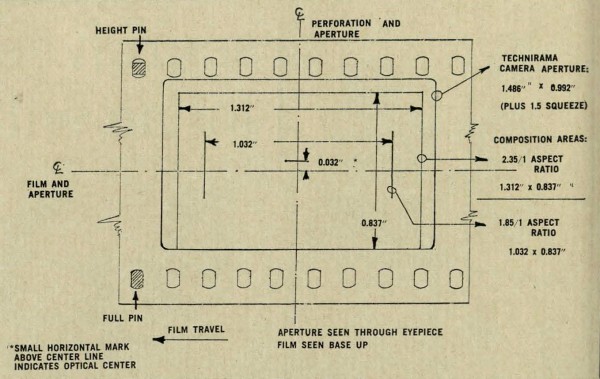
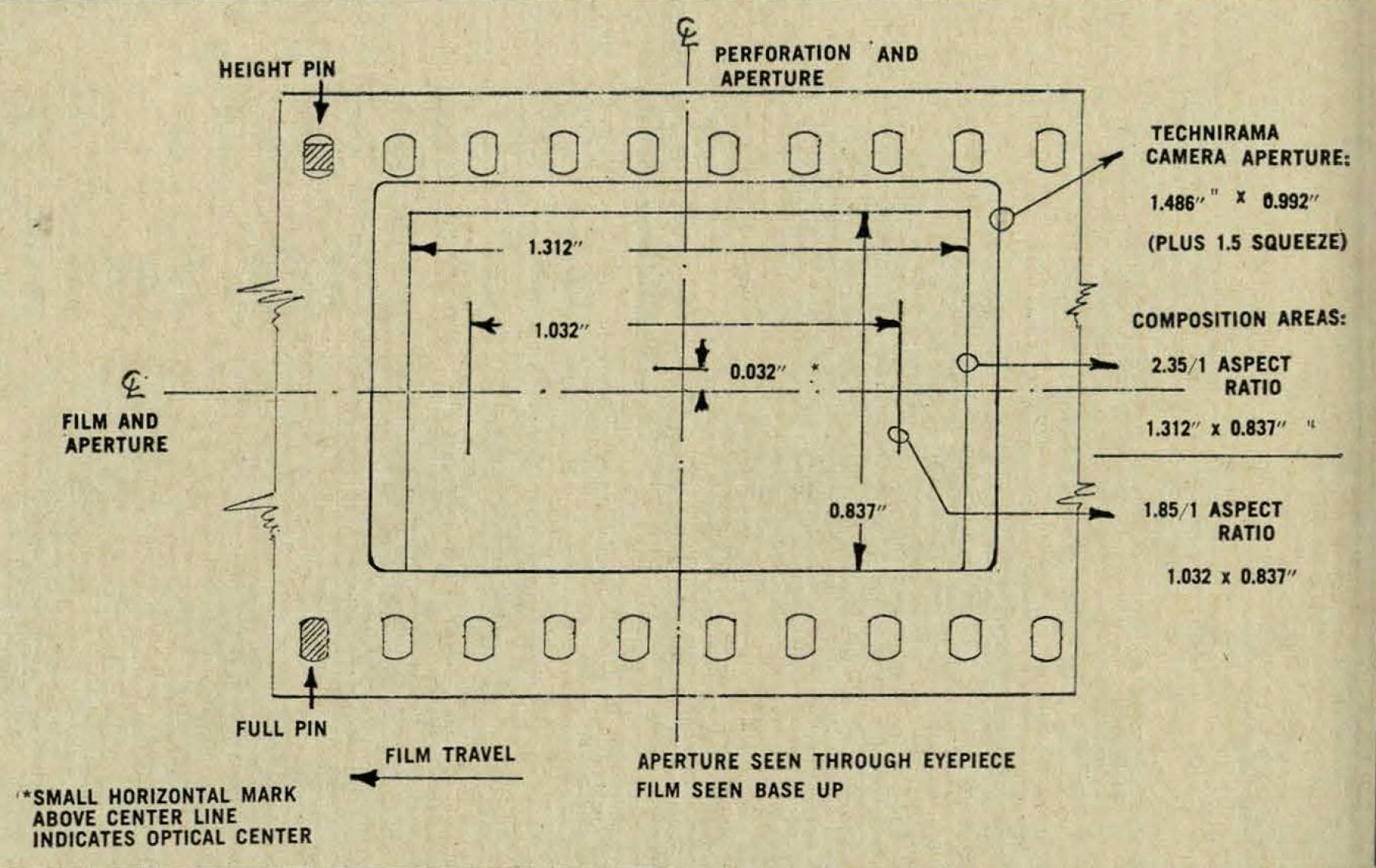
Technical specifications of the 8-perforation horizontal negative.
Beyer, Walter (1966). “The Technirama and VistaVision Systems”, American Cinematographer, 47:10 (Oct.): p. 702.
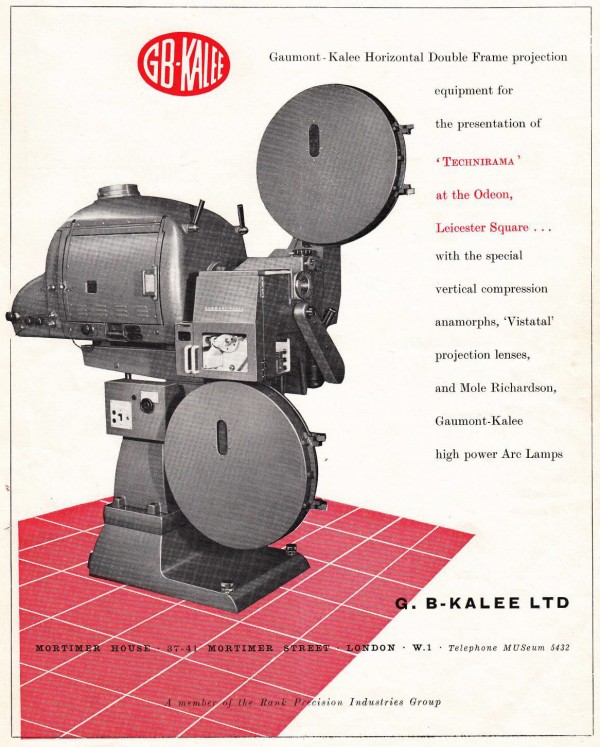
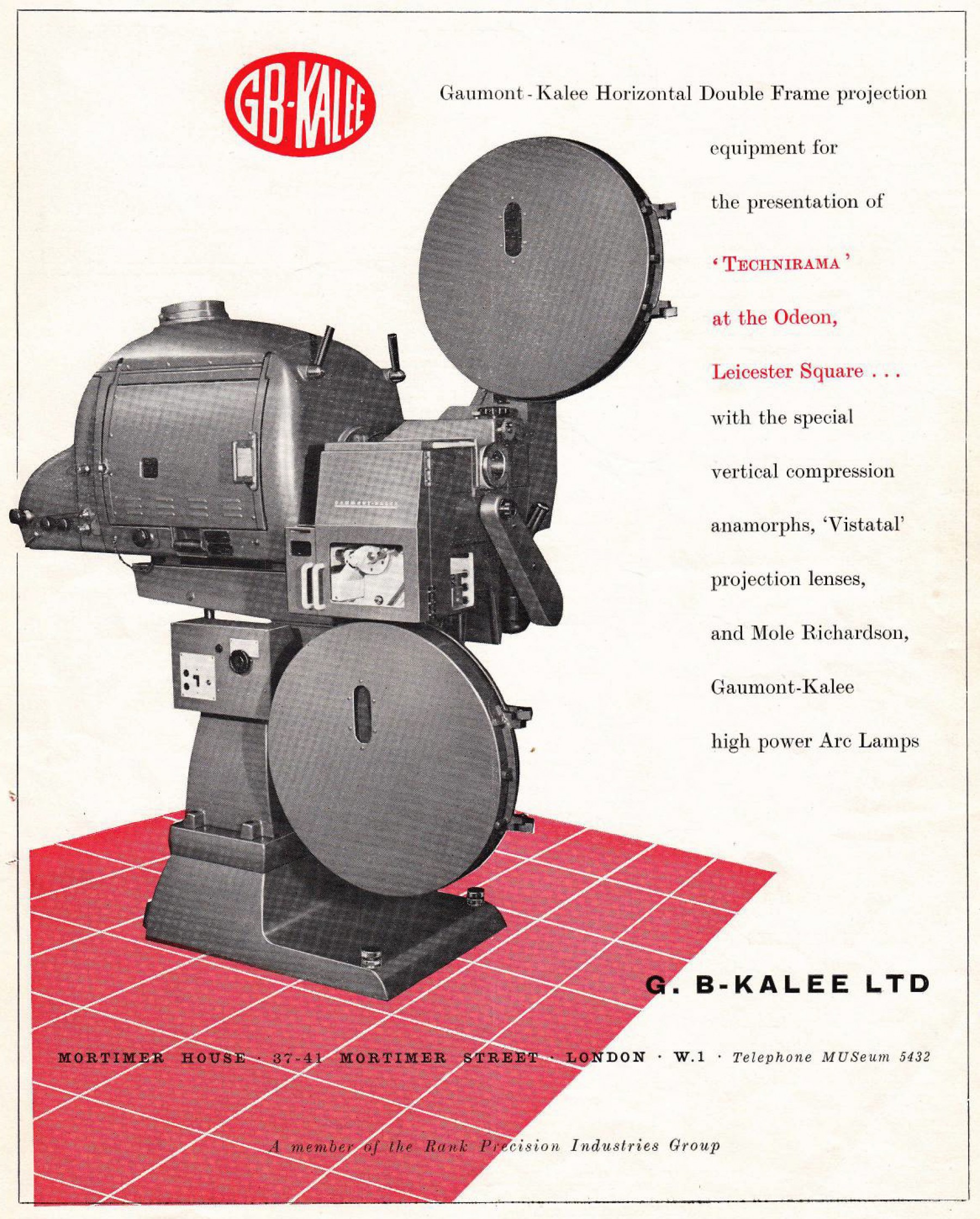
A limited number of Technirama screenings were presented in 8-perforation horizontal prints.
G. B-Kalee advertisement (1957). Supplement to Kinematograph Weekly (May 30): p. v.
References
American Widescreen Museum (2013). “Technirama”. American Widescreen Museum (website). https://www.widescreenmuseum.com/widescreen/wingtr1.htm (accessed Jul. 26, 2026).
Carr, Robert E. & R.M. Hayes (1988). Wide Screen Movies: A History and Filmography of Wide Gauge Filmmaking. Jefferson, NC & London: McFarland, p. 162.
Gunn, George (1959). “Technirama”. British Kinematography, 34:4: pp. 94–8.
International Projectionist (1957). “Technirama Process Debuts in Italy”. International Projectionist, 32:5 (May): p. 21.
Kinematograph Weekly (1957a). “Production from Edison to Technirama”. Kinematograph Weekly, 479:2588 (Mar. 21): p. 7.
Kinematograph Weekly (1957b). “Kine Technirama Special”. Kinematograph Weekly, 481:2598 (May 30): Supplement.
Lobban, Grant (2000). “The Technirama Story”. In70mm, 61 (Jun.; updated Sep. 2000). https://www.in70mm.com/presents/1959_technirama/library/story/index.htm (accessed Jul. 26, 2026).
Marcorelles, Louis (1960). “Projection Standards”. Sight and Sound, 29:2 (Spring): pp. 69.
Roberts, Steven Francis (2019). “High Fidelity Widescreen Cinema: VistaVision Film Production and Style in Britain and the USA”, PhD diss., University of Bristol.
Rowan, Arthur (1957). ““Night Passage” – First in New Technirama Large-Screen System”. American Cinematographer, 38:3 (Mar.): pp. 148–9 & 182.
Sherlock, Daniel J. (1994–2004). “Widescreen Movies Corrections”. https://www.in70mm.com/news/2014/mitchell_book/_images/WSMC20.pdf (accessed Jul. 26, 2026).
Variety (1956). “Technicolor’s New Widescreen Process”. Variety, 204:3 (Sep. 19): p. 7.
Variety (1957a). “B&W Stronger, Kodak In; Feel Both at Techni”. Variety, 206:7 (Apr. 17): p. 13.
Variety (1957b). “Technirama Makes Hit at London Screening”. Variety, 207:3 (Jun. 19): p. 14.
Variety (1958). “Kalmus Sees Better Technicolor Year; Barbs Fly at Annual Owners’ Meet”. Variety, 210:12 (May 21): p. 13.
See also the Super Technirama 70 pages at in70mm.com, https://www.in70mm.com/presents/1959_technirama/index.htm
Patents
Gunn, Frank George, Photographic Production of Anamorphous Records. US patent 3,165,969, filed October 24, 1955, and issued January 19, 1965. https://patents.google.com/patent/US3165969A/
Preceded by
Followed by
Compare
Related entries
Author
Sheldon Hall is an Emeritus Fellow at Sheffield Hallam University, UK, where he taught for 27 years. Graduating from the University of Warwick with a degree in Film and Literature, he became a freelance journalist and lecturer, serving as film critic for the major regional newspaper The Northern Echo from 1986 to 1997 before becoming a full-time academic. Hall has an MA and a PhD in Film Studies from the University of East Anglia. He is the author of Zulu: With Some Guts Behind It – The Making of the Epic Film (2005; 2nd edn, 2014) and Armchair Cinema: A History of Feature Films on British Television, 1929–1981 (2024); co-author (with Steve Neale) of Epics, Spectacles, and Blockbusters: A Hollywood History (2010); and co-editor of Widescreen Worldwide (2010) and Film Critics and British Film Culture: New Shots in the Dark (2025). In addition, he has contributed chapters and articles on British and American film history to numerous books and journals. His research interests include Hollywood and British cinema; film criticism, textual analysis and film aesthetics; widescreen cinema; film distribution and exhibition; and films on television.
Hall, Sheldon (2026). “Technirama”. In James Layton (ed.), Film Atlas. www.filmatlas.com. Brussels: International Federation of Film Archives / Rochester, NY: George Eastman Museum.