Super Technirama 70(1959–1985)
A large-gauge widescreen exhibition format, utilizing non-anamorphic, vertical-feed 70mm positive prints derived from anamorphic, horizontal-feed 35mm negatives, developed by Technicolor.
Film Explorer
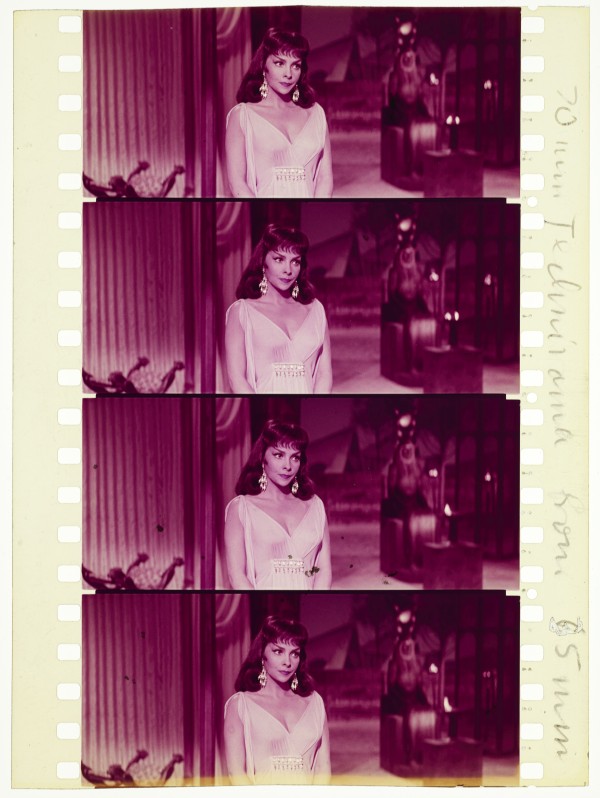
A color-faded 70mm Super Technirama 70 print of Solomon and Sheba (1959), without magnetic striping.
National Science and Media Museum, Bradford, United Kingdom.
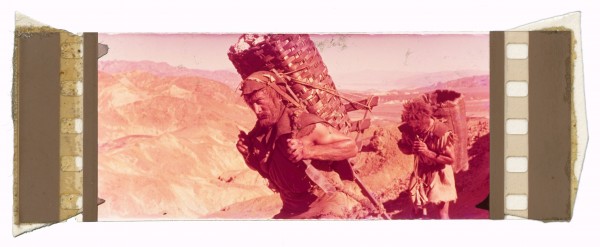
A color-faded 70mm Super Technirama 70 frame clipping of Spartacus (1960), with 6-track magnetic striping, partially obscured by tape.
Earl I. Sponable Collection, Columbia University, New York, NY, United States.
Identification
48.59mm x 21.99mm (1.913 in x 0.866 in).
Eastman Color.
Standard Eastman Kodak edge markings.
1
Surviving 70mm Eastman Color prints all suffer from heavy color fading, except where they have been preserved in sub-zero conditions, such as at the Scandinavian film archives.
Technirama; Technirama-70, 70mm Super Technirama; Super Technirama 70, Super Technirama-70; Super-Technirama 70; Filmed in SUPER TECHNIRAMAⓇ–70
6-track stereo applied as magnetic stripes along the film’s edges.
and a control signal.
US: 37.74mm x 25.19mm (1.486 in x 0.992 in); Europe: 37.59mm x 23.24mm (1.480 in x 0.915 in).
Eastman Color.
Standard Eastman Kodak edge markings.
History
[This essay is a continuation of Technirama.]
Although trade advertisements for Technirama had from its inception promised “Standard or road-show prints all from the same negative”, none of the early films made in the process was released on a roadshow basis. The sole confirmed public presentation of a Technirama film in its native double-frame, horizontal-feed 35mm format was the premiere run of The Monte Carlo Story (1956) at the Reposi theater in Turin, Italy, which does not seem to have had any successors, with one possible exception. It was not until late 1958 that a spinoff process, Technirama 70, was first mentioned in the trade press as an exhibition format utilizing 70mm positive prints and six-track magnetic stereophonic sound. The inaugural title released in this process (still billed on screen simply as Technirama) was Walt Disney’s $6 million animated feature Sleeping Beauty (1959). In the US, the 75-minute film was exhibited on a “grind” basis (continuous performances, unreserved seats), but with roadshow-level ticket prices scaled up to $2.40 to help Disney recover the huge production cost, though the film still lost money on first release. Overseas, Sleeping Beauty played some “hard-ticket” roadshow engagements (separate performances, reserved seats), for example at the Astoria Charing Cross Road in London’s West End.
The first live-action Technirama film released in 70mm, Solomon and Sheba (1959), was launched more widely (though not universally) as a “true” hard-ticket roadshow, with marketing materials announcing another new process name, Super Technirama 70, though the on-screen titles again credited only Technirama. The commercial viability of the format having been established by the moderate success of Solomon and Sheba, it was subsequently employed on several other roadshow pictures, including Spartacus (1960), Barabbas (1961) and four produced by Samuel Bronston from his base in Spain, albeit with international financing: King of Kings, El Cid (both 1961), 55 Days at Peking (1963), and Circus World (aka The Magnificent Showman, 1964). The last of these was initially exhibited in Cinerama theaters, which had switched to single-strip projection from a variety of 70mm formats to fill their deeply curved screens. According to Grant Lobban, the prints used for Cinerama exhibition were “rectified” to fit the screens by retaining the anamorphic squeeze at the outer edges of the negative frame, which appeared undistorted when projected due to the deeper curvature of the screen at its sides (Lobban, 2000). Four more Super Technirama 70 films were also presented “in Cinerama”: La Fayette (1962), The Golden Head (1964), Custer of the West (1967) and a promotional short, Shellarama (1965). From circa 1961, most films photographed in Technirama were announced for release in Super Technirama 70, but there is some doubt over how many actually were exhibited in 70mm, or how widely. Definite 70mm sightings can be confirmed for Un, deux, trois, quatre! (aka Black Tights, 1960), Zulu and The Long Ships (both 1964). Other Technirama films may have been shown in 70mm exclusively in continental Europe, Latin America, South Africa, Australasia, or Japan, markets where large-format screenings were more commonplace than in the US and UK.
Following Custer of the West and another western produced in Europe, Clint the Lonely Nevadan (aka Clint the Stranger, 1967), Super Technirama 70 seemed to disappear as surely as did its 35mm counterpart, squeezed out by the widespread adoption of Panavision and by the availability from 1963 of 70mm blow-up prints from standard anamorphic 35mm negatives. But in the 1980s it made a partial comeback through two more Disney features. A Technirama negative was used during post-production for the computer-animated portions of Tron (1982), the live-action scenes being shot in Super Panavision, and for the whole of the traditionally animated feature The Black Cauldron (1985), which was extensively released in 70mm prints. The latter film proved even more of a commercial disappointment than Sleeping Beauty 26 years earlier, and the process was thereafter retired permanently. So obsolete had the technology become within just a few years that when Robert A. Harris and James C. Katz came to restore Spartacus for rerelease in 1991, they were unable to locate equipment to print onto 70mm from the Technirama protection masters (the negative having faded beyond the point of usability). Harris commented: “I really don’t want to deal with Technirama again. It’s a bastard of a process, as if VistaVision and CinemaScope got together for an evening of incredible pleasure and their child was Technirama, the worst of the two processes” (Kelleher, 1991).
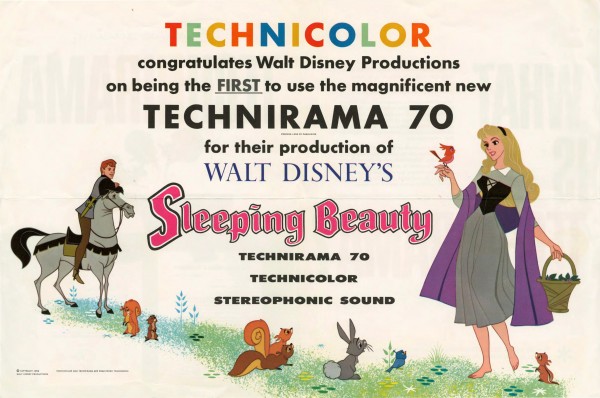
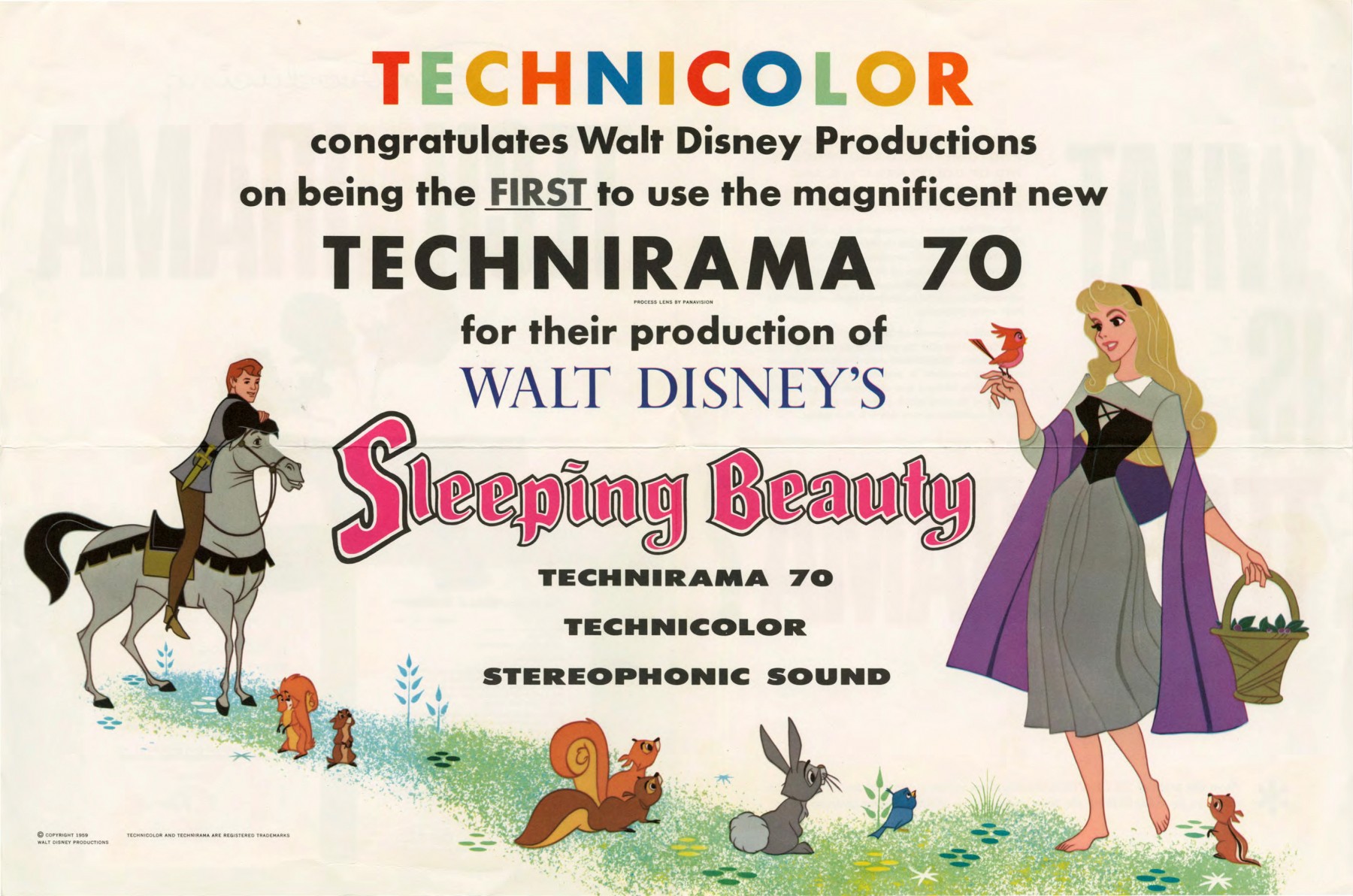
Trade advertisement for the first Super Technirama 70 release, Sleeping Beauty (1959). At this time, the format was known as Technirama 70.
Technicolor Corporate Archive, George Eastman Museum, Rochester, NY, United States.
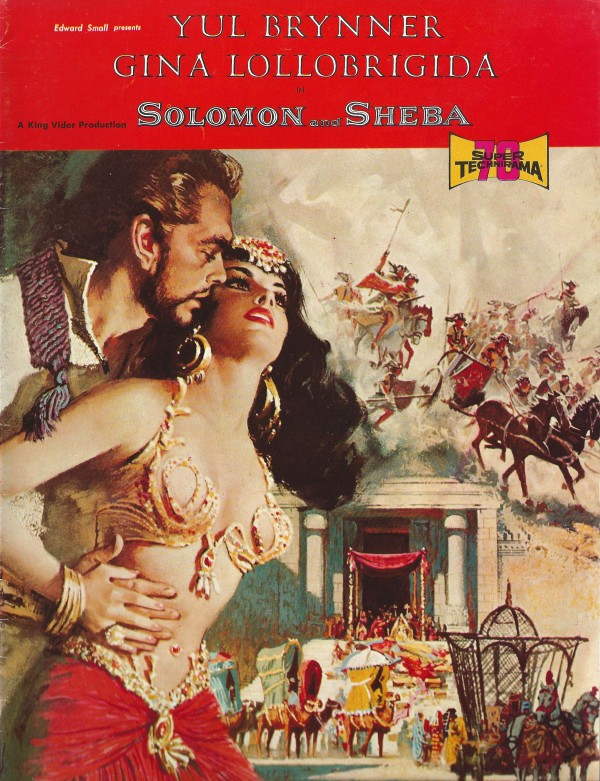
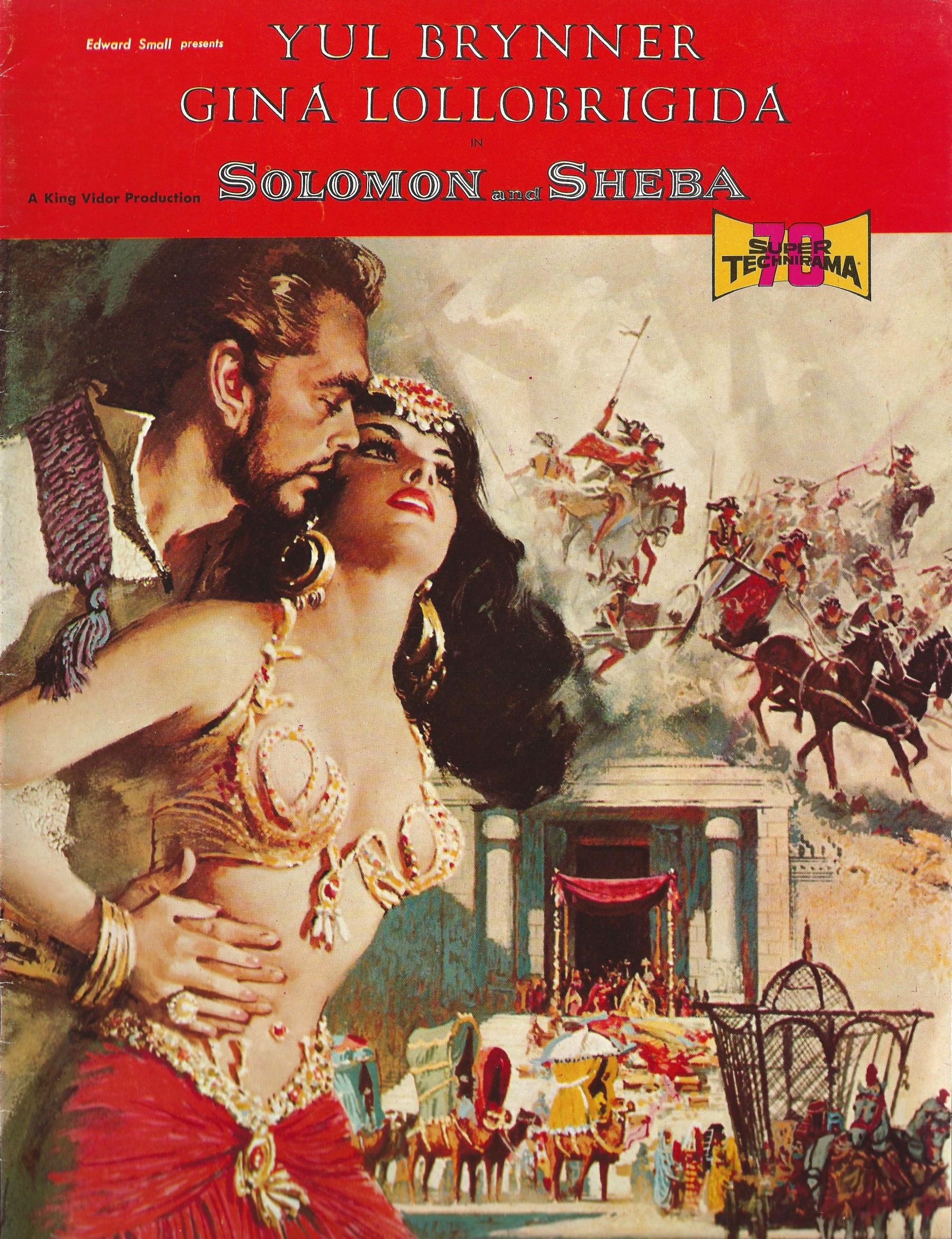
US souvenir program brochure for Solomon and Sheba (1959), the first live-action Super Technirama 70 release.
Courtesy of Sheldon Hall.
Selected Filmography
The final film photographed in Technirama, a second Disney animated feature. The on-screen titles carry no credit for the photographic process and press advertisements for 70mm engagements mentioned only “70mm” in billing rather than “Super Technirama 70”.
The final film photographed in Technirama, a second Disney animated feature. The on-screen titles carry no credit for the photographic process and press advertisements for 70mm engagements mentioned only “70mm” in billing rather than “Super Technirama 70”.
Commercially the most successful Super Technirama 70 release, this medieval epic was extensively roadshown throughout the world by a variety of territorial distributors. Five of producer Samuel Bronston’s six Spanish-based super-productions were shot in Technirama, four of them being released in 70mm. Anthony Mann had directed the first Hollywood film shot in Technirama, Night Passage (1957), and had begun shooting Spartacus before being replaced by Stanley Kubrick. Its restoration and reissue in 1993 utilized only 35mm prints.
Commercially the most successful Super Technirama 70 release, this medieval epic was extensively roadshown throughout the world by a variety of territorial distributors. Five of producer Samuel Bronston’s six Spanish-based super-productions were shot in Technirama, four of them being released in 70mm. Anthony Mann had directed the first Hollywood film shot in Technirama, Night Passage (1957), and had begun shooting Spartacus before being replaced by Stanley Kubrick. Its restoration and reissue in 1993 utilized only 35mm prints.
The first Asian picture released in 70mm, this Japanese production dramatizes the life of the sixth-century Indian prince Siddhartha and his spiritual journey to becoming the founder of the Buddhist religion. The film had only limited exhibition in the West.
The first Asian picture released in 70mm, this Japanese production dramatizes the life of the sixth-century Indian prince Siddhartha and his spiritual journey to becoming the founder of the Buddhist religion. The film had only limited exhibition in the West.
Photographed in Technirama with the successive-exposure method used to film cartoons in Technicolor, this animated feature launched “Technirama 70” as an exhibition format. According to film historian Michael Coate, original 70mm release prints retained the 2.55:1 aspect ratio, hard-matted within the 2.21:1 frame, of the Technirama negative (Coate, 2010).
Photographed in Technirama with the successive-exposure method used to film cartoons in Technicolor, this animated feature launched “Technirama 70” as an exhibition format. According to film historian Michael Coate, original 70mm release prints retained the 2.55:1 aspect ratio, hard-matted within the 2.21:1 frame, of the Technirama negative (Coate, 2010).
The first live-action Technirama film utilizing 70mm release prints. The budget of this biblical epic ballooned following the death during production of its initial star, Tyrone Power, and the consequent need for extensive reshoots with his replacement, Yul Brynner. The increased cost has been linked by some to the subsequent decision to roadshow the film at raised prices.
The first live-action Technirama film utilizing 70mm release prints. The budget of this biblical epic ballooned following the death during production of its initial star, Tyrone Power, and the consequent need for extensive reshoots with his replacement, Yul Brynner. The increased cost has been linked by some to the subsequent decision to roadshow the film at raised prices.
Promoted as the most expensive film up to its time to have been largely shot in North America, this large-scale, three-hour Roman epic – photographed by Russell Metty and produced by its star, Kirk Douglas – was the first to carry an onscreen credit for Super Technirama 70. In 1991, it was restored and reissued with new 70mm prints.
Promoted as the most expensive film up to its time to have been largely shot in North America, this large-scale, three-hour Roman epic – photographed by Russell Metty and produced by its star, Kirk Douglas – was the first to carry an onscreen credit for Super Technirama 70. In 1991, it was restored and reissued with new 70mm prints.
Though produced on only a moderately sized budget (under $2 million), this spectacular reconstruction of a nineteenth-century colonial battle is immeasurably enhanced by Stephen Dade’s photography. Although it was widely seen and highly popular in 35mm anamorphic prints, the film’s release in Super Technirama 70 was more sporadic, 70mm prints not being available in its country of origin, the United Kingdom, until a 1972 reissue. The latter was launched with a roadshow engagement at London’s Casino Cinerama theater.
Though produced on only a moderately sized budget (under $2 million), this spectacular reconstruction of a nineteenth-century colonial battle is immeasurably enhanced by Stephen Dade’s photography. Although it was widely seen and highly popular in 35mm anamorphic prints, the film’s release in Super Technirama 70 was more sporadic, 70mm prints not being available in its country of origin, the United Kingdom, until a 1972 reissue. The latter was launched with a roadshow engagement at London’s Casino Cinerama theater.
Lineage
Technology
[See Technirama for this format’s original technical specifications.]
70mm Super Technirama 70 prints were optically printed directly from their 35mm horizontal negative. Technicolor Limited’s technical director Bernard Happé described the optical printing steps in detail in a 1961 lecture:
Super Technirama-70 uses 5250 type Eastman Color Negative, which receives special processing to improve its resolution and to reduce the print value of its grain structure. Once processed, the negatives may be handled on conventional 35mm negative handling equipment.
From this Technirama negative, a wide variety of print types may be made. For “road show” usage 70mm width prints are made on Eastman Color Positive 5382 stock. These are the prints that are known as Super Technirama-70. They are produced on an optical printer, making use of liquid printing techniques [...]. This process all but eliminates the print value of any residual negative grain and surface defects.
In the printing process, the negative moves horizontally and is illuminated by means of an additive illumination optical system, which provides very precise and reproducible scene to scene printing exposure.
The printing image is formed on the 70mm print stock by means of a specially designed lens which removes the [1.5x] anamorphic compression in the negative image, thereby producing an undistorted image. (Happé, 1961)
Souvenir program brochures for Solomon and Sheba (1959) and promotional booklets sold in theaters carried the process logo and attempted to explain the technology behind it, noting: “Super Technirama-70 is the only completely universal photographic and projection system in that, while it reaches the peak of perfection when shown in theatres equipped with Super Technirama-70 projectors which fill its giant screen, the double-frame negative may be printed in practically any other standard motion picture size with an enormous increase in clarity over any other negative system.”
Spartacus (1960) was the first Super Technirama 70 release to carry a credit for Panavision lenses, as well as being the first to credit the process itself by its new name on-screen. But in stating “Filmed in Super Technirama-70”, Spartacus also initiated the confusion which has dogged the process ever since. Contrary to the implications of this credit, which was widely used in screen titles and on promotional materials, films released in Super Technirama 70 were not photographed any differently from those released “only” in 35mm Technirama. “Super Technirama” properly referred to the printing and exhibition format, not to photographic origination, which was identical with that of regular Technirama films.
The specifications of the 70mm prints were identical with those for prints in Todd-AO, Super Panavision and other spherical processes, making them fully compatible with existing theater projection equipment. Similarly, the six magnetic soundtracks striped on the prints were identical with those used for these other formats. However, not all Super Technirama 70 films were fully stereophonic: some titles, such as The Long Ships (1964), were apparently equipped only with monaural soundtracks despite their six-track format. Although Technicolor never used dye-transfer imbibition (IB) printing for the large format, the 70mm prints made by its labs were of superior quality: “The negatives were specially processed (zircotan bleach) to give them an image with the grain and contrast characteristics more suitable for optical printing. As the number of prints were relatively small, the original negative was always used” (Lobban, 2000). Lobban also notes that Technicolor’s 70mm prints were made with an optical step printer rather than contact printing.
The popularity of Technirama and Super Technirama 70 with producers based in Europe may have been partly due to the limited availability of 65mm negative processing facilities outside North America. Technicolor had laboratories in London (and briefly Paris), opening another plant in Rome in 1958. However, the introduction in 1963 of Panavision’s blow-up process for making 70mm prints from regular 35mm negatives may have had an adverse impact on Technirama, just as it ultimately did on 65mm-originated processes.
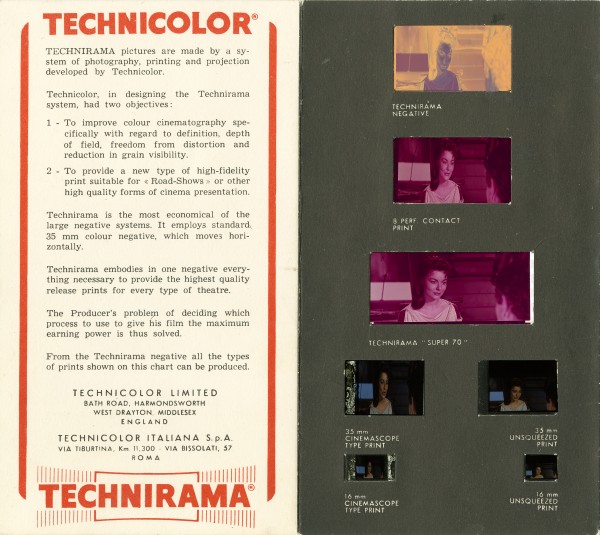
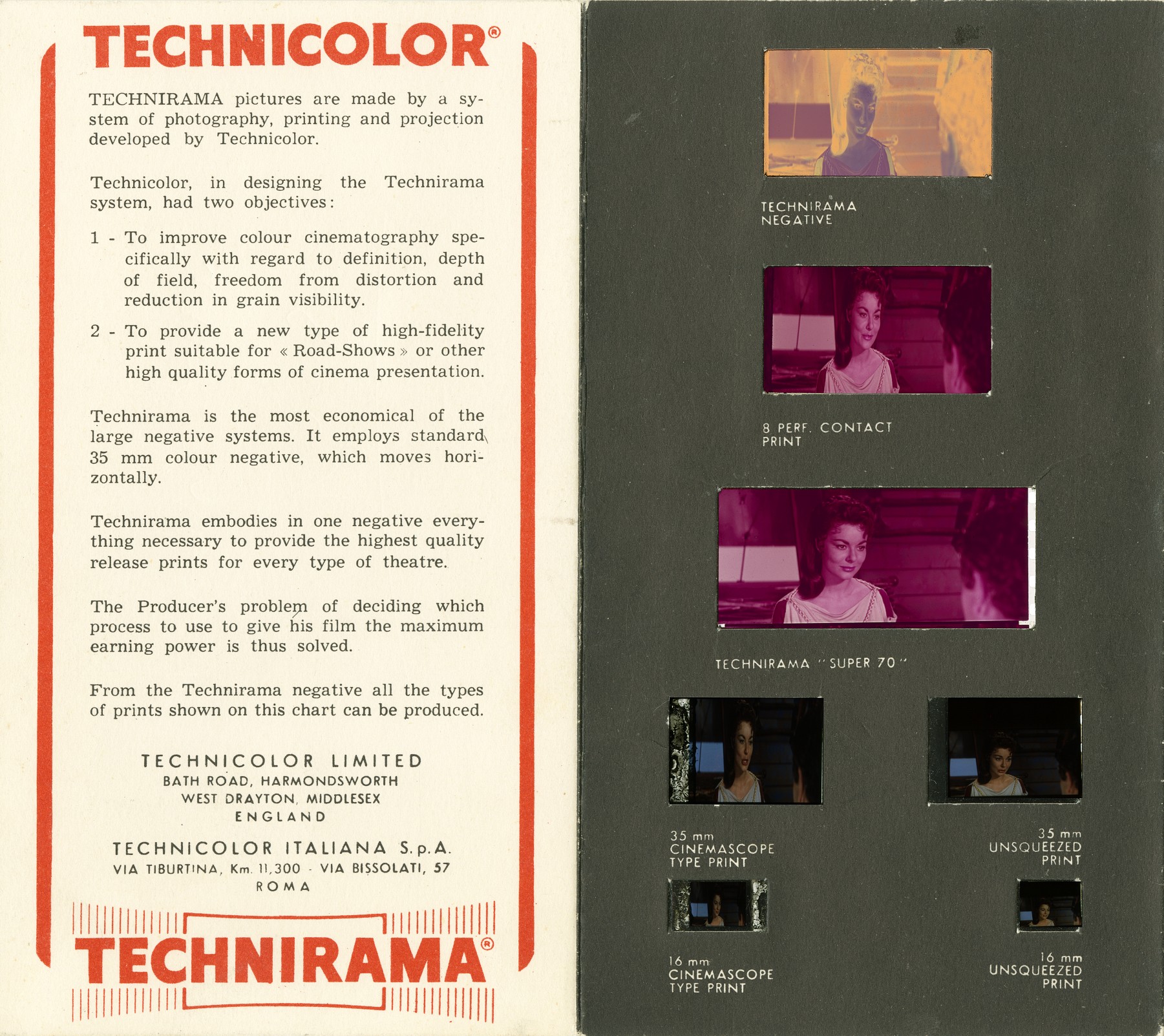
Technirama promotional booklet containing mounted film frames demonstrating the multiple print formats that could be derived from the Technirama negative.
Technicolor Corporate Archive, George Eastman Museum, Rochester, NY, United States.
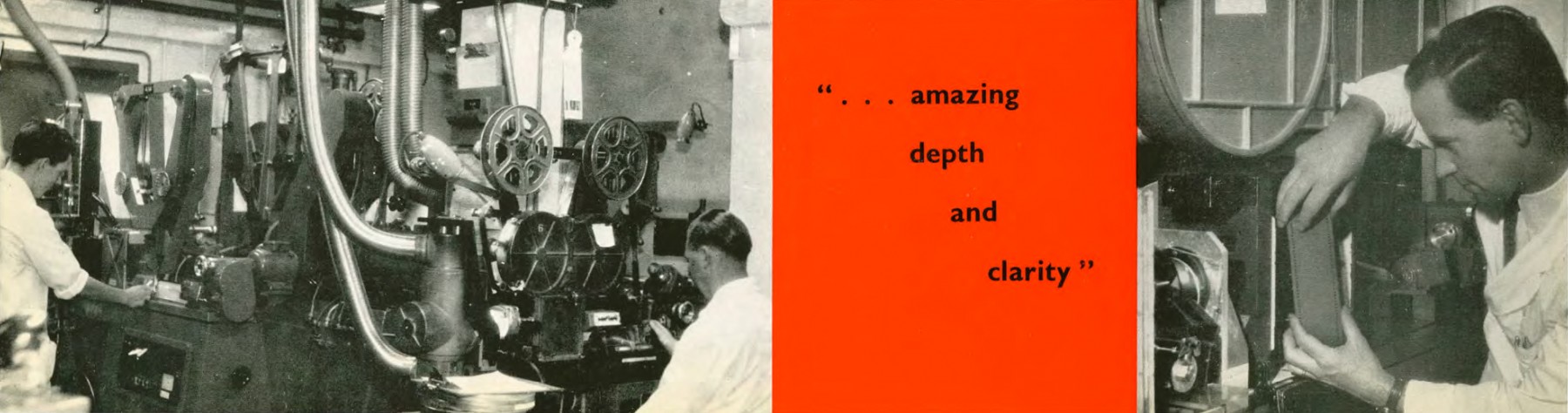
The optical printers used by Technicolor Limited in London to make 70mm Super Technirama 70 prints.
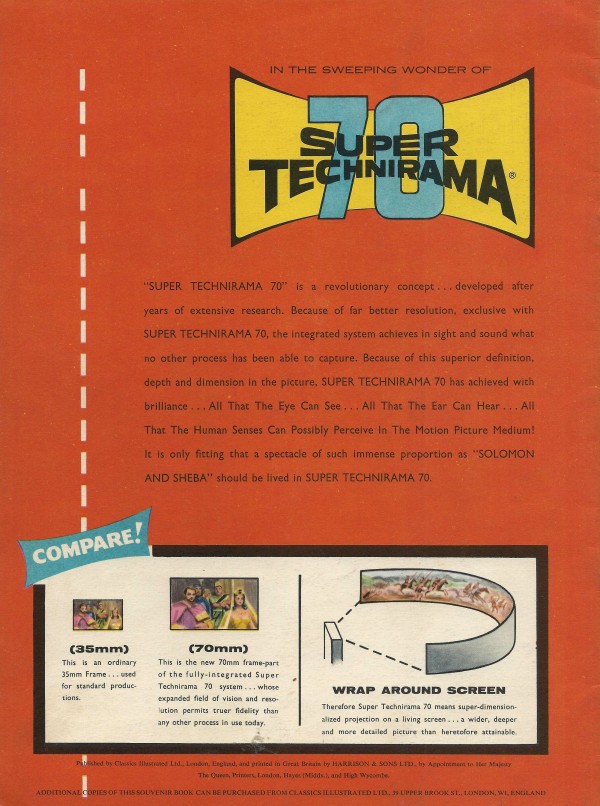
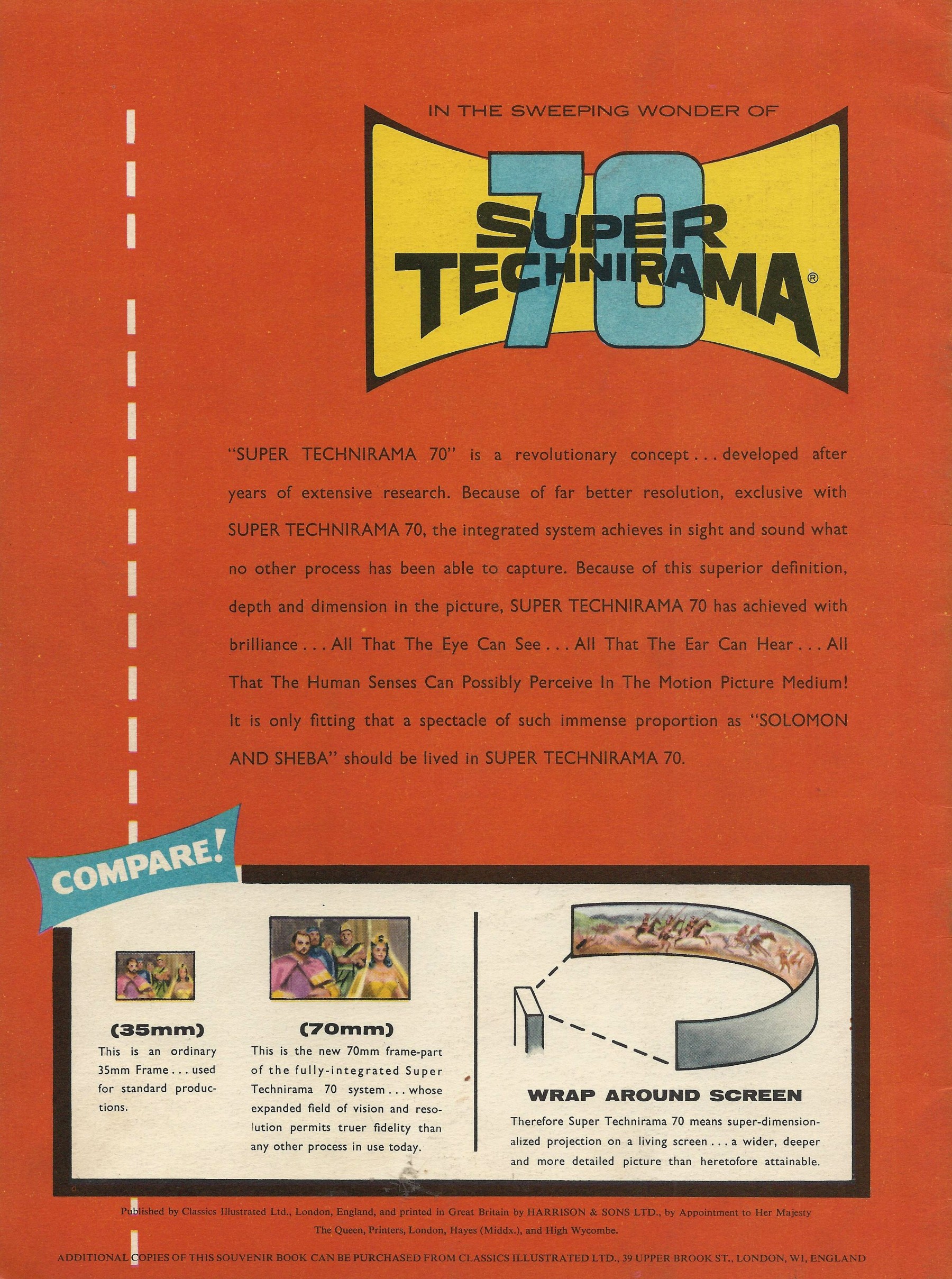
The back cover of the UK souvenir program brochure for Solomon and Sheba (1959) highlights the immersive nature of Super Technirama 70.
Courtesy of Sheldon Hall.
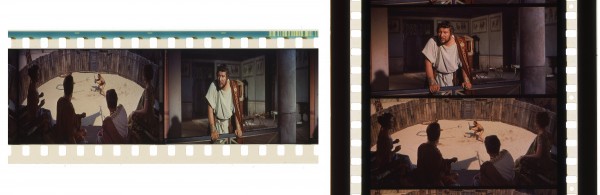
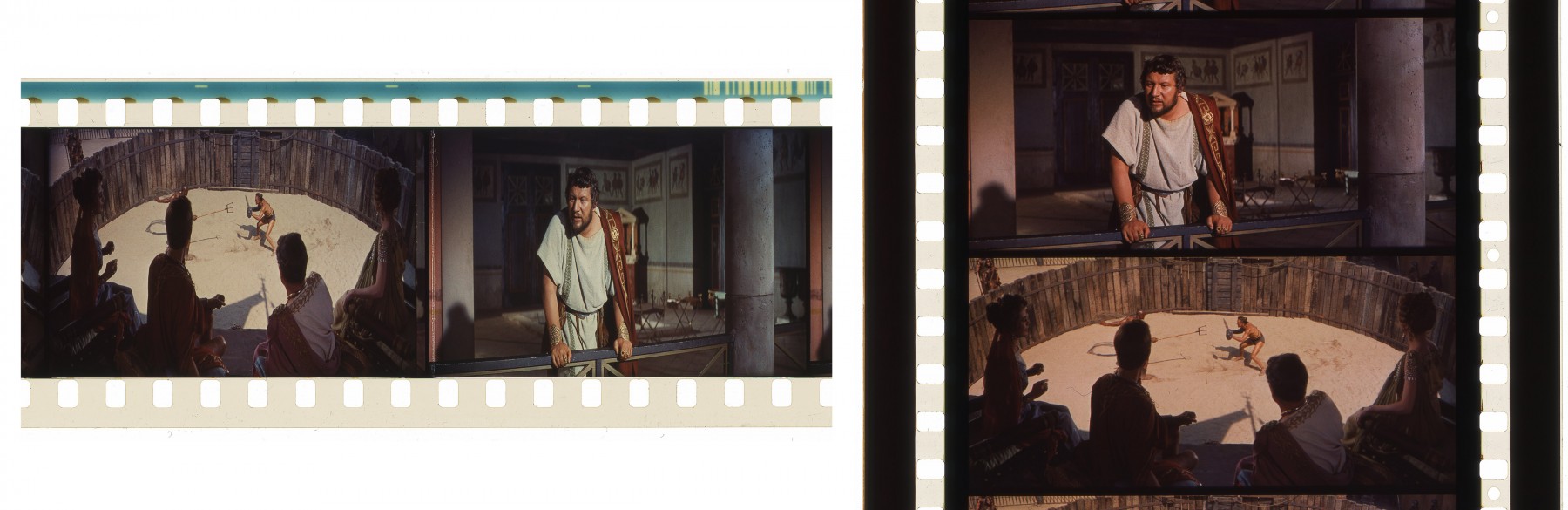
Two elements made during the 1991 restoration of Spartacus (1960). Left: A 35mm horizontal contact print made directly from the Technirama camera negative with anamorphic compression. Right: The unsqueezed widescreen image on a 70mm print.
Courtesy of Thomas Hauerslev (in70mm.com).
References
Anon. (1959). Solomon and Sheba souvenir program brochure. Author’s collection.
American Widescreen Museum (2013). “Technirama”. American Widescreen Museum (website). https://www.widescreenmuseum.com/widescreen/wingtr1.htm (accessed Jul. 27, 2026).
Carr, Robert E. & R.M. Hayes (1988). Wide Screen Movies: A History and Filmography of Wide Gauge Filmmaking. Jefferson, NC & London: McFarland.
Coate, Michael (2010). “Sleeping Beauty: The North American 70mm Engagements”. In70mm (website). https://www.in70mm.com/presents/1959_technirama/1959_sleeping_beauty/engagements (accessed Jul. 27, 2026).
Cohn, Lawrence (1982). “Summer’s a-Comin’ in Widescreen Format”. Variety, 306:11 (Apr. 14): pp. 6 & 21.
Happé, Bernard (1961). “Super-Technirama-70” (Apr. 13). Folder 12, Box 1: p. 2 Bernard Happé Collection. BFI National Archive, Berkhamsted, United Kingdom.
Hauerslev, Thomas (2017). “Which Films Were Probably Never Shown in Super Technirama 70?”. In70mm (website), posted Feb. 13, 2017. https://www.in70mm.com/presents/1959_technirama/library/not_in_70mm/index.htm (accessed Jul. 27, 2026).
Kelleher, Ed (1991). “Universal’s Restored Epic Spartacus Arrives”. The Film Journal, 94:4 (Apr.): pp. 26 & 86.
Leslie Frewin Organisation Ltd (1959). “Everything about Super Technirama 70 Is New”. Promotional booklet. Available at: https://www.in70mm.com/presents/1959_technirama/library/_pdf/technirama_brochure.pdf (accessed Jul. 27, 2026).
Lobban, Grant (2000). “The Technirama Story”. In70mm (website). https://www.in70mm.com/presents/1959_technirama/library/story/index.htm (accessed Jul. 27, 2026).
Roberts, Steven Francis (2019). “High Fidelity Widescreen Cinema: VistaVision Film Production and Style in Britain and the USA”, PhD diss., University of Bristol.
Sherlock, Daniel J. (2004). “Widescreen Movies Corrections”. In70mm (website). https://www.in70mm.com/news/2014/mitchell_book/_images/WSMC20.pdf (accessed Jul. 27, 2026).
Thompson, Frank (1991). “Spartacus Restored: The Gladiator’s Cut”. American Film, 16:3 (Mar.): p. 39.
Variety (1958). “Seventy-Five Min. Film at $2.40”. Variety, 213:2 (Dec. 10): p. 5.
Variety (1959). “Technirama Cues UA Sell on ‘Sheba’”. Variety, 215:13 (Aug. 26): pp. 7 & 20.
Patents
Gunn, Frank George, Photographic Production of Anamorphous Records. US patent 3,165,969, filed October 24, 1955, and issued January 19, 1965. https://patents.google.com/patent/US3165969A/
Preceded by
Followed by
Compare
Related entries
Author
Sheldon Hall is an Emeritus Fellow at Sheffield Hallam University, UK, where he taught for 27 years. Graduating from the University of Warwick with a degree in Film and Literature, he became a freelance journalist and lecturer, serving as film critic for the major regional newspaper The Northern Echo from 1986 to 1997 before becoming a full-time academic. Hall has an MA and a PhD in Film Studies from the University of East Anglia. He is the author of Zulu: With Some Guts Behind It – The Making of the Epic Film (2005; 2nd edn, 2014) and Armchair Cinema: A History of Feature Films on British Television, 1929–1981 (2024); co-author (with Steve Neale) of Epics, Spectacles, and Blockbusters: A Hollywood History (2010); and co-editor of Widescreen Worldwide (2010) and Film Critics and British Film Culture: New Shots in the Dark (2025). In addition, he has contributed chapters and articles on British and American film history to numerous books and journals. His research interests include Hollywood and British cinema; film criticism, textual analysis and film aesthetics; widescreen cinema; film distribution and exhibition; and films on television.
Hall, Sheldon (2026). “Super Technirama 70”. In James Layton (ed.), Film Atlas. www.filmatlas.com. Brussels: International Federation of Film Archives / Rochester, NY: George Eastman Museum.