Techniscope(1963–c.1978)
An Italian widescreen system using a 35mm negative with two perforations per frame, subsequently optically enlarged to a four-perforation anamorphic frame for release printing. Developed at Technicolor Italiana in Rome, the system was conceived as a cost-effective alternative to anamorphic cinematography while remaining fully compatible with existing CinemaScope projection standards.
Film Explorer
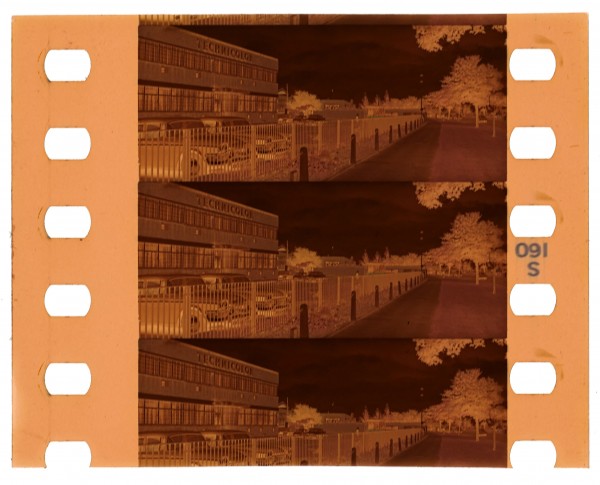
A 35mm 2-perforation Techniscope negative (c. 1963), showing colour test footage of the Technicolor London facilities in Harmondsworth, demonstrating the characteristic half-height frame layout of the format.
Kodak collection, National Science and Media Museum, Bradford, United Kingdom.
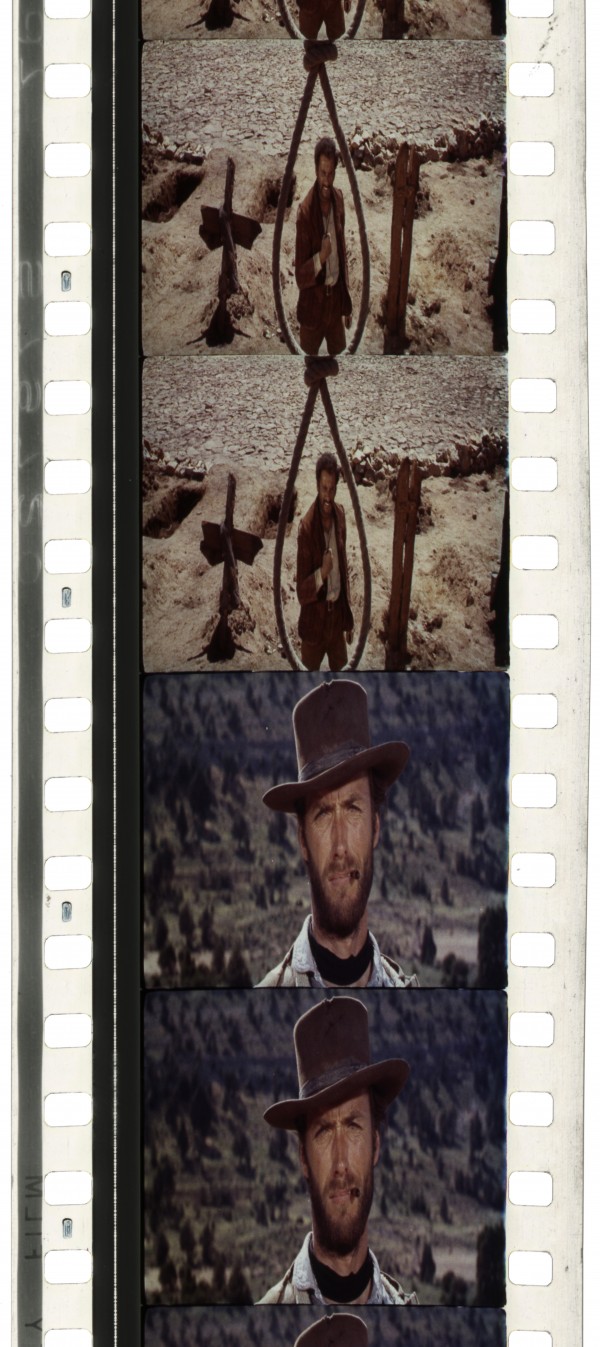
A 35mm Techniscope print of The Good, the Bad and the Ugly (1966), showing the full-height 4-perforation printed image derived from the half-height 2-perforation-tall negative. Note the clarity of Sergio Leone’s close-up compositions within the widescreen frame.
The Museum of Modern Art, New York, NY, United States.
Identification
21.31mm x 18.16mm (0.839 in x 0.715 in).
Technicolor dye-transfer (IB) colour for standard Techniscope release prints; non-IB colour stocks (Eastmancolor, Ferraniacolor, or equivalent) for optical enlargements produced outside Technicolor.
Standard Kodak Eastmancolor positive edge codes (e.g., EASTMAN and numeric batch markings), regardless of whether the print was produced by dye-transfer, or on monopack colour stock; occasional dye-transfer prints also carried Technicolor edge identifiers. Release prints did not carry the term “Techniscope”, as the 4-perf anamorphic print stock was identical to standard CinemaScope.
1
Fine-grain color reproduction with a moderate increase in grain visibility due to the optical enlargement of the 2-perf half-height frame negative. The use of improved spherical lenses (such as the Cooke Series III) and the emergence of Kodak’s fine-grain Eastmancolor 5251 negative stock (introduced in 1962) generally compensated for the reduced image area and maintained high resolution.
“Techniscope” or “Filmed in Techniscope”.
Release prints contained standard optical mono tracks.
Standard mono optical playback (single front channel).
22.05mm × 9.47mm (0.868 in x 0.373 in).
Eastmancolor fine-grain negative (standard).
“TECHNISCOPE 2P”, or “Technicolor – Roma” (leader).
History
Developed at Technicolor Italiana in Rome between 1960 and 1963 under the supervision of Giovanni Ventimiglia, Techniscope was Italy’s most significant postwar film technology innovation, and one of the few to achieve lasting international impact (Caranti, 2005; Vitella, 2012). Conceived as a response to the rapid spread of anamorphic formats, it offered a low-cost, fully compatible widescreen alternative by recording a spherical 2.35:1 image on 2-perforation-tall 35mm negative and shifting the anamorphic work required for a standard CinemaScope positive entirely to the laboratory. The trademark Techniscope itself – adopted in 1963 after an unrelated anamorphic process that had briefly circulated under the same name was renamed Euroscope – extended Technicolor’s branding strategy, while echoing the prestige of Technirama’s widescreen colour productions, but at a more economical end of the spectrum (Belton, 1992; Vitella, 2010).
Launched with Vittorio De Sica’s Ieri, oggi, domani (Yesterday, Today and Tomorrow, 1963), Techniscope reached full stylistic maturity in Sergio Leone’s pivotal trilogy Per un pugno di dollari (A Fistful of Dollars, 1964), Per qualche dollaro in più (For a Few Dollars More, 1965) and Il buono, il brutto, il cattivo (The Good, the Bad and the Ugly, 1966). Freed from the optical constraints of anamorphic cinematography, Leone reintroduced the full expressive range of classical composition into the panoramic frame, deploying sharp depth of field, graduated planes of focus and a plastic articulation of space that balanced intimacy and monumentality (Salt, 1983; Grespi, 2004; Vitella, 2018). This defining visual vocabulary encouraged the widespread adoption of the system across the Italian western, giallo and peplum cycles, while the emerging poliziottesco – with its fast-paced urban action – benefited from its economy and distinctive agility of movement, as in Stefano Vanzina’s foundational La polizia ringrazia (Execution Squad, 1972). Further key uses of the process include Lucio Fulci’s expressionist Non si sevizia un paperino (Don’t Torture a Duckling, 1972), which combines abrupt tonal shifts between pastoral realism and moments of stylised violence, demonstrating the format’s suitability for psychologically charged and formally controlled genre filmmaking.
As production volumes rose – reaching approximately 50 titles per year, or roughly half of all Italian widescreen productions of the 1960s – Techniscope rapidly exceeded the processing capacity available within Technicolor’s Italian facilities, prompting increasing reliance on Tecnostampa for auxiliary laboratory work. Surplus material was handled using Mario Calzini’s recently designed automated optical printer and released under the newly coined trade name Chromoscope (Calzini, 1965; Vitella, 2018). In a highly competitive commercial environment marked by intense rivalry among widescreen processes and the absence of full industrial standardisation, the Chromoscope brand consequently gained prominent visibility in posters and publicity materials associated with the 2-perf widescreen system. Among the most significant films photographed in Techniscope and promoted under the Chromoscope label was Dario Argento’s stylish debut L’uccello dalle piume di cristallo (The Bird with the Crystal Plumage, 1970).
Abroad, the system was also met with a favourable reception, and not only for European co-productions with Italian partners. In the United Kingdom, it was adopted for the downbeat alternative to the James Bond franchise The Ipcress File (1965), for the box-office hit Dr. Who and the Daleks (1965), for Lewis Gilbert’s critically acclaimed Alfie (1966), as well as for Hammer Films’ influential gothic horror Dracula: Prince of Darkness (1966). In France, Jean-Luc Godard explored its potential through disruptive and often startling compositions in Pierrot le Fou (1965), Made in U.S.A. (1966) and Deux ou trois choses que je sais d’elle (Two or Three Things I Know About Her, 1967). Across the Atlantic, Paramount, Columbia and Universal employed the process on an industrial scale for low- and mid-budget westerns, adventure films and science fiction – including Robinson Crusoe on Mars (1964), Arizona Raiders (1965) and Hostile Guns (1967) – while Olimpiada en México (The Olympics in Mexico, 1968) demonstrated its capacity to handle large-scale documentary coverage with clarity and operational efficiency.
More notably, the format later found an authorial reinterpretation aligned with New Hollywood sensibility in George Lucas’s THX 1138 (1971) and American Graffiti (1973). The first pushed Techniscope toward sharp focus and spatial abstraction in its futuristic settings, signalling a move away from its cost-saving rationale toward overtly experimental uses indebted to the modernist aesthetics of Michelangelo Antonioni. The second exploited the luminous spherical optics of 2-perforation 35mm to capture night-time locations with a documentary immediacy that shaped its nostalgic realism, giving texture to roaming car culture, neon-lit streets and ensemble choreography, and allowing the widescreen frame to feel intimate rather than monumental.
Industrial use of the format largely ended by the late 1970s, as the spread of superior anamorphic systems such as Panavision and Technovision, together with the contraction of Italy’s genre-film market, reduced the need for low-cost widescreen solutions. At the same time, emerging alternatives such as Super 35 – which offered a larger negative area and more flexible blow-up workflows – gradually replaced the industrial function once occupied by Techniscope. Yet the basic principle of Techniscope resurfaced in the 2000s, when several independent productions such as Hunger (2008) and Silver Linings Playbook (2012) adopted 2-perf 35mm in conjunction with digital intermediates, exploiting its economy and depth-of-field potential in new creative contexts. More than a technical innovation, Techniscope embodied a distinctly Italian form of modernity – functional, economical and adaptable – through which the expressive possibilities of widescreen cinematography became accessible outside the sphere of major studios and auteurs. In extending high visual quality to low- and medium-budget filmmaking, it contributed to forms of stylistic refinement that resonated internationally and later underpinned the cinephile revaluation of genre cinema (Vitella, 2022).
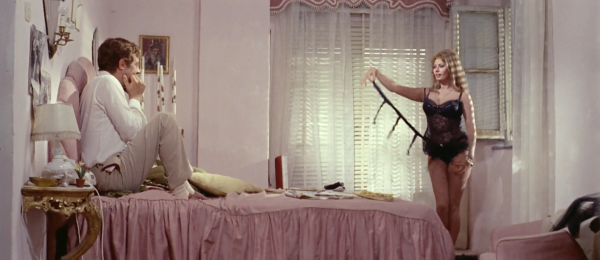
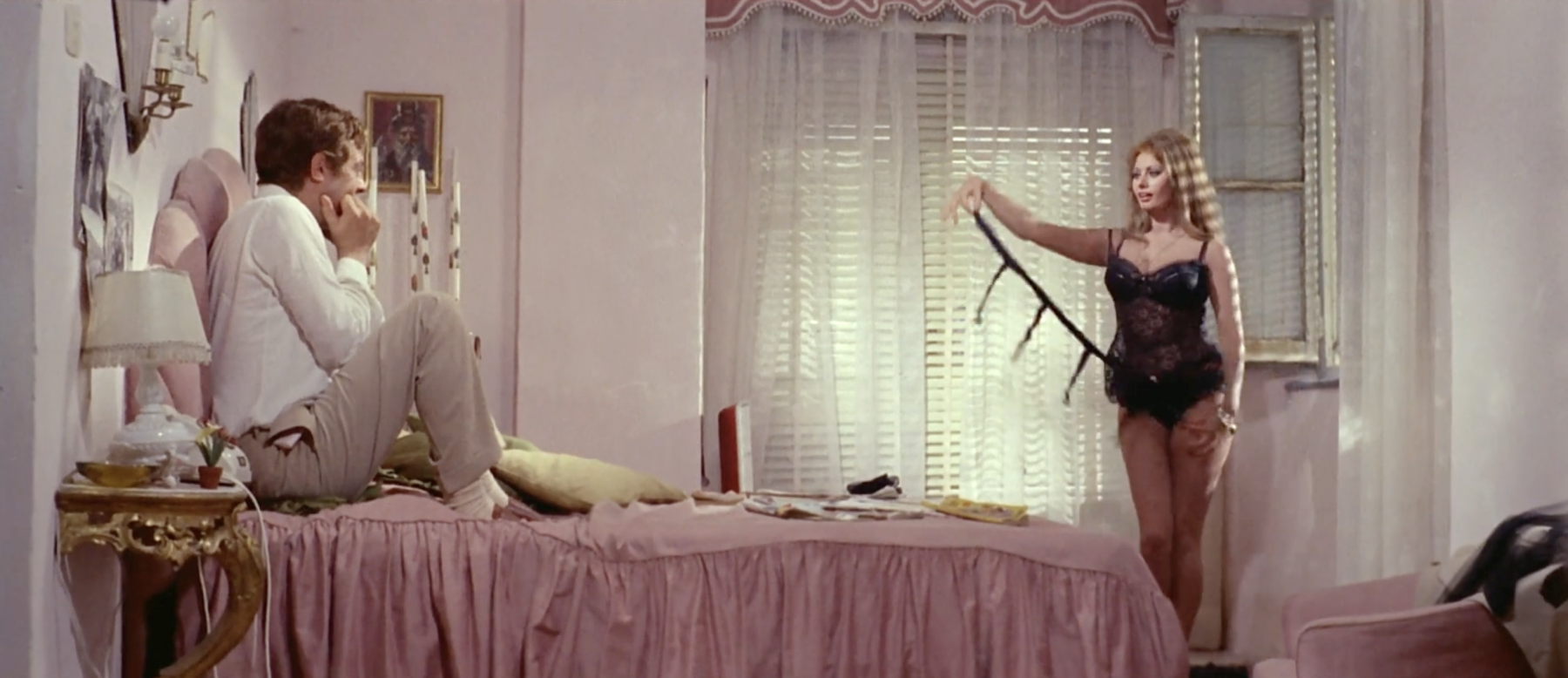
Horizontally polarised composition from a well-known bedroom scene in Ieri, oggi e domani (1963), the first feature film photographed in Techniscope. Sophia Loren and Marcello Mastroianni are placed at opposite ends of the frame, exploiting to the full the panoramic extension of the 2.35:1 image area and emphasising spatial tension through lateral balance, empty central space and reduced vertical emphasis.
Ieri, oggi e domani (Yesterday, Today and Tomorrow, Italy/France, 1963). DVD frame grab.
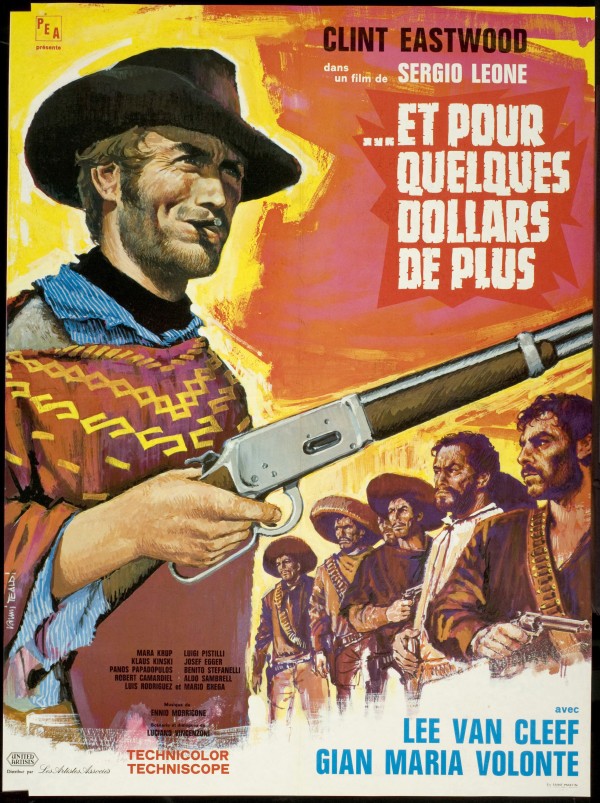
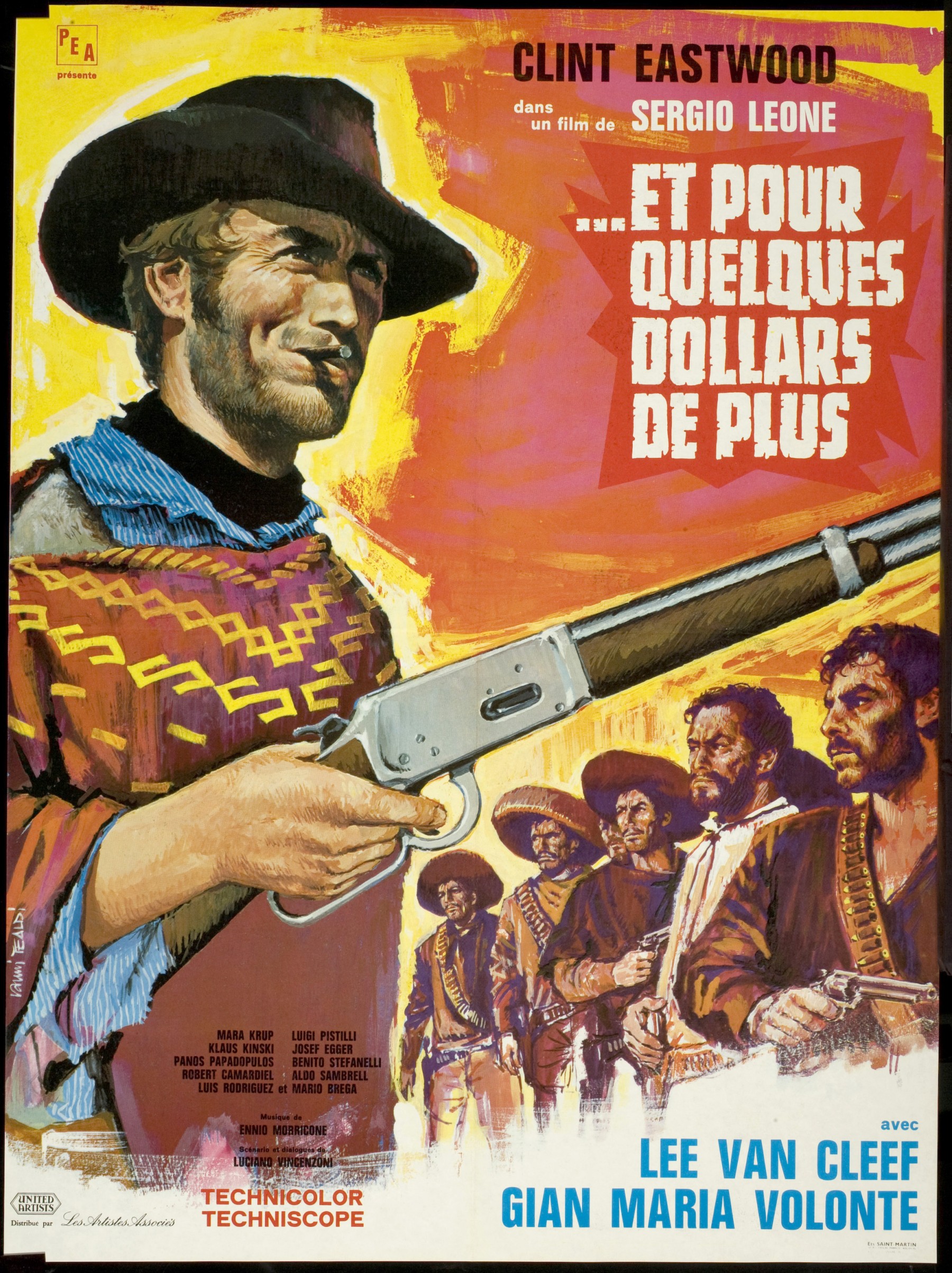
French release poster for Per qualche dollaro in più (For a Few Dollars More, 1965), featuring the Techniscope trademark as part of Technicolor’s branding strategy, which paired the prestige of Technirama with the economy-oriented identity of its 2-perforation widescreen system.
George Eastman Museum, Rochester, NY, United States.
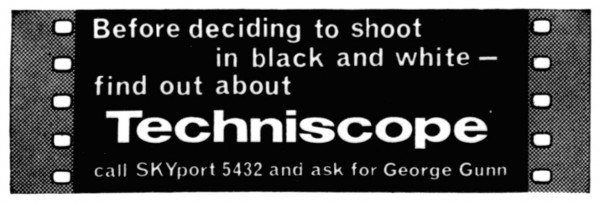
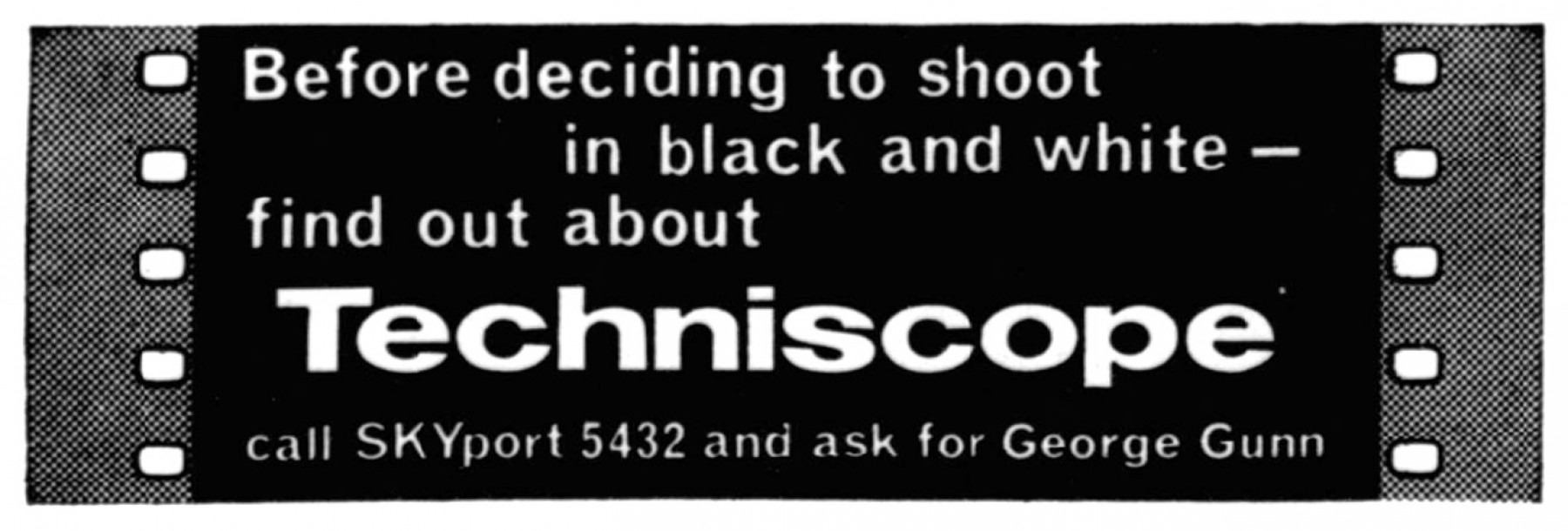
Trade advertisement for Techniscope promoted through Technicolor London’s camera department, West Drayton, headed by George Gunn, encouraging producers to consider the new 2-perf colour format as an economical widescreen alternative to shooting in B/W.
Kine Weekly, January 16, 1964, p. 6.
Selected Filmography
Techniscope’s luminous spherical optics and economical negative area allowed the production to film extensive night-time sequences with documentary immediacy. The format’s flexibility enhanced the film’s roaming car culture, neon-lit settings and nostalgic realism.
Techniscope’s luminous spherical optics and economical negative area allowed the production to film extensive night-time sequences with documentary immediacy. The format’s flexibility enhanced the film’s roaming car culture, neon-lit settings and nostalgic realism.
Within the British studio system, the film demonstrates how Techniscope enabled the routine use of widescreen colour cinematography in serial genre production. A landmark entry in Hammer’s Dracula cycle and a cult classic of British gothic horror, it exemplifies the format’s economic viability beyond prestige and mainstream productions.
Within the British studio system, the film demonstrates how Techniscope enabled the routine use of widescreen colour cinematography in serial genre production. A landmark entry in Hammer’s Dracula cycle and a cult classic of British gothic horror, it exemplifies the format’s economic viability beyond prestige and mainstream productions.
The first feature shot in Techniscope. Giuseppe Rotunno’s cinematography demonstrated the format’s suitability for mainstream colour production and helped validate the system’s industrial potential; its impact was further amplified after winning the 1965 Academy Award for Best Foreign Language Film, which effectively publicised Techniscope on an international scale.
The first feature shot in Techniscope. Giuseppe Rotunno’s cinematography demonstrated the format’s suitability for mainstream colour production and helped validate the system’s industrial potential; its impact was further amplified after winning the 1965 Academy Award for Best Foreign Language Film, which effectively publicised Techniscope on an international scale.
Otto Heller’s cinematography exploited the format’s precision in low-light interiors and its capacity for fine-grain colour rendition under controlled lighting, reinforcing the film’s tense, stripped-down Cold War aesthetic.
Otto Heller’s cinematography exploited the format’s precision in low-light interiors and its capacity for fine-grain colour rendition under controlled lighting, reinforcing the film’s tense, stripped-down Cold War aesthetic.
Sergio D’Offizi’s Techniscope cinematography combines naturalistic rural exteriors with tightly modulated interiors, using the 2-perf frame’s clarity and light-handling latitude to negotiate abrupt tonal contrasts. The format’s advantages freed up Fulci to reinforce the interplay of documentary realism and expressionist tension, allowing moments of violence and revelation to emerge with stark visual precision.
Sergio D’Offizi’s Techniscope cinematography combines naturalistic rural exteriors with tightly modulated interiors, using the 2-perf frame’s clarity and light-handling latitude to negotiate abrupt tonal contrasts. The format’s advantages freed up Fulci to reinforce the interplay of documentary realism and expressionist tension, allowing moments of violence and revelation to emerge with stark visual precision.
A large-scale documentary filmed at the 1968 Mexico City Games. The format proved capable of handling high-contrast outdoor events, fast motion and variable lighting, with clarity and efficiency across extended shooting days. It also supported selected large-format blow-up prints for prestige screenings.
A large-scale documentary filmed at the 1968 Mexico City Games. The format proved capable of handling high-contrast outdoor events, fast motion and variable lighting, with clarity and efficiency across extended shooting days. It also supported selected large-format blow-up prints for prestige screenings.
Shot by Massimo Dallamano, Leone’s breakthrough western inaugurated the “spaghetti western” cycle. Its combination of extreme close-ups, panoramic compositions and muscular editing helped define the visual grammar associated with Techniscope.
Shot by Massimo Dallamano, Leone’s breakthrough western inaugurated the “spaghetti western” cycle. Its combination of extreme close-ups, panoramic compositions and muscular editing helped define the visual grammar associated with Techniscope.
Photographed by Raoul Coutard, the film exploits the 2-perf format’s horizontal extension to orchestrate bold chromatic contrasts and graphic disruptions. Shot in Techniscope, but processed and printed on Eastmancolor at Laboratoire LTC (Laboratoire de Traitement Cinématographique), Paris, its widescreen format supports Godard’s stylistic fragmentation of space, allowing for abrupt shifts between intimacy and visual excess.
Photographed by Raoul Coutard, the film exploits the 2-perf format’s horizontal extension to orchestrate bold chromatic contrasts and graphic disruptions. Shot in Techniscope, but processed and printed on Eastmancolor at Laboratoire LTC (Laboratoire de Traitement Cinématographique), Paris, its widescreen format supports Godard’s stylistic fragmentation of space, allowing for abrupt shifts between intimacy and visual excess.
Shot in Techniscope by Riccardo Pallottini, the film is widely regarded as the first true poliziottesco. Its rapid car chases, handheld street sequences and location shooting in Rome exploited the agility and negative economy of the 2-perf system, helping to establish the visual and kinetic template that would define the genre’s early development.
Shot in Techniscope by Riccardo Pallottini, the film is widely regarded as the first true poliziottesco. Its rapid car chases, handheld street sequences and location shooting in Rome exploited the agility and negative economy of the 2-perf system, helping to establish the visual and kinetic template that would define the genre’s early development.
Processed at Tecnostampa and released under the Chromoscope label, Argento’s debut uses the 2-perf format to emphasise elongated interiors, reflective surfaces and controlled palettes, which sharpen the film’s architectural precision. The format’s fine-grain resolution under stylised lighting conditions enhances the choreography of suspense, contributing decisively to the visual identity of the early giallo revival.
Processed at Tecnostampa and released under the Chromoscope label, Argento’s debut uses the 2-perf format to emphasise elongated interiors, reflective surfaces and controlled palettes, which sharpen the film’s architectural precision. The format’s fine-grain resolution under stylised lighting conditions enhances the choreography of suspense, contributing decisively to the visual identity of the early giallo revival.
Lucas used Techniscope to achieve sharp focus, spatial abstraction and low-light precision in futuristic environments, marking the format’s transition from an economical trade widescreen solution, to an instrument of New Hollywood experimentation.
Lucas used Techniscope to achieve sharp focus, spatial abstraction and low-light precision in futuristic environments, marking the format’s transition from an economical trade widescreen solution, to an instrument of New Hollywood experimentation.
Technology
Techniscope employed a modified 35mm camera movement in which the film was advanced by two perforations per frame, producing an image approximately 22 mm x 9.5 mm in size (0.866 in x 0.374 in) – half the height of the standard 4-perforation 35mm negative. The 2-perf frame preserved the 2.35:1 widescreen aspect ratio, while reducing negative stock consumption by 50 per cent when compared to anamorphic systems – and by as much as 75 per cent compared to large-format processes – a decisive advantage for low- and medium-budget productions. Moreover, because the recorded image was spherical rather than anamorphic, it avoided the optical distortions and alignment issues typically associated with the early generations of front-mounted anamorphic attachments (Foster, 1964).
The 2-perforation negative was converted to a conventional 4-perforation-tall anamorphic format entirely within the laboratory. During optical printing, the image was vertically enlarged by a factor of two to create a standard 4-perf anamorphic intermediate compatible with all CinemaScope-equipped projection systems. This workflow integrated smoothly into existing laboratory pipelines and quickly overcame concerns about its ability to deliver adequate projection quality and justify the savings in negative stock (Calzini, 1965). Although the limited negative area increased the visibility of grain, improvements in Eastman Color fine-grain negative stocks, together with the adoption of high-performance spherical optics during photography at this time, kept perceptual differences between Techniscope enlargements and full-frame anamorphic prints to a minimum (Film Tecnica, 1963; Pohl, 1965).
In addition to this standard workflow, it is worth noting that the Techniscope negative proved sufficiently flexible to allow Technicolor to generate alternative print formats and aspect ratios for specific distribution contexts, including occasional non-standard blow-ups for prestige, or institutional, screenings. This flexibility, explicitly acknowledged in the relevant patents (Caranti, 2005), reinforced the system’s versatility within Technicolor’s laboratory infrastructure, enabling it to accommodate heterogeneous exhibition demands without departing from established industrial workflows. By the mid-1960s, such adaptability corresponded to a stratified exhibition landscape, ranging from smaller venues relying on flat projection with widescreen masking, through the dominant industrial circuit equipped for anamorphic projection, to a limited number of prestige theatres capable of accommodating 70mm presentations (Vitella, 2010).
From a mechanical standpoint, the system required only a revised pulldown assembly rather than a full redesign of the camera body. Mitchell and Arriflex models could therefore be converted with minimal intervention, maintaining reliability while reducing wear on the film path. The smaller frame size also reduced film abrasion and mechanical noise, as the 2-perf movement relied on a shorter and lighter intermittent pull-down. The use of standard spherical lenses provided improved sharpness, easier focusing and greater flexibility in low-light conditions – advantages that facilitated handheld work, location shooting and rapid setup changes (Ventimiglia, 1963).
The combined effect of these attributes shaped a distinctive visual profile. The format’s inherently deep focus, absence of anamorphic distortion and compatibility with fast spherical lenses enabled a clear articulation of planes and a mobile camera style suited to a wide range of production contexts. While the reduced negative area imposed certain limits on ultimate resolution, the balance of economy, optical clarity and operational efficiency made Techniscope a pragmatic alternative to conventional widescreen systems and a technologically coherent solution for productions seeking expressive flexibility within constrained resources (Vitella, 2022).
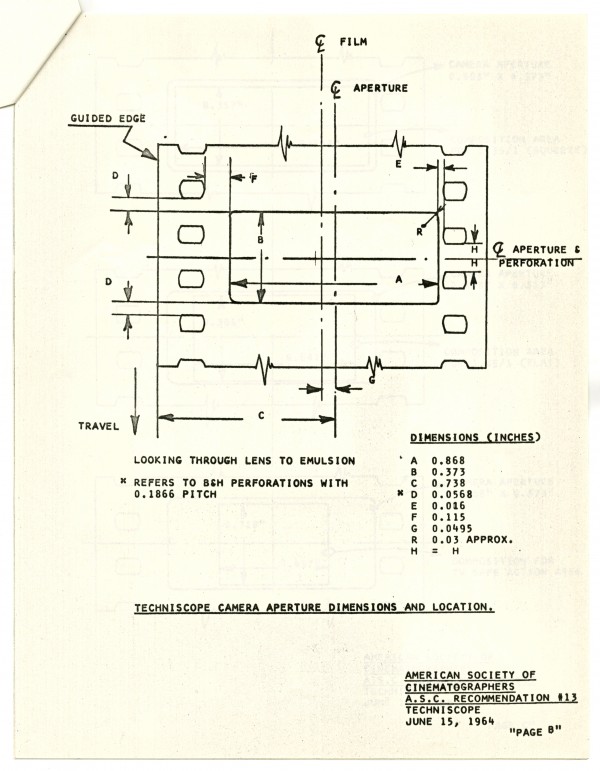
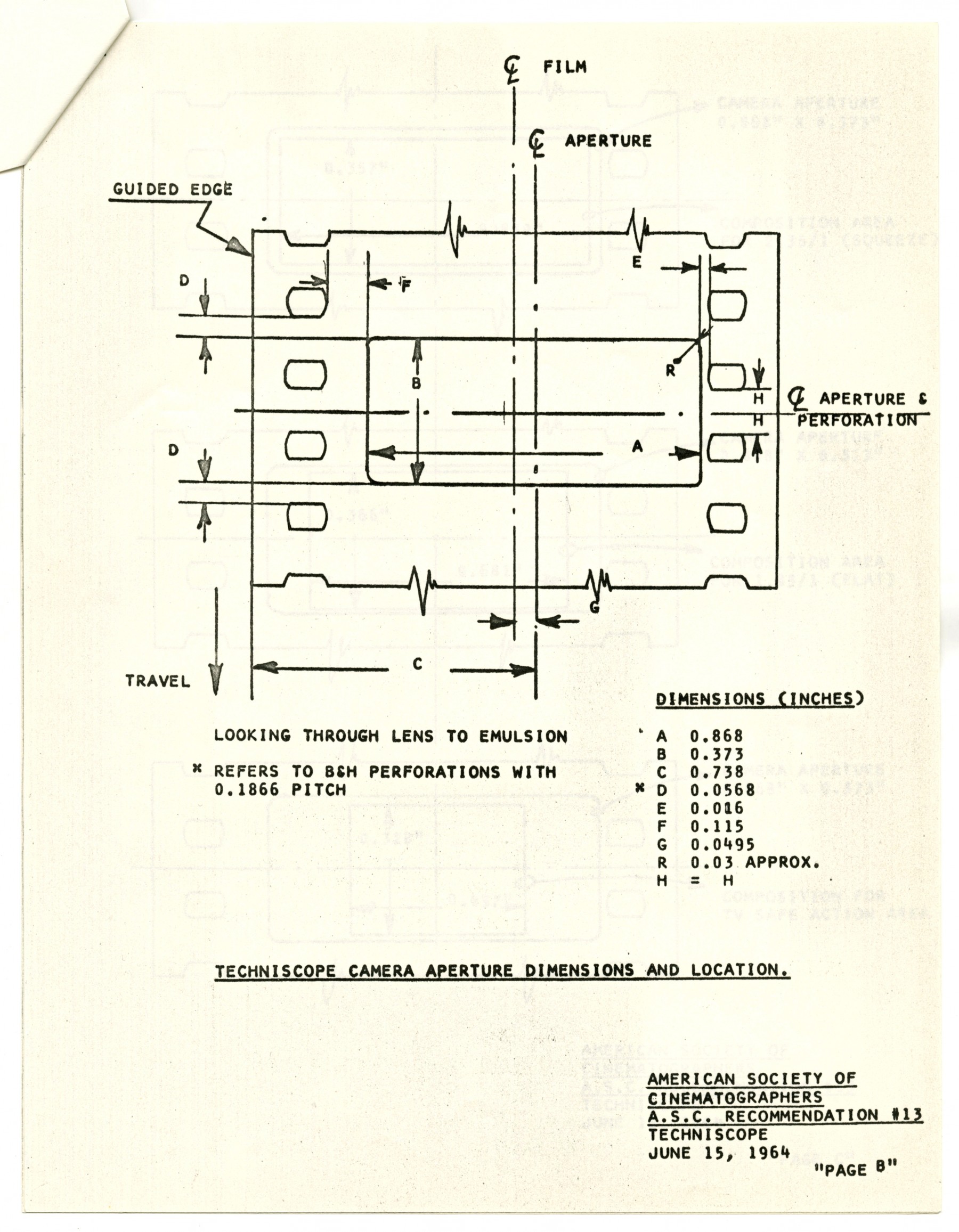
Techniscope camera aperture diagram from the ASC Recommendation No. 13 (American Society of Cinematographers, June 15, 1964), specifying the dimensions and placement of the 2-perforation-tall camera aperture, for standardised use across the industry.
John M. Andreas Collection, box 37, folder 2. George Eastman Museum, Rochester, NY, United States.
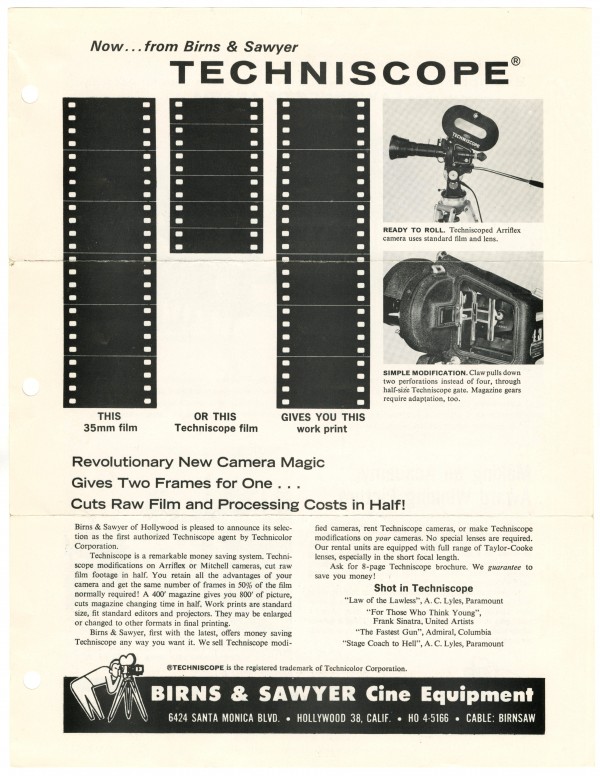
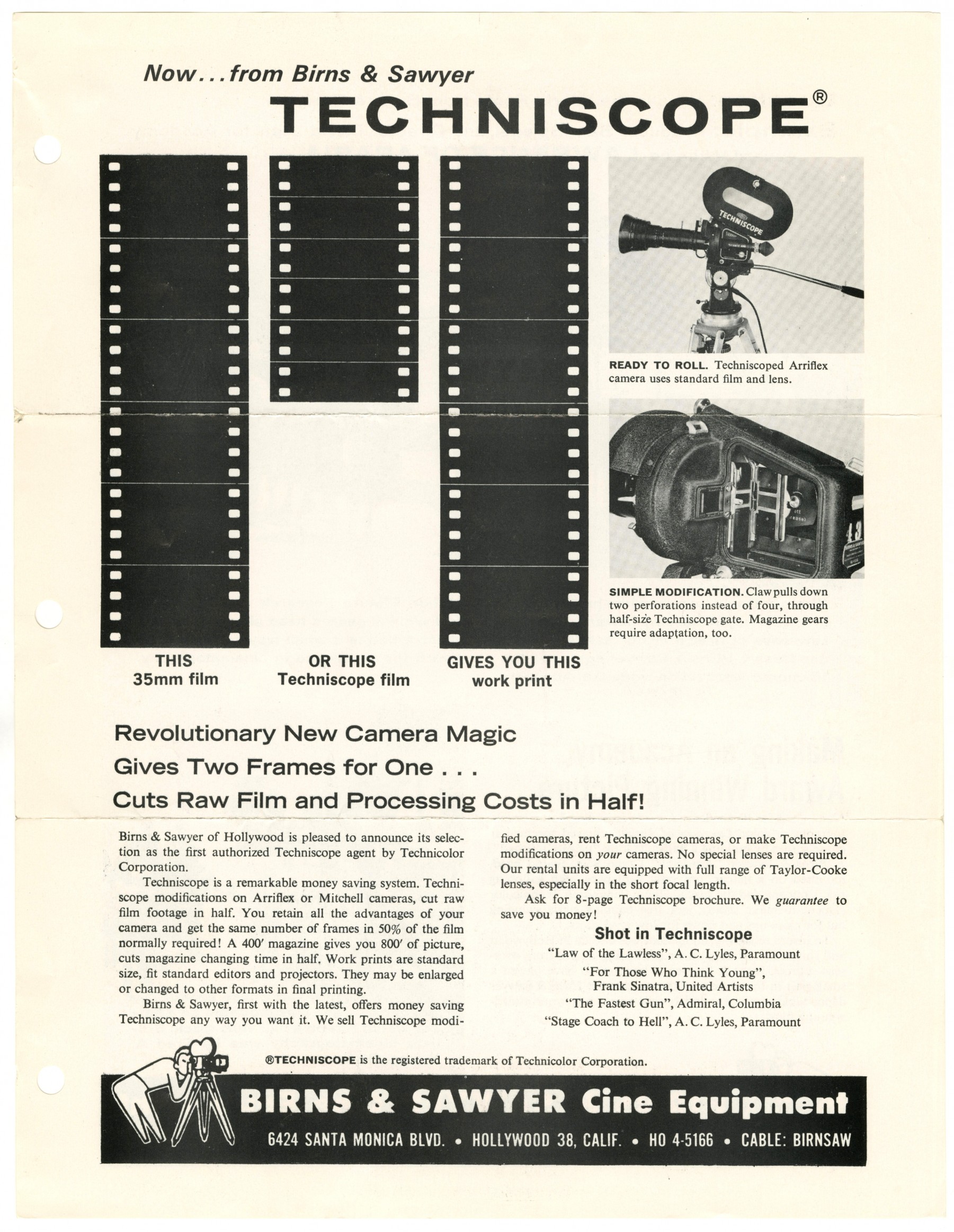
Promotional flyer issued by Birns & Sawyer, the first authorised Techniscope agent in Hollywood (c. 1964), illustrating the 2-perf frame layout, the modified ArriFlex camera mechanism, and the cost-saving advantages – ‘two frames for one’ – that the company used to market Techniscope to American producers.
Technicolor Corporate Archive, Hoffman (July 2018), box 3, folder 23. George Eastman Museum, Rochester, NY, United States.
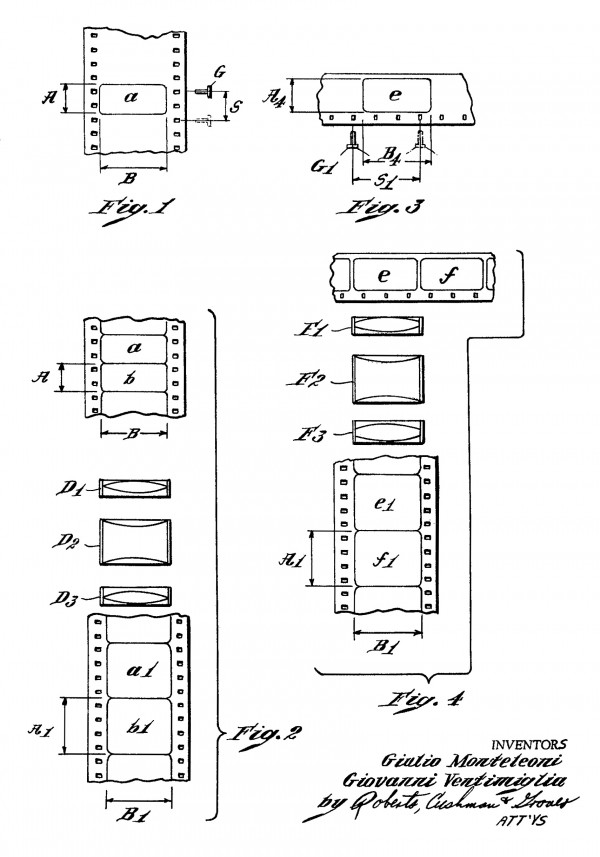
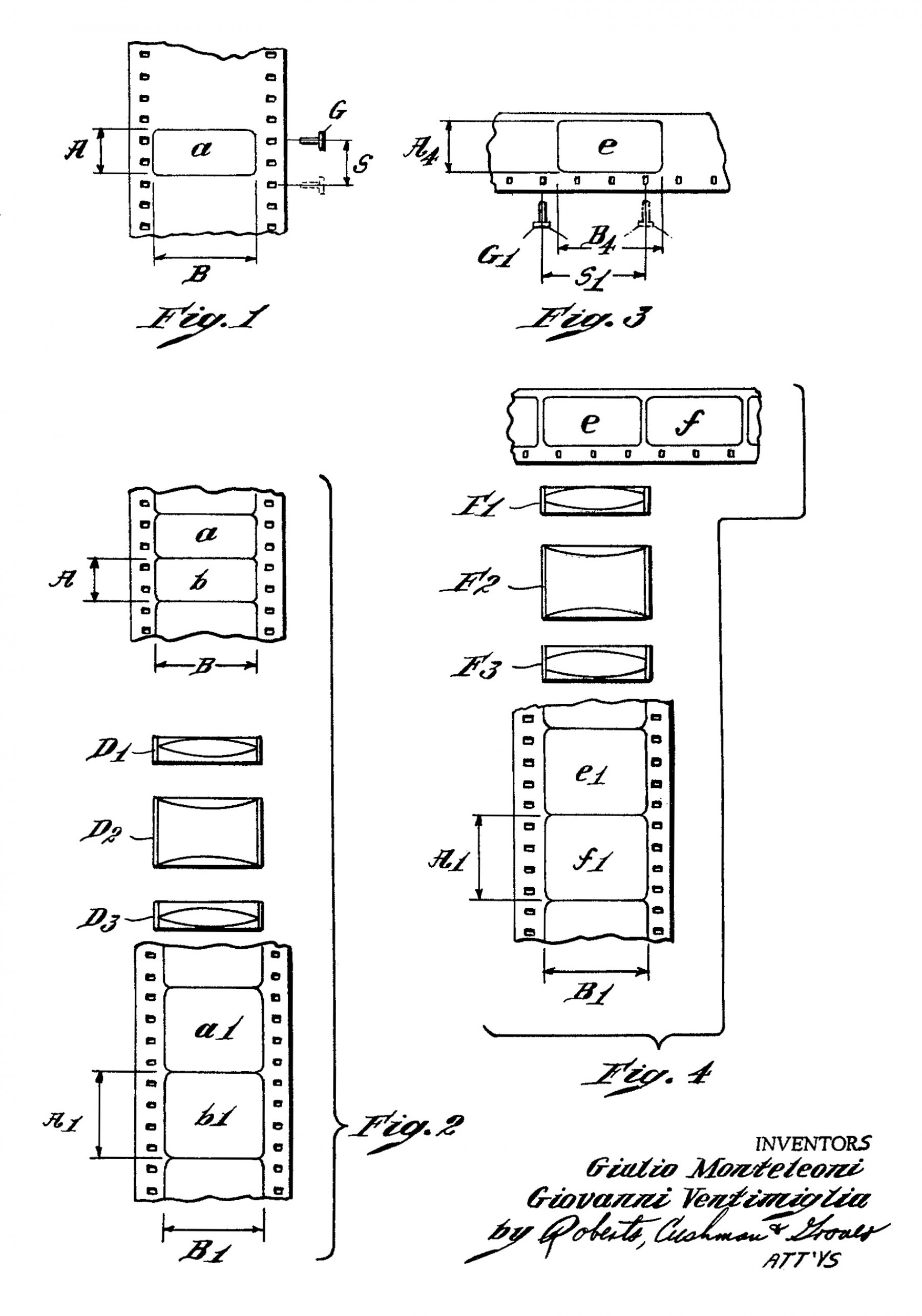
The US patent illustrated the reduced-height 2-perforation 35mm camera negative, the optical enlargement process, and the conversion to standard 4-perforation anamorphic release formats within the laboratory workflow.
Giulio Monteleoni & Giovanni Ventimiglia. Process for producing widescreen motion-picture images on reduced-height 35mm film. United States patent US3396021A, filed December 26, 1963, and issued August 6, 1968.
References
Belton, John (1992). Widescreen Cinema. Cambridge, MA: Harvard University Press.
Calzini, Mario (1965). “Una nuova stampatrice ottica automatica per il sistema Techniscope”. AIC: Associazione Italiana Cineoperatori – Bollettino Tecnico, 11: pp. 15–18.
Film Tecnica (1963). “Il Techniscope”. Film Tecnica, 17–18: pp. 13-14.
Foster, Frank (1964). “Techniscope – What It Is and How It Works”. American Cinematographer, 45:7 (Jul.): pp. 376–8.
Grespi, Barbara (2004). “Sergio Leone e il wide screen all’italiana”. Comunicazioni sociali, 26:1 (Jan.–Apr.): pp. 87–100.
Caranti, Chiara (2005). “Tecnica e tecnologia in Italia: brevetti e modelli negli anni Sessanta”. In L’arte del risparmio: Stile e tecnologia. Il cinema a basso costo in Italia negli anni Sessanta, Giacomo Manzoli & Guglielmo Pescatore (eds), pp. 125–51. Rome: Carocci.
Paul, W. E. (1965). “Techniscope – A Technical Note”. Journal of the SMPTE, 74:2 (Feb.): p. 121.
Salt, Barry (1983). Film Style and Technology: History and Analysis. London: Starword.
Ventimiglia, Giovanni (1963). “Technicolor – Techniscope 2”. AIC: Associazione Italiana Cineoperatori – Bollettino Tecnico, 1–2: pp. 21–2.
Vitella, Federico (2010). “Before Techniscope: The Penetration of Foreign Widescreen Technology in Italy (1953–1959)”. In Widescreen Worldwide, John Belton, Sheldon Hall & Steve Neale (eds), pp. 163–73. New Barnet: John Libbey.
Vitella, Federico (2012). “The Italian Widescreen Era: The Adoption of Widescreen Technology as Periodizing Element in the History of Italian Cinema”. Quarterly Review of Film and Video, 29:1 (Nov.): pp. 24–33.
Vitella, Federico (2018). L’età dello schermo panoramico: Il cinema italiano e la rivoluzione widescreen. Pisa: ETS.
Vitella, Federico (2022). “Tecnologia”. In Fare storia del cinema, Fabio Andreazza (ed.), pp. 195–204. Rome: Carocci.
Patents
Giulio Monteleoni & Giovanni Ventimiglia, Metodo di ripresa per cinematografie panoramiche, che consente di ridurre il consumo di pellicola. Italian patent 681360, filed January 16, 1963, and issued January 26, 1965.
Giulio Monteleoni & Giovanni Ventimiglia. Process for producing widescreen motion-picture images on reduced-height 35mm film. United States patent US3396021A, filed December 26, 1963, and issued August 6, 1968.
Preceded by
Followed by
Compare
Related entries
Author
Federico Vitella is a Full Professor at the University of Messina, where he teaches film history and theory. His research focuses on the cultural and social history of Italian cinema, with particular attention to stardom, fandom, screen technologies and media reception. His most recent books include Maggiorate. Divismo e celebrità nella nuova Italia (2024) and Lettere ad Alida Valli. Il culto di una diva nell’Italia fascista (2025). He is also the author of L’età dello schermo panoramico. Il cinema italiano e la rivoluzione widescreen (2018), the first comprehensive study of Italy’s widescreen transition, offering an integrated analysis of its technologies, industrial strategies and aesthetic transformations.
The author gratefully acknowledges James Layton and Crystal Kui for their help with research and images; John Belton for encouraging a deeper investigation into the diffusion of widescreen cinema in Italy; and Federico Pierotti for his sustained collegial support and shared passion for the history of film technology.
Vitella, Federico (2026). “Techniscope”. In James Layton (ed.), Film Atlas. www.filmatlas.com. Brussels: International Federation of Film Archives / Rochester, NY: George Eastman Museum.