1.85:1 (aspect ratio)
A flat widescreen format for 35mm projection introduced in the 1950s.
Film Explorer
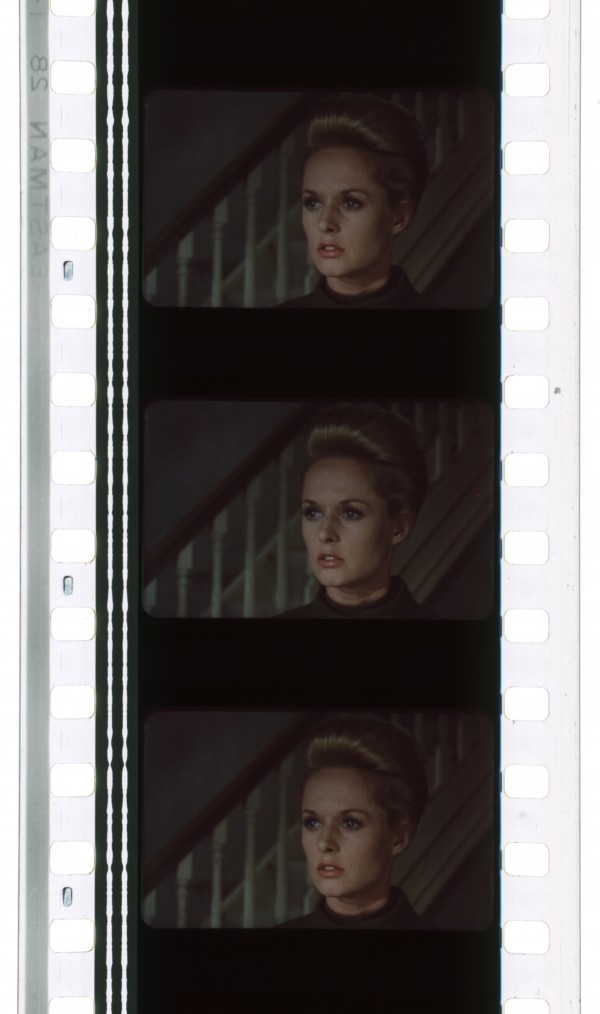
Original 35mm release prints of Marnie (1964) were “hard matted” at the top and bottom of each frame, to the 1.85:1 aspect ratio. 1.85:1 means the image’s width is 1.85 times its height.
George Eastman Museum, Rochester, NY, United States.
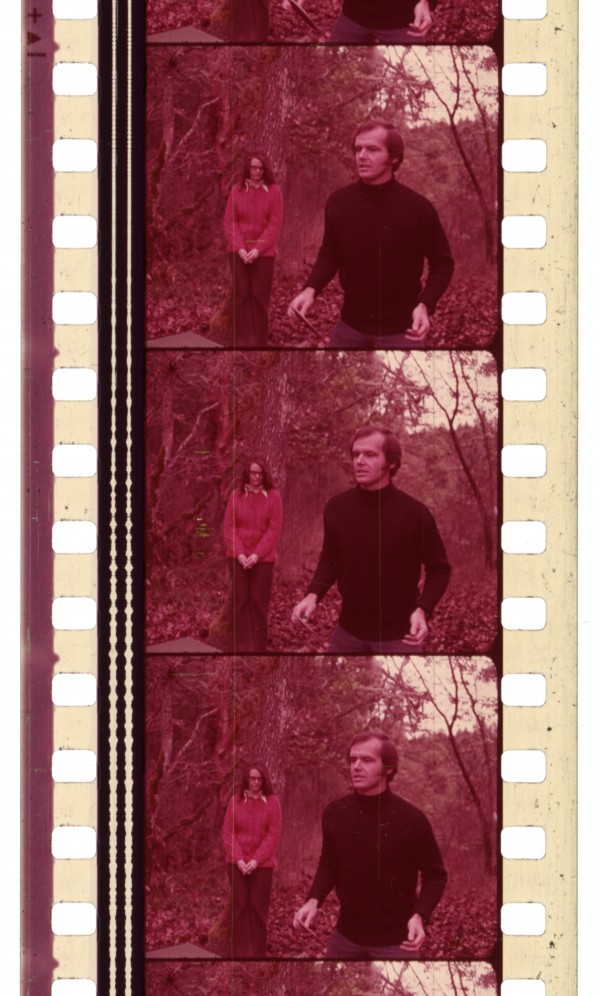
This original 35mm release print of Five Easy Pieces (1970) is “open matte”, showing the full height of the full aperture frame, printed from the camera negative. During projection, the top and bottom sections of the image are cropped out, by the use of a projector aperture plate, to the widescreen aspect ratio of 1.85:1.
Film Atlas Collection, George Eastman Museum, Rochester, NY, United States.
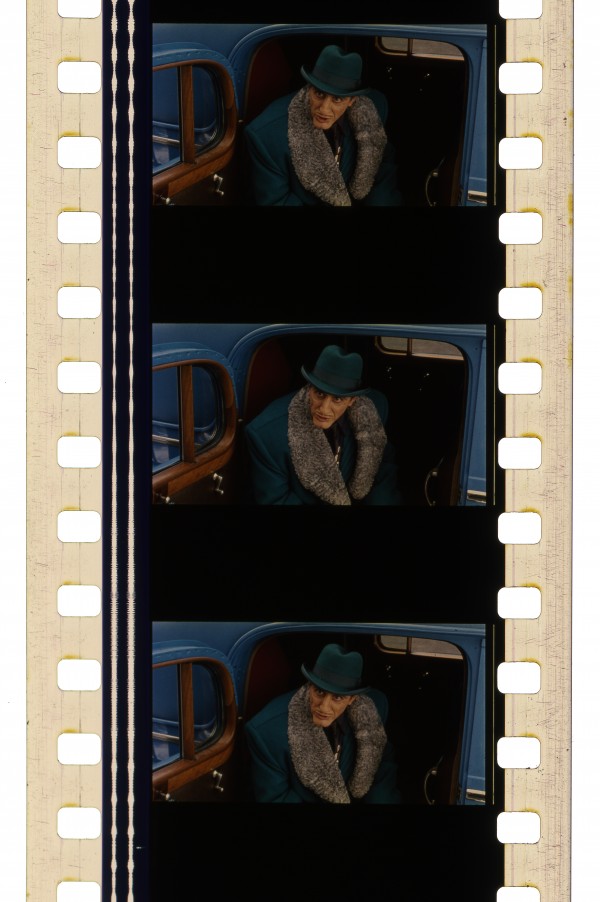
A 35mm original release print of Warren Beatty’s Dick Tracy (1990), “hard matted” to 1.85:1.
UCLA Film & Television Archive, Los Angeles, CA, United States.
Identification
20.96 mm x 11.33 mm (0.825 in x 0.446 in).
B/W or color.
1
Compatible with any color process.
Variable; 22.05mm x 12.60 mm (0.868 in x 0.496 in) (open matte), or 20.96 mm x 11.33 mm (0.825 in x 0.446 in) (hard matte).
B/W or color.
History
With the rise of television in the early 1950s, cinema faced unprecedented competition for audience attention. In an effort to draw audiences back to movie theaters, Hollywood studios and theater chains promoted larger, wider screens to enhance the spectacle. Before an industry standard was established, producers and exhibitors tested a range of approaches and aspect ratios in pursuit of that goal.
Widescreen formats like Cinerama and CinemaScope were expensive, requiring auditoriums to be rebuilt with larger screens, new projection equipment and enhanced sound systems. A cheaper alternative was to crop the top and bottom of the standard 35mm Academy frame to a wider aspect ratio, using shorter focal-length lenses to enlarge the image yet further. This came at a cost to picture quality: reduced sharpness, increased grain and reduced image brightness, with the effect worsening as the crop – and therefore the enlargement – increased. The most common resulting ratios were 1.66:1, 1.75:1, 1.85:1 and 2:1.
In May 1953, a conference was held in New York, where executives from Paramount, Universal-International, Metro-Goldwyn-Mayer and Columbia presented their preferred choices of aspect ratio. They emphasized that the same screen could be used to show both 3-D and 2-D pictures, with the aspect ratio “based entirely on masking the projector aperture plate, using lenses of different focal length and installing an all-purpose maskless screen” (Canby, 1953). The “all-purpose” screens proposed by Paramount and Universal could handle aspect ratios from 1.37:1 up to 2:1, and would be perfectly suitable for differing widescreen systems chosen by the other studios.
On May 17, 1953, a report from Universal Studios, led by studio manager Mr. Steiner, showed that the studio had begun screening its dailies in a 1.85:1 aspect ratio for the production crew, using a screen measuring 25.6 ft x 14.3 ft (7.80m x 4.36m); while executives viewed the same footage in a 2:1 aspect ratio on a slightly larger screen, measuring 26 ft x 13 ft (7.92m x 3.96m). This dual-format approach reflected Universal’s early embrace of widescreen, further demonstrated by its adoption of B/W CinemaScope for its leading director, Douglas Sirk, in late 1956. Paramount, meanwhile, having initially picked a 1.66:1 aspect ratio for VistaVision, switched to 1.85:1 as its preferred format in February 1954. The rapid proliferation of anamorphic widescreen systems such as CinemaScope caused considerable confusion within the industry by 1955, resulting in a growing demand for industry standardization. By the late 1950s, the industry had experimented with as many as 15 different aspect ratios, but Universal and Paramount, among others, ultimately settled on 1.85:1 as the standard, delivering a more consistent visual experience.
By September 1956, the 1.85:1 ratio had become the dominant, non-anamorphic industry standard for widescreen presentation in the US, since it was already the format most commonly used for shooting. At the 43rd biannual convention of the International Alliance of Theatrical Stage Employees and Moving Picture Machine Operators in Kansas City, MO, Merle Chamberlin, MGM’s Chief of Projection, emphasized that preserving this ratio through both shooting and projection would improve the visual quality of the projected image, and that standardization would accelerate the modernization of projection equipment, minimize unnecessary grain and improve the definition of 35mm prints.
By the late 1970s, major US studios had largely settled on 1.85:1 as the standard theatrical flat (non-anamorphic) widescreen format, gradually replacing earlier regional variants such as 1.66:1 in Europe and transitional formats like 1.75:1. Although 1.66:1 and 1.75:1 had long been popular in Europe, 1.85:1 has since become the default “flat” format in commercial cinema worldwide, since it requires minimal cropping on standard screens and suits a wide range of mainstream genres, from dramas and comedies, to horror and action films. The expansion of the multiplex model in the 1980s shifted cinema exhibition from single-screen theaters with customized projection practices to standardized, multi-auditorium complexes built for efficiency, further reinforcing the worldwide adoption of 1.85:1.
Selected Filmography
Starring Ron Perlman, Daniel Emilfork and Judith Vittet. One of the most expensive French films released to date. Noted for its use of special effects, but also recognized as one of the most creative expressions of art direction and design in French cinema.
Starring Ron Perlman, Daniel Emilfork and Judith Vittet. One of the most expensive French films released to date. Noted for its use of special effects, but also recognized as one of the most creative expressions of art direction and design in French cinema.
Starring Colin Farrell, Micheal Keaton and Danny DeVito. A live-action remake inspired by the 1941 animated film.
Starring Colin Farrell, Micheal Keaton and Danny DeVito. A live-action remake inspired by the 1941 animated film.
Starring Todd Armstrong, Nancy Kovack and Gary Raymond. A fantasy film based on the “SuperDynamation” process developed by the producer Charles H. Schneer and visual effects pioneer Ray Harryhausen.
Starring Todd Armstrong, Nancy Kovack and Gary Raymond. A fantasy film based on the “SuperDynamation” process developed by the producer Charles H. Schneer and visual effects pioneer Ray Harryhausen.
Starring Makiko Esumi, Takashi Naitô and Tadanobu Asano. The first fiction film made by one of the finest directors of Japanese contemporary cinema.
Starring Makiko Esumi, Takashi Naitô and Tadanobu Asano. The first fiction film made by one of the finest directors of Japanese contemporary cinema.
Starring Tippi Hedren, Sean Connery and Diane Baker. The filmmaker had purchased the motion picture rights to Winston Graham’s novel, just two months after its publication.
Starring Tippi Hedren, Sean Connery and Diane Baker. The filmmaker had purchased the motion picture rights to Winston Graham’s novel, just two months after its publication.
Starring Jeanne Moreau, Marcello Mastroianni and Monica Vitti. The film questions the uncertainty of feelings through the story of the character Lidia's attempt to free herself from a broken relationship.
Starring Jeanne Moreau, Marcello Mastroianni and Monica Vitti. The film questions the uncertainty of feelings through the story of the character Lidia's attempt to free herself from a broken relationship.
Starring Meryl Streep, Robert Redford and Malik Bowens. Screenplay by Kurt Luedtke, an adaptation of Out of Africa and other writings by Isak Dinesen, the pseudonym chosen by Karen von Blixen-Finecke. The story is based on the memoir of her life in British East Africa during the early twentieth century.
Starring Meryl Streep, Robert Redford and Malik Bowens. Screenplay by Kurt Luedtke, an adaptation of Out of Africa and other writings by Isak Dinesen, the pseudonym chosen by Karen von Blixen-Finecke. The story is based on the memoir of her life in British East Africa during the early twentieth century.
Starring Randolph Scott, Claire Trevor and Joan Weldon. An offbeat western exhibited in Technicolor and 3-D.
Starring Randolph Scott, Claire Trevor and Joan Weldon. An offbeat western exhibited in Technicolor and 3-D.
Starring James Stewart, Joanne Dru and Gilbert Roland. An action and adventure drama, shot in Technicolor and with stereophonic sound. On May 20, 1953, the movie premiered in a 1.85:1 aspect ratio (Universal's first release in the 1.85:1 format) at Loew's State Theatre in New York, even though the intended ratio during principal photography was 1.37:1.
Starring James Stewart, Joanne Dru and Gilbert Roland. An action and adventure drama, shot in Technicolor and with stereophonic sound. On May 20, 1953, the movie premiered in a 1.85:1 aspect ratio (Universal's first release in the 1.85:1 format) at Loew's State Theatre in New York, even though the intended ratio during principal photography was 1.37:1.
Starring Brad Pitt, Jessica Chastain and Sean Penn. A philosophical hymn to life, a visionary and dense work.
Starring Brad Pitt, Jessica Chastain and Sean Penn. A philosophical hymn to life, a visionary and dense work.
Technology
1.85:1 is a “flat”, or spherical (non-anamorphic), matted widescreen format. Spherical lenses magnify light equally in the horizontal and vertical planes, while anamorphic camera lenses squeeze a wider image horizontally to fit within a standard 35mm film frame. During projection, the image is then expanded horizontally using a complementary anamorphic projection lens, typically producing an on-screen image with an aspect ratio of 2.35:1 or greater. Films with a 1.85:1 aspect ratio have a screen image 1.85 times wider than it is tall.
From 1953 onward in the United States, most flat movies were cropped top and bottom, then enlarged on-screen to a wider aspect ratio, producing a widescreen effect. Frames captured in camera at the Academy aspect ratio of 1.37:1 or taller could be cropped to 1.66:1, 1.75:1, 1.85:1, and even wider. This could be done using a soft matte or a hard matte.
Soft Matte
A soft matte (also known as an open matte) involves shooting and printing the Academy (1.37:1) or full-aperture (cropped by the soundtrack to approximately 1.19:1) frame, knowing that the top and bottom of the image will be cropped during projection to produce a widescreen aspect ratio.
During shooting, the negative is exposed at either the full aperture of 1.33:1 (24.89mm x 18.66mm [0.980 in x 0.735 in]) or the Academy aperture of 1.37:1 (20.96mm x 15.24mm [0.825 in x 0.600 in]). Cinematographers could precisely frame their scenes by adding a ground-glass mask with the 1.85:1 frame outline to the camera viewfinder, blurring out areas of the scene that lay outside the 1.85:1 composition. Theater projectionists would install a 1.85 aperture plate in the projector, along with an appropriate focal-length lens, to project a 1.85:1 image onto a wider cinema screen. It then fell to the projectionist to carefully align the vertical position of the film frame with the 1.85:1 rectangular opening in the aperture plate, ensuring that objects captured during shooting but not intended for the screen – such as boom microphones or stage lights – were hidden from theater audiences.
Hard Matte
A hard matte involves masking the frame in the camera during filming, so that black bars obscure the top and bottom of the image to the desired aspect ratio. This is accomplished using a masking plate in the camera: anything outside the 1.85:1 masking plate is not exposed, so the resulting print has black bars above and below the image that define its aspect ratio. During projection, the film frame must be carefully aligned in the vertical plane so that the hard-matted image aligns precisely with the opening in the projector’s aperture plate. Hard mattes can also be added during post-production by the film laboratory.
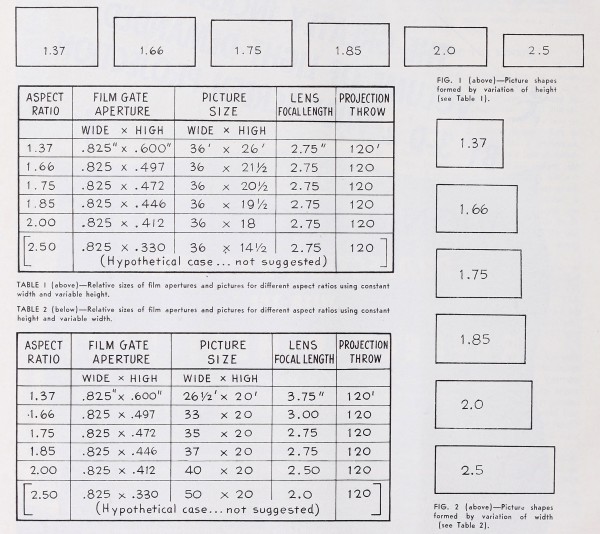
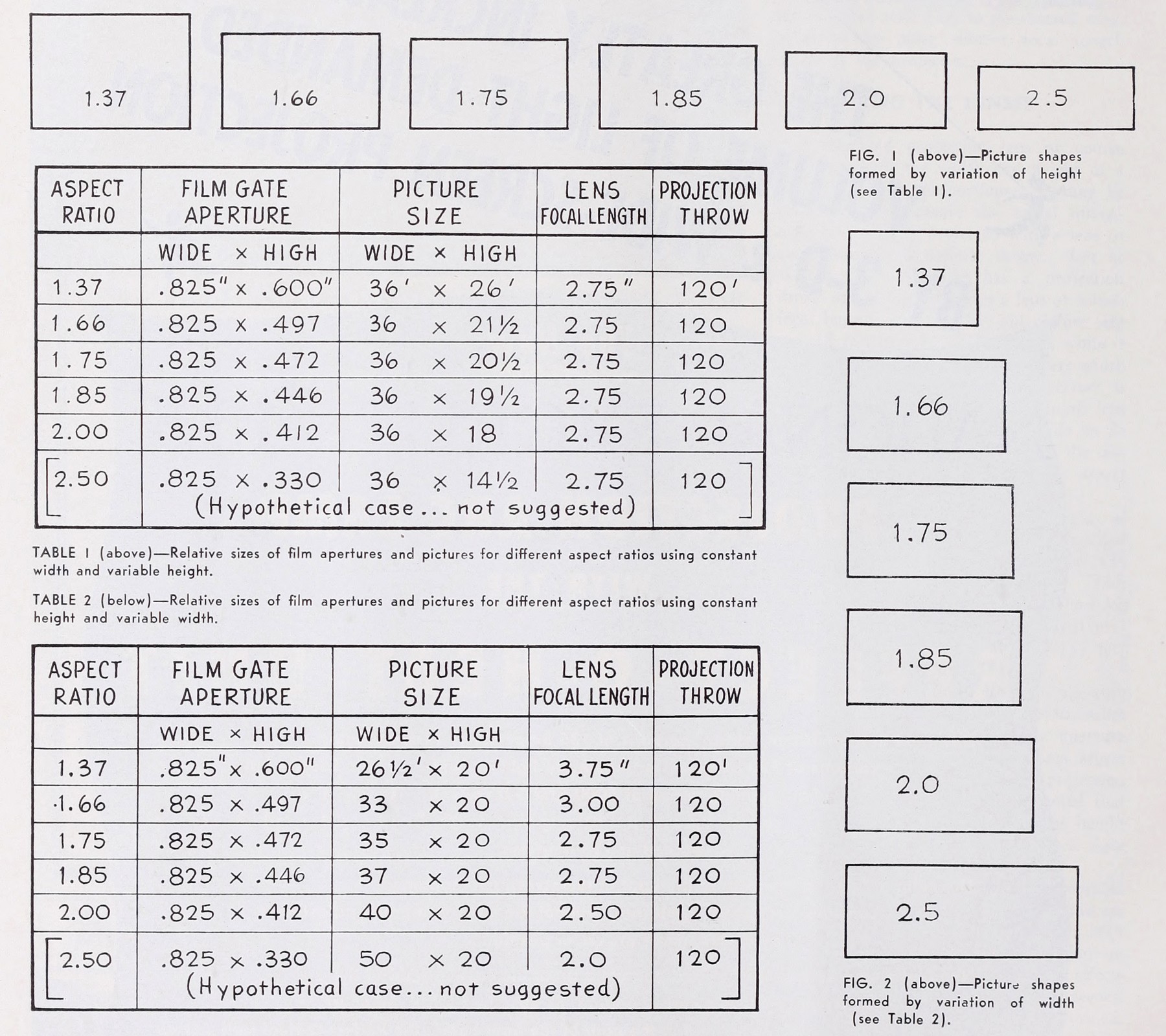
Gagliardi Gio (1953). “Setting Up Conditions for Variable Aspect Ratios”, Motion Picture Herald, 92:10 (Sep. 5): p. 42.
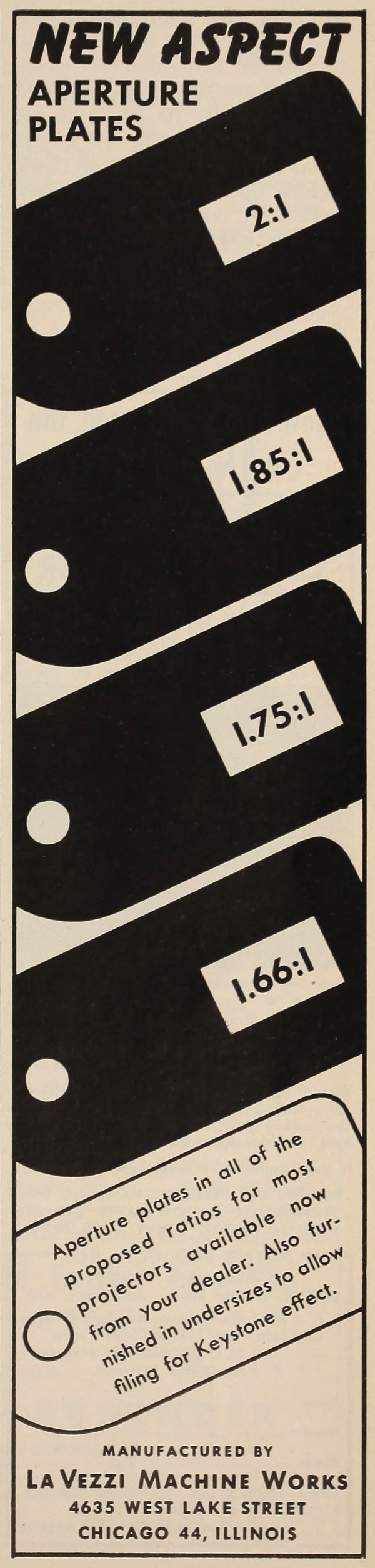
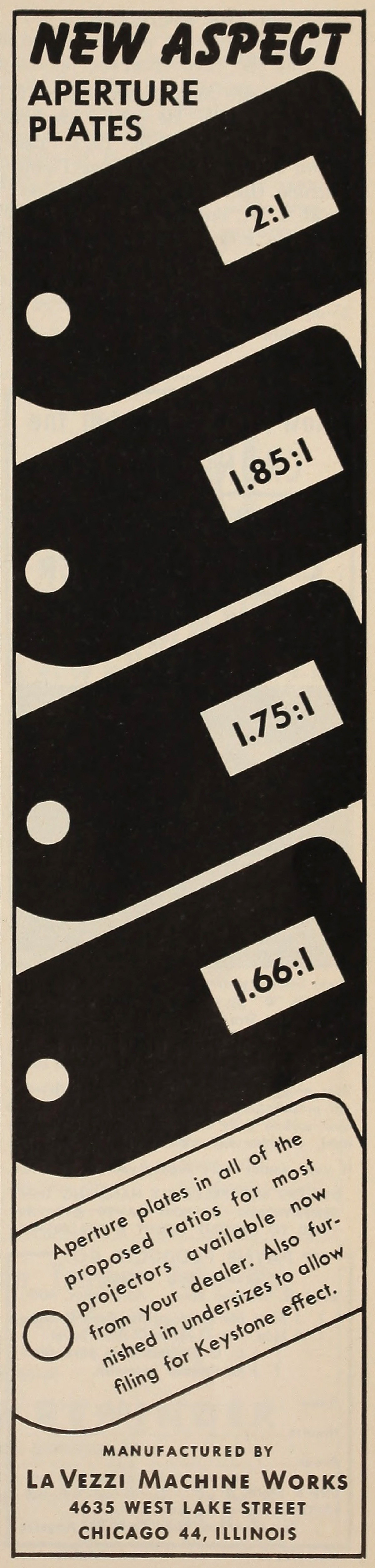
Advertisement for “New Aspect Aperture Plates" manufactured by La Vezzi Machine Works, Illinois, United States.
La Vezzi Machine Works (1953), International Projectionist, 28:10 (Oct.): p. 31.
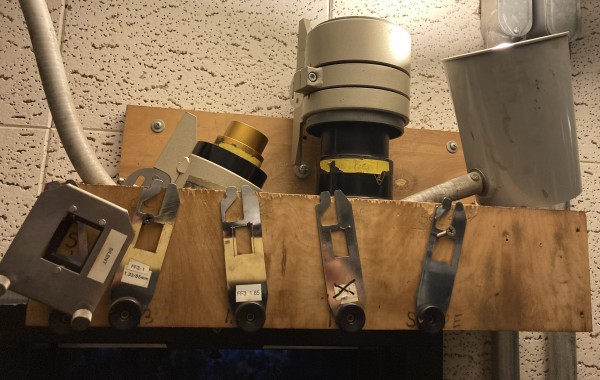
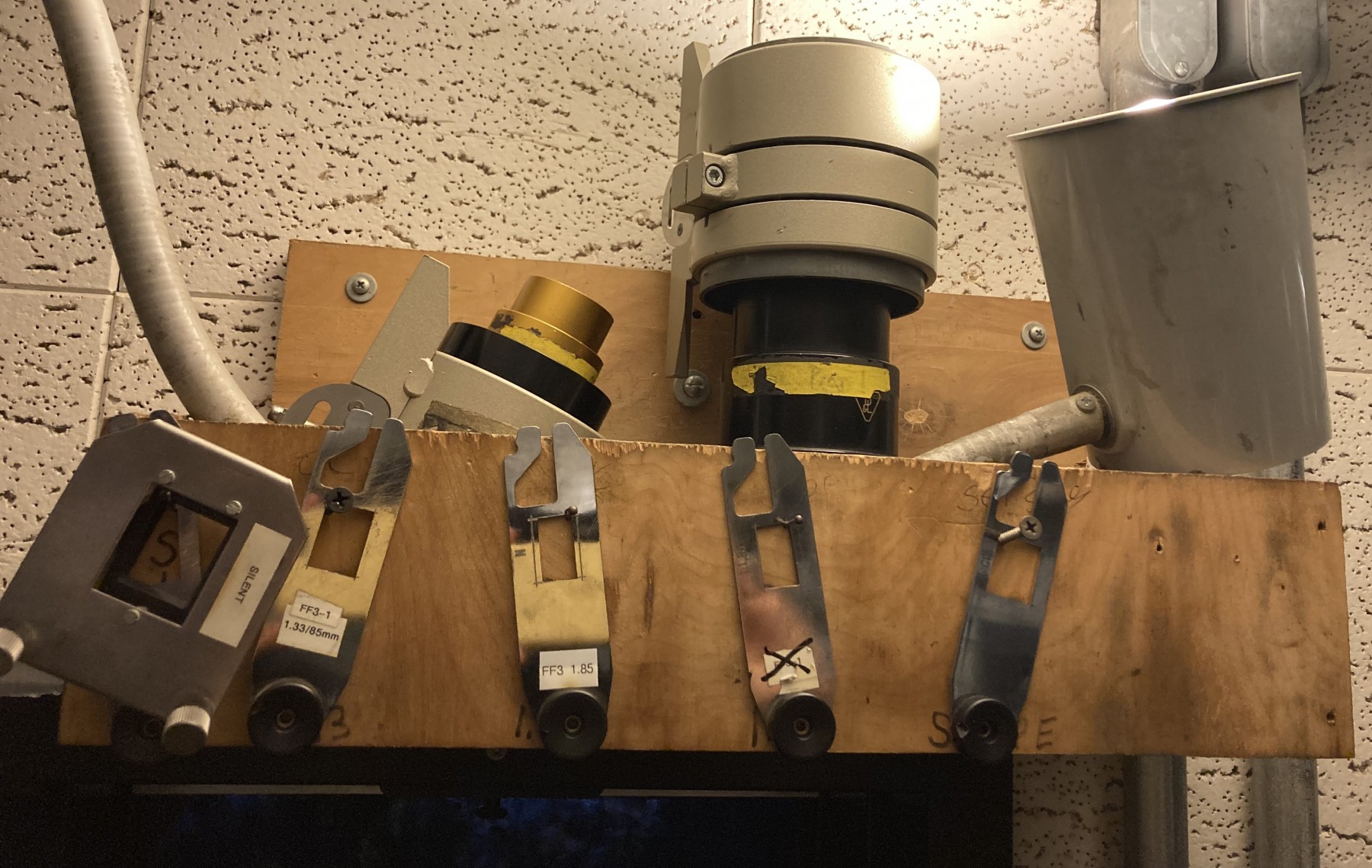
Projection aperture plates of varying sizes in the projection booth of Film Forum, a nonprofit movie theater on West Houston Street in Greenwich Village, New York, NY, United States.
Photograph by Loubna Régragui.
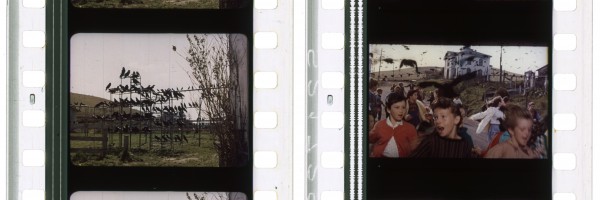
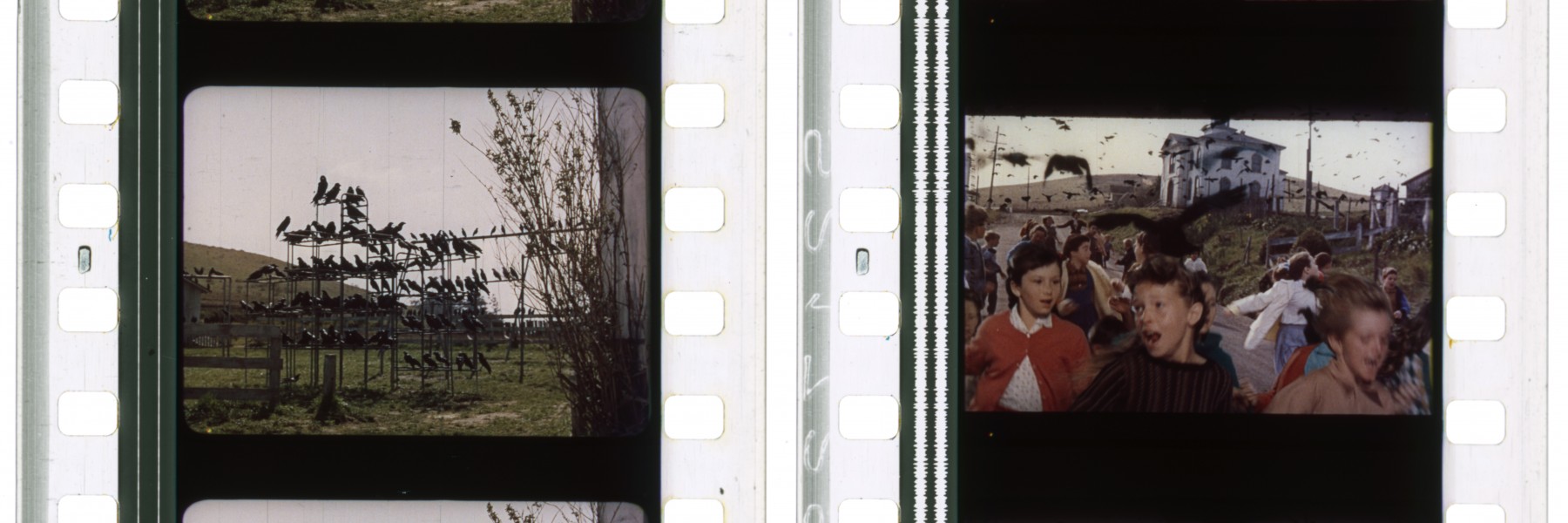
Original release prints of The Birds (1963) were mostly open matte, but the visual effects shots were hard-matted to 1.85:1.
George Eastman Museum, Rochester, NY, United States.
References
Belton, John (1992). Widescreen Cinema. Cambridge, MA: Harvard University Press.
Canby, Vincent (1953). “Projection Technique Can Give a ‘Wide-Look’ To Conventional Picture”. Motion Picture Herald, 191:7 (May 16): p. 13.
Eames, John Douglas (1985). The Paramount Story: The Complete History of the Studio and Its 2,805 Films. New York: Random House.
Enticknap, Leo (2005). Moving Image Technology, from Zoetrope to Digital. London: Wallflower Press: pp. 53–73.
Finler, Joel W. (1988). The Hollywood Story. London: Octopus Books.
Furmanek, Bob (2015). “The First Year of the Widescreen Production”. The 3-D Film Archive (website). https://sites.google.com/site/3dfilmarchive/first-year-of-widescreen-production (accessed Jan. 20, 2025).
Gomery, Douglas (2005). The Hollywood Studio System: A History. London: British Film Institute.
Lipton, Lenny (2021). The Cinema in Flux: The Evolution of Motion Picture Technology from the Magic Lantern to the Digital Era. New York: Springer.
Mitchell, Robert A. (1956). “A Common Sense to Screens, Apertures and Aspect Ratios”. International Projectionist, 31:6 (Jul.): pp. 4–12.
Mitchell, Robert A. (1961). “Non-Anamorphic Aspect Ratios: A Return to Sanity”. International Projectionist, 36:12 (Dec.): pp. 4–6.
Motion Picture Research Council (1955). “Count Them! 15 Different 35-mm Release Prints”. International Projectionist, 30:10 (Oct.): p. 22.
Saetervadet, Torkell (2006). The Advanced Projection Manual. Oslo: Norwegian Film Institute / FIAF.
Compare
Related entries
Author
Loubna Régragui is an independent film curator/preservationist and filmmaker with solid experience in an international, multicultural professional environment.
Loubna’s training in film preservation included participation in the ARCHIMEDIA European training network for the Promotion of Film Heritage, in addition she is a certified motion picture projectionist. She graduated from The L. Jeffrey Selznick School of Film Preservation, at the George Eastman Museum, where she had the opportunity to work on the private film collection of Martin Scorsese. Since then, Loubna has collaborated with major film festivals (Europe and US), with leading film archives (US and Europe) and with specialized film laboratories on film preservation programs and many prestigious restoration projects around the world.
She is a film director and Paris-based producer. Written as an homage to the finest poet and director of Indian cinema, Mani Kaul, her debut film The Nine Lakh Stars had its world premiere at the prestigious International Film Festival in Rotterdam (IFFR 2022). She’s currently developing further feature films, and is writing a book on the cinema of Mani Kaul.
In addition, Loubna is a doctoral researcher at Sorbonne Nouvelle University, Paris. Her PhD dissertation investigates Technicolor’s dye-imbibition process in the US, notably through the exploration of the unique Technicolor collections conserved by the George Eastman Museum, Rochester, NY.
The author would like to extend warm thanks to James Layton, Crystal Kui and Ken Fox (George Eastman Museum).
Régragui, Loubna (2026). “1.85:1 (aspect ratio)”. In James Layton (ed.), Film Atlas. www.filmatlas.com. Brussels: International Federation of Film Archives / Rochester, NY: George Eastman Museum.