1.75:1 (aspect ratio)(1953–c.1987)
A flat widescreen format for 35mm projection introduced in the 1950s.
Film Explorer
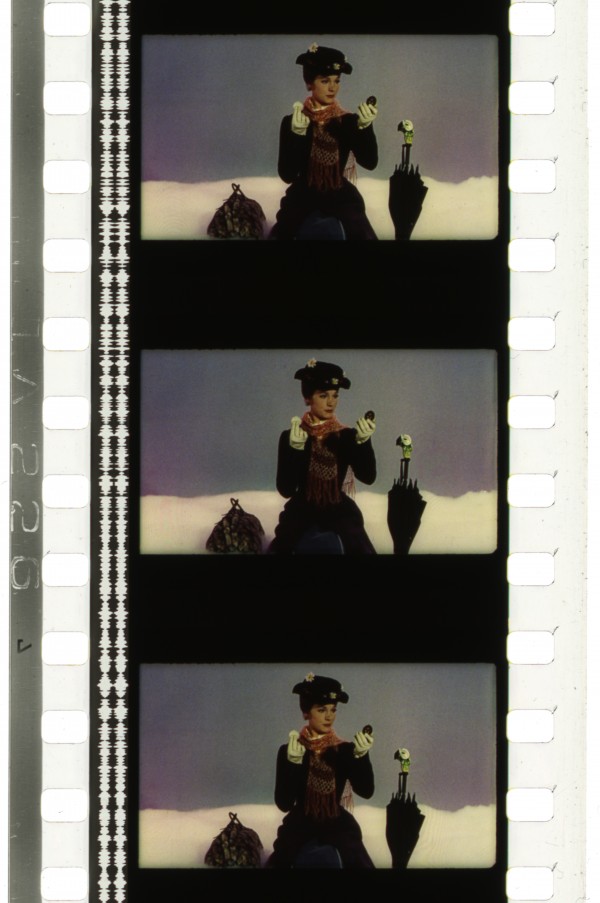
Original 35mm release prints of Mary Poppins (1964) were “hard matted” on the top and bottom of each frame to the 1.75:1 aspect ratio. 1.75:1 means the image’s width is 1.75 times its height.
Library of Congress, Culpeper, VA, United States.
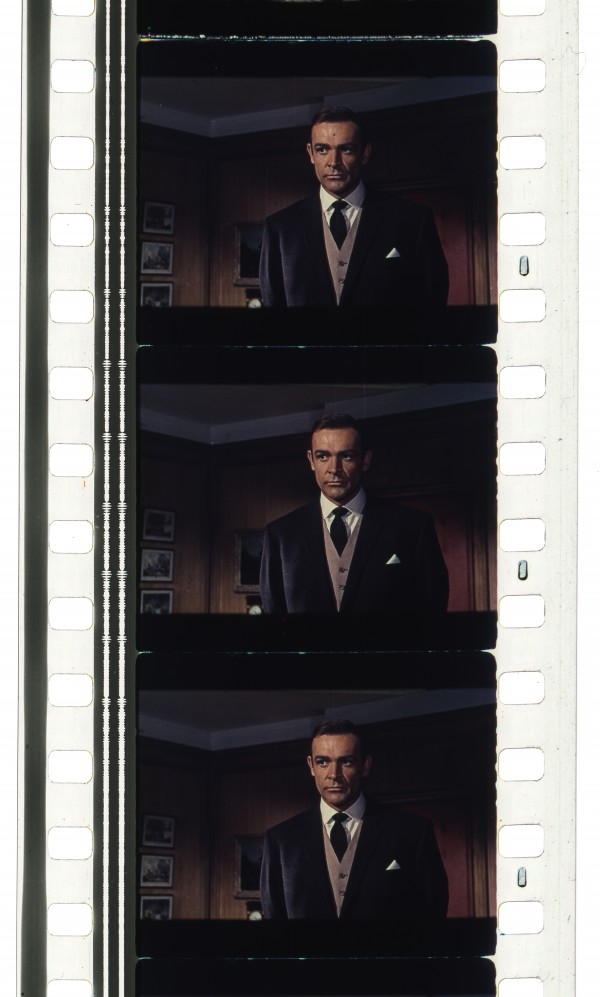
This original 35mm “open matte” release print of Goldfinger (1964) is printed in the Academy aspect ratio of 1.37:1, however the film was intended to be shown at 1.75:1 in theaters. During the projection, the top and bottom of the image would be cropped from view. The first three James Bond releases were composed for the 1.75:1 aspect ratio (commonly in use in the UK at the time), before the series switched to 2.35:1 anamorphic, from Thunderball (1965) onwards.
The Museum of Modern Art, New York, NY, United States.
Identification
20.96mm x 11.96mm (0.825 in x 0.471 in).
B/W or color.
1
Compatible with any color process.
Variable: 22.05mm x 12.60 mm (0.868 in x 0.496 in) – open matte; or, 20.96 mm x 11.96 mm – hard matte.
B/W or color.
History
In the early 1950s, films composed in the 1.37:1 Academy ratio began competing with the growing popularity of television, despite the latter’s relatively small screens. In response, studios sought to attract audiences back to cinemas without incurring the substantial costs of anamorphic widescreen production. As a result, the standard 35mm frame was frequently cropped to wider aspect ratios, requiring shorter focal-length lenses to enlarge the image, which often led to a perceived decline in image quality – reduced sharpness and increased grain – though any loss of brightness could usually be corrected by refocusing the projector lamp. In practice, however, the projectionist exercised significant control over the final image, a role that could reinforce or compromise the filmmaker’s intentions. Projectionists could use either “soft masking”, where the projector’s aperture plate defined the frame, or “hard masking”, where black bars blocked the top and bottom of the image on the film strip. This period preceded the consolidation of a standardized system: producers and exhibitors experimented with a range of aspect ratios and projection techniques in search of stable conventions.
Following the launch of CinemaScope on February 4, 1953, Metro-Goldwyn-Mayer moved quickly to follow 20th Century-Fox’s lead, introducing its own custom aspect ratio. After in-house testing, the studio’s engineers adopted the 1.75:1 aspect ratio for future productions, both 2-D and 3-D, judging it the ideal ratio for general use in American theaters. (The image was 1.75 times wider than its height). At the time, projectionists often considered it the most visually pleasing widescreen aspect ratio, describing it as producing a picture that “looks sharper, steadier, and slightly brighter” (Mitchell, 1961). MGM also announced that it would no longer produce B/W films in favor of those photographed in Technicolor, Ansco Color or Eastman Color negative.
In May 1953, at the London Empire theater, MGM “unveiled its panoramic screen, the largest in Europe” (53-ft wide by 27-ft high [16.15m x 8.23m]), covered with aluminum paint to increase luminosity (Burnup, 1953). The projector’s aperture plate masked the image to a ratio of approximately 1.75:1, paired with a stereophonic sound system. This new panoramic screen was installed in all MGM (Loew’s) theaters abroad. As MGM’s first feature-length stereoscopic production, Richard Fleischer’s Arena (1953) was photographed in the Academy ratio and subsequently matted to 1.75:1 for theatrical exhibition. The film received a fifteen-city premiere on June 19, 1953. In the United States, an estimated 10 per cent of feature films released that year were exhibited in the 1.75:1 aspect ratio.
Around October 1953, MGM introduced the Variscope – its Variable Wide Screen Projection Lens – to professionals and members of the Society of Motion Picture and Television Engineers (SMPTE) in Hollywood, “aiming at screening films at any aspect ratio with the same projection lens” (Foster, 1953). It was a response to the proliferation of aspect ratios then in use, and the lack of an industry standard. It had a limited lifespan, probably because MGM’s engineers focused their research on improving movie cameras instead. In 1956, they joined Panavision to develop MGM Camera 65, which used a large-format negative to reduce visible grain in widescreen color projection.
By September 1955, MGM had ceased using the 1.75:1 aspect ratio in favor of the more widely used 1.85:1 ratio. Despite adopting this “flat” aspect ratio, three quarters of MGM’s films released in 1955 were shot in anamorphic CinemaScope.
By 1955, the proliferation of competing cropped and anamorphic widescreen systems had strengthened calls for standardization among art directors and cinematographers, who wanted their creative intentions reproduced accurately in exhibition. Yet it would be another two years before a standard flat aspect ratio prevailed among the 15 variants that had emerged in film exhibition.
By September 1956, 1.85:1 had become the accepted non-anamorphic industry standard for widescreen presentation in the US, because it was frequently used for shooting. In Europe, France opted for 1.66:1, while the 1.75:1 ratio was favored by some Italian filmmakers in the 1960s. In the UK, it was largely standardized by film producers after the Camera Technical Committee of the British Film Producers Association recommended 1.75:1 as the optimum ratio for national productions, on February 10, 1955. It was the most widely used ratio in British productions between 1957 and 1966, and was still used on 30 per cent of British films in 1970.
During the 1960s, Walt Disney Productions adopted the 1.75:1 aspect ratio as its standard for theatrical exhibition, balancing cinematic presentation with the practical demands of television distribution. Although films were composed primarily for the 1.75:1 frame, filmmakers also preserved an uncropped 4:3 composition to facilitate subsequent television broadcasts, a practice that coincided with the studio’s expanding output in television production. The adventure film Kidnapped (1960) was the first Disney title shot in 1.75:1, filmed in Scotland and at Pinewood Studios in London. In 1961, One Hundred and One Dalmatians was shot in the 1.37:1 open matte ratio on the negative, but with an intended theatrical ratio of 1.75:1. The last Disney feature released in the 1.75:1 aspect ratio is believed to be The Fox and the Hound (1981).
Selected Filmography
Starring Glenn Ford, Ursula Thiess and Abbe Lane. Shot in Eastman Color, partly in Brazil, and then in Los Angeles. Cattleman Sam Dent from Texas has to deliver Brahma bulls to Brazil.
Starring Glenn Ford, Ursula Thiess and Abbe Lane. Shot in Eastman Color, partly in Brazil, and then in Los Angeles. Cattleman Sam Dent from Texas has to deliver Brahma bulls to Brazil.
Starring William Holden, Eleonor Parker and John Forsythe. A Western set in 1863, in Arizona territory. Shot in Anscocolor.
Starring William Holden, Eleonor Parker and John Forsythe. A Western set in 1863, in Arizona territory. Shot in Anscocolor.
An unexpected friendship between a young red fox and a hound, based on the 1967 novel written by Daniel P. Mannix.
An unexpected friendship between a young red fox and a hound, based on the 1967 novel written by Daniel P. Mannix.
Starring Derek Bond, Reed de Rouen and Bryan Coleman. Written by Ray Cooney and Tony Hilton – a thriller about a mysterious killer who amputates the hands of his victims.
Starring Derek Bond, Reed de Rouen and Bryan Coleman. Written by Ray Cooney and Tony Hilton – a thriller about a mysterious killer who amputates the hands of his victims.
A film about voyeurism, the internal mechanisms of the feeling of fear and the power of a camera. The film was originally produced in the European theatrical ratio of 1.66:1 on the negative, while its ultimate intended aspect ratio was 1.75:1.
A film about voyeurism, the internal mechanisms of the feeling of fear and the power of a camera. The film was originally produced in the European theatrical ratio of 1.66:1 on the negative, while its ultimate intended aspect ratio was 1.75:1.
Starring Jane Wyman, Hayley Mills and Karl Malden. In 1961, Hayley Mills won the Golden Globe Award for the Most Promising Newcomer.
Starring Jane Wyman, Hayley Mills and Karl Malden. In 1961, Hayley Mills won the Golden Globe Award for the Most Promising Newcomer.
Starring Virna Lisi, Gastone Moschin and Nora Ricci. A comedy of manners in a sketch format, which depicts, in a corrosive way, the sex life of the Veneto bourgeoisie. In B/W.
Starring Virna Lisi, Gastone Moschin and Nora Ricci. A comedy of manners in a sketch format, which depicts, in a corrosive way, the sex life of the Veneto bourgeoisie. In B/W.
Starring Joan Crawford, Michael Wilding and Gig Young. A Technicolor drama based on the story ‘Why Should I Cry’ by I.A.R. Wylie.
Starring Joan Crawford, Michael Wilding and Gig Young. A Technicolor drama based on the story ‘Why Should I Cry’ by I.A.R. Wylie.
Starring Barbara Stanwyck, George Sanders and Gary Merrill. A B/W suspense film. Cheryl Draper witnesses a murder then becomes the killer’s next target.
Starring Barbara Stanwyck, George Sanders and Gary Merrill. A B/W suspense film. Cheryl Draper witnesses a murder then becomes the killer’s next target.
Technology
1.75:1 is a “flat”, or spherical (non-anamorphic), matted widescreen format. Spherical lenses magnify film images equally in the horizontal and vertical planes, while anamorphic camera lenses squeeze a wider-ratio image along the horizontal axis, so as to fit within a standard 35mm film frame. The image is then horizontally expanded during projection by the use of a similar, complementary anamorphic projection lens, typically producing an on-screen image with an aspect ratio of 2.35:1, or greater. Films with a 1.75:1 aspect ratio have a screen image that is 1.75 times wider than it is tall.
From 1953 onwards, in the United States, most flat movies were cropped top and bottom, and then enlarged on-screen to a wider aspect ratio, producing a widescreen effect. The Academy aspect ratio of 1.37:1 could be cropped to 1.66:1, 1.75:1, 1.85:1 and even wider. There are two ways to do so: with a soft matte or a hard matte.
(For definitions of soft and hard mattes, please visit the essays on 1.66:1, or 1.85:1.)
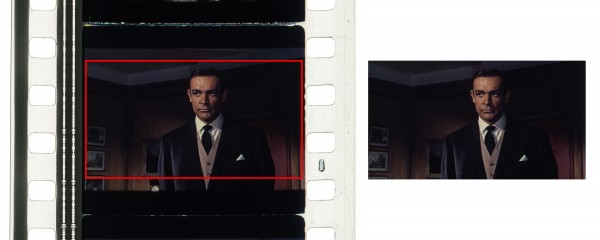
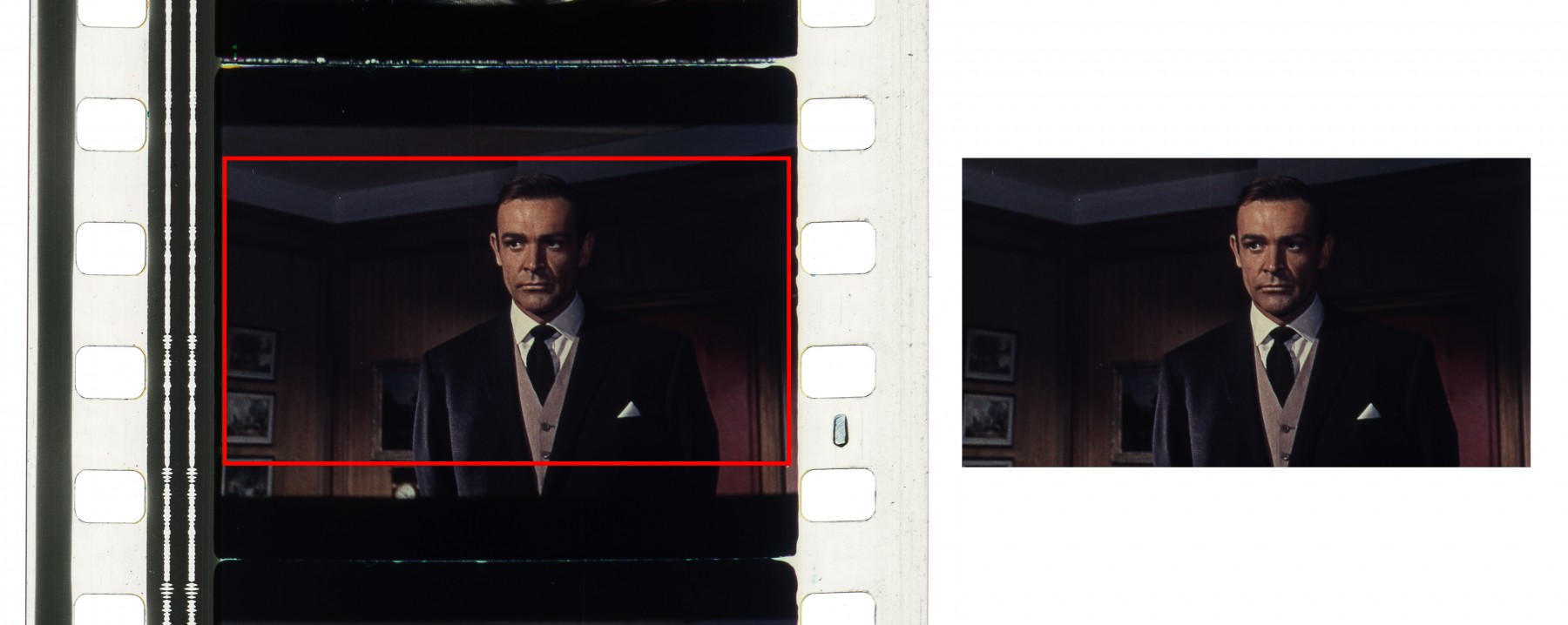
An original 35mm Technicolor print of Goldfinger (1964). On open matte prints like this, the top and bottom of the image were masked out during projection.
The Museum of Modern Art, New York, NY, United States. Design by Crystal Kui.
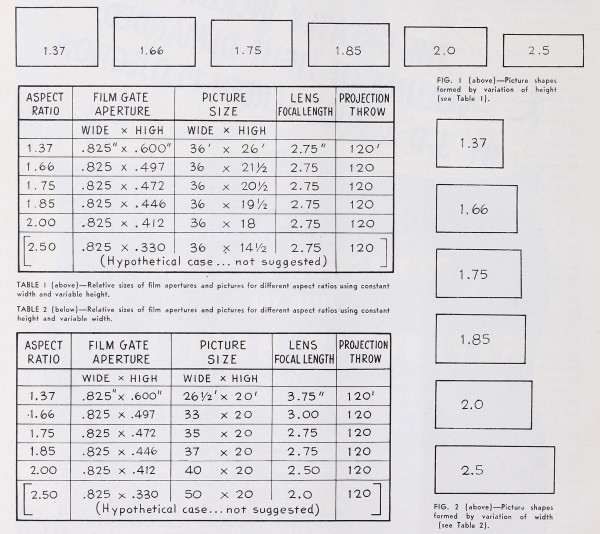
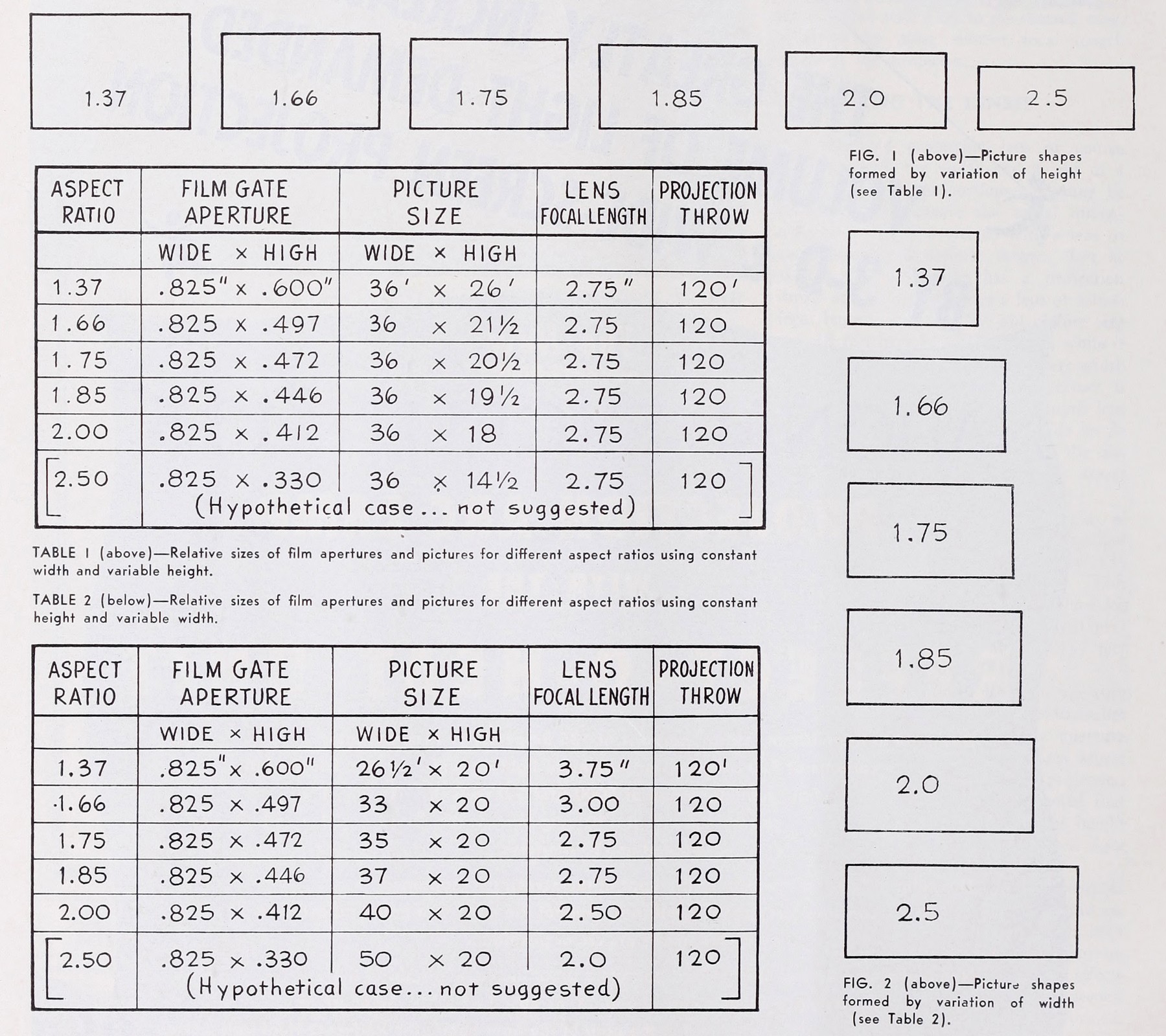
A comparison of screen sizes formed by varying the height and width. Depending on the restrictions imposed by a theater’s shape and size, it either had to expand the width of its existing screen to obtain a widescreen image, or reduce its height.
Gagliardi Gio (1953). “Setting Up Conditions for Variable Aspect Ratios”. Motion Picture Herald (Sep. 5): p 42.
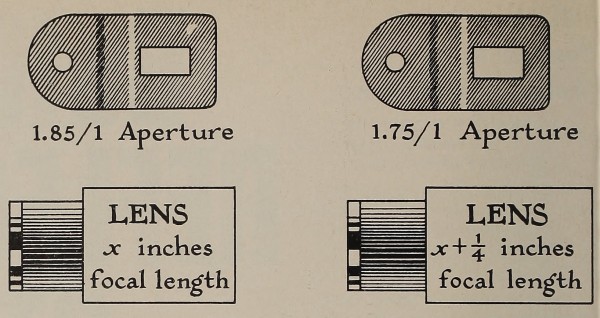
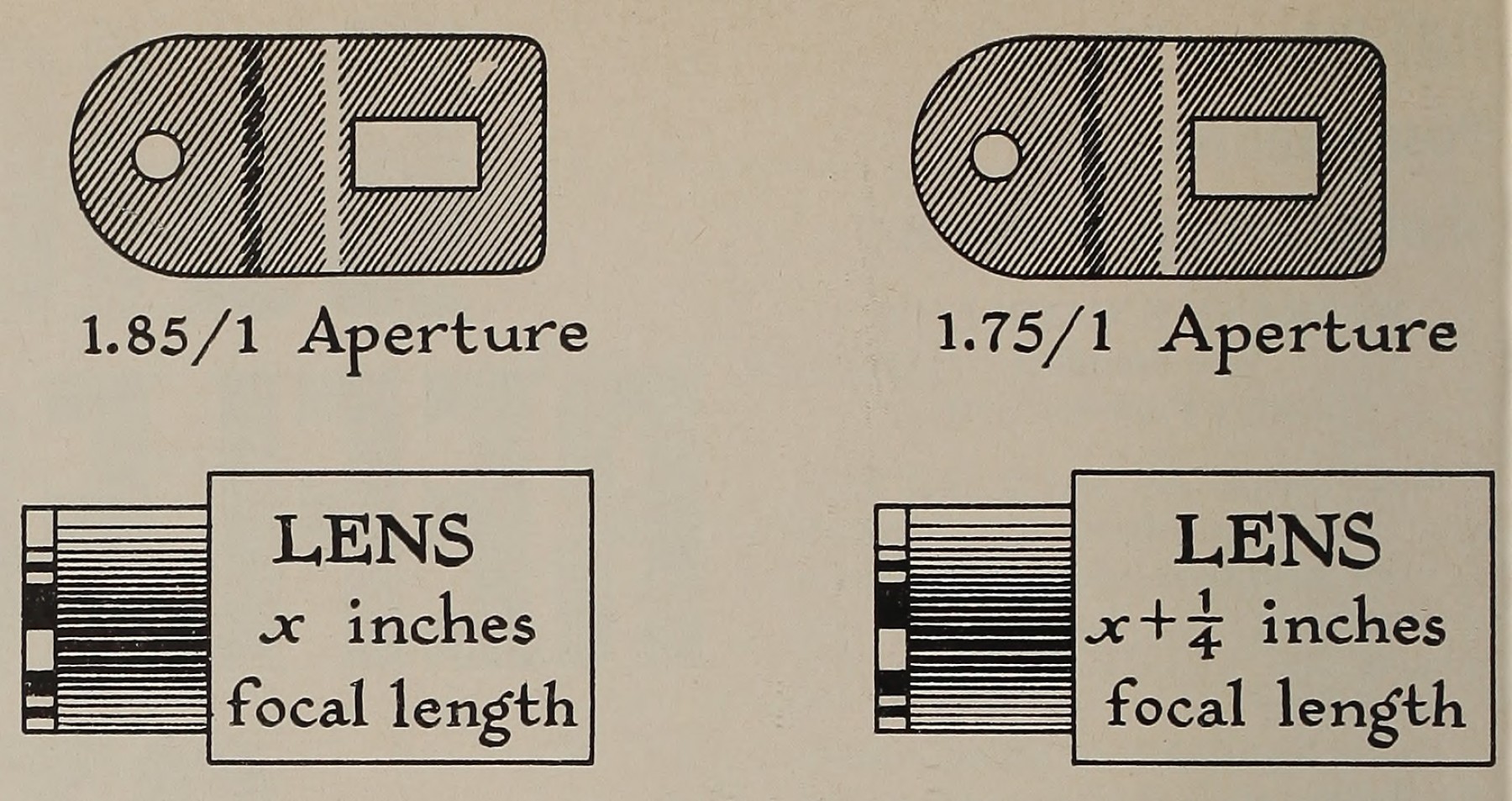
Cropping a projected image to 1.85:1, or 1.75:1, required changing both the aperture plate and the projector lens in order for the widescreen image to adequately fill the screen.
International Projectionist, (Dec. 1961): p.14.
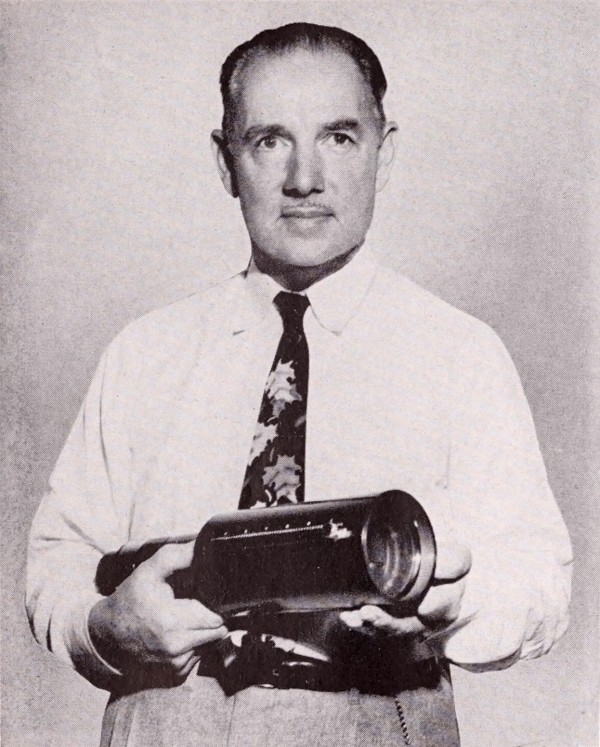
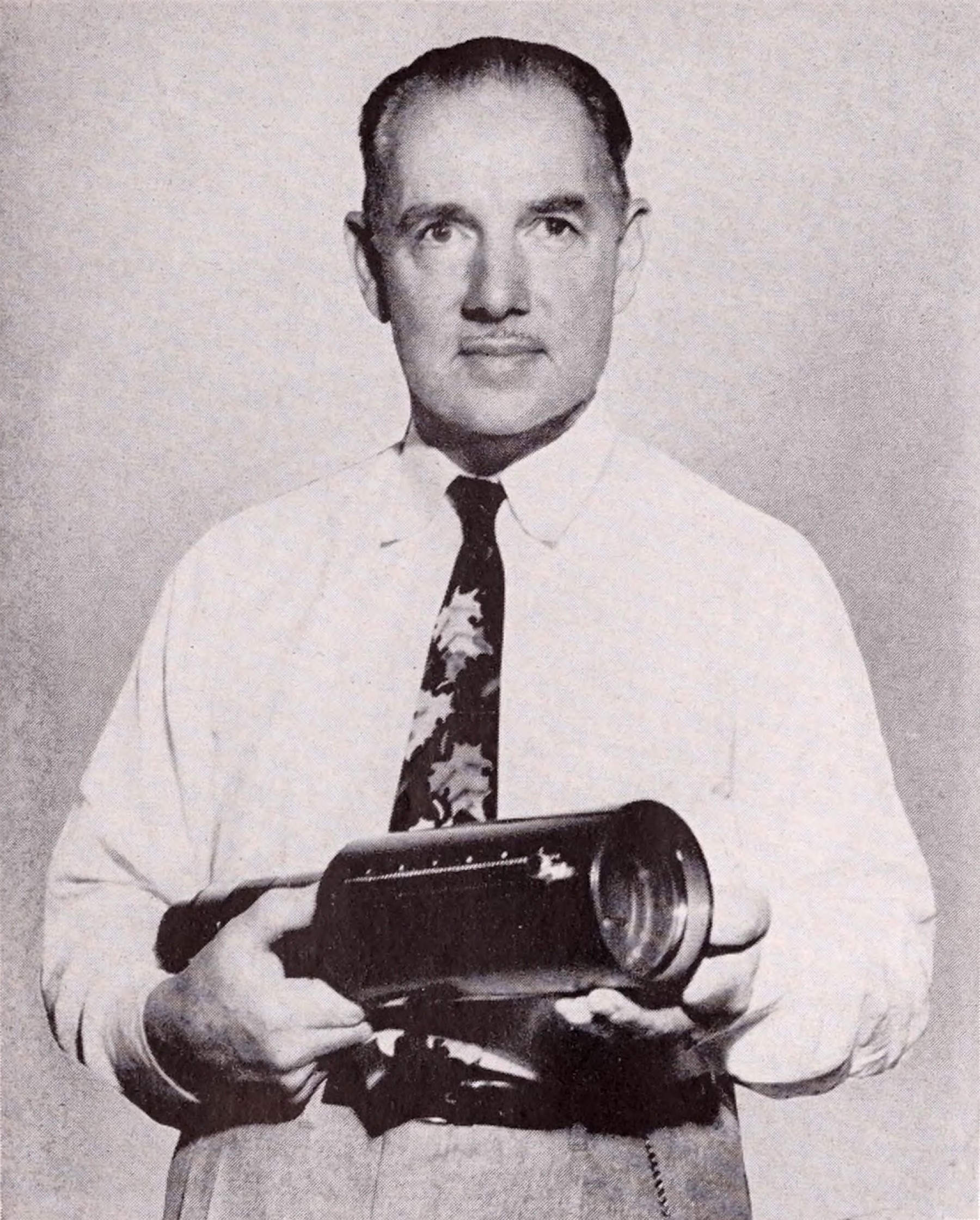
MGM projectionist Purdon C. Young, holding his invention, the Variscope widescreen projection lens.
Foster, Frederick (1953). “MGM Variable Wide Screen Projection Lens”. American Cinematographer (Oct.): p. 484.
References
Belton, John (1992). Widescreen Cinema. Cambridge, MA: Harvard University Press.
Burnup, Peter (1953). “MGM Screen is Seen in London”. Motion Picture Herald, 191:9 (May 30): p. 12.
Canby, Vincent (1953). “Projection Technique Can Give a ‘Wide-Look’ To Conventional Picture”. Motion Picture Herald, 191:7 (May 16): p. 13.
Enticknap, Leo (2005). Moving Image Technology, from Zoetrope to Digital. London: Wallflower Press: pp. 53–73.
Finler, Joel W. (1988). The Hollywood Story. London: Octopus Books.
Foster, Frederick (1953). “MGM Variable Wide Screen Projection Lens”. American Cinematographer, 34:10 (Oct.): p. 484.
Furmanek, Bob (2015). “The First Year of the Widescreen Production”. The 3-D Film Archive(website). https://sites.google.com/site/3dfilmarchive/first-year-of-widescreen-production (accessed Jan. 20, 2025).
Gomery, Douglas (2005). The Hollywood Studio System: A History. London: British Film Institute.
Leebron, Elizabeth & Lynn Gartley (1979). Walt Disney: A Guide to References and Resources. Boston, MA: G.K. Hall & Co.
Lipton, Lenny (2021). The Cinema in Flux: The Evolution of Motion Picture Technology from the Magic Lantern to the Digital Era. New York: Springer.
Mitchell, Robert A. (1956). “A Common Sense to Screens, Apertures and Aspect Ratios”. International Projectionist, 31:6 (Jul.): pp. 4–12.
Mitchell, Robert A. (1961). “Non-Anamorphic Aspect Ratios: A Return to Sanity”. International Projectionist, 36:12 (Dec.): pp. 4–6.
Motion Picture Research Council (1955). “Count Them! 15 Different 35-mm Release Prints”. International Projectionist, 30:10 (Oct.): p. 22.
Saetervadet, Torkell (2006). The Advanced Projection Manual. Oslo: Norwegian Film Institute/FIAF.
Compare
Related entries
Authors
Loubna Régragui is an independent film curator/preservationist and filmmaker with solid experience in an international, multicultural professional environment.
Loubna’s training in film preservation included participation in the ARCHIMEDIA European training network for the Promotion of Film Heritage, in addition she is a certified motion picture projectionist. She graduated from The L. Jeffrey Selznick School of Film Preservation, at the George Eastman Museum, where she had the opportunity to work on the private film collection of Martin Scorsese. Since then, Loubna has collaborated with major film festivals (Europe and US), with leading film archives (US and Europe) and with specialized film laboratories on film preservation programs and many prestigious restoration projects around the world.
She is a film director and Paris-based producer. Written as an homage to the finest poet and director of Indian cinema, Mani Kaul, her debut film The Nine Lakh Stars had its world premiere at the prestigious International Film Festival in Rotterdam (IFFR 2022). She’s currently developing further feature films, and is writing a book on the cinema of Mani Kaul.
In addition, Loubna is a doctoral researcher at Sorbonne Nouvelle University, Paris. Her PhD dissertation investigates Technicolor’s dye-imbibition process in the US, notably through the exploration of the unique Technicolor collections conserved by the George Eastman Museum, Rochester, NY.
The author would like to extend warm thanks to James Layton, Crystal Kui and Ken Fox (George Eastman Museum).
& Loubna Régragui (2026). “1.75:1 (aspect ratio)”. In James Layton (ed.), Film Atlas. www.filmatlas.com. Brussels: International Federation of Film Archives / Rochester, NY: George Eastman Museum.