Nord Process(1953–1954)
A single-strip stereoscopic 3-D release print format developed by the Nord Company of Minneapolis.
Film Explorer
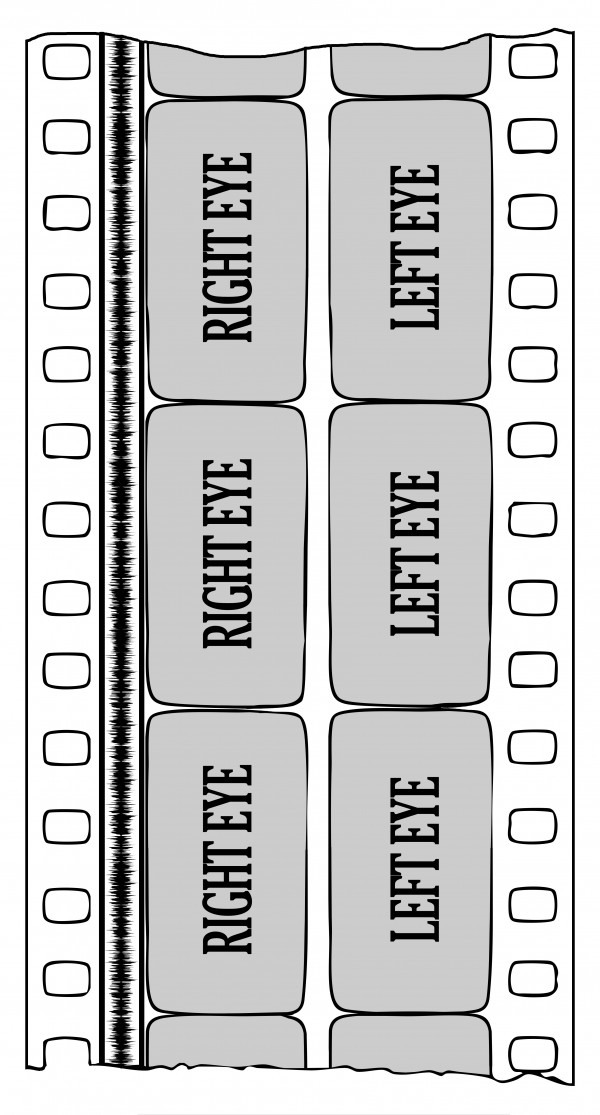
The Nord process contained left- and right-eye stereoscopic 3-D image pairs on one 35mm print, rotated 90 degrees to the vertical. A projection attachment rotated these images back to standard orientation, cross-polarized and superimposed them on a highly-reflective screen for viewing in 3-D with complementary polarized glasses.
Design by Christian Zavanaiu.
Identification
Unknown
B/W; IB Technicolor.
Unknown
1
Optical sound on the print or magnetic full-coat sound on a separate 35mm strip.
Unknown
B/W or color.
Unknown
History
The Nord Company of Minneapolis made small-gauge movie gear for non-theatrical filmmakers and hobbyists. In late 1951, Nord introduced simple camera and projector attachments for those who wished to make their own 3-D films in 16mm format (St. Louis Globe-Democrat, 1951). (See 16mm Nord 3-D).
When Arch Oboler’s Bwana Devil (in Natural Vision 3-Dimension) became a box-office sensation in late 1952, exhibitors rushed to install the equipment needed to show 3-D films in dual-strip format using two synchronized projectors. They and their audiences soon discovered that loss of synchronism could easily derail dual-strip 3-D projection. Sensing an opportunity, Nord conceived a single-strip 35mm release print format and compatible projection attachments so theatres could show 3-D films using individual projectors and standard changeover techniques. Nord promised to make the format and necessary laboratory procedures available to the movie industry “without charge” (Variety, 1953a).
Trade demonstrations of the Nord Process in New York in mid-June 1953 presented selected scenes from several contemporaneous 3-D features, plus sequences filmed using Nord’s proprietary 35mm camera attachment (Boxoffice, 1953; The Exhibitor, 1953). Harrison’s Reports said: “The images projected on the screen were equal to the best yet shown in any other 3-D process” (Harrison, 1953) – a view shared by The Hollywood Reporter (Hollywood Reporter, 1953a). Others felt the Nord system reduced 3-D-related eyestrain compared to dual-strip projection systems (The Exhibitor, 1953).
Technical personnel from Universal, Paramount and unspecified companies saw demos in Los Angeles in August 1953 but offered no public reactions. The trade press, however, was openly critical this time around. According to one report, the first demo was “pretty trying stuff” – subsequently, inventor Roy Clapp made technical adjustments. Footage from the recent dual-strip release I, the Jury was reportedly unimpressive, having “the appearance of old film”. (Daily Variety, 1953a). Some scenes appeared “poorly aligned” (Hollywood Reporter, 1953b). However, scenes shot using Nord’s own camera device looked “flawless” (Weaver, 1953).
Producer Victor Saville considered using the Nord Process for the general release of I, the Jury (Variety, 1953b), but distributor United Artists balked in the face of threatened lawsuits from a disgruntled Nord stockholder who wanted to take control of the enterprise (Handel, 1953) and from Natural Vision designer Friend Baker, who mistakenly believed the Nord Process infringed on his Stereo 16 patent (US 2,627,201) (Blumofe, 1953).
Things were looking up in October 1953, when Columbia promised to make all its 3-D films, “past, present, and future”, available in the Nord format (Motion Picture Herald, 1953a). One reel of the studio’s Gun Fury (1953) was shown to industry observers in Los Angeles (Hollywood Reporter, 1953c), and sample frames from that film were printed in the Minneapolis Sunday Tribune in January 1954 (Flanagan, 1954). Film historian James Limbacher claimed that Nord-format prints were ultimately made of six Columbia releases (Limbacher, 1978), but this has not been confirmed elsewhere. Allied Artists and independent producers Hal Wallis, Edward Small and Bryan Foy expressed interest (Weekly Variety, 1953a), and Warner Bros. briefly delayed 2-D distribution of its 3-D hits House of Wax and The Charge at Feather River “pending study” of the Nord system (Daily Variety, 1953b).
Things went sideways again when Texas mega-exhibitor Bob O'Donnell forcefully refuted Nord’s claim that his theatre chain would soon replace its dual-strip 3-D equipment with the Nord system (Daily Variety, 1953c; Variety, 1953c). A proposed tie-in with Polacoat’s Magic-Vuer 3-D glasses somehow ran afoul of the Robinson-Patman Act of 1936, which prohibits favoritism in pricing for “preferred” customers (Business Week, 1953).
An incompatible rival, single-strip Pola-Lite, shouldered Nord aside in late 1953 and early 1954, in what the trade press dubbed a “local skirmish” in the overall “battle of the systems.” (Motion Picture Herald, 1953b). Both Nord and Pola-Lite found themselves caught in a “chicken-and-egg” situation, as theatres would not buy their equipment until studios made compatible prints available, but studios would not strike single-strip prints until enough theatres could play them (Variety, 1953d). There appears to have been little interest in Nord after the first quarter of 1954.
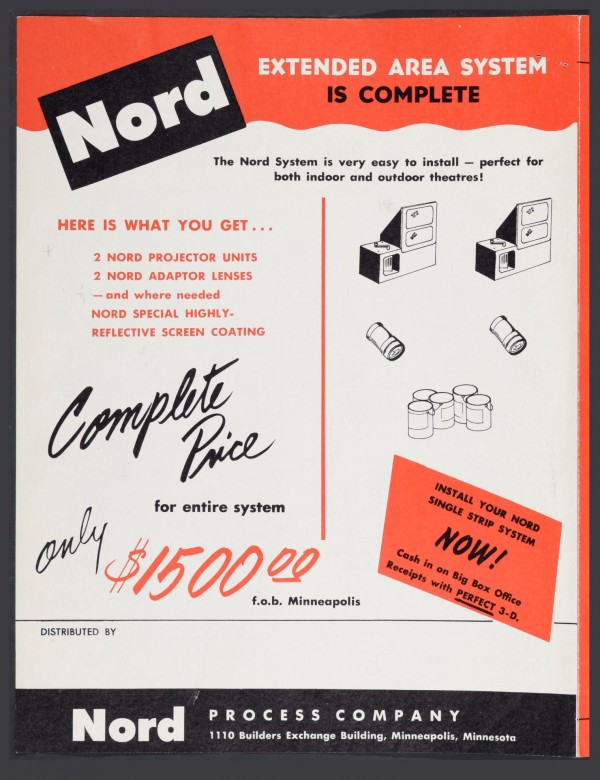
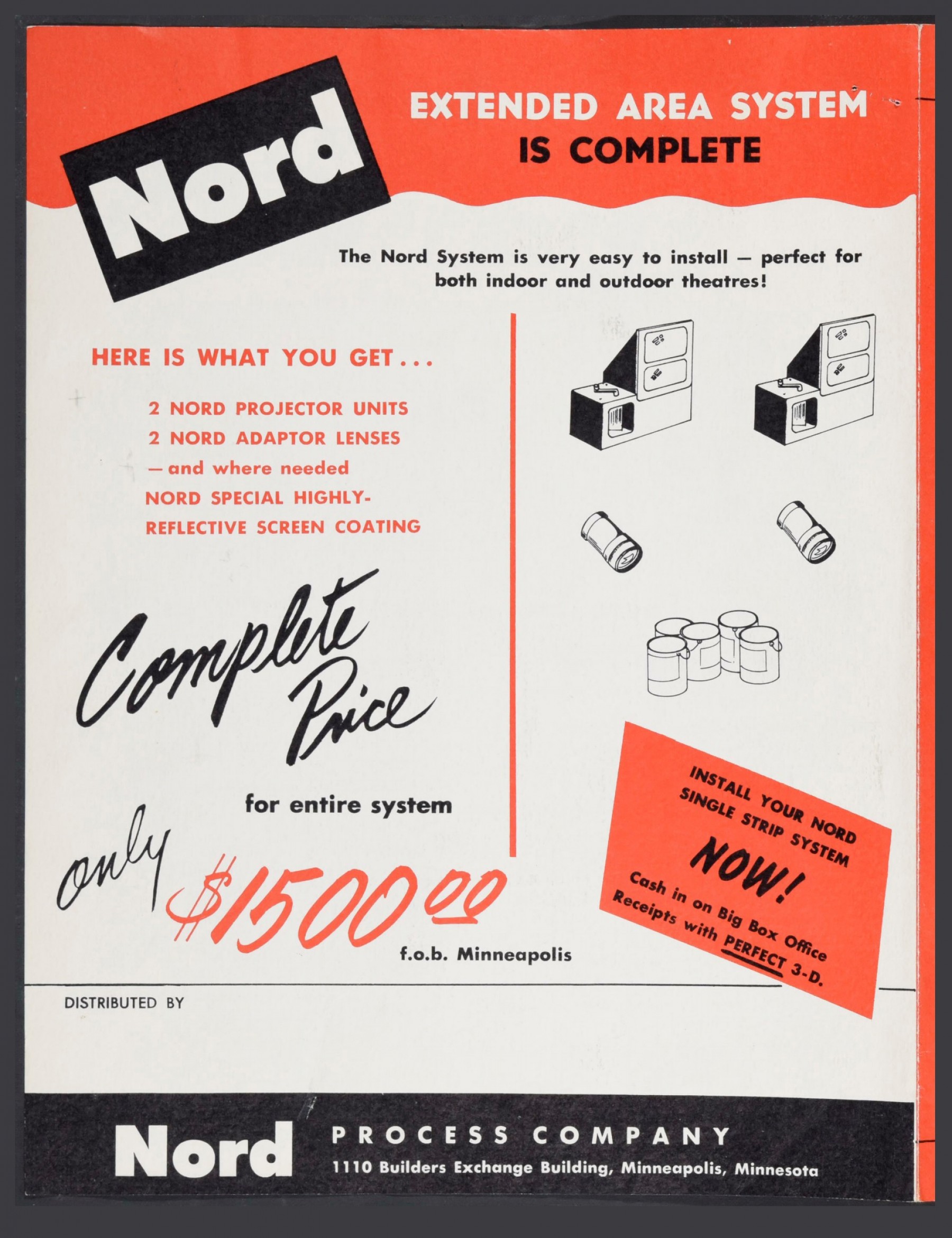
A Nord promotional brochure, c. 1954.
Courtesy Library of Congress.
Selected Filmography
Feature. One or several Nord Process prints were made for exhibition.
Feature. One or several Nord Process prints were made for exhibition.
Feature. Selected scenes for demonstration purposes were printed in the Nord Process.
Feature. Selected scenes for demonstration purposes were printed in the Nord Process.
Feature. Selected scenes for demonstration purposes were printed in the Nord Process.
Feature. Selected scenes for demonstration purposes were printed in the Nord Process.
Feature. Selected scenes for demonstration purposes were printed in the Nord Process.
Feature. Selected scenes for demonstration purposes were printed in the Nord Process.
Feature. Selected scenes for demonstration purposes were printed in the Nord Process.
Feature. Selected scenes for demonstration purposes were printed in the Nord Process.
Short. Selected scenes for demonstration purposes were printed in the Nord Process.
Short. Selected scenes for demonstration purposes were printed in the Nord Process.
Technology
The Nord Process put two reduced-sized subframes on one strip of 35mm film in same-sense (“head-to-toe”) orientation, rotated 90 degrees in relation to the guided edge of the film. These subframes together filled the area normally occupied by a single full-height frame. Nord advocated the use of a full silent aperture to maximize picture area for the subframes, each of which would thus be 87.5 per cent the size of a standard 35mm 2-D frame cropped to the same approx. 1.75:1 aspect ratio (Roe, 1953). Of course, using the full-silent aperture area would leave no room on the filmstrip for an optical soundtrack, potentially hindering wide adoption of the Nord system. However, a newspaper illustration from January 1954 shows sample frames printed in the Nord format along with a variable area soundtrack (Flanagan, 1954).
The Nord Process offered compelling benefits to exhibitors who wished to show 3-D movies. Single-strip presentation meant no extra pay for additional projectionists, no outsized reels and shipping cans, no mid-feature intermissions, no splicing complications and no audience complaints owing to loss of synchronism, all commonly associated with dual-strip projection (Spooner, 1953).
However, the head-to-toe configuration of the Nord-format subframes meant that illumination was unevenly distributed across the left and right image fields onscreen. Given the small image area of the left and right subframes, light loss for the Nord format was substantial, and industry observers felt the system would work best in smaller theatres (International Projectionist, 1953).
Custom-built for each theatre, Nord projection kits would cost $1,500 (Oboler, 1954). These kits consisted of two adaptor lenses and two projection attachments. The projection attachments housed an assembly of first-surface mirrors to cross-polarize the left and right stereo images and superimpose them on a “silver” (i.e., aluminized) screen for viewing through 3-D glasses containing complementary polarizers. An early prototype, “much larger than the production model”, was used for the initial demonstrations (Boxoffice, 1953). A bulky, cockeyed contraption that threw one subframe up and to the left and the other down and to the right, this prototype had to be mounted outside a theatre’s projection port. The production model, mounted close to the projector inside the projection booth (Roe, 1953: pp. 485, 509), had a more concise optical path, throwing both views leftwards and then upwards into twin converging mirrors. According to reports, use of this latter projection attachment would require physical enlargement of existing projection ports and might possibly require repositioning of the projectors (Boxoffice, 1953).
Nord claimed that its projection attachments need never be removed for showing 2-D movies. This may have been true for Academy-ratio and spherical widescreen films, as a gate on the attachments could be opened to clear the optical path for “flat” projection (Boxoffice, 1953). But anamorphic lenses for CinemaScope were simply too large to share space with Nord attachments.
In the end, Nord never patented its theatrical 3-D equipment (Oboler, 1962). Despite claims made by Natural Vision co-inventor Friend Baker, neither the frame architecture nor the optical design of the Nord projection attachment bears more than a superficial resemblance to his Stereo 16 system. However, British single-strip 3-D specialist Hubert Dewhurst had previously demonstrated a device very similar to Nord (Dewhurst, 1954), and Nord inventor Roy Clapp was later “happy” to learn that the Motion Picture Research Council, working independently, had created its own variation of the Nord concept for single-strip 3-D (Weekly Variety, 1953b).
Design specifications for Nord’s proprietary single-camera 35mm 3-D system are unknown.
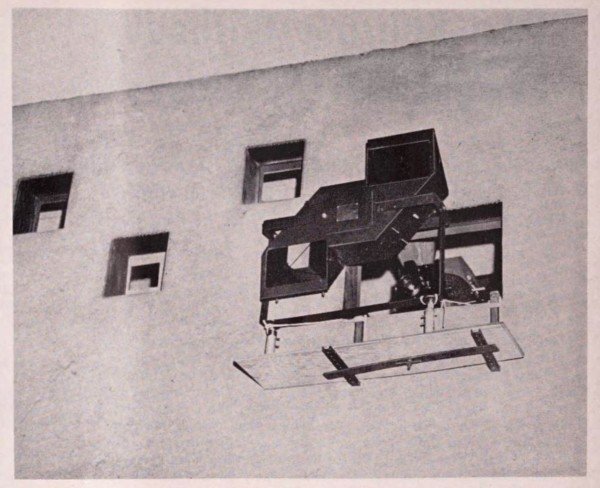
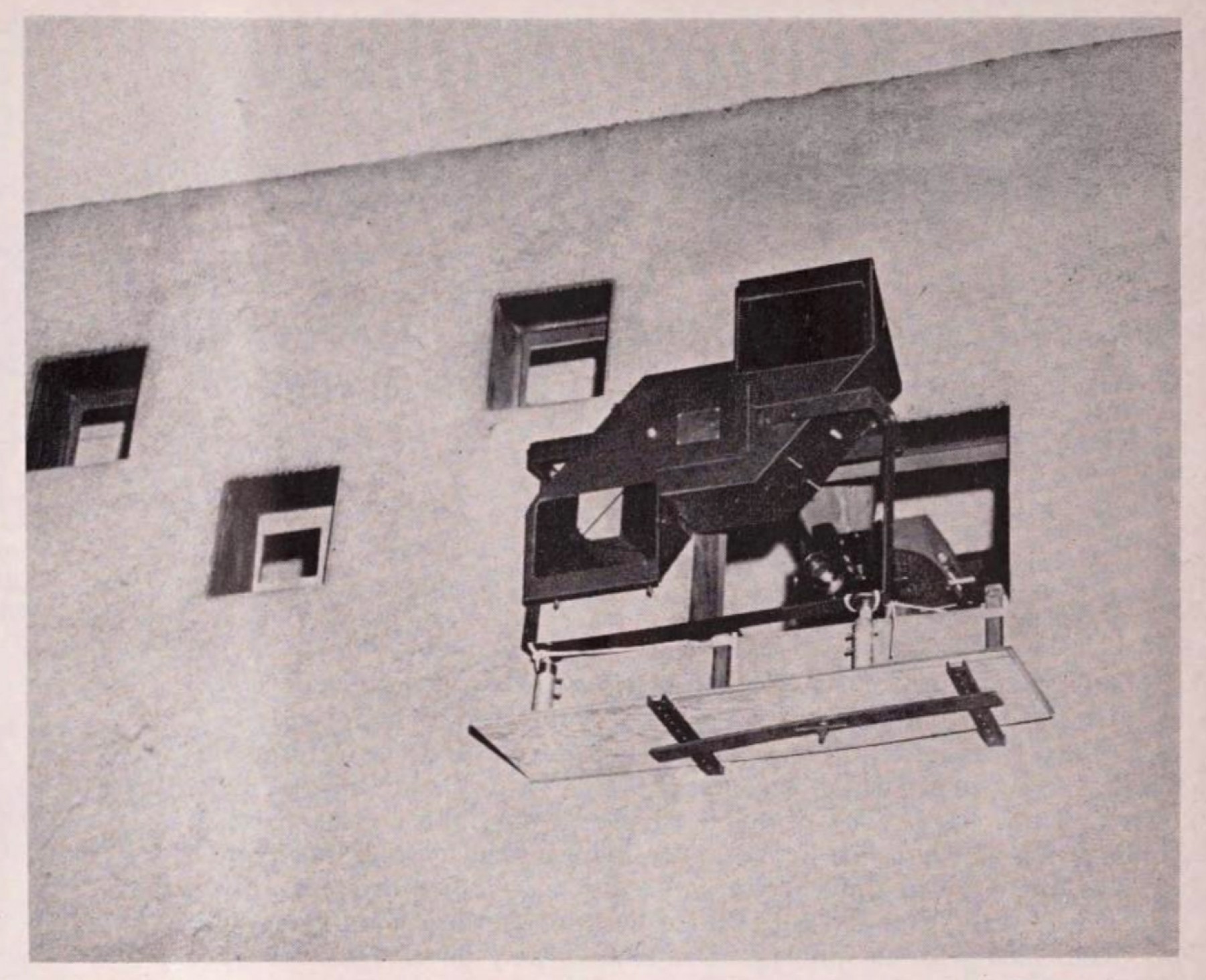
A photograph of the large prototype Nord device mounted outside a projection port in August 1953.
Roe, Alvin D. (1953). “Simplified Single-film System For 3-D Exhibition”. American Cinematographer, 34:10 (Oct.): p. 485.
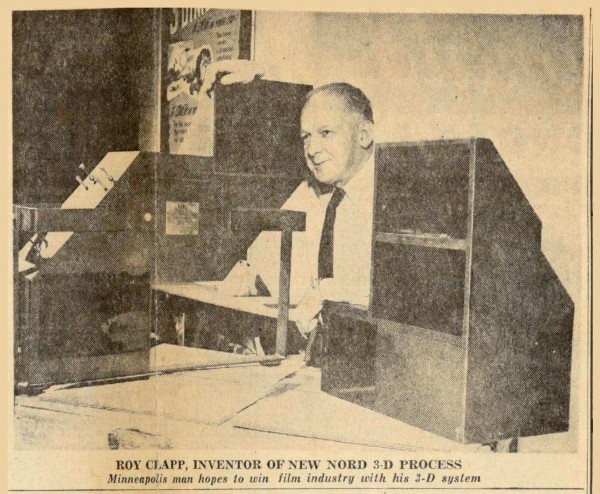
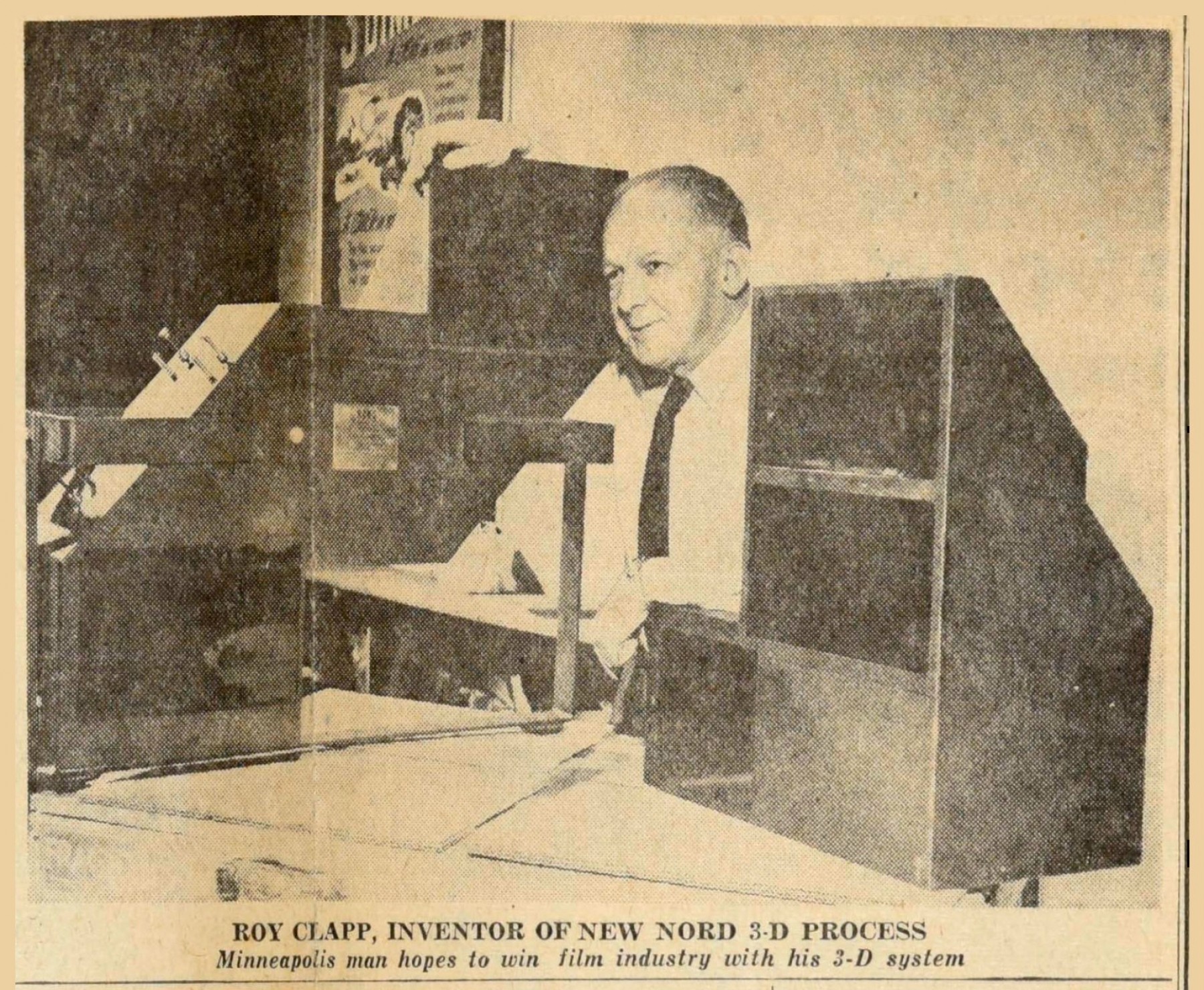
Inventor Roy Clapp with the large prototype device (left) and the smaller production unit (right), January 1954.
Flanagan, Barbara (1954). “City Man’s 3-D Film Process Sees Double“. Minneapolis Sunday Tribune, January 10, 1954: Section 2, p. 11.
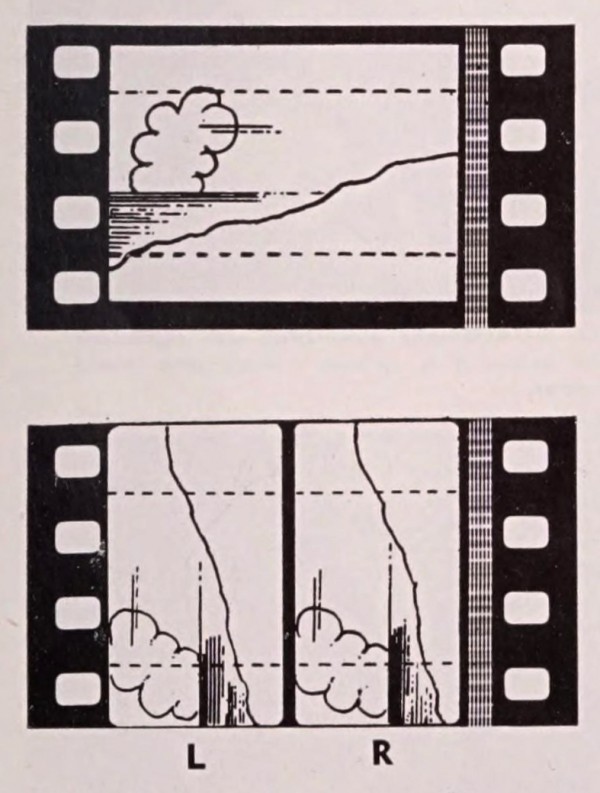
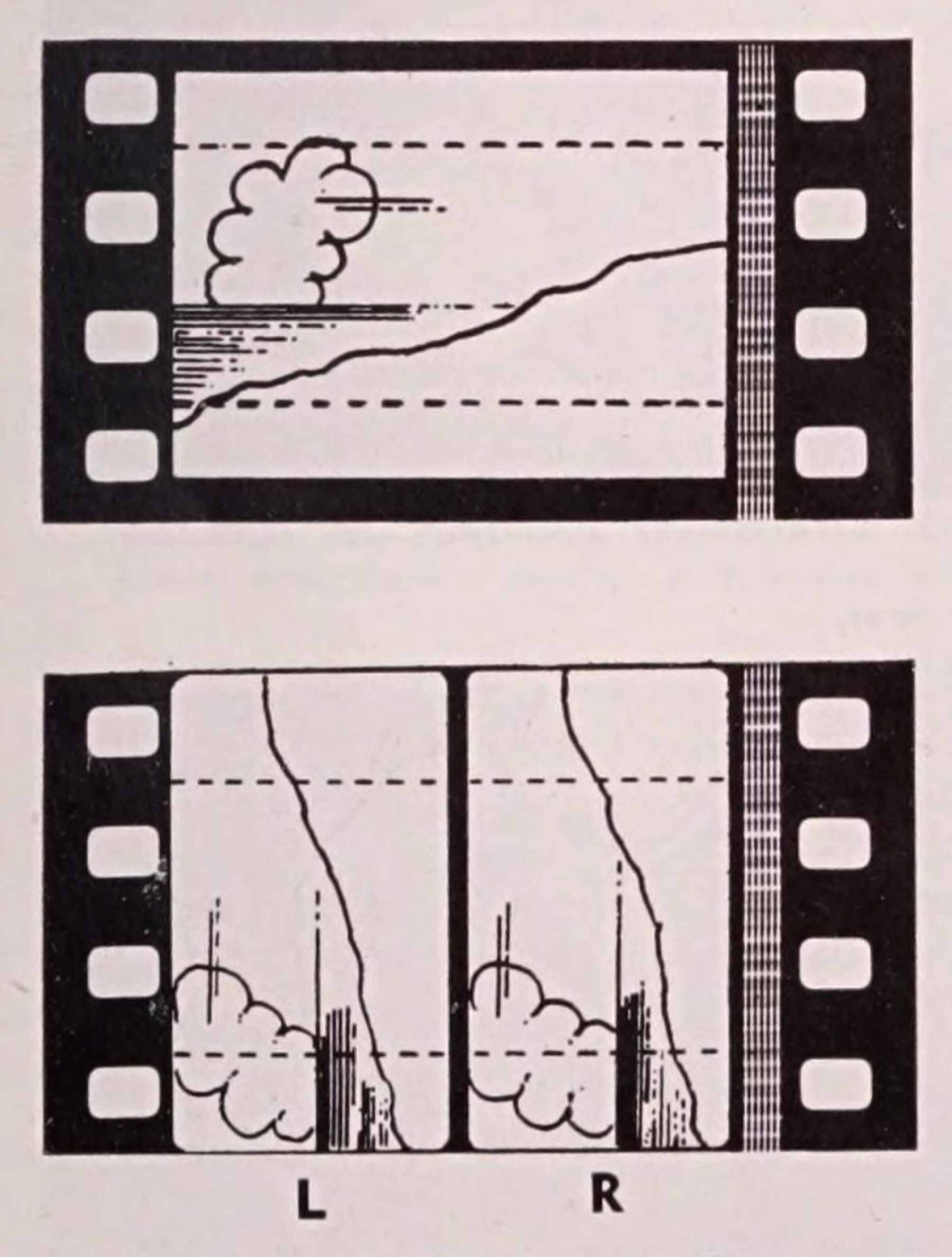
A comparison of Nord-format frames (below) with a frame cropped for spherical widescreen (above).
Roe, Alvin D. (1953). “Simplified Single-film System For 3-D Exhibition”. American Cinematographer, 34:10 (Oct.): p. 485.
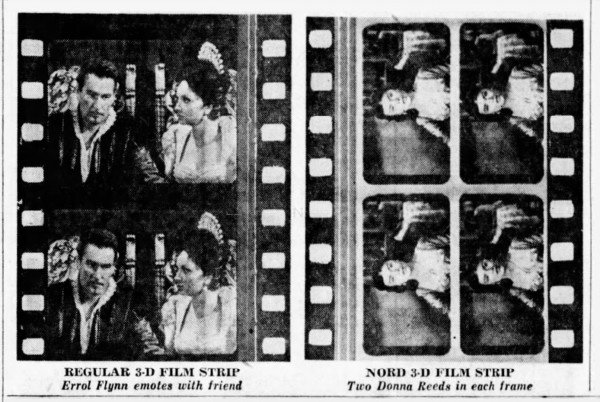
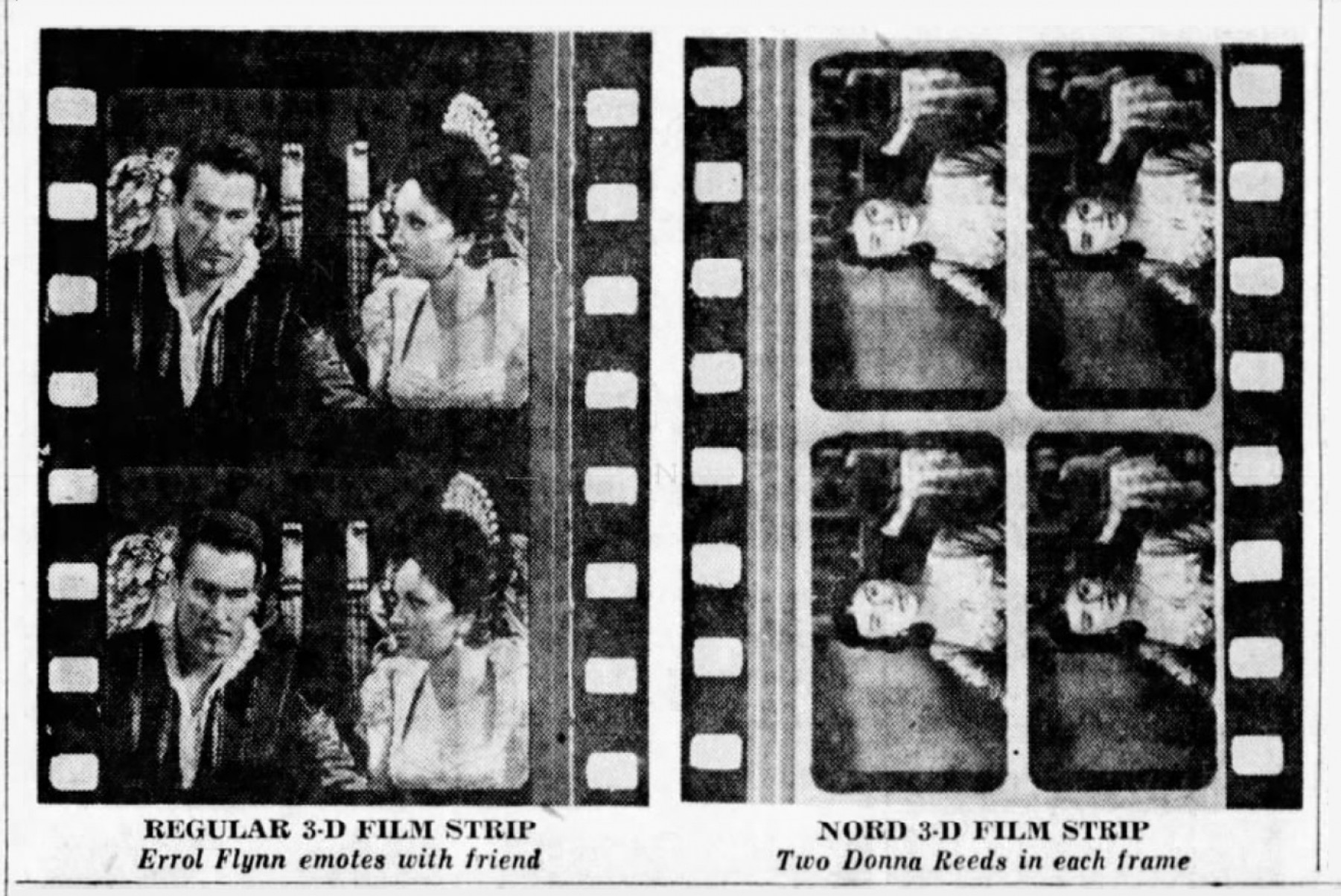
A comparison of Nord-format frames (right) with an Academy-ratio film frame.
Flanagan, Barbara (1954). “City Man’s 3-D Film Process Sees Double“. Minneapolis Sunday Tribune, January 10, 1954: Section 2, p. 11.
References
Blumofe, Robert F. (1953). Personal correspondence from Robert F. Blumofe to Arthur Krim (Jul. 16). United Artists Records, Folder 8, Box 4. Wisconsin Center for Film & Theater Research, University of Wisconsin-Madison.
Boxoffice (1953). “Three-D On Single Film Is Shown in New York”. Boxoffice, 63:8 (Jun. 20): p. 20.
Business Week (1953). “3-D Comeback”. Business Week, 1267 (Dec. 12): p. 46.
Daily Variety (1953a). “Nord, In Single-Strip 3-D Projection, Stresses Economy”. Daily Variety, 191:11. (Aug. 19): p. 11.
Daily Variety (1953b). “Hollywood Inside”. Daily Variety, 81:22 (Oct. 7): p. 4.
Daily Variety (1953c). “Hollywood Inside”. Daily Variety, 81:25 (Oct. 12): p. 4.
Dewhurst, Hubert (1954). Introduction to 3-D. New York: Macmillan, pp. 103–5
The Exhibitor (1953). “3-D With One Projector Getting Near”. The Exhibitor, 50:8 (Jun. 24): p. 10.
Flanagan, Barbara (1954). “City Man’s 3-D Film Process Sees Double“. Minneapolis Sunday Tribune, January 10, 1954: Section 2, p. 11.
Handel, Del (1953). Personal telegram and letter from Del Handel to Lesser Samuels (Jul. 16). United Artists Records, Folder 8, Box 4. Wisconsin Center for Film & Theater Research, University of Wisconsin-Madison.
Harrison, Pete (1953). “A Significant 3-D Advancement“. Harrison’s Reports, 35:25 (Jun. 20): p. 1.
Hollywood Reporter (1953a). “1-Film, 1-Projector 3-D System Shown”. The Hollywood Reporter, 124:44 (Jun. 17): pp. 1 & 4.
Hollywood Reporter (1953b). “Backers of 3-D Nord System in Local Showing”. The Hollywood Reporter, 125:39 (Aug. 19): p. 4.
Hollywood Reporter (1953c). “Nord 3-D Demonstration”. The Hollywood Reporter, 127:17 (Oct. 22): p. 7.
International Projectionist (1953). “Nord Single-Film 3-D Set for Release”. International Projectionist, 289:11 (Nov.): p. 13.
Limbacher, James L. (1978). Four Aspects of the Film. New York: Arno Press, p. 167.
Motion Picture Herald (1953a). “Columbia Uses Nord System”. Motion Picture Herald, 193:2 (Oct. 10): p. 24.
Motion Picture Herald (1953b). “3-D Leaping Back Into Fame, Perhaps Fortune”. Motion Picture Herald, 193:9 (Nov. 28): p. 13.
Oboler, Arch (1954). ”Nord System: For the First Time, Perfect 3-D on One Film Strip”. Arch Oboler Papers, B-130 Other 3-D Systems. Library of Congress: p. 4.
Oboler, Arch (1962). Journal entry (Jun. 12). Arch Oboler Papers, B-130 Other 3-D Systems. Library of Congress: p. 1.
Roe, Alvin D. (1953). “Simplified Single-film System For 3-D Exhibition”. American Cinematographer, 34:10 (Oct.): pp. 485, 509.
Spooner, Bill (1953). “Advantages of the Nord Extended Area System for 3-D Projection”. Arch Oboler Papers, B-130 Other 3-D Systems. Library of Congress: p. 1.
St. Louis Globe-Democrat (1951). “What’s New: Dimensional”. St. Louis Globe-Democrat, 77:155 (Nov. 9): Section C, p. 1.
Variety (1953a). “Exhibs Eye Chances of Less Costly 3-D Modes: Nord, Vectograph, Norling”. Variety, 190:13 (Jun. 24): p. 8.
Variety (1953b). “Nord 3-D in L.A. Test Mid-July; for ‘Jury’?”. Variety, 191:5 (Jul. 8): p. 7.
Variety (1953c). “O’Donnell Chides Nord”. Variety, 192:6 (Oct. 14): p. 3.
Variety (1953d). “Single-Strip 3-D Has Acceptance Problems; Who Takes Initiative?”. Variety, 193:3 (Dec. 23): p. 4.
Weaver, William R. (1953). “Hollywood Scene“. Motion Picture Herald, 192:9 (Aug. 29): p. 26.
Weekly Variety (1953a). “Nord Single-Strip 3-D Tells Allied Exhibitors of Important Acceptance”. Weekly Variety, 192: 5 (Oct. 7): p. 5.
Weekly Variety (1953b). “Roy Clapp Flattered By ‘Virtual Duplicate’”. Weekly Variety, 193:1 (Dec. 23): p. 13.
Compare
Related entries
Author
Mike Ballew is a writer and film historian specializing in the history of stereoscopic motion pictures. He is currently working on a book, Close Enough to Touch: 3-D Comes to Hollywood, which tells the story of 3-D movies in the English-speaking world, prior to 1985. He has been employed in television post-production for 25 years.
Ballew, Mike (2026). “Nord Process”. In James Layton (ed.), Film Atlas. www.filmatlas.com. Brussels: International Federation of Film Archives / Rochester, NY: George Eastman Museum.