Cinepanoramica(1911–1929)
A 70mm widescreen format developed by Filoteo Alberini in Italy.
Film Explorer
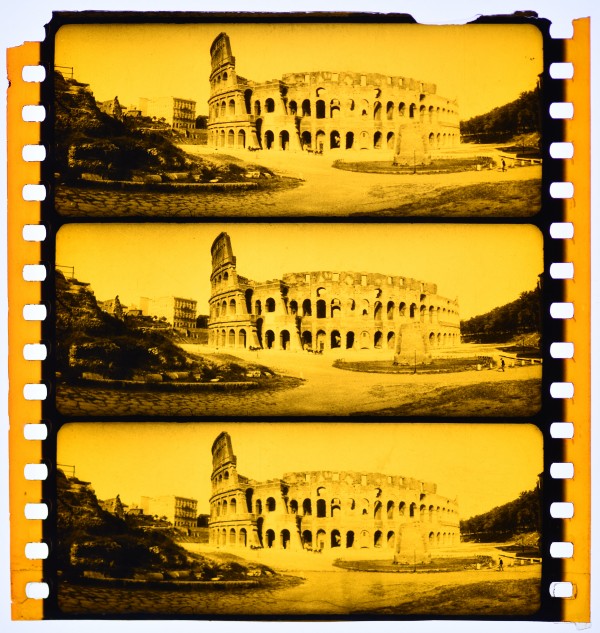
An unidentified 70mm film fragment, shot with Filoteo Alberini's Cinepanoramica camera for experimental use. The fragment is in the collection of Alberini’s material at the Museo Nazionale del Cinema in Turin. It's possible to recognize the Colosseum in Rome, but it's likely that this fragment doesn't belong to a specific feature film.
Museo Nazionale del Cinema – Torino, Turin, Italy.
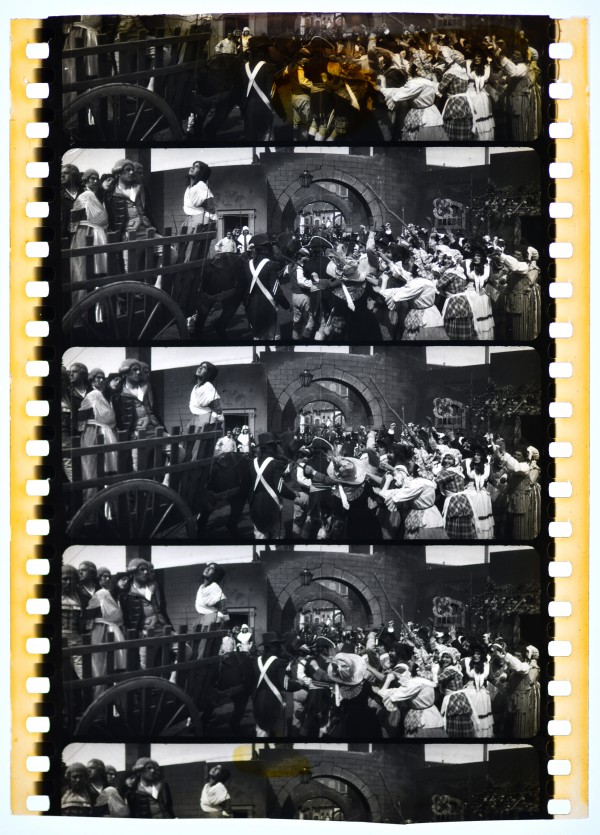
A 70mm Cinepanoramica fragment of Madame Tallien (1916). Some scenes of the film were shot with Filoteo Alberini's Cinepanoramica camera, but probably only for experimental use.
Museo Nazionale del Cinema – Torino, Turin, Italy.
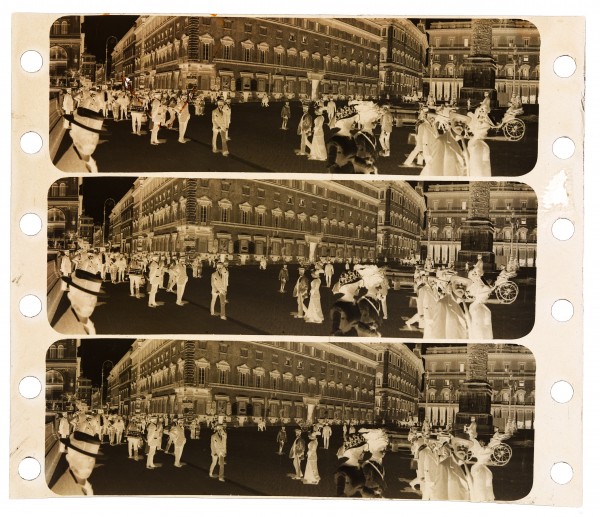
An unidentified 70mm film fragment, catalogued by George Eastman Museum as “Alberini”. It possesses a different frame size and perforation type from the other confirmed examples of the Cinepanoramica format, but Alberini was known to experiment and iterate his technologies over time.
George Eastman Museum, Rochester, NY, United States.
Identification
Approx. 57mm x 22.5mm (Approx. 2.244 in x 0.885 in).
(Approx.)
B/W
None
1
B/W. Some surviving examples are tinted.
Unknown
Silent
Unknown
B/W
Unknown
History
Filoteo Alberini, born in Orte, in the Lazio region of Italy, in 1867, was a filmmaker and a pioneer of photographic and cinematographic technologies. Thanks to the invention of his “Kinetografo” (1895), he was the first Italian to join the frenetic race of inventions and patents that burst forth at the dawn of cinematography (Prolo, 1951: p. 15). He also made many contributions that proved fundamental to the birth of the Italian film industry, as well as the development of film industries worldwide. For example: he founded the first Italian production company Alberini & Santoni, in 1905, which later changed its name to Cines (Società Italiana Cines); he realised the first Italian fiction film La presa di Roma (1905); as well as producing numerous patents and inventions, such as a mechanical device for cleaning film (1907), the Cineorologio, a sort of pocket-sized cinematograph (1911), a stereoscope (1923), and many more besides.
Of all his inventions, one of the most important was undoubtedly the Cinepanoramica, an apparatus for shooting in wide-gauge 70mm format, patented on March 13, 1911. On the industrial property rights certificate (Italian patent 115.957, 1911), the invention is described as: a “new apparatus for capturing cinematographic frames”. The first experimental version required its own proprietary projector and was therefore very expensive. To bring the cost of the technology down, Alberini continued with modifications and improvements right up to 1929.
Following initial experiments carried out by the inventor himself, director Enrico Guazzoni used the Cinepanoramica for some scenes of the historical feature films Madame Tallien (1916) and Il sacco di Roma (1920). While the wide format proved to be excellent for filming epic, crowded scenes – as well as other subjects of a spectacular and grandiose nature – the technology was utilised primarily because of Alberini’s close friendship with the director.
In June 1914, Alberini presented an experimental camera to the Royal House of Italy, news of which was reported in the press (Lombardi, 2024: p. 184). Nevertheless, the Cinepanoramica failed to find significant uptake in his homeland. Alberini’s proposal of this gigantic 70mm format, compared to the 35mm standards of the day, was incredibly innovative – however, it would probably be true to say that the nascent moving-image industry was not yet ripe enough for such technology (Lalli, 2004: p. 101).
Having achieved no success in Italy, Alberini decided to try his luck in the United States, where he stayed for four years.
In May 1924, he presented the Cinepanoramica with its first modification (standard 35mm reduction prints from a 70mm negative) to the convention of the Society of Motion Picture Engineers in New York. During this event, Alberini presented a comprehensive report on how Cinepanoramica worked and presented some of his experiments, including 70mm and 35mm projections.
Giovanni C. Ziliotto reported on this presentation in detail for Transactions of the Society of Motion Picture Engineers, heralding the invention as a turning point, insisting that, “Mr. Alberini has started in the right direction towards the goal for better pictures.” On the other hand, he also highlighted some features that could be improved: “I do not want to detract from the mechanical skill and ingenuity of Mr. Alberini, but, as a mechanical engineer, I have to say that many features can be improved upon.” (Ziliotto, 1924: p. 212)
All in all, the invention was well received, and the significant scale and scope of discussion, reported following the presentation, suggests the high level of interest it aroused. It was also reviewed positively in moving-image magazines of the time. In one particular article from The Moving Picture World, the author concluded with a confident statement: “In my opinion, Mr. Alberini's invention will find a place in industry.” (Richardson, 1924)
Ultimately, the Cinepanoramica did not achieve its hoped for success, so Alberini attempted to sell on the patent in the hope of finally seeing his innovative technology exploited. He recalled: “I finally signed a contract with a modest company, ‘Widescope’, and only I know exactly how many and what injustices I had to endure. In November of 1926, with my own eyes I witnessed – at the Cameo Theatre [New York, NY] – the screening of a number of films shot with my device, under the name Natural Vision Pictures and with the invention attributed to some fellow I’d never heard of!” (Alberini, 1930). [Editor’s note: Alberini’s recollection is mixing two different formats and is likely misleading. His original letter makes reference to “Vitescope” which historians have interpreted as Widescope. Widescope did have a demonstration screening in New York in 1926 at the Cameo Theatre. It seems unlikely that Natural Vision was related to Alberini’s invention in any way]. In all likelihood, it’s probable that the patent was purchased less with the aim to develop Albertini’s original invention, than to eliminate competition and extract inspiration from it.
Now a distant country, and Alberini being no expert in commercial matters, the invention was exploited by others (Pantieri, 1994: p. 52), or perhaps it did indeed simply serve as inspiration. In fact, the patent battle at the time tended to overlook many other inventors, highlighting only those with definitive inventions and perhaps linked to economically stronger companies.
Alberini's stubbornness led him to take legal action to obtain proper recognition from the Widescope. Unfortunately, this battle ultimately proved to be fruitless and ruined the inventor financially (Alberini, 1930).
In 1928, the Fox Film Corporation purchased the Alberini patent from Widescope, and after making a series of improvements, launched Fox Grandeur to the public in 1929 (Lombardi, 2024: p. 189), a novelty that received considerable press coverage, but which, at least in Italy, would have been considered old news.
In a short article entitled “The Great Struggle”, which appeared in the periodical L’Eco del Cinema in 1929, the editor Carlo Josè Bassoli reminded readers that the invention of “wide film” had already been patented by Alberini in 1911. The author highlighted the tendency of Europeans to view American enterprises with greater expectation and satisfaction, to the detriment of those from their own nations.
Nevertheless, if there existed a certain inclination to gaze across the ocean in wide-eyed wonder, it is still essential to underline some factors that aided the Fox Grandeur launch. One was the advent of sound: the new 70mm format provided significantly increased area for the soundtrack, allowing for a higher quality of both picture and sound (Gelas, 1930). Another aspect that should not be underestimated was the decidedly larger film theatres to be found in the United States, compared to the far smaller Italian theatres which struggled to accommodate projections that were twice the standard size.
From a variety of testimonies, it is clear how embittered Alberini felt by the discovery that his beloved invention had been attributed to others and by the fact that, by and large, the Italian press failed to support him. In fact, only a few publications recalled the Italian origins of the invention. One of those was the newspaper Il Popolo di Roma, to whom Alberini wrote a letter in 1930 expressing his gratitude for their support and clarifying events surrounding the Cinepanoramica. In concluding his remarks, Alberini outlined a modification he had made to eliminate problems associated with the need to upgrade standing equipment: “Today I possess a new Italian patent, also obtained in the United States (14 August, 1928, No. 1.680.498), which resolves the problem in its entirety. The capturing of the photographic images takes place using a new device, which allows for the use of standard film instead of, as was previously the case, the wide-gauge format.” (Alberini, 1930). This new technique used 35mm film running sideways in the camera to capture high-resolution widescreen images. It foreshadowed Paramount’s VistaVision format by some 25 years. [See also Alberini-Hill]
Supporting the theory that Alberini's invention was probably bought and directly exploited in the United States, was a short article reporting the inventor's death in 1937: “Filoteo Alberini, an early inventor of motion picture apparatus, whose devices were widely used in the United States, died in Rome Monday after an operation. He was 70 years old.” (Motion Picture Herald, 1937)
Although the Cinepanoramica did not receive the recognition it deserved at the time, it contributed to the international advancement of cinematographic technologies. The invention may simply have been too far ahead of its time, as it clearly inspired subsequent wide-gauge formats and significantly anticipated those of the 1950s, such as CinemaScope and Todd-AO.
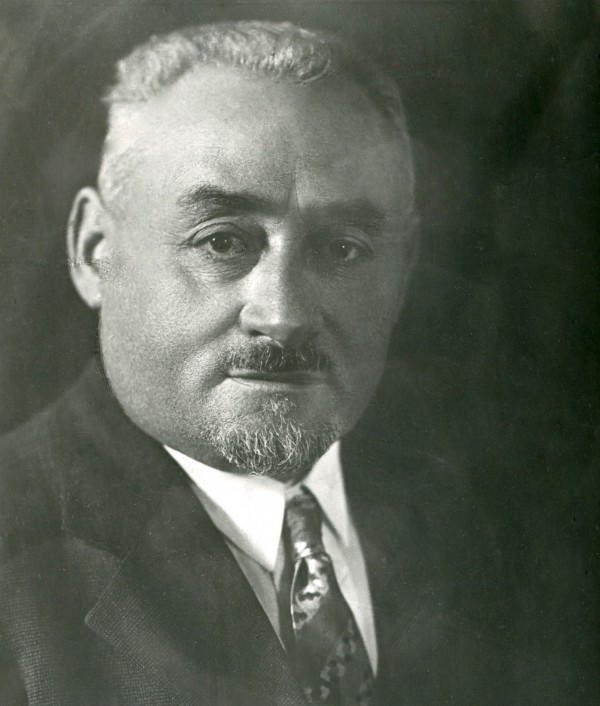
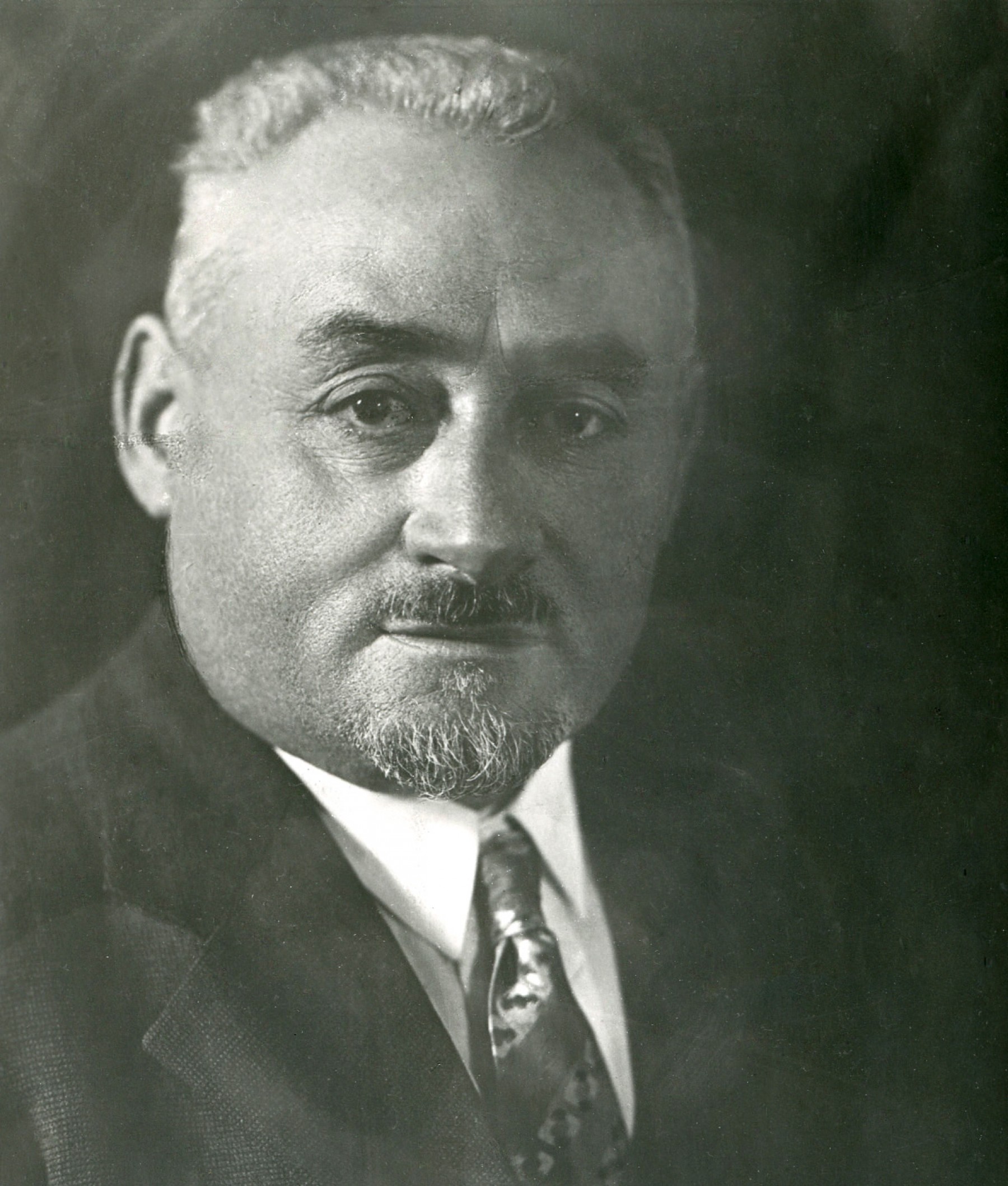
Filoteo Alberini (1865–1937)
Museo Nazionale del Cinema – Torino (Italy).
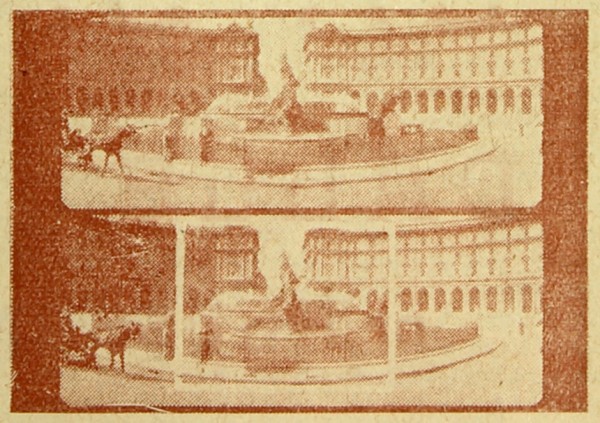
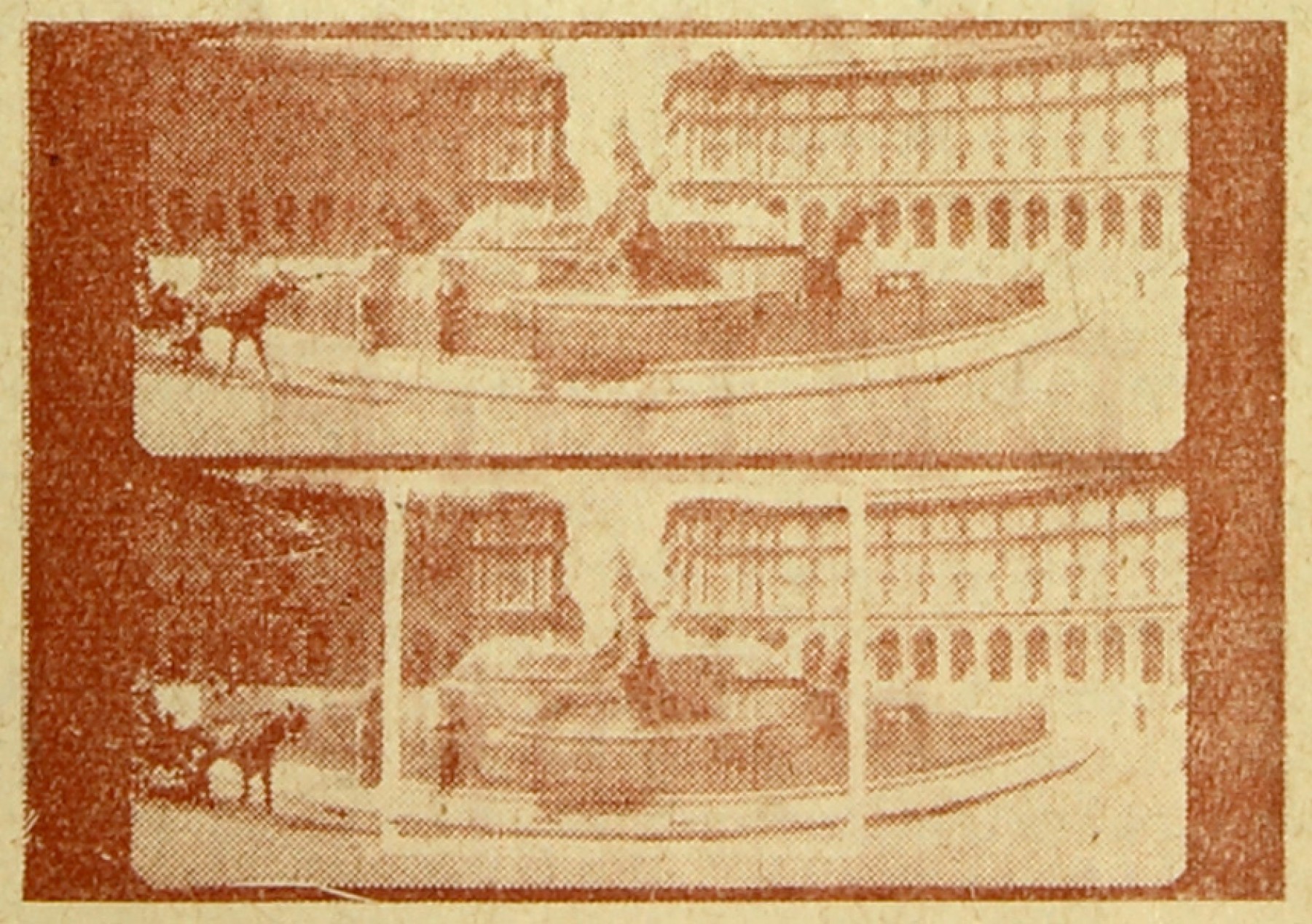
Unidentified Cinepanoramica footage, c. 1918.
Anon. (1918). "La 'Cinepanoramica’ di Filoteo Alberini”, Lux [Roma], 01: pp. 39–41.
Selected Filmography
A tinted film fragment of the Colosseum in Rome. Alberini made several experiments with his Cinepanoramica camera to test the technology. This fragment might be one of them. Conserved at the Museo Nazionale del Cinema – Torino, Italy.
A tinted film fragment of the Colosseum in Rome. Alberini made several experiments with his Cinepanoramica camera to test the technology. This fragment might be one of them. Conserved at the Museo Nazionale del Cinema – Torino, Italy.
A feature film shot and released in 35mm, with an original length of 1,855m (6,086 ft) (Martinelli, 1992). Some scenes were shot with 70mm Cinepanoramica film, but probably for experimental use only. A drama set during the French Revolution, based on the story by Victorien Sardou and Émile Moreau, the film was very successful thanks to the casting of such renowned actors as Lyda Borelli and Amleto Novelli. The scenes shown are impressive: from the movement of the great masses in the stadium in Rome used as a stage set, to the spectacular dramatic scenes, such as the execution of Robespierre. This film is the first of Palatino Film, a Production Company established in February 1915 at the same location as Cines by director Enrico Guazzoni. Madame Tallien was produced in 1914, but its distribution was delayed until 1916. The standard 35mm version of Madame Tallien was restored in 1995 in a collaboration between Cineteca Italiana, Cinématèque française and Cineteca di Bologna.
A feature film shot and released in 35mm, with an original length of 1,855m (6,086 ft) (Martinelli, 1992). Some scenes were shot with 70mm Cinepanoramica film, but probably for experimental use only. A drama set during the French Revolution, based on the story by Victorien Sardou and Émile Moreau, the film was very successful thanks to the casting of such renowned actors as Lyda Borelli and Amleto Novelli. The scenes shown are impressive: from the movement of the great masses in the stadium in Rome used as a stage set, to the spectacular dramatic scenes, such as the execution of Robespierre. This film is the first of Palatino Film, a Production Company established in February 1915 at the same location as Cines by director Enrico Guazzoni. Madame Tallien was produced in 1914, but its distribution was delayed until 1916. The standard 35mm version of Madame Tallien was restored in 1995 in a collaboration between Cineteca Italiana, Cinématèque française and Cineteca di Bologna.
A feature film shot and released in 35mm, with an original length of 2,311m (7,582 ft) (Martinelli, 1980). Some scenes were shot with 70mm Cinepanoramica film, but probably only for experimental use. This film is about the Sack of Rome, in 1527, by mutinous troops of the Holy Roman Emperor Charles V.
A feature film shot and released in 35mm, with an original length of 2,311m (7,582 ft) (Martinelli, 1980). Some scenes were shot with 70mm Cinepanoramica film, but probably only for experimental use. This film is about the Sack of Rome, in 1527, by mutinous troops of the Holy Roman Emperor Charles V.
Lineage
Technology
The 1911 Cinepanoramica camera was an apparatus for shooting a widescreen image on 70mm film. The film was pulled down vertically in the camera and was positioned, slightly curved, in the camera gate in correspondence with an oscillating lens. The optical system employed an intermittent “back and forth” motion in the horizontal plane and was positioned concentrically to the curvature of the film in the camera gate. A small tubular chamber was positioned behind the lens, which had a rectangular aperture on its underside that regulated the amount of light admitted for the exposure of each individual photographic frame. The image was captured via the curved swinging movement of the lens, which was capable of moving through an arc of approximately 110 degrees or more – later limited by Alberini to 90 degrees. The film was transported a set distance within the camera by claws that engaged with five perforations, which corresponded to the height of one frame (Italian patent 115.957, 1911). The frame aspect ratio was 2.53:1 and it measured approximately 57mm x 22.5mm (approx. 2.244 in x 0.885 in).
The first version of Alberini’s invention required a separate camera and projector, as well as twice the amount of film. For these reasons, the invention was never adopted for commercial production in Italy and its further development was due to the stubbornness of Alberini, who self-financed the majority of the experiments. As a result, it is difficult to find detailed technical specifications and unfortunately all records of the pioneer’s experiments have been lost. Furthermore, press articles at the time all reported more or less the same limited information, principally discussing how certain aesthetic issues had been resolved thanks to ingenious technological innovation, but that it was too expensive for widespread use.
The Cinepanoramica format was born from the desire to broaden the field of view, to allow for a more realistic representation of a scene and include more detail in the background information, as summarized in an article in Lux from 1918: “This cinematographic camera – which has its own projector – boasts the advantage of having a frame size one and a half times larger than the current one. As a result, even in close-up, one can see almost all of the setting, unlike with close-ups at present, in which the figures occupy the entire frame impeding any view of the background.” (Anon., 1918a). In an era when cinematographic art was silent and sustained mainly by imagery, the Cinepanoramica overcame issues of harmony and verisimilitude by producing “greater aesthetic satisfaction, with regard to both the settings in which the human actions unfold and the expression of the range of sentiments felt by people in those scenes” (Anon., 1918b). It was a technology that elevated the moving image to a higher plane: no longer simply reproduction for the sake of narration, but also the bearer of a richer, more mature aesthetic that increased emotional participation.
Eager to improve his invention, Alberini made an important modification that allowed a reduction print of the 70mm negative to be made onto a standard 35mm positive, thus anticipating the future Todd-AO system of the 1950s (Lalli, 2004: p. 102). Later, in 1928, Alberini resolved the issue of requiring non-standard equipment and gauges by designing a camera that used a standard 35mm negative, but running horizontally in the camera (giving enlarged frame dimensions of 24mm x 45mm), which was then reduced and rotated onto a standard 35mm print running vertically in the projector, anticipating the later VistaVision system (Lalli, 2004: p. 112). [See also Alberini-Hill]
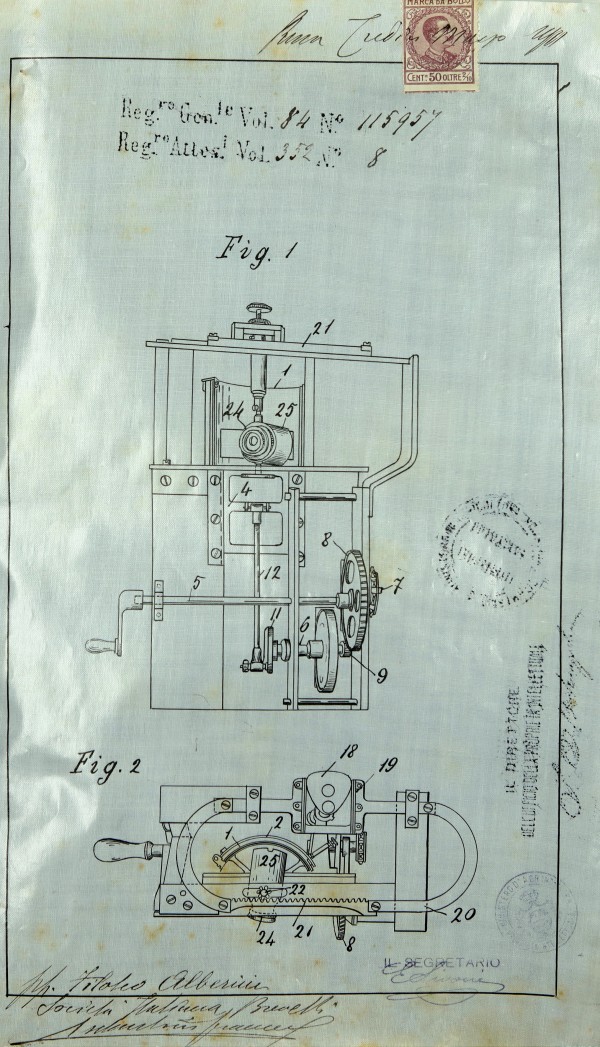
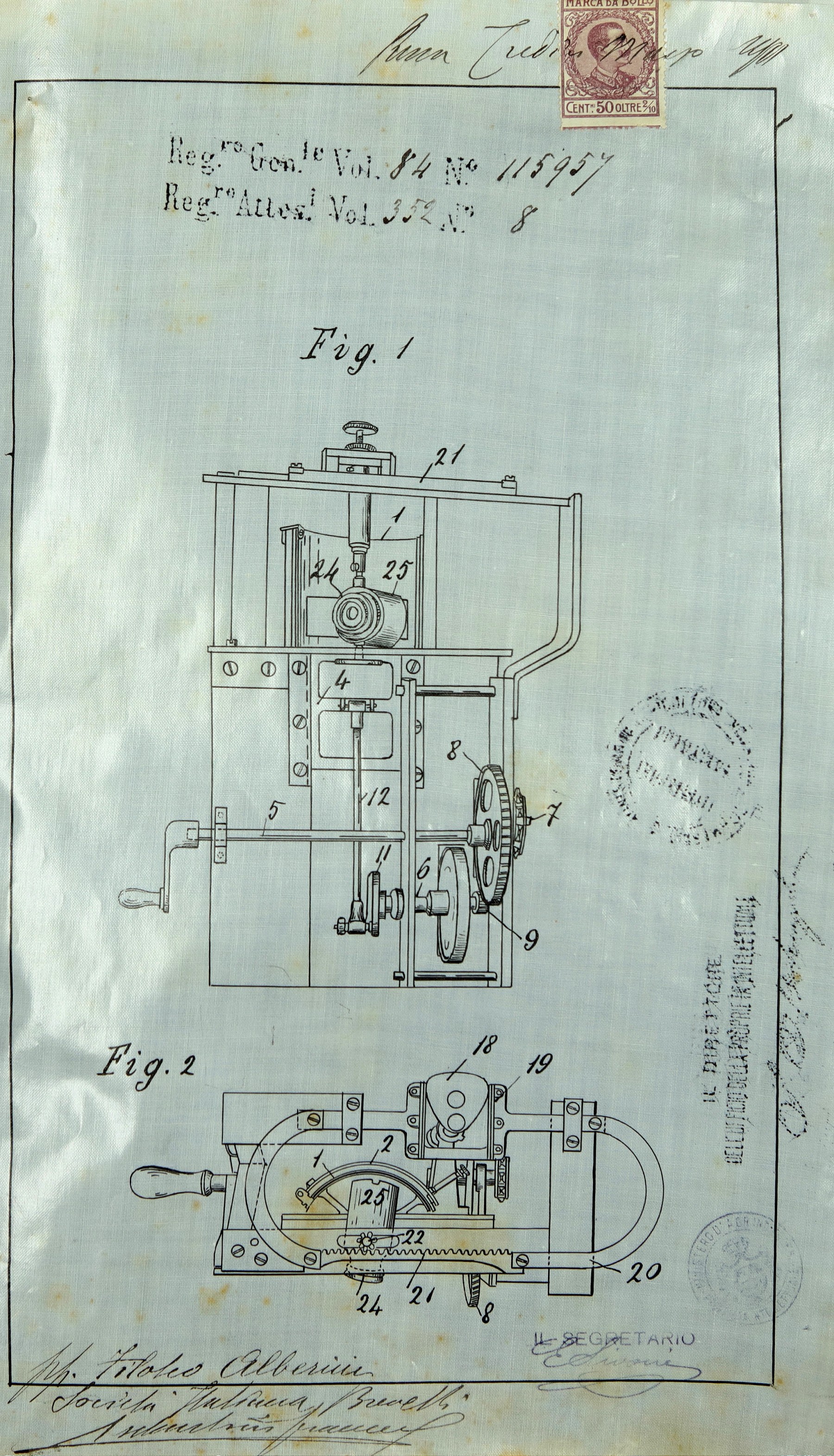
Figures 1 and 2 from the first Italian patent: Cinepanoramica view from the front, and from the top. The optical system (24) utilized an innovative intermittent “back and forth” motion in a horizontal plane and was positioned concentrically to the curvature of the film (1). The transportation of the film was timed in opposition to the movement of the lens: when the film moved, the lens was stationary and positioned away from the light, against the body of the camera (20).
Italian patent: Reg.ro Gen.le, Vol. 84, No.115.957, Reg.ro Attes.i, Vol. 352, No. 8. Property of Archivio Centrale dello Stato, courtesy of Ministero della Cultura. Protocol: No. 516/2025.
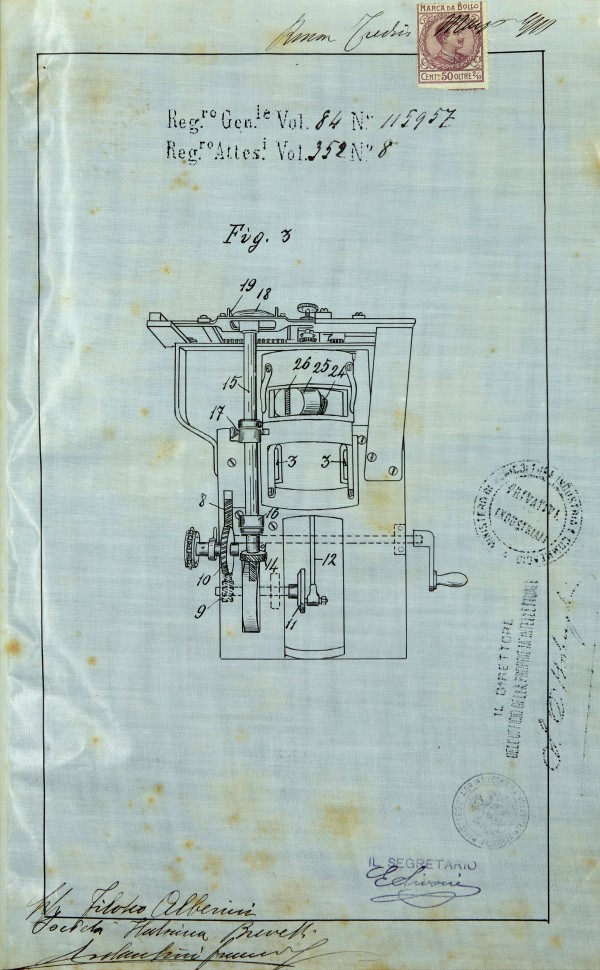
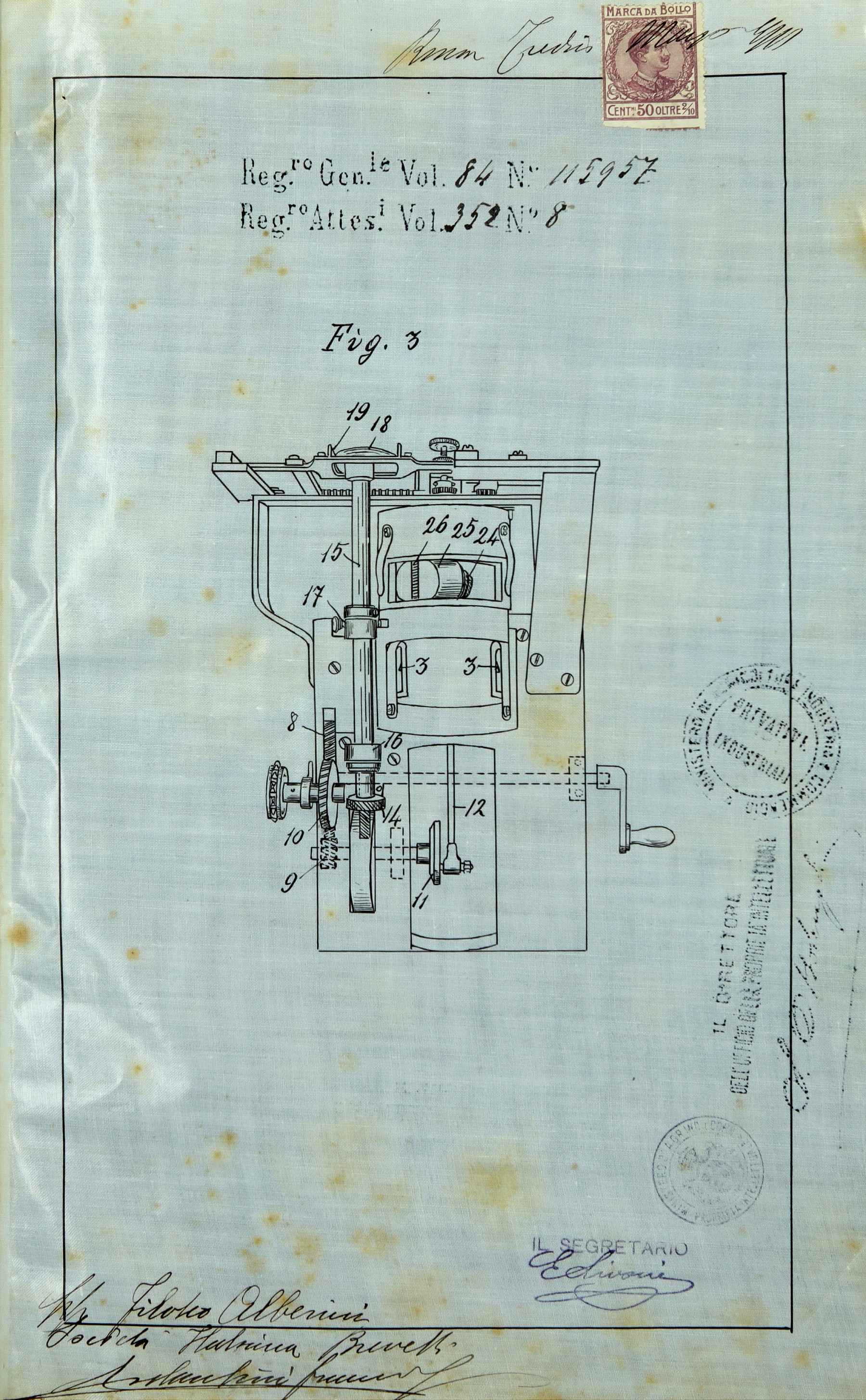
Figure 3 from the first Italian patent: Cinepanoramica, view from behind. A small tubular chamber (25) was located at the rear of the lens, on the bottom of which a rectangular aperture (26) regulated the amount of light admitted for the exposure of the individual photographic frames. The image was captured thanks to the arciform (curved) movement of the lens, which could achieve an arc of approximately 110 degrees, or more – later limited by Alberini to 90 degrees. The film was transported by claws (3) for a set distance, namely five perforations, which corresponded to the height of one frame.
Italian patent: Reg.ro Gen.le, Vol. 84, No. 115.957, Reg.ro Attes.i, Vol. 352, No. 8. Property of Archivio Centrale dello Stato, courtesy of Ministero della Cultura. Protocol: No. 516/2025.
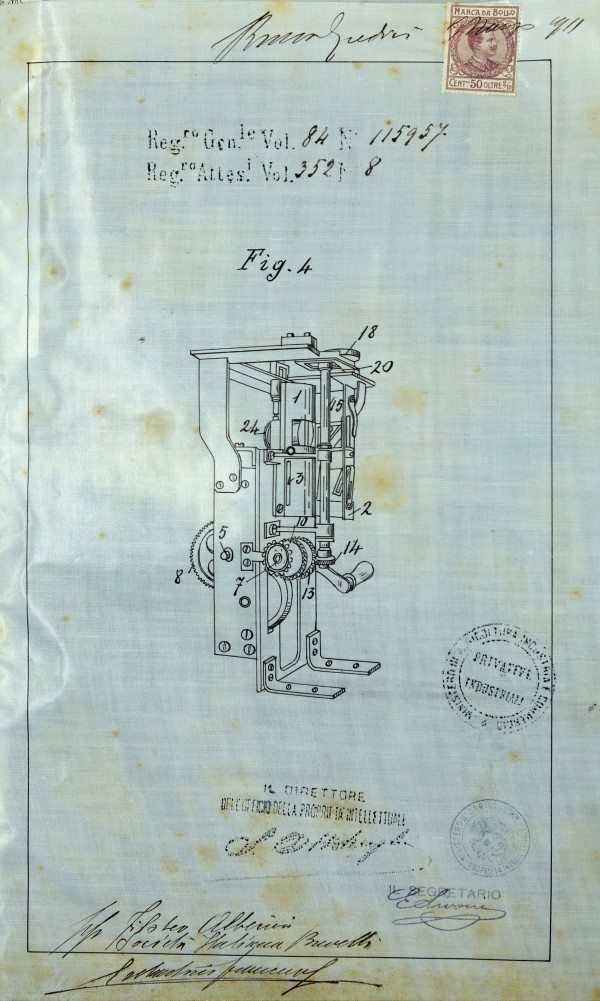
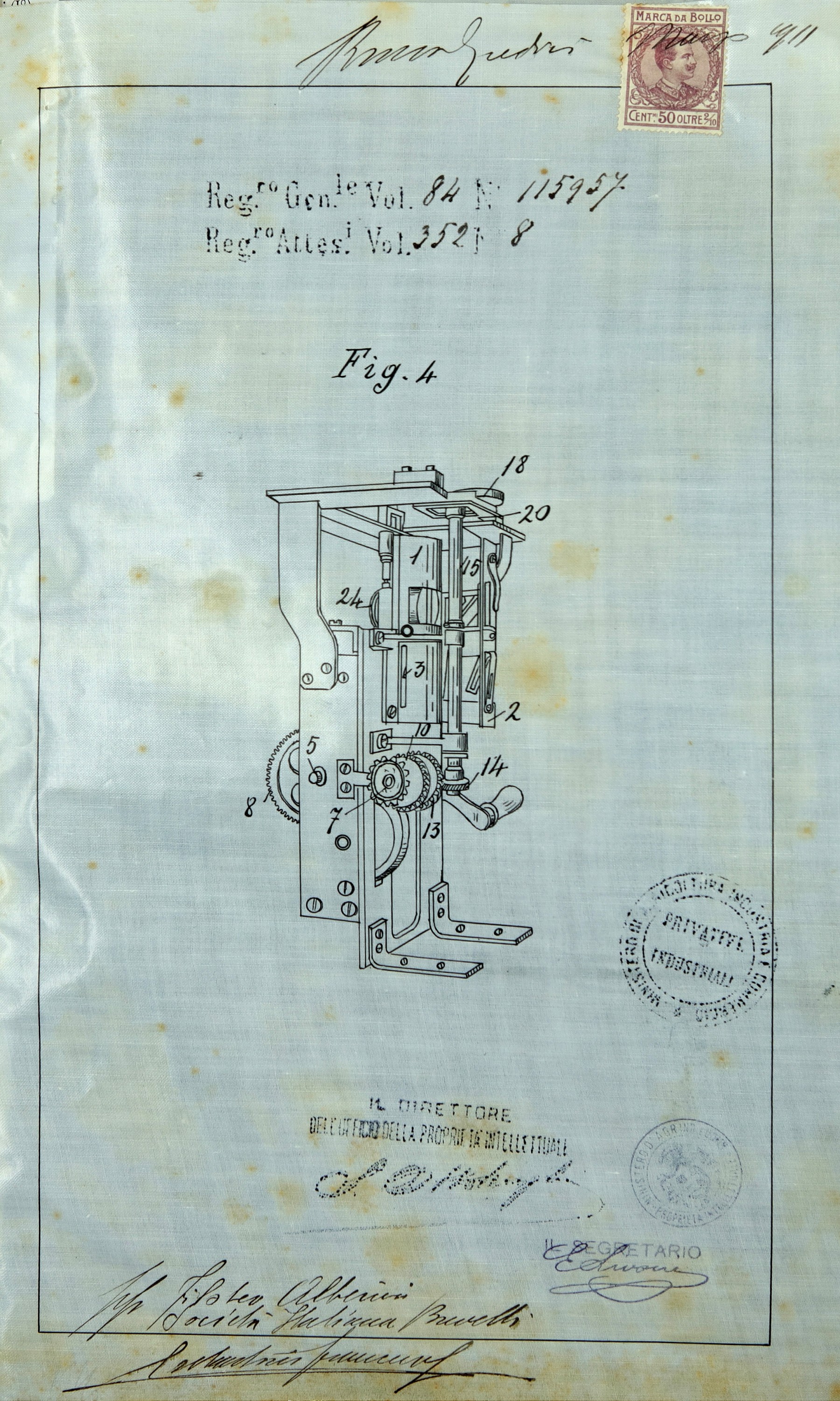
Figure 4 from the first Italian patent: Cinepanoramica, view with the door open.
Italian patent: Reg.ro Gen.le, Vol. 84, No. 115.957, Reg.ro Attes.i, Vol. 352, No. 8. Property of Archivio Centrale dello Stato, courtesy of Ministero della Cultura. Protocol: No. 516/2025.
References
Anon. (1918a). "La 'Cinepanoramica’ di Filoteo Alberini”. Lux [Roma], 01: pp. 39–41. http://www2.museocinema.it/collezioni/PeriodiciMonografie.aspx (accessed February 1, 2025).
Anon. (1918b). “La Cineparamica [sic]”. Film: Corriere dei cinematografi, 07: p. 6. http://www2.museocinema.it/collezioni/PeriodiciMonografie.aspx (accessed Feb. 1, 2025).
Alberini, Filoteo (1923). “Dalla prima sala cinematografica alla Stereoscopia”. La Rivista Cinematografica, 03: pp. 6-8. http://www2.museocinema.it/collezioni/PeriodiciMonografie.aspx (accessed Feb. 1, 2025).
Alberini, Filoteo (1930). Letter to Giuseppe Rosati, deputy director of “Il Popolo di Roma”, Roma (Dec. 19). Coll. Archivio Storico del Museo Nazionale del Cinema – Torino, Italy.
Bassoli, Carlo Josè (1929). “La grande Lotta”. L'Eco del cinema, 73: p. 2. http://www2.museocinema.it/collezioni/PeriodiciMonografie.aspx (accessed February 1, 2025).
Caranti, Chiara and Alberto Friedemann (eds) (2006). Dizionario dei brevetti di cinema e fotografia rilasciati in Italia, 1894–1945. Torino: Fert Rights.
Gelas, J. P. (1930). “Un’altra rivoluzione nell’industria cinematografica. Il ‘Grandeur-Film’”. La Rivista Cinematografica, 10 (reprinted from L’action Française, 18 April, 1930): pp. 8-9. http://www2.museocinema.it/collezioni/PeriodiciMonografie.aspx (accessed Feb. 1, 2025).
Lalli, Alexandra (2004). Innovazione tecnica e creatività di un pioniere italiano: Filoteo Alberini nel cinema delle origini. Orte: Stabilimento Tipografico Alberico Menna, with the support of Amministrazione Comunale,Orte.
Lasi, Giovanni (2015). La presa di Roma 20 settembre 1870. Milano: Mimesis Cinema/Origini.
Lombardi, Giovanna (2024). Filoteo Alberini: L’italiano che inventò il cinema (2nd edn). Voghera: Zanette Edizioni.
Martinelli, Vittorio (1980). “Il cinema muto italiano. I film del dopoguerra. 1920”. Bianco e Nero, 4:6: p. 297. Rome: Edizioni di Bianco e Nero – Centro Sperimentale di Cinematografia.
Martinelli, Vittorio (1992). Il cinema muto italiano. I film della Grande Guerra. 1916 (Seconda parte), p. 25, Rome: Centro Sperimentale di Cinematografia.
Motion Picture Herald (1937). “This week”. Motion Picture Herald (Apr 17) : p. 8. https://lantern.mediahist.org/catalog/motionpictureher1261unse_0746 (accessed Oct. 31, 2025).
Motion Picture News (1921). “New camera will produce pictures of 60 degrees visual angle, can have pictures of twice view area of present pictures”. Motion Picture News (June 25): pp. 98, 104. https://lantern.mediahist.org/catalog/motionpicturenew23moti_7_0994 (accessed Oct. 31, 2025).
Pantieri, Josè (1994). Filoteo Alberini. Pioniere del cinema italiano. Roma: Museo Internazionale del Cinema e dello Spettacolo (M.I.C.S.).
Prolo, Maria Adriana (1951). Storia del cinema muto Italiano (Vol. I). Milano: Poligono.
Richardson, F. H. (1924). “Panoramic Motion Pictures a Success with New Invention”. The Moving Picture World (May 10): p. 197. https://archive.org/details/movpicwor68movi/page/n127/mode/2up (accessed Oct. 31, 2025).
Ziliotto, Giovanni C. (1924). “Panoramic Motion Picture”. Transactions of the Society of Motion Picture Engineers (Meeting of May 19,20,21,22 1924, Roscoe, NY), 18: pp. 206–14. https://lantern.mediahist.org/catalog?f%5Bcollection%5D%5B%5D=Technical+Journals&idWork=journalofsociety36socirich&q=alberini&range%5Byear%5D%5Bbegin%5D=1900&range%5Byear%5D%5Bend%5D=1924 (accessed Oct. 31, 2025).
Patents
Alberini, Filoteo. Nuovo apparecchio per la presa di fotogrammi cinematografici. Italian patent: Reg.ro Gen.le Vol. 84 No. 115.957, Reg.ro Attes.i Vol. 352 No. 8, issued March 13, 1911.
Alberini, Filoteo. Nouvel appareil pour la prise de vues cinématographiques. French patent: No. FR443.367, issued September 23, 1912. https://data.inpi.fr/brevets/FR443367?q=alberini%20#FR443367
Alberini, Filoteo. Cinepanoramica. US patent, No.1.680.498, issued August 14, 1928.
Alberini, Filoteo. Cinepanoramica. Italian patent, No.286.134, issued July 27, 1929 / n.11–12.
Compare
Related entries
Author
Nadia Maltauro is a film archivist at the Film Archive of Museo Nazionale del Cinema in Turin (Italy). At La Camera Ottica, University of Udine, she participated in digital restoration projects for the Imperial War Museum and for the preservation and promotion of Italian audiovisual heritage (small-gauge formats and video). After graduating in Audiovisual Heritage, she worked at the Anim digital laboratory of Cinemateca Portuguesa, for a project coordinated by Cineric (New York) and Irmalucia (Lisbon). She then started working for Museo del Cinema di Torino, where she specialises in archival work.
I would like to express my gratitude to the colleagues at the Museo Nazionale del Cinema, primarily Stefania Carta, for constant exchange and support. For patent analysis, thanks also to Raffaella Isoardi and Valentina Malvicino (Devices and Pre-cinema Collections).
Maltauro, Nadia (2026). “Cinepanoramica”. In James Layton (ed.), Film Atlas. www.filmatlas.com. Brussels: International Federation of Film Archives / Rochester, NY: George Eastman Museum.
Art and Culture Translated Ltd