Panacolor(1953–1968)
A sophisticated three-color subtractive printing process which used B/W film stock that was exposed and treated multiple times to create a full-color image.
Film Explorer
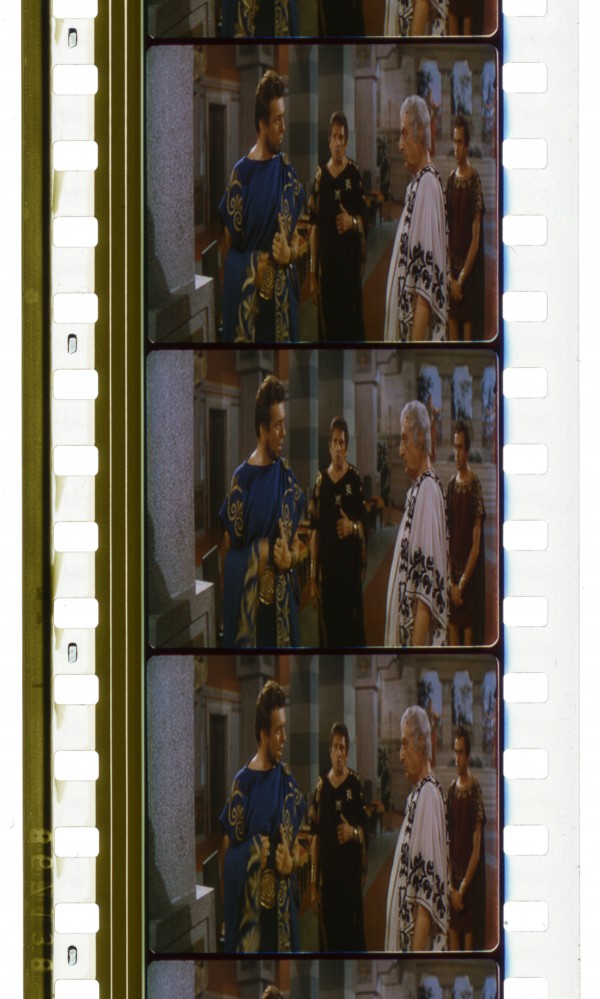
Actors Gérard Tichy and Francesco Sormano in The Secret Seven (1963). 35mm Panacolor print.
National Audio-Visual Conservation Center, Library of Congress, Culpeper, VA, United States.

Martha Hyer in Pyro (1964). 35mm Panacolor print – most likely a sample made without a soundtrack.
Gert Koshofer Collection. Timeline of Historical Film Colors. Photograph by Barbara Flueckiger. https://filmcolors.org/galleries/panacolor-samples-gert-koshofer-collection/
Identification
Respectively for 35mm and 16mm.
Three-color. A silver halide emulsion on positive film stock was exposed through three color separation negatives in succession and treated to produce a full color print.
Unknown
1
Contemporary reviews contained both positive and negative responses to the color quality of Panacolor films. Positive comments were made about sharpness and clarity, but reviews of some films noted issues such as unnatural skin tones and poor rendition of blue skies. These mixed reactions, combined with ongoing technical issues in the printing process, suggests the possibility that color properties were inconsistent across prints.
Prints by Panacolor, Color by Panacolor.
Optical soundtrack, printed in B/W.
Respectively for 35mm and 16mm.
Color, likely Eastman Color.
Unknown
History
The Panacolor process was a three-color subtractive film printing process developed for movie release prints in the late 1950s. Its main selling point was that it used B/W film stock, promising a significant economic advantage over other color processes of the time. The method enabled printing and processing in a single continuous process. This led to claims of faster printing times than those found in intermittent step printing, though there were other continuous printing processes already in existence by this time (Broadcasting, 1962: p. 56). Ultimately, only three films were officially released in Panacolor, and the modest success of those films, combined with ongoing technical issues with the printing process, made it an uphill battle to achieve large-scale adoption.
Panacolor was first developed as a new photographic iron–silver color process by photo-chemist Michele Pasquale Luigi Martinez. Originally from Italy, Martinez had been working on color film processes in Europe since the 1920s and was a long-time collaborator with Kodak Limited in the advancement of color film technology (Le Guern, 2017: p. 273). He filed an initial US patent for Panacolor in 1953 while working at Metro-Goldwyn-Mayer (MGM), though he developed the process independently. In 1957, he left his position at MGM to form Panacolor, Inc. to focus on refining the process further (Hollywood Reporter, 1957: p. 10). Following the death of Martinez, his work was continued under Leo Joseph Nicastro. The result, which was submitted for patent approval in 1961, was a subtractive three-color printing process that was unique because it produced natural color prints on positive B/W film (Ryan, 1977: p. 218).
In 1961, MGM purchased 50,000 shares of Panacolor Inc., and the company also completed construction of a laboratory in Hollywood equipped to print up to 160 million ft (48,768 km) of release prints per year (Hollywood Reporter, 1962: pp. 1, 4). Harry E. Eller, who served as president of Panacolor, began hosting demonstrations for journalists and stockholders in 1962, promising a cheaper color process, faster processing speeds, and a high degree of color control (Variety, 1962: p. 61). He touted cost savings of more than 50% compared to other color printing methods, due to the ability to print 200 ft (60.96 m) of 35mm film per minute, compared to the 50 ft-per-minute standard of the time (Broadcasting, 1962: p. 56). Excerpts were shown of an Air Force film from the Deep Sea Survival School and The Horizontal Lieutenant (Variety, 1962: p. 61). Reports claimed that reactions were mixed (Boxoffice, 1963a). One noted that the image was cloudy, skin colors appeared somewhat unnatural, and the blue of the sky seemed too dark (Variety, 1962: p. 61). The Horizontal Lieutenant (1962) was an MGM feature, and while 50 prints in Panacolor were ordered, the film was primarily released in Eastman Color prints by MGM’s Metrocolor lab (Hollywood Reporter, 1962: pp. 1, 4; Seventeen, 1962: p. 48). In a separate presentation, excerpts of the CBS television documentary A Look at Monaco and the upcoming film The Castilian (1963) were shown (Variety, 1962: p. 61). One report noted that the color was sharp, but another expressed skepticism that the color quality was comparable to other contemporary color processes (Archer, 1963: p. 28; Boxoffice, 1963a).
Panacolor was responsible for the color printing of the historical Spanish epic The Castilian in 1963. The film was an independent co-production between the United States and Spain with a large cast, including Espartaco Santoni, Frankie Avalon and Cesar Romero (Boxoffice, 1963b). Reviews were lukewarm, but one praised Panacolor for giving beauty and softness to the landscapes in the film (Boxoffice, 1963c). Producer Sidney W. Pink noted that Panacolor had experienced significant technological issues in the making of these prints. As a result, only 60 prints were made before the remaining color printing was turned over to Technicolor (Pink, 1989: pp. 151–2).
Following his work on The Castilian, Pink entered into an agreement with Panacolor, Inc. to produce four more films to be released in Panacolor. The deal gave his company, S.W.P. Productions, claim to the entirety of Panacolor, Inc.’s potential output for 1963. At the time, Panacolor, Inc. was setting up facilities to print 16mm for educational, government, and television use, though there are no records of these plans ever coming to fruition (Variety, 1963: pp. 4, 22). Pink’s first film under this deal, Pyro (1964), a horror film starring Barry Sullivan and Martha Hyer, was released in the United States and Spain to poor reviews (Monthly Film Bulletin, 1964: p. 151; Variety, 1964: p. 6). The remaining three films included in the Pink deal were never produced.
The final film printed in Panacolor was The Oldest Profession, a film about prostitution throughout history presented in six vignettes. It was released in the United States by Goldstone Film Enterprises in 1968, and while most reviews focused on the quality of the stories and poor dubbing, one described the color as “lousy”. (Los Angeles Times, 1968: p. B7; Boxoffice, 1968). By this time, Panacolor Inc. had reported financial losses for several years and had failed to take on any major clients. Ultimately, the company abandoned its film printing business to focus on developing a new color film cartridge and projector (Wall Street Journal, 1970: p. 14).
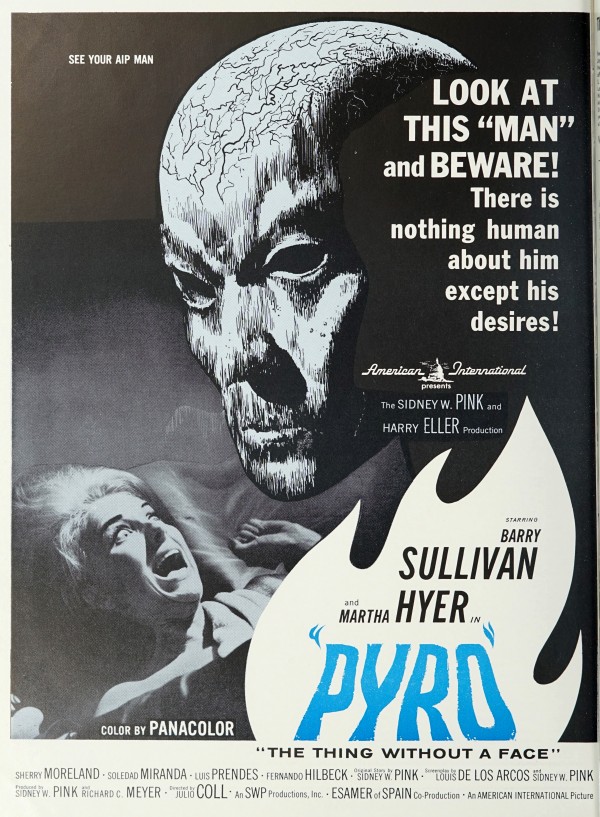
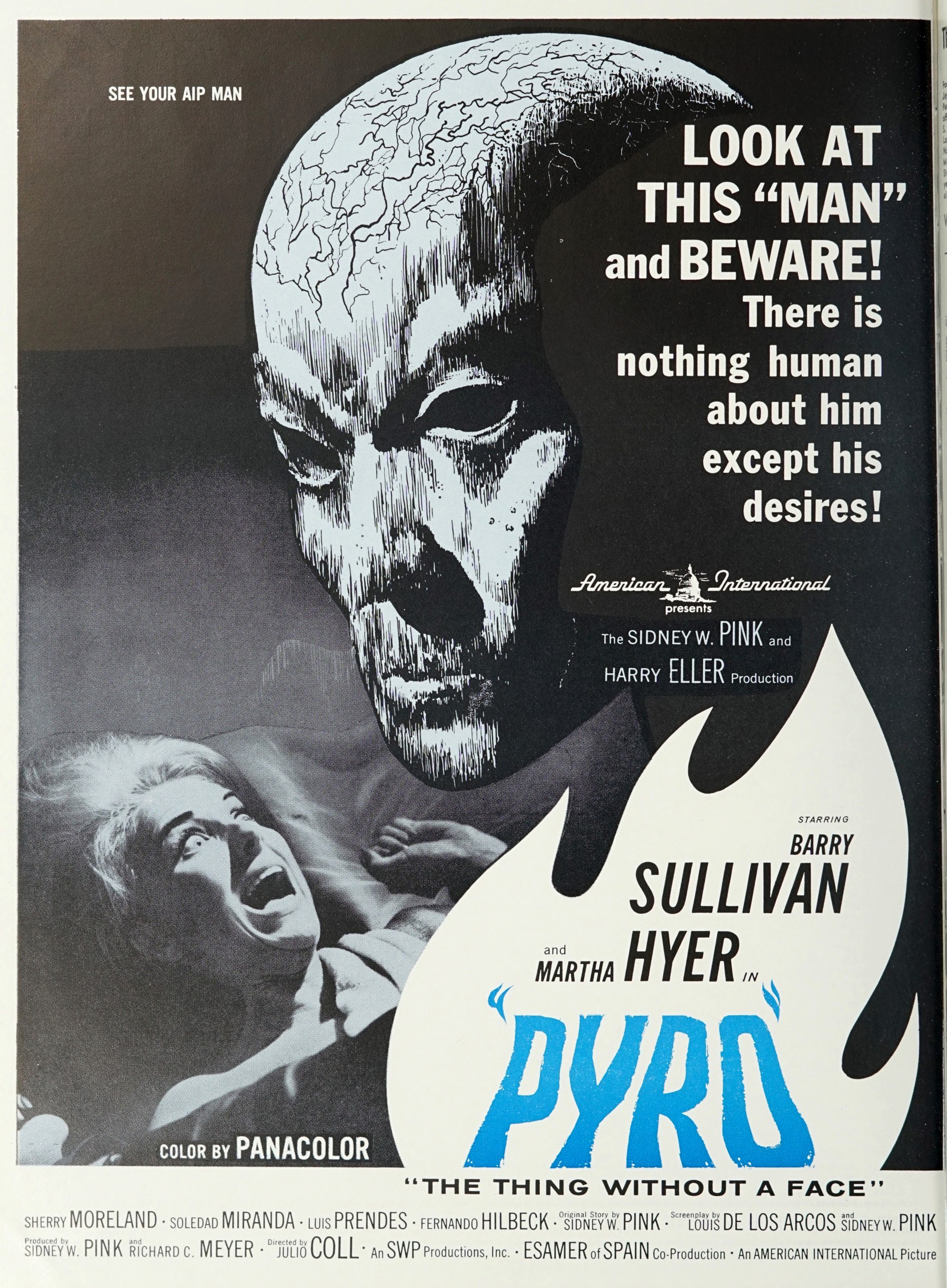
Full-page advertisement for the 1964 independent horror film Pyro… The Thing Without a Face [Fuego], announcing “Color by Panacolor”.
Advertisement. Box Office (Oct.–Dec.), 1963.
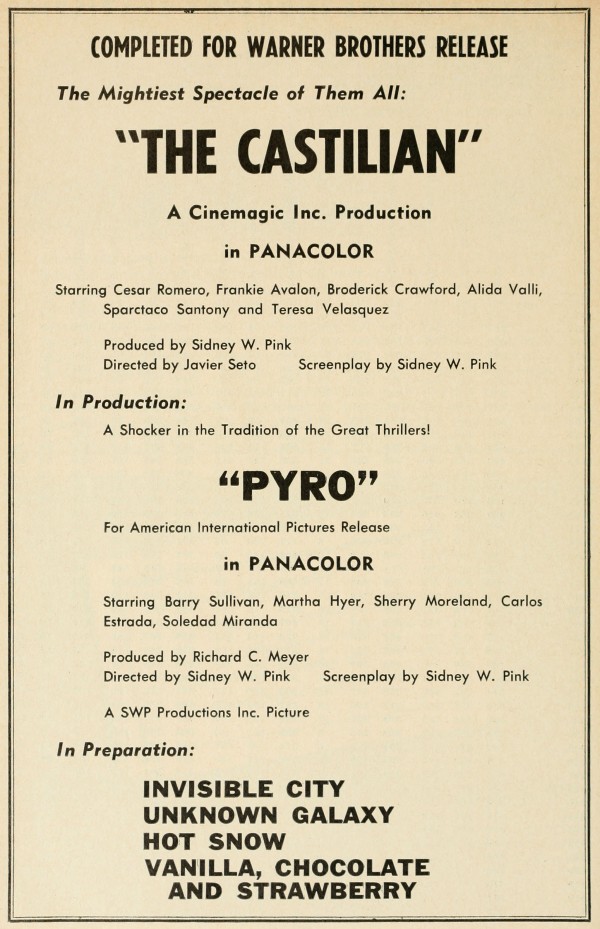
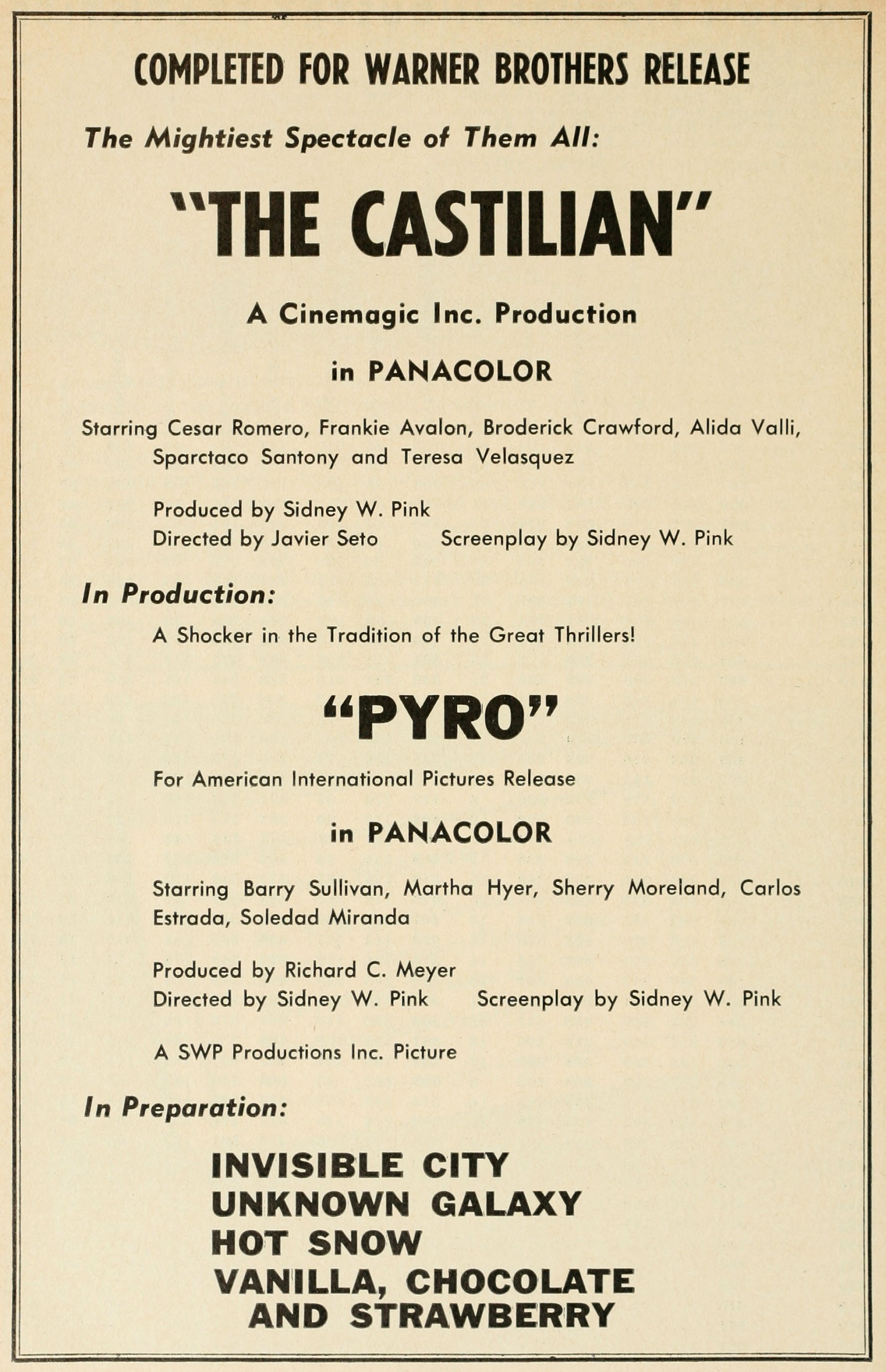
Advertisement for two films set for release in Panacolor. The three upcoming productions, listed as “In Preparation”, were never completed.
Advertisement. The 1963 Film Daily Year Book of Motion Pictures. New York : The Film Daily: p. 108.
Selected Filmography
Feature film co-production between Spain and the United States. Its world premiere was held in Venezuela, and it was released theatrically in the US and the United Kingdom, with prints provided by both Panacolor and Technicolor.
Feature film co-production between Spain and the United States. Its world premiere was held in Venezuela, and it was released theatrically in the US and the United Kingdom, with prints provided by both Panacolor and Technicolor.
Feature film. Following demonstrations, 50 prints were ordered, but it was primarily released in Metrocolor.
Feature film. Following demonstrations, 50 prints were ordered, but it was primarily released in Metrocolor.
International feature film co-production. Anthology film consisting of six vignettes. Dubbed release prints for the United States were printed by Panacolor.
International feature film co-production. Anthology film consisting of six vignettes. Dubbed release prints for the United States were printed by Panacolor.
Feature film co-production between Spain and the United States, released theatrically in the US and Spain, with prints provided by Panacolor.
Feature film co-production between Spain and the United States, released theatrically in the US and Spain, with prints provided by Panacolor.
Feature film co-production between Italy and Spain. It premiered in Italy and was subsequently released in many more countries around the world. Prints were produced by both Panacolor and Eastman Color.
Feature film co-production between Italy and Spain. It premiered in Italy and was subsequently released in many more countries around the world. Prints were produced by both Panacolor and Eastman Color.
Technology
Panacolor was a complicated 40-step process that used a single-layered print stock that was exposed, treated and resensitized multiple times to produce a full color image (Lipton, 2021: p. 46). It required three color-separation negatives, that were printed one-by-one onto B/W film stock and treated using a dye-coupling process.
There were several potential approaches to the printing process depending on the method of principal photography used during filming. With an original color negative like Eastman Color, a single color interpositive and three color-separation negatives could be used. If the original photography produced something other than three color-separation negatives, further printing steps were required. If the principal photography was shot on reversal film stock, then color separation negatives could be made directly from it. For a multi-layered tri-pack negative, three separation positives and three separation negatives would need to be made first. (Ryan, 1977: p. 218). It is unclear which methods were ever used, though the process via an Eastman Color negative was likely the most common.
Once the separation negatives were prepared, they were placed on loop racks, one for each of the color printers, and one for the sound-track printer. Bell and Howell Model D printers were modified to carry out the process, said to be continuous and able to run up to 240 ft (73.15m) per minute.
For each of the three color records, the B/W print stock was exposed and converted into a dye image, then the emulsion was resensitized so it could be exposed by the next color record. This B/W emulsion was first exposed to the red separation negative, and through the developer solution, which acted as the dye coupler, and was partially converted to a cyan dye-image. The film was then washed and treated with a bleaching agent at a temperature between 80 and 120 degrees Fahrenheit (27–49°C), in order to remove any latent image that may still have been present after exposure (Ryan, 1977: p. 218). Nicastro emphasized that any remaining latent image from the cyan step could produce unwanted effects when the print was exposed to other colors. The bleach also acted as an oxidizer, which converted the metallic silver particles into a light-sensitive silver salt (Nicastro, 1968).
Following this step, the film was dried before continuing on to the second printer, this time exposing the green separation negative overlaid in the same emulsion layer to produce magenta. It went through another wash, treatment and drying process before moving on to print the final separation negative. The third blue separation negative was then exposed, along with the previously printed cyan and magenta images (Ryan, 1977: p. 218). An optical soundtrack could be added before or after this exposure, or even simultaneously (Nicastro, 1968). In this stage, the yellow dye-forming coupler produced both a silver and yellow color in the image and soundtrack area. The film was then washed. A final oxidizing treatment in only the picture area allowed the metallic silver produced from the yellow exposure to convert to light-sensitive salt. Finally, the film was washed, fixed, washed again, and dried (Ryan, 1977: p. 218).
In practice, the system experienced many technical difficulties as Panacolor attempted to fulfill its release print orders. Film producer Sidney Pink recalled that during the printing for The Castilian, they could only produce one acceptable print out of every ten efforts, which directly opposed the company’s claims of the process being more efficient and cost-effective than its competitors (Pink, 1989: p. 152). The fact that these issues were never resolved is a significant reason why the Panacolor printing process ultimately failed.
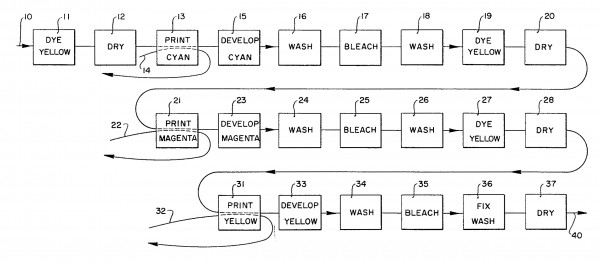
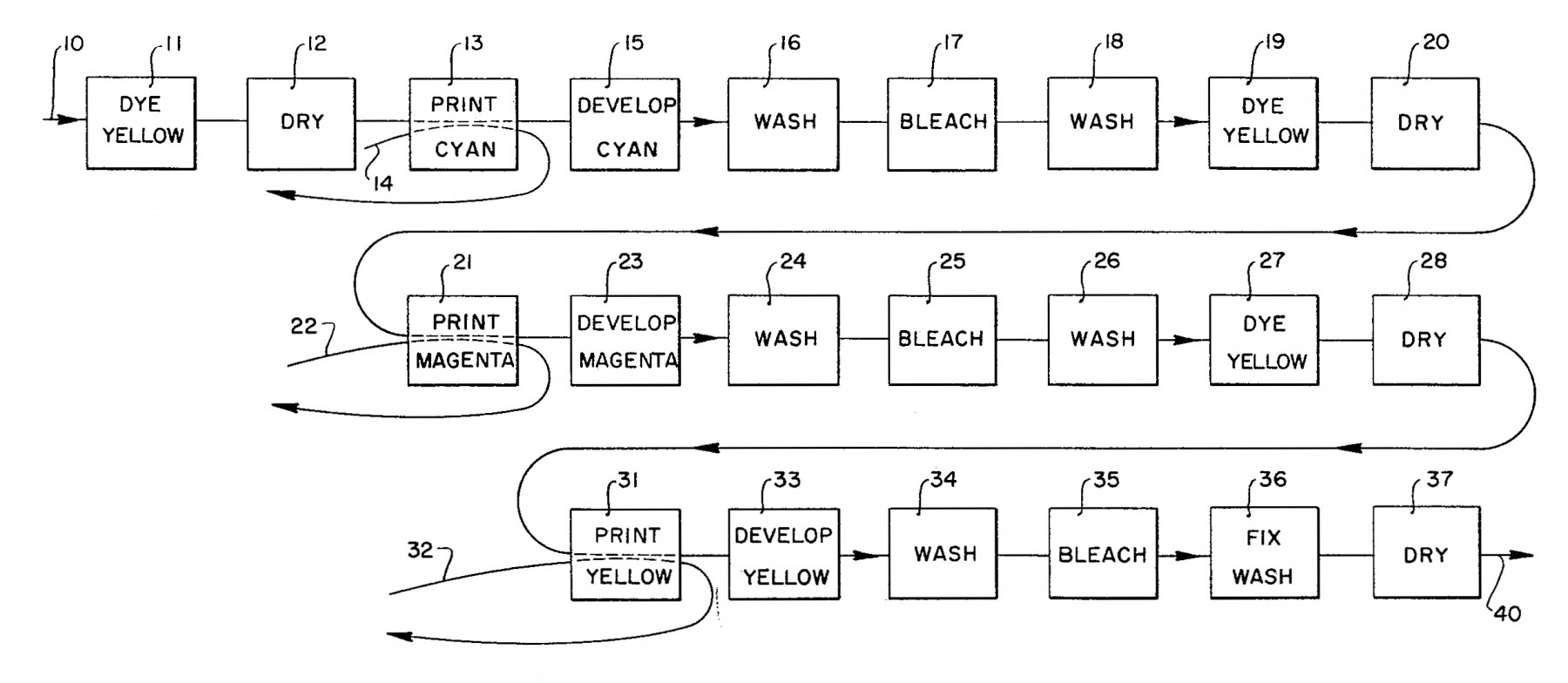
Diagram illustrating the color exposure and dye treatment process as submitted by inventor Leo J. Nicastro for Panacolor. Note that the silver halide film positive is exposed to each color negative, one at a time, with washing and bleaching treatments in between each step. After each exposure, the film was treated and dried to produce a final full color print.
Nicastro, Leo J. 1968. Color process utilizing a single layer silver halide emulsion. Patent US 3372028A filed September 14, 1967, and issued March 5, 1968.


A magnified detail of a close-up of actress Martha Hyer in Pyro (1964), illustrating the film grain of the silver particles present in a Panacolor print.
Gert Koshofer Collection. Photograph by Barbara Flueckiger. https://filmcolors.org/galleries/panacolor-samples-gert-koshofer-collection/
References
Anon. (1930). “New Ways of Color Photography”. Der Kinematograph (Apr. 5): p. 21.
Archer, Eugene. 1963. “Panacolor Displayed.“ New York Times, May 29, 1963. https://www.proquest.com/historical-newspapers/1-000-role-miss-taylor/docview/116405833/se-2.
Boxoffice (1963a). ”Panacolor Demonstrates New Color Process on Black & White Positive". Boxoffice (Jun. 3): p. 5. https://www.proquest.com/magazines/panacolor-demonstrates-new-color-process-on-black/docview/1670944135/se-2.
Boxoffice (1963b). “Review Flashes: CASTILIAN, THE (WB).” Boxoffice, 83:25 (Oct. 14): p. 8. https://www.proquest.com/magazines/reveiw-flashes-castilian-wb/docview/1670977691/se-2.
Boxoffice (1963c). “‘No Product Shortage,' Says Sidney Pink”. Boxoffice, 82:17 (Feb. 18): p. 10. https://www.proquest.com/magazines/no-product-shortage-says-sidney-pink/docview/1670954345/se-2.
Boxoffice (1968). “’Oldest Profession' Debuts”. Boxoffice, 93:11 (Jul. 1): p. 11. https://www.proquest.com/magazines/oldest-profession-debuts/docview/1476027985/se-2.
Broadcasting (1962). ”EQUIPMENT & ENGINEERING: Cheaper Color Prints Claimed by Panacolor". Broadcasting, 63:1, (Jul. 2): p. 56. https://www.proquest.com/magazines/equipment-engineering-cheaper-color-prints/docview/1014456114/se-2.
Flueckiger, Barbara (2012). “Timeline of Historical Film Colors”. https://filmcolors.org/timeline-entry/1292.
Hollywood Reporter (1957). “New Incorporations”. The Hollywood Reporter, 143:46 (Mar. 8): p. 10. https://www.proquest.com/trade-journals/new-incorporations/docview/2338183565/se-2.
Hollywood Reporter (1962). ”Panacolor System of Low-Cost Tint Prints Now Ready”. The Hollywood Reporter (Jun. 28): pp. 1, 4. https://www.proquest.com/trade-journals/panacolor-system-low-cost-tint-prints-now-ready/docview/2339767644/se-2.
Le Guern, Nicolas (2017). “Contribution of the European Kodak Research Laboratories to Innovation Strategy at Eastman Kodak”. PhD dissertation, De Montfort University, Leicester, United Kingdom.
Lipton, Lenny (2021). The Cinema in Flux: The Evolution of Motion Picture Technology from the Magic Lantern to the Digital Era. New York: Springer.
Los Angeles Times (1968). “U.S. Premiere of 'the Oldest Profession' Set”. Los Angeles Times (Jun. 27): p. e20. https://www.proquest.com/historical-newspapers/u-s-premiere-oldest-profession-set/docview/156007849/se-2.
Monthly Film Bulletin (1964). ”WHEEL OF FIRE". Monthly Film Bulletin, 31:360 (Jan. 1): p 151. https://www.proquest.com/magazines/wheel-fire/docview/1305824998/se-2.
Panacolor (1961). 1961 Annual Report. Hollywood, CA/New York, NY: Panacolor Inc.
Pink, Sydney (1989). So You Want to Make Movies: My Life as an Independent Film Producer. Sarasota, FL: Pineapple Press.
Ryan, Roderick T. (1977). A History of Motion Picture Color Technology. London: Focal Press.
Seventeen (1962). ”Advertisement: THE HORIZONTAL LIEUTENANT”. Seventeen, 21: 4 (Apr.): p. 48. https:/www.proquest.com/magazines/advertisement-horizontal-lieutenant/docview/2047132926/se-2
Variety (1962). ”Pictures: Panacolor Reports Cheaper Process; Color-on-Monochrome Positive Print". Variety, 227:6 (Jul. 4): p. 61. https://www.proquest.com/magazines/pictures-panacolor-reports-cheaper-process-color/docview/1032423231/se-2.
Variety (1963). ”Pictures: Pink's Panacolor Four-Film Deal with Eller Co". Variety, 229:11 (Feb. 6): pp. 4, 22. https://www.proquest.com/magazines/pictures-pinks-panacolor-four-film-deal-with/docview/1017089346/se-2.
Variety (1964). “Film Review: Pyro”. Variety, 234:10 (Apr. 29): p. 6. https://www.proquest.com/magazines/film-review-pyro/docview/962671906/se-2.
Wall Street Journal (1970). ”Panacolor Inc. Says it may Not Survive without New Capital”. Wall Street Journal (Jun. 16): p. 14. https://www.proquest.com/historical-newspapers/panacolor-inc-says-may-not-survive-without-new/docview/133500248/se-2.
Patents
Martinez, Michele P. L. Photographic iron-silver color process. US patent US2886435A, filed August 21, 1953, and issued May 12, 1959.
Nicastro, Leo J. Color process utilizing a single layer silver halide emulsion. US patent US3372028A, filed September 14, 1967, and issued March 5, 1968.
Compare
Related entries
Author
Caroline Roll is an archivist and digital asset manager, based in New York. She holds a BSc in Radio-Television-Film from The University of Texas at Austin and an MA in Moving Image Archiving and Preservation from New York University. She is currently the Director of Research and Digital Asset Management for Cognitive Science Systems, a business management consulting firm. She was formerly the Manager, Video Archives at Meredith Corporation and has also held positions at La MaMa E.T.C., JDC Archives and Bobst Library at NYU.
Roll, Caroline (2026). “Panacolor”. In James Layton (ed.), Film Atlas. www.filmatlas.com. Brussels: International Federation of Film Archives / Rochester, NY: George Eastman Museum.