Edison Home Kinetoscope(1912–1916)
A home projection system developed by Thomas A. Edison, Inc., using proprietary 22mm film.
Film Explorer
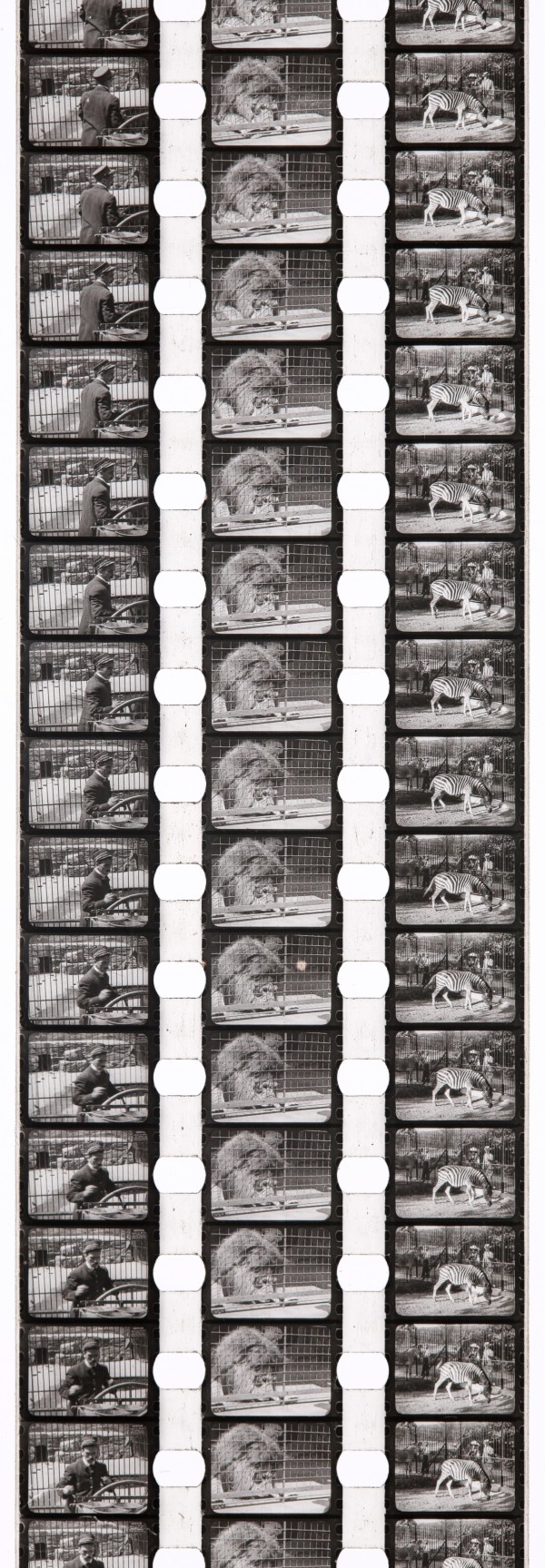
An unidentified 22mm Edison Home Kinetoscope print. Possibly New York Zoological Gardens (Kalem, 1914).
George Eastman Museum, Rochester, NY, United States.

An Edison Home Kinetoscope print of A Trip to Mars (1910). The film measured 22mm wide, with three columns of images, each measuring a minuscule 5.1mm x 3.9mm (0.201 in x 0.154 in).
Cinémathèque française, Paris, France.
Identification
5.1mm x 3.9mm (0.201 in x 0.154 in).
Bell and Howell style, virtually identical in size and shape to 28mm perforations. Two perforations centered between three horizontally aligned image frames.
Film travels down, up and then down with a horizontal shift at the end of each section.
B/W
None
Manufactured by Eastman Kodak.
1 strip containing 3 columns of images.
B/W
History
Sold to the public as a “biograph that a child can handle, and that an ordinary living room can hold”, Edison’s Home Kinetoscope was inspired by the inventor’s desire to promote film’s use in educational settings and in the home (Talking Machine World, 1912b). A patent for what became the Home Kinetoscope was submitted on October 12, 1911, by Adolph Gall of West Orange, New Jersey (curiously, Edison’s name is nowhere to be found on the application). The patent was not granted until November 14, 1916, by which point the projector and its proprietary film were already off the market. Described in the application as “a very simple and efficient form of kinetoscope […] having a plurality of rows of pictures” across the 22mm width of the film it projected, the Home Kinetoscope was designed to “be used successfully by unskilled persons” (US patent 1,204,424).
Writing in the pages of Educational Screen in 1943, William Jamison credited someone other than Gall with inspiration for the system: Edison employee “Bill” Waddell, who tinkered “with a couple of simple sprockets out of which he hoped to evolve a toy projector for children.” According to Jamison, Edison jettisoned Waddell’s idea of a toy projector in favor of making an easy-to-operate device and a film format to go with it, aimed at home and classroom use. According to Jamison, Edison assigned “Billy Gaul” (surely a nickname and misspelling of Adolph Gall), “the laboratory expert on machine design”, to develop the system (Jamison, 1943: p. 18).
The Home Kinetoscope hit the market in 1912. In their publicity for the new device, Thomas A. Edison, Inc. tried to convince the public that the projector was “safe”, easy to use, well designed, and even comparable in quality to the Edison projectors being used for theatrical exhibition (Edison Company, c. 1912). The safety claim was based primarily on the choice to use cellulose diacetate film stock, which is often referred to simply as “safety” film. Regarding the format’s intended use in the home, in a letter to Thomas Edison, George Eastman wrote that “the furnishing of cellulose nitrate for such a purpose would be wholly indefensible and reprehensible” (quoted in Coe, 1981: p. 164).
Back catalogue 35mm films made by Edison Co. were reduced and printed onto the system’s unique three-column, 22mm format. Historian Alan Kattelle has described the way that these films were presented to the consumer “on 1-inch wooden cores, in round galvanized steel cans 1½ inches deep and either 2¾ or 3⅜ inches in diameter.” (Kattelle, 2002: p. 124). Each of the wooden spools had a small, attached metal clamp that one end of the film was slid under to prevent it from spinning loosely. Edison even printed the phrase “attach this end to spool this side out” on the ends of the prints to aid the amateur projectionist.
Edison divided the films for the Home Kinetoscope into classes, ranging from A to H, with purchase prices from US$2 to US$20 based on the film’s “cost of their production”, which was directly proportional to the length of the film (Edison Company, c. 1912). When an owner tired of a film, they were encouraged to mail it back, along with a small fee, to exchange for another film in the same class. There was a total of 260 films in the company’s 22mm film catalog. In a 2002 issue of The Moving Image, Kattelle and the Association of Moving Image Archivists Small Gauge Working Group published a list of copyright entries and archival locations for Edison Home Kinetoscope 22mm films, noting that “close to 70 percent of the EHK films survive in some form, a much higher percentage than all other silent American films” (Small Gauge Working Group, 2002).
As innovative as the idea for a Netflix-like mail-in film system was, few users appear to have exchanged films, suggesting an unconvinced and unenthusiastic public. Film historian Ben Singer sums up the fizzling out of the system: “marketing mistakes, technological imperfections, a misperceived cultural environment, economic disincentives, basic inconveniences, and an act of God [a fire at Edison’s New Jersey facilities]” conspired to end the life of the Home Kinetoscope not long after its market debut (Singer, 1988). A fitting summation appears in a November 18, 1916, classified advertisement for an Edison Home Kinetoscope being sold with several film subjects and a book of exchange coupons for US$50 – less than half of what it would have cost when first introduced to the market, but not yet so pitiful a sum as to indicate complete obsolescence (Moving Picture World, 1916: p. 1069).
Careful examination of the University of Southern California’s 22mm print of The Amateur William Tell reveals some of the problems inherent to the system. The print shows significant printed-in dirt, indicating that quality was not a primary concern at the time it was produced. When the picture is enlarged during projection, the action looks like it is taking place in a light snowstorm, with white specks appearing across the screen. At least in this case, the Home Kinetoscope was enlarging an image from a crudely reduction-printed, approximately 5mm-wide frame, which, of course, can only be blown up so large before it begins to appear very fuzzy. Although the image size was similar in dimension to that of future 8mm film prints, the later technology benefitted greatly from more than two decades’ worth of technical improvements in optical printing techniques.
Projection size and brightness varied based on the different illumination systems and lenses available. There were three different light sources which included an acetylene burner (similar to the lanterns used by miners) for rural areas not equipped for electricity. The two electrical options included an early incandescent lamp called the Nernst lamp, named after inventor Walther Nernst, and what seems to be the most commonly found one in archives and collections, the Baby Arc lamp, with an accompanying rheostat or transformer to accommodate different types of electrical current.
Three different lenses were available for the system; these utilized a similar lettering system to the film classes. The model “A” lens was designed for long projection, the “B” for normal, and the “C” for wide angle. Combined with the choice of light source, a model “B” lens with the Nernst lamp was said to provide an adequate picture of roughly 18 in x 24 in (45.72cm x 60.96cm), whereas the Baby Arc lamp used with the model “A” lens was advertised as being capable of throwing an image of 54 in x 72 in (137.2cm x 182.9cm) at 30 ft (9.14m). The downgrade in image quality created by stretching the 5.1mm image up to a 6-ft-wide (1.83m) projection would have been significant.
Edison Co.’s system was launched the same year as Pathé’s 28mm projector and film, which was also aimed at the home market. The obvious quality differences between the two systems were exaggerated by the poor printing of the EHK films as compared to the almost theatrical quality of many of Pathé’s films, which is not surprising given the significant difference in the size of the image, which was more than four times as large as the EHK image. The perforations used for both 28mm and the EHK are surprisingly similar in size and shape; they are roughly similar in size to, but slightly smaller than, the Bell and Howell perforations. Perhaps ironically, given its conceptual origins, the Home Kinetoscope was, in fact, closer to the quality of a toy projector, while also being considerably more complicated to use.
According to Kattelle’s research at the Edison Historic Site, a 1915 internal report revealed that only around 500 Home Kinetoscope machines had been sold, out of the 4,686 manufactured. By the end of 1914, Edison Co. had essentially abandoned the system.
The Edison Manufacturing Company's The Amateur William Tell (1909), digitized from an Edison Home Kinetoscope print. USC HMH Foundation Moving Image Archive, University of Southern California, Los Angeles, CA, United States.


Thomas Edison in his West Orange, New Jersey, library examining a strip of film.
Wikimedia Commons.


Brochure for Edison Home Kinetoscope.
Courtesy Thomas Edison National Historical Park, West Orange, NJ, United States.


Brochure for Edison Home Kinetoscope.
Courtesy Thomas Edison National Historical Park, West Orange, NJ, United States.
Selected Filmography
A comedy in which a young boy dreams he is the famous marksman. A copy exists at the University of Southern California, HMH Foundation Moving Image Archive, Los Angeles, CA, United States.
A comedy in which a young boy dreams he is the famous marksman. A copy exists at the University of Southern California, HMH Foundation Moving Image Archive, Los Angeles, CA, United States.
“A bachelor’s dream, showing the incidents of his love story. The vision dissolves into the ashes of his fire – typical of his life” (Edison Company, c. 1912).
“A bachelor’s dream, showing the incidents of his love story. The vision dissolves into the ashes of his fire – typical of his life” (Edison Company, c. 1912).
“The marvels of glass blowing are depicted – spinning glass to a spiderweb-like texture, and other wonderful feats of the glass blower’s art.” (Edison Company, c. 1912).
“The marvels of glass blowing are depicted – spinning glass to a spiderweb-like texture, and other wonderful feats of the glass blower’s art.” (Edison Company, c. 1912).
Currently a lost film.
Currently a lost film.
“Handsome Harry rolls a workman downhill in a barrel and steals his lunch, but the revenge is awful to behold.” (Edison Company, c. 1912).
“Handsome Harry rolls a workman downhill in a barrel and steals his lunch, but the revenge is awful to behold.” (Edison Company, c. 1912).
Three reels. An early adaptation of the story by Charles Dickens and the only multi-reel film available on the system.
Three reels. An early adaptation of the story by Charles Dickens and the only multi-reel film available on the system.
Although little is known about the use of the Edison Home Kinetoscope format outside of the United States, a print of this film with Spanish intertitles exists in a private collection in Buenos Aires, Argentina. It is titled Un Viaje a Marte.
Although little is known about the use of the Edison Home Kinetoscope format outside of the United States, a print of this film with Spanish intertitles exists in a private collection in Buenos Aires, Argentina. It is titled Un Viaje a Marte.
Technology
The Edison Home Kinetoscope (EHK) is a compact machine that was produced for the relatively untapped home market. It was mounted onto a wooden board along with its lamphouse, and everything fit into a small metal case measuring 16 in x 10 in x 6 in. It used 22mm film with three separate columns of vertically running images. Perforations were in the small spaces between the three columns, and each column had 70 frames per ft (230 frames per m), which meant there were 210 total frames per ft (690 frames per m) of film. The operator would crank forward to project the first column of images until “a tiny white spot” appeared on the screen; then, using a shifting device, the projectionist would need to adjust the “baby” film (as Edison’s marketing brochure described it) over to project the next column by cranking in the opposite direction (the middle row of frames was printed in reverse to accommodate this novel mode of projection); and, finally, shift the film once more and crank a third time, now in a forward direction, to project the final column of images (Talking Machine World, 1912b).
The main advantage of this format was its economy: three columns of images on a single, 50–80 ft (15.24–24.38m) roll of film is the equivalent of a full 1,000-ft (304.8m) roll of 35mm film. But there were also significant drawbacks, including the fact that any damage caused while cranking the first row of images through the projector would be compounded two more times before a reel was finished.
The roughly 5mm-wide frame was illuminated by one of three different available light sources: baby arc lamp, Nernst lamp, or acetylene gas (Wilson, 1912). In a 1912 letter to Thomas Edison and Adolph Gall, Carl Hillis Wilson observed that the best results were obtained with the arc and the least satisfying with acetylene (Wilson, 1912). However, even with a fairly strong light source the projected image is far from clear and, for reasons having to do with the tiny size of the image on the film strip, the quality only got worse the farther the projector was from the screen.
The projector did not have a shutter to block the pulldown mechanism, so some degree of drag in the projected image was always present, although the rapid movement of the gear-driven claw minimized this. In an effort to avoid burnt frames, a safety shutter dropped into place to block the light source should the operator stop cranking. This would not, however, protect the film should the operator continue cranking if the film slipped off the claw.
Each projector came with two lenses: one for motion pictures and another for lantern slides. It was important to look closely at the lenses to make sure they were placed in the proper sleeve since a misplaced lantern lens in the motion picture sleeve would result in poor projection. The lantern slides were novel, as well: 4-in-long (10.16cm) slides, with two rows of five images each. As marketing materials reminded potential buyers, this system allowed the home projectionist to present both magic lantern and film shows.
The projector did not utilize multiple sprocket wheels to propel the film. Instead, a gear-driven claw was coupled with belt-driven take-up and feed reels. The wire belt, however, easily slipped out of sync with the gear, causing the film to either slow down in forward movement, or be pulled too hard onto the take-up reel. This would cause the claw to punch through the film itself instead of sliding neatly into the perforation holes.
The patent application shows a simplified version of the crank and pulley system used to propel the film from reel to reel, and even includes what is described as a “roller” to guide the film into the gate area. Unfortunately, the produced machines included spring-loaded, but non-rotating, pieces of metal that the film was forced to slide across when exiting and entering each reel. These were designed to regulate the tension caused by any slippage of the belt, but were very easily pulled into a stationary position if there was too much slippage of the belt. This is similar to a standard projector losing its top or lower loop, which puts additional stress on the film, most notably in the sprocket holes.


Close-up of EHK film coming off the feed reel.
USC HMH Foundation Moving Image Archive, University of Southern California, Los Angeles, CA, United States.


Edison Home Kinetoscope Projector with Baby Arc lamp and films.
References
Coe, Brian (1981). The History of Movie Photography. Westfield, NJ: Eastview Editions.
Edison Company (c. 1912). Brochure for Edison Home Kinetoscope. Thomas Edison Patent Records, EDIS 53951, Box 1. Thomas Edison National Historic Site, West Orange, NJ, United States.
Everett, Dino & Marsha Gordon (2021). “Dusting Off That Old Projector: Preservation Through Projection”. The American Archivist, 84:1 (Spring/Summer): pp. 139–64.
Jamison, William L. (1943). “Edison Tried It, Too”. The Educational Screen, 22:1 (Jan.): pp. 17–18 & 35.
Kattelle, Alan (2002). “The Edison Home Kinetoscope and Its Films”. The Moving Image,2:2 (Fall): pp. 121–8.
Moving Picture World (1916). Classified advertisement for Edison Home Kinetoscope. Moving Picture World (November 18): p. 1069.
Singer, Ben (1988). “Early Home Cinema and the Edison Home Projecting Kinetoscope”. Film History, 2:1 (Winter): pp. 37–69.
Small Gauge Working Group (2002). “Edison Home Kinetoscope (22mm): A List of Films and Sources”. The Moving Image, 2:2 (Fall): pp. 128–36.
Talking Machine World (1912a). “The Edison Home Kinetoscope”. The Talking Machine World, 8:4 (Apr. 15): p. 23.
Talking Machine World (1912b). “Edison Home Kinetoscope”. The Talking Machine World, 8:5 (May 15): p. 54.
Weissman, Ken & William O’Farrell (2002). “Restoring 22 mm Edison Home Kinetoscope Films”. The Moving Image, 2:2 (Fall): pp. 137–41.
Wilson, Carl Hillis (1912). Personal correspondence from Carl Hillis Wilson to Thomas Alva Edison, Frederick B. Thompson & Adolph F. Gall (May 11). Archival ref. E1259AR. Thomas Edison National Historic Site. https://edisondigital.rutgers.edu/document/E1259AR.
Patents
Gall, Adolph F. Kinetoscope. US patent US 1,204,424, filed October 12, 1911, and issued November 14, 1916. https://patents.google.com/patent/US1204424A/en?oq=US1204424
Preceded by
Compare
Related entries
Authors
Dino Everett is the HMH Foundation Archivist at University of Southern California’s Moving Image Archive.
Marsha Gordon is Professor of Film Studies at North Carolina State University.
Leonard DeGraaf, Thomas Edison National Historic Park.
Everett, Dino & Marsha Gordon (2026). “Edison Home Kinetoscope”. In James Layton (ed.), Film Atlas. www.filmatlas.com. Brussels: International Federation of Film Archives / Rochester, NY: George Eastman Museum.