Sistema Duplex(1910–c.1913)
A dual-format that used 35mm film split in two. The frames were printed horizontally, one above the other. The film was projected in one direction and, at the end of the reel, again in the opposite direction. The process was developed in Italy by Carlo Rossi of Duplex-Rossi Film.
Film Explorer
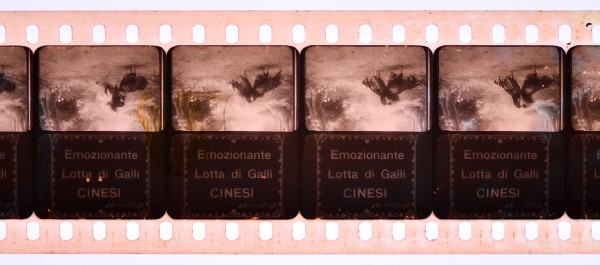
Frames from a tinted 35mm Duplex nitrate print of Emozionante Lotta Di Galli Cinesi (1913). Note that in this print – contrary to descriptions within the format’s patents – the first scene (title sequence) is located on the lower section of the film, while the final images of the last scene, exposed in the reverse direction, are located on the upper section.
Museo Nazionale del Cinema – Torino, Turin, Italy.
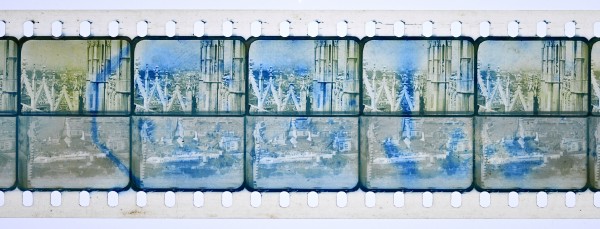
Frames from a tinted-and-toned 35mm Duplex nitrate print of Milano dalle guglie del Duomo (Milan from the spires of the Duomo) (1910). This example illustrates the dye fading that has occurred in some of the surviving tinted-and-toned nitrate prints.
Museo Nazionale del Cinema – Torino, Turin, Italy.
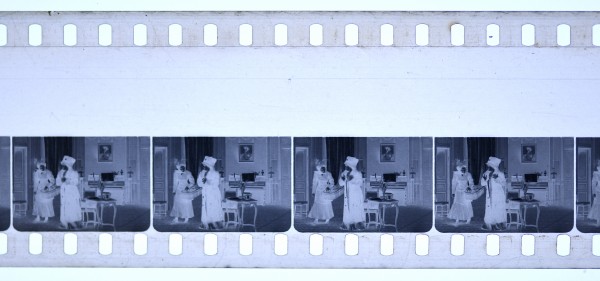
35mm Duplex nitrate printing negative of Unidentified film (Monoplex). This image shows a negative with only one half of the frame exposed – possibly used to create Duplex projection prints following two passes through the printer.
Museo Nazionale del Cinema – Torino, Turin, Italy.
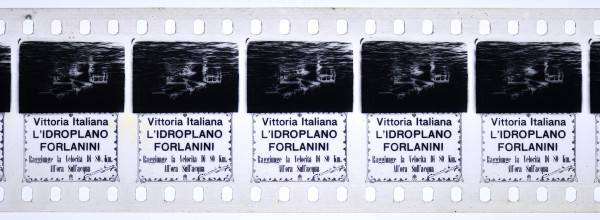
35mm Duplex nitrate printing negative of L’idroplano Forlanini raggiunge la velocità di 80 km all'ora sull'acqua (The Forlanini hydroplane reaches a speed of 80 km/h on water) (1910). As Carlo Rossi appended, in the final revision of his French patent, this example illustrates the possibility of obtaining multiple negatives from standard 35mm positives. By way of multiple printing phases, with copies appropriately distanced, and arranged perpendicularly, or in parallel, to each other, multiple 35mm negatives could be obtained, allowing positive copies to be produced more efficiently.
Museo Nazionale del Cinema – Torino, Turin, Italy.
Identification
Monoplex frame: 19mm x 12.5mm (0.748 in x 0.492 in); total Duplex area: 19mm x 25mm (0.748 in x 0.984 in).
B/W
None
1
Some surviving examples are tinted and/or toned.
None
Silent
Standard silent aperture: Approx. 24.89mm x 18.66mm (0.980 in x 0.735 in).
B/W
None
History
The invention patented as “Pellicola cinematografica multipla e processo per ottenerla” [“Multiple cinematographic film and process for obtaining it”] (Italian patent 102.939, 1910) was the work of chemist and Italian cinema pioneer, Carlo Rossi, who was of Armenian origin. It outlined the printing of two rows of small images, one above the other, onto a single strip of 35mm film. The 1910 patent did not imply the subsequent separation of the two sets of images, but rather their projection in succession, involving a process of inversion at the end of the reel, projecting the scenes on the lower half, following the projection of those printed on the upper half of the film. The primary aim that motivated Rossi was to develop a cinematographic format capable of utilising standard 35mm film stock – the most widespread format since the turn of the 20th century, which became the industry standard after 1909. This approach had the potential to provide significant economies over existing methods, doubling the space available for the printing of images compared to standard 35mm prints in use at the time – while maintaining a high-quality image on screen.
Carlo Rossi arrived at the design for his patent following several years of intense activity in the film industry. His interest in cinema “arose from his business dealings with the Paris-based Pathé Frères around the year 1905” (Bernardini, 2015: p. 416) and he subsequently became very active in his native Italy. In Turin, in 1907, he founded – along with Guglielmo Remmert, an industrialist of Prussian origin – the production company Carlo Rossi & Co., “a new grandiose factory of film and photographic equipment” (Bernardini, 1981: p. 105). Despite quickly expanding into international distribution, the new production studio didn’t survive its first year of trading due to a dispute between the partners. From the ashes, however, in 1908, arose Itala Film, headed by Carlo Sciamengo and Giovanni Pastrone, the latter of whom had previously been employed at Carlo Rossi & Co. Finally, in 1909, Rossi joined the board of management of Società Italiana Cines, in Rome.
During these years, Rossi continued to cultivate his passion for invention: after a brief period experimenting with radiotelephony, he fully immersed himself in the development of motion picture technologies. With the intent of commercially exploiting his patents, on September 12, 1910, he founded “a Cinematographic corporation by the name of Duplex-Rossi” (Anon, 1910), with registered offices in Plainpalais, Switzerland (Canton of Geneva) – Rue de l’Arquebuse 22 – and an administrative office in Turin, Italy – Corso Vittorio Emanuele 78.
After patenting his first two inventions in 1908, respectively a mechanism for the advancement of film in cinematographic cameras (Italian patent 95.255, 1908), and a panoramic platform for shooting photographic and cinematographic vues (Italian patent 99.843, 1908). In 1909, Rossi applied for a patent for his Duplex film to the Ministry of Agriculture, Industry and Commerce of the Kingdom of Italy, for which he was granted industrial property rights in 1910.
The Italian patent was followed by a number of other inventions, patented in 1910, where Rossi continued to make explicit reference to this “multiple film” and which contributed to refining and perfecting some of the technical aspects, in particular with regard to its projection. Specifically, these industrial patents were for: a device for joining the ends of the film together (Italian patent 109.305, 1910), aimed at speeding up and simplifying the loading of reels into the projector, thereby considerably reducing the pause between the projection of the upper and lower sections of the film; a support system to enable the projection of standard film and Duplex film with the same machine (Italian patent 109.306, 1910), through the rotation of the respective lens and mattes, along with the possibility to switch from vertical projection to horizontal projection; and, finally, an apparatus capable of projecting a continuous loop the film (Italian patent 110.210, 1910), which foresaw the advancement of the film, the head and tail of which were joined together, inside a special collecting reel. This last invention proved to be the most significant technical improvement, as it resolved the issue of having to interrupt the screening at the end of the reel, as well as representing “a predecessor of today’s platter system, developed by Kinoton and subsequently by Cinemeccanica, which consists of a specialised take-up spool that collects the film as it is projected, winding it onto a centre hub from which it is once again ready to be projected” (Caranti, 2006: p.26). All of the above innovations were integrated by Rossi in the patent extensions of the “multiple film” deposited in France between 1909 and 1912 (French patents 406941, 1909; 12688E, 1910; 15357E, 1912).
The stated intention of Rossi’s invention was to double the number of frames in comparison to standard 35mm film, making it possible to “reduce costs and facilitate the production and consultation of films in didactic or scientific settings” (Bernardini, 1982: p. 75), conceiving of his invention as facilitating the use of cinema in education and in the production of scientific films, an area that was regarded as a high priority in Italy at the time: (Prolo, 1951: p.10).
Further proof of third-party use of the multiple film is found in the negotiations that took place between Rossi and the French Ministry of Education to adopt the “Duplex system (Scholastic Cinematography) in the schools of the neighbouring nation” (La vita cinematografica, 1912).
It is also plausible to assume that Italian photographer, director and producer Luca Comerio adopted the technology introduced by Rossi to print a number of copies of his documentaries, with the years of his productions coincided with those of Rossi’s patents: surviving proof of the collaboration lies in Comerio’s Milano dalle guglie del Duomo (1910), the oldest known surviving work to have used Duplex film.
The adoption of Rossi’s invention was, nevertheless, limited to the first half of the 1910s after which its use dwindled “due to the difficulty in adapting lenses and the deterioration caused to the film by having it pass through the projector twice as often” (Prolo, 1951: p. 98). The limited success of the patent may also have been linked to the industrial context of the period. When it came to the production of film stock, Italy remained “at a level that was still more artisanal than industrial, consisting of extremely competent and creative individuals who were unable to find fertile ground […] to reach levels of competitive effectiveness in the market” (Caranti, 2005: p. 30) and, further, who were not well supported by a robust native chemical industry.
In the years when Rossi was developing his project, the idea of a multiple film was also being explored by Frenchman Ulysse Pierre, who, in 1908, patented a dual-image format where the frames were arranged vertically and parallel to the centre line of the film (French patents 398220, 1909; 11317E, 1910; 12942E, 1910). Emulating these same characteristics, Rossi proposed a second version of his Duplex film in the patent described as “Cinematographic film with two series of frames” (Italian patent 113.384, 1910).
Ironically, a few years later, in 1915, the US company Duplex Corporation created Split Duplex, a film format where the frame was rotated 90 degrees, occupying half of a conventional frame, in exactly the same manner as described by Rossi’s patent.
Milano dalle guglie del Duomo (Milan from the spires of the Duomo) (1910). Restoration carried out by Museo Nazionale del Cinema – Torino (Italy) from a 42m-long (138-ft) tinted-and-toned nitrate positive printed in the rare Duplex format.
Museo Nazionale del Cinema – Torino, Turin, Italy.
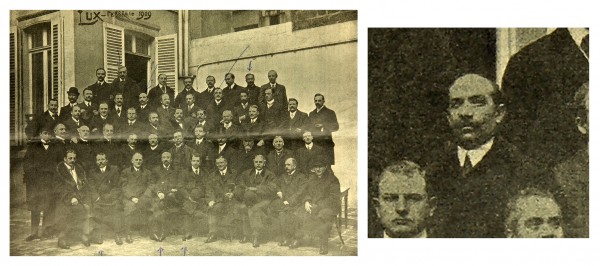
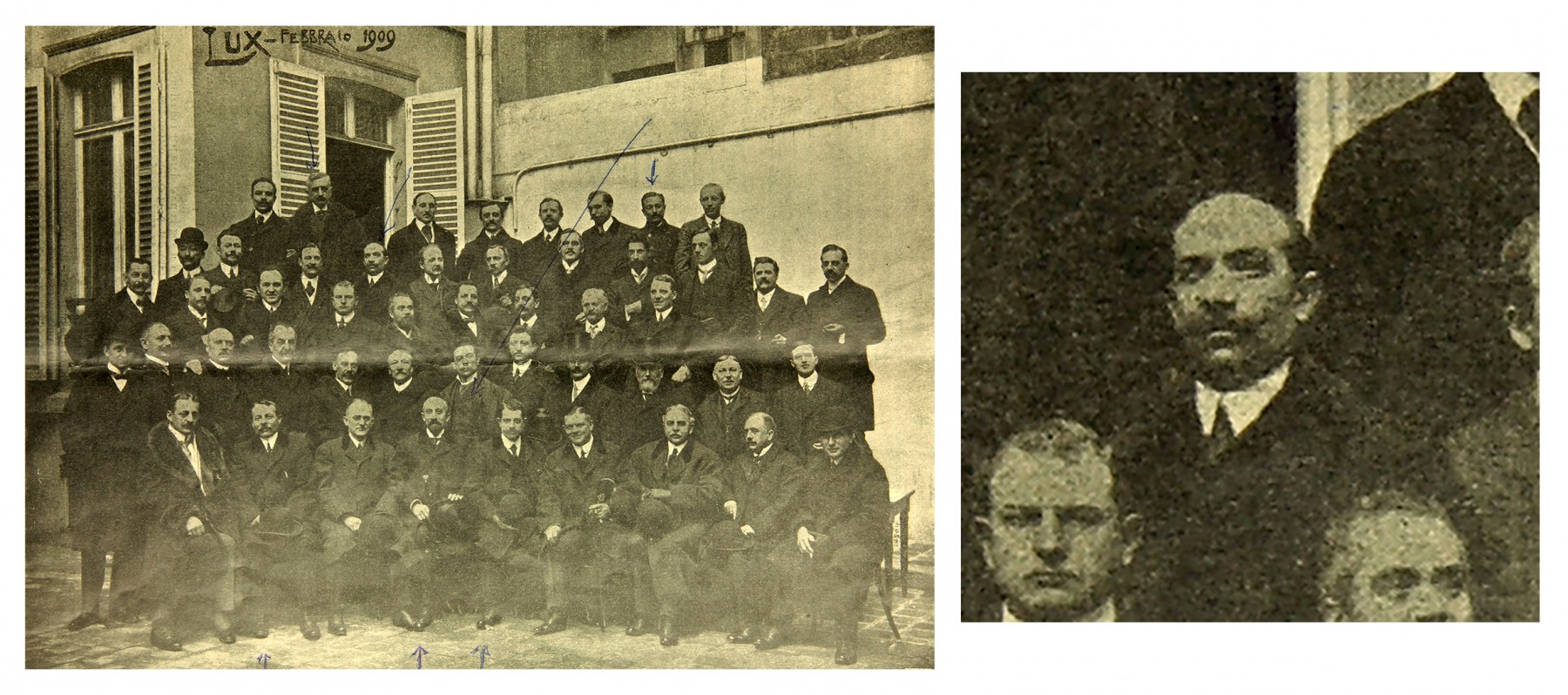
Participants at the Paris “Congrès International des Fabricants de Film”, which took place in early February 1909, with Georges Méliès as its chairman and Charles Pathé and George Eastman its patrons. Carlo Rossi participated as a representative of the Società Italiana Cines company. Carlo Rossi is fourth from the left in the second row from the top.
Lux [Napoli] (1909), 03: p. 11.
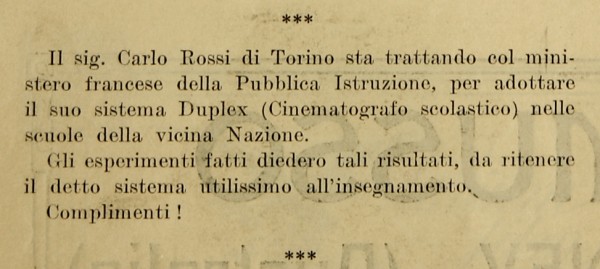
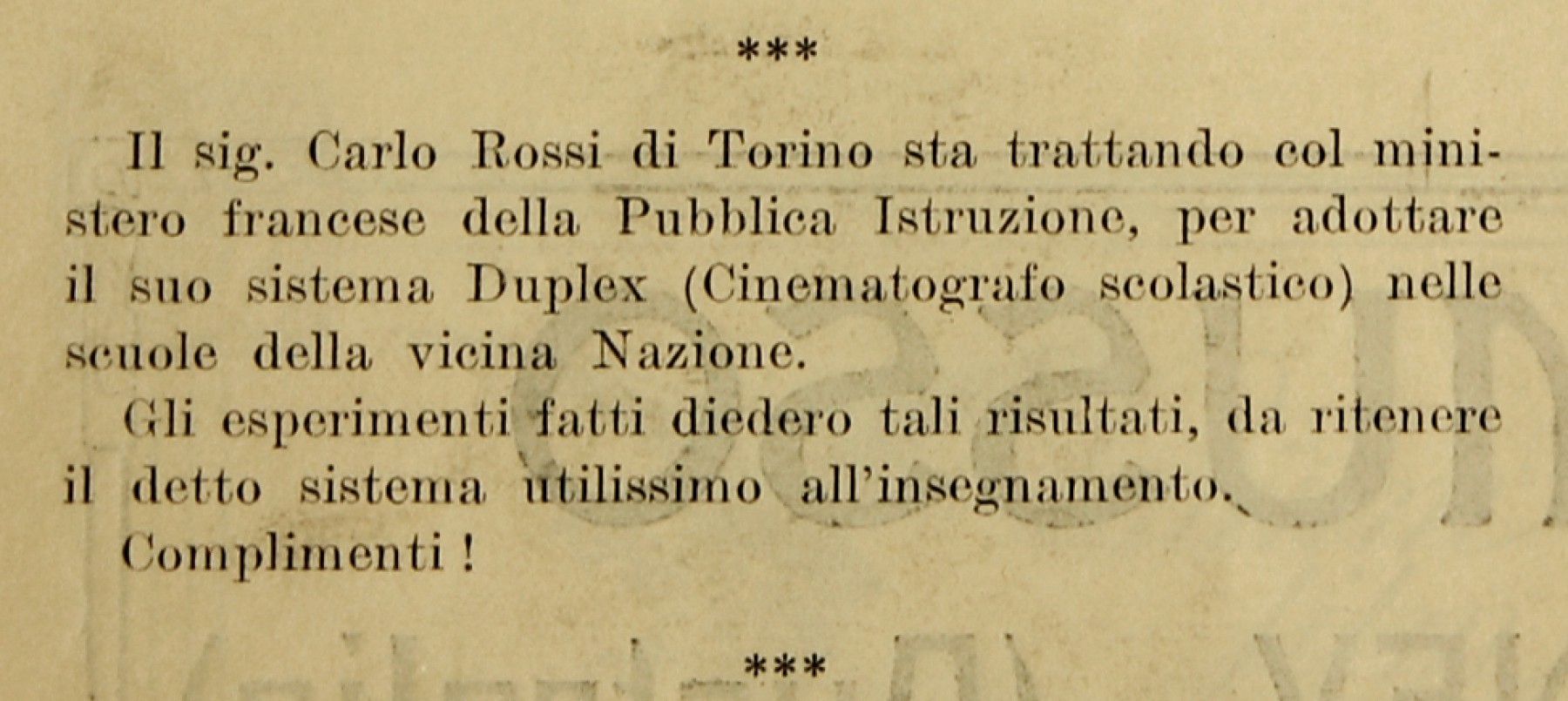
“Mr. Carlo Rossi of Turin is negotiating with the French Ministry of Education to adopt its Duplex system (Scholastic Cinematography) in schools in the neighbouring nation. The experiments carried out gave such results that this system was considered most useful for teaching. Congratulations!”
La vita cinematografica (1910). 08: p.18.
Selected Filmography
A short, negative fragment yet to be identified – without title or intertitles. Footage of two women in a living room from the 1910s. Conserved by Museo Nazionale del Cinema – Torino.
A short, negative fragment yet to be identified – without title or intertitles. Footage of two women in a living room from the 1910s. Conserved by Museo Nazionale del Cinema – Torino.
A tinted, short documentary, produced and directed by Luca Comerio in 1913. Footage of cockfighting. Also known as Il combattimento dei galli in Cina (Cockfighting in China). Conserved by Museo Nazionale del Cinema – Torino.
A tinted, short documentary, produced and directed by Luca Comerio in 1913. Footage of cockfighting. Also known as Il combattimento dei galli in Cina (Cockfighting in China). Conserved by Museo Nazionale del Cinema – Torino.
A short documentary produced and directed by Luca Comerio about the Forlanini hydroplane. Conserved by Museo Nazionale del Cinema – Torino.
A short documentary produced and directed by Luca Comerio about the Forlanini hydroplane. Conserved by Museo Nazionale del Cinema – Torino.
A short documentary produced and directed by Luca Comerio in 1910 – considered lost until 2017. Exploring, through a marble forest, the Milanese skyline at the beginning of the 20th Century: picturesque footage of Milan, shot from the roof of its cathedral. Restored by Museo Nazionale del Cinema – Torino.
A short documentary produced and directed by Luca Comerio in 1910 – considered lost until 2017. Exploring, through a marble forest, the Milanese skyline at the beginning of the 20th Century: picturesque footage of Milan, shot from the roof of its cathedral. Restored by Museo Nazionale del Cinema – Torino.
Technology
The invention, as originally conceived by Carlo Rossi, envisages the use of a multiple image 35mm format where “the orientation of the individual frames is arranged perpendicularly with respect to the centre line of the film, and their progression is one beside the other, instead of one below the other” (Italian patent 102.939, 1910), thereby exploiting the film in a horizontal direction. This multiple image format presents two series of frames, each of which measures 19mm x 12.5mm (0.748 in x 0.492 in), ensuring a satisfactory projection quality for screens in use at the beginning of the 20th century.
Two different techniques existed to obtain the multiple image film. The first involved the exposure of only one half of the frame of a 35mm negative (either above, or below, the centre line of the film), allowing for the contact printing of positives “whose frames will therefore occupy only one portion of the film used for projection, while another scene or other scenes obtained from other negatives can then be printed onto the portion of the positive that remains empty” (Italian patent 102.939).
The second technique involved the use of a standard 35mm negative with vertically arranged frames. Therefore, it was no longer possible to use contact printing to obtain a horizontal scrolling, multiple-image positive. It was instead necessary to use a device that permitted: either, the reduction of the image through a lens, when the appropriately distanced negative and positive were arranged perpendicular to one another during the printing process [Fig. 4 of patent below]; or, the reduction of the image through a lens and its rotation by 90 degrees, using a prism system, if the advancement of the positive and negative – again appropriately distanced – is achieved by parallel scrolling.
Through the use of these procedures, the length of the negative film required remained unaltered, while the length of the resulting positive was halved by doubling the use of space compared to the standard format, with a consequential reduction in costs – the principal aim of Rossi’s invention.
Regardless of the printing process, the scenes on the upper and lower sections of multiple film positives could be printed running in the same direction or, in opposite directions, inverted with respect to the centre line of the film. In the first instance, once the scenes on the upper half of the film were projected, the lens had to be moved into position so that it corresponded to the scenes printed on the lower half. But if the two rows of images proceeded in opposing directions, “the lens remains where it is and the film is inverted” [manually flipped over by 180 degrees by the projectionist] (Italian patent 102.939).
No matter how the frames were arranged, in addition to “the advantage of obtaining two scenes instead of one while using the same amount of film” (Italian patent 102.939), there was the benefit, once the projection had ended, of not having to rewind the film to return the first frame to the start of the reel to be projected again, as was required with standard 35mm film reels.
Given that the projection of the scenes ran from the first frame of the upper section, horizontally from left to right, then continued with the lower section in the opposite direction – a sort of U-turn – the last image of the final scene was located directly above or below the first image of the first scene. Therefore, the reel is always ready to be projected and the support is subjected to less wear, as it needs to run through the equipment half as often as a standard film reel.
Also, regarding projection, the patent indicates the possibility of advancing the film in a 35mm projector “horizontally or vertically by rotating the image with prisms or other suitable systems”, and foresees, as already specified, an interruption in the passage from the scenes printed on the upper section to those on the lower section.
However, between 1909 and 1912, with three successive extensions to the patent, approved by the French Republic, Carlo Rossi introduced an apparatus for the continuous loop projection of his multiple film, aimed precisely at overcoming the need to interrupt the projection between scenes. In particular, the 1910 revision concerned film where the scenes on the upper and lower sections were arranged in the same direction, while the 1912 revision concerned film where the scenes on the upper and lower sections were inverted.
Finally, Carlo Rossi’s patents did not include any indications concerning the shooting of negatives on only one half of the film; however, one can hypothesise the use of a 35mm camera in conjunction with the appropriate lenses and mattes. The exception being the final revision to the French patent, where the inventor introduced the possibility of obtaining multiple negatives from standard 35mm positives. By means of multiple printing phases, with copies appropriately distanced and arranged perpendicularly, or in parallel, to each other, Duplex 35mm negatives could be obtained, ready for the contact printing of positives.
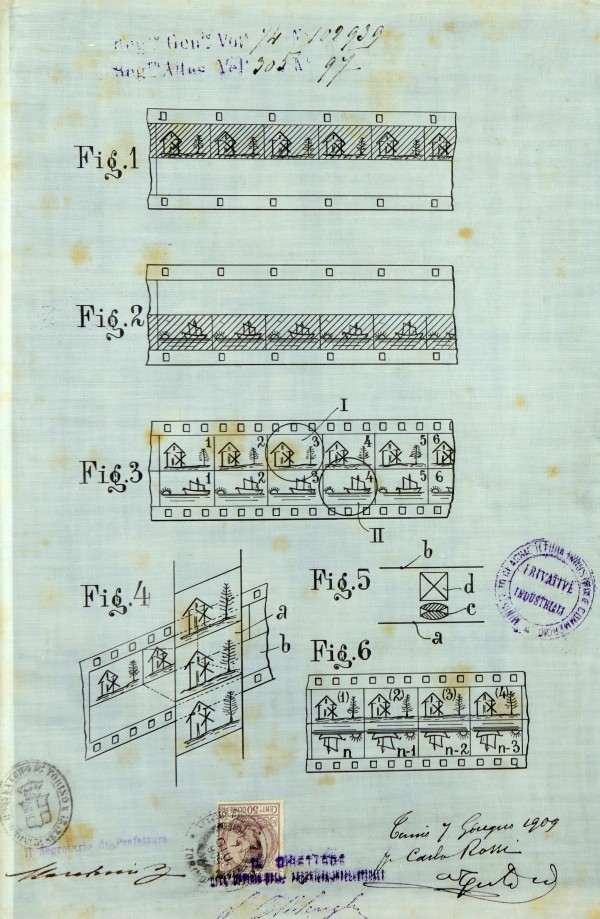
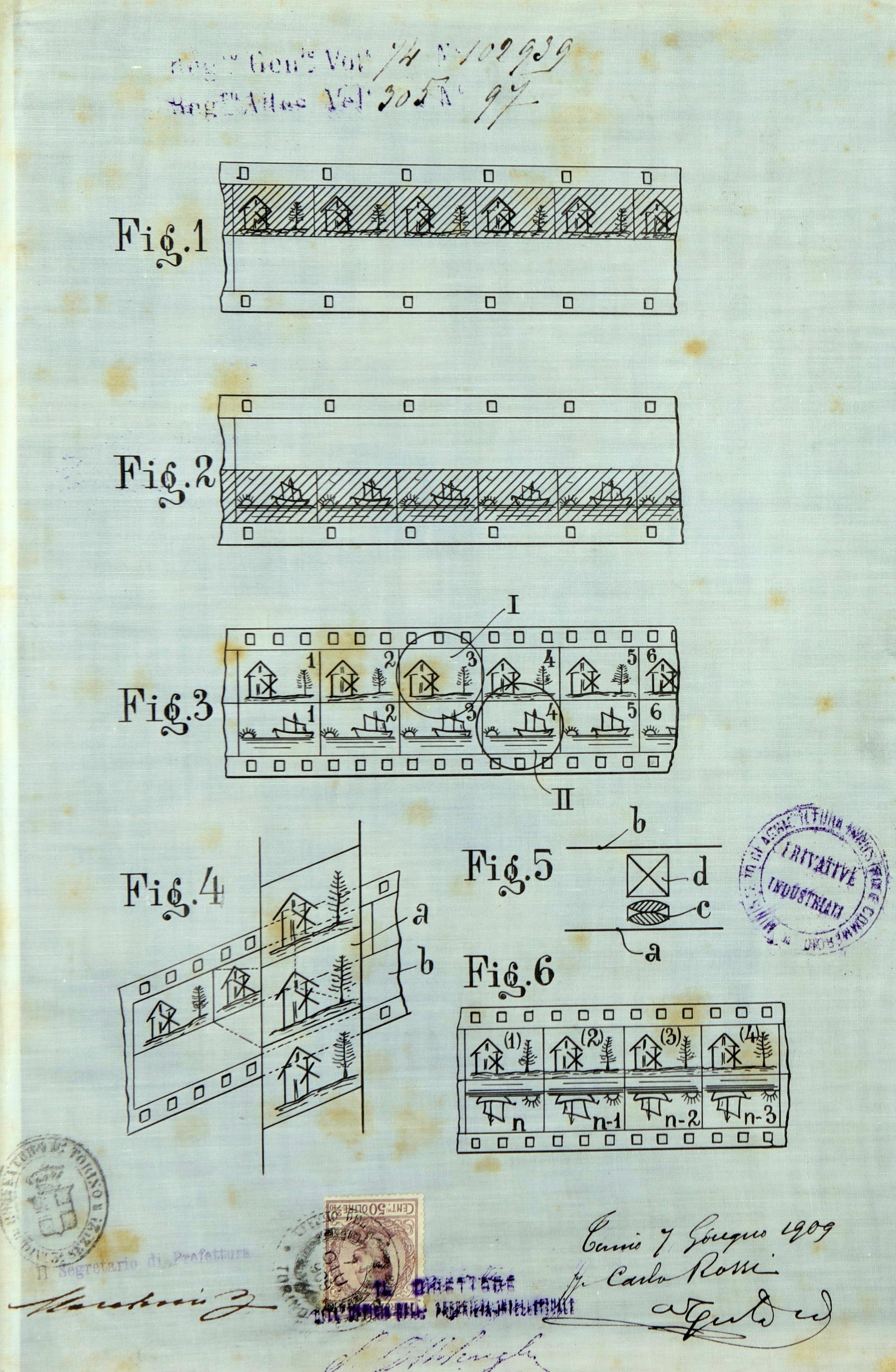
Patent drawing from Rossi, Carlo. Pellicola cinematografica multipla e processo per ottenerla (Italian patent 102.939). Figs 1 & 2: negative 35mm prints with only one half of the frame exposed (either above or below the centre line of the film), used for the contact printing of positives via two passes in the printer. Figs 3 & 6: the scenes on the upper and lower sections of multiple film positives may be printed in the same direction or, conversely, inverted with respect to the centre line of the film. Figs 4 & 5: the second printing technique that involves the use of a standard negative with vertically arranged frames, requiring the reduction of the image through a lens (Fig. 4); or, the through a lens and its rotation by 90 degrees, using prisms (Fig. 5).
Property of Archivio Centrale dello Stato, courtesy of Ministero della Cultura [Italian patent: Reg.ro Gen.le Vol. 74 No. 102.939, Reg.ro Attes.i Vol. 305 No. 97].
References
Anon. (1909). Lux [Napoli]. 03, p. 11. http://www2.museocinema.it/collezioni/PeriodiciMonografie.aspx
Anon. (1910). Lux e cine. 03, p. 4. http://www2.museocinema.it/collezioni/PeriodiciMonografie.aspx
Bernardini, Aldo (1981). Cinema muto italiano: II. Industria e organizzazione dello spettacolo, 1905–1909. Rome/Bari: Laterza.
Bernardini, Aldo (1982). Cinema muto italiano: III. Arte, divismo e mercato, 1910–1914. Rome/Bari: Laterza.
Bernardini, Aldo (2015). Le imprese di produzione del cinema muto Italiano. Bologna: Persiani.
Caranti, Chiara (2005). “I brevetti italiani 1896–1920. Criteri e metodologia di ricercar”. In I brevetti del cinema muto torinese : 1897–1913 (Vol. I). Turin: Biblioteca Fert.
Caranti, Chiara (2006). “Innovazioni nella tecnica cinematografica. I brevetti italiani (1908-20)”. In Cinema muto italiano: tecnica e tecnologia: Brevetti, macchine, mestieri (Vol. 2). Rome: Carocci Editore.
Fabri, Ira (ed.) (1997). Le fabbriche della fantasticheria. Atti di nascita del cinema a Torino. Turin: Testo & Immagine.
Friedemann, Alberto (2003). Celluloide e argento. Le società tecniche torinesi. Turin: Biblioteca Fert.
Friedemann, Alberto (2005). I brevetti cinematografici torinesi nel periodo del muto. In I brevetti del cinema muto torinese : 1897–1913 (Vol. I). Turin: Biblioteca Fert.
La vita cinematografica (1912). La vita cinematografica, n. 08, p. 18. http://www2.museocinema.it/collezioni/PeriodiciMonografie.aspx
Prolo, Maria Adriana (1951). Storia del cinema muto italiano (Vol. 1). Milan: Poligono.
Patents
Rossi, Carlo. Pellicola cinematografica multipla e processo per ottenerla. Italian patent 102.939, filed June 7, 1909, and issued 1910 / n. 5.
Rossi, Carlo. Film cinématographique multiple et son mode d'obtention. French patent FR406941, filed June 6, 1909, and issued February 15, 1910. https://data.inpi.fr/brevets/FR406941?q=FR406941#FR406941
Rossi, Carlo. Dispositivo per l’allacciamento delle estremità delle pellicole cinematografiche. Italian patent 109.305, filed April 13, 1910, and issued 1910 / n. 21.
Rossi, Carlo. Sistema di supporto per rendere girevoli attorno all’asse dell’obiettivo le macchine cinematografiche da proiezione. Italian patent 109.306, filed April 13, 1910, and issued 1910 / n. 21.
Rossi, Carlo. Film cinématographique multiple et son mode d'obtention. French patent FR12688E, filed May 31, 1910, and issued October 26, 1910. https://data.inpi.fr/brevets/FR12688E?q=FR12688E#FR12688E
Rossi, Carlo. Sistema ed apparecchio per fare passare in modo continuativo le pellicole cinematografiche. Italian patent 110.210, filed June 6, 1910, and issued 1911 / n. 1.
Rossi, Carlo. Film cinématographique multiple et son mode d'obtention. French patent FR15357E, filed January 23, 1912, and issued June 25, 1912. https://data.inpi.fr/brevets/FR15357E?q=FR15357E#FR15357E
Compare
Related entries
Author
Stefania Carta is Curator of the Film Archive of the Museo Nazionale del Cinema – Torino (Italy). Since 2006, she has been dealing with cataloguing, supervision of the archiving material, analysis, film inspection and repair, valorization and distribution of the collections. She graduated in Modern Literature, specializing in film studies at the University of Torino, with a thesis about Italian film archives and film restoration. In 2010 she took part in an internship at the Cineco laboratory in Amsterdam coordinated by the Haghefilm Foundation.
My thanks to my colleagues for their support and discussion: Sergio Geninatti Chiolero (Cinema Massimo), Nadia Maltauro (Film Archive), Raffaella Isoardi and Valentina Malvicino (Devices and Pre-cinema Collections). Thanks also to Stella Dagna for identifying Carlo Rossi’s 35mm Split Duplex in 2016.
Carta, Stefania (2026). “Sistema Duplex”. In James Layton (ed.), Film Atlas. www.filmatlas.com. Brussels: International Federation of Film Archives / Rochester, NY: George Eastman Museum.
Art and Culture Translated Ltd