Dyaliscope(c.1954–1975)
A French trademark for anamorphic camera and projection lenses, marketed by Adolphe Landau’s Société d’applications techniques et d’exploitation cinématographique (SATEC). DyaliScope prints featured a single monophonic optical sound-track and a 2.35:1 aspect ratio.
Film Explorer
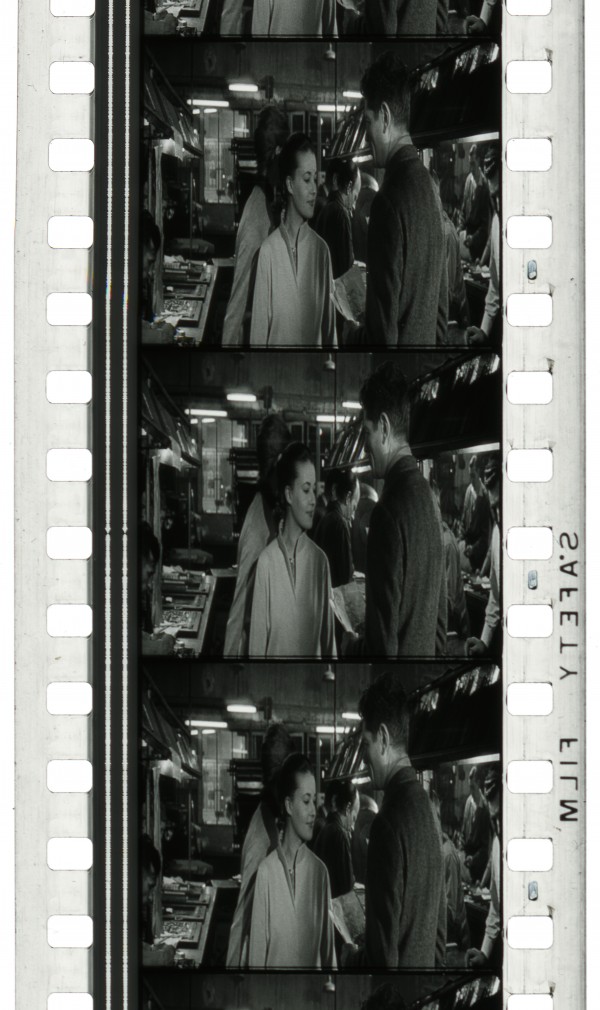
A 35mm projection print of Louis Malle’s Les Amants (1958) made for US distribution. The DyaliScope camera lens horizontally compressed a 2.35:1 widescreen image into a narrow film frame. This image was uncompressed to its full width during projection.
The Museum of Modern Art, New York, NY, United States.
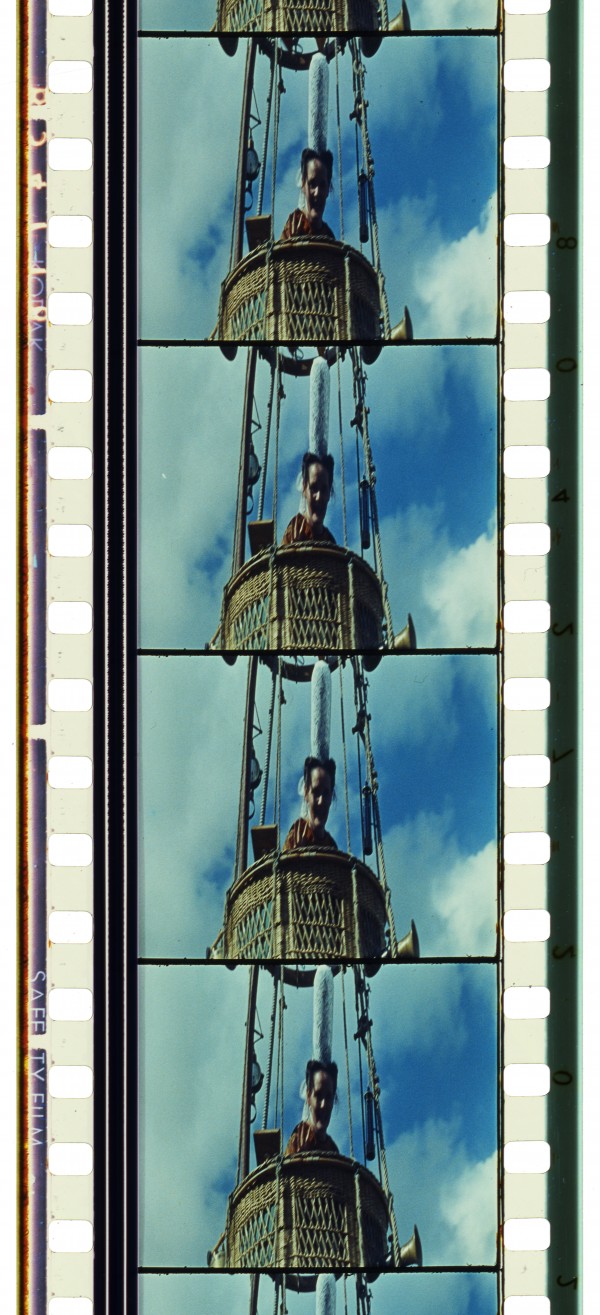
A 35mm US distribution print of Le Voyage en ballon (1959) by Albert Lamorisse.
Identification
21.3mm x 18.15mm (0.839 in x 0.715 in).
B/W; various color processes (Agfacolor, Eastmancolor, Ferraniacolor).
Standard stock manufacturer markings.
1
Many original color prints now suffer from color fading.
The DyaliScope trademark was noted in a film’s credits (with or without the logo) and advertising.
Single, standard monophonic optical soundtrack.
22mm x 18.7mm (0.866 in x 0.736 in).
B/W; various color processes (Agfacolor, Eastmancolor, Ferraniacolor).
Standard stock manufacturer markings.
History
Between 1955 and 1969, 108 French films were shot with DyaliScope anamorphic lenses, making it the second-largest French manufacturer of widescreen lenses after Franscope. The lenses were produced by Société d’applications techniques et d’exploitation cinématographique (SATEC) based in Saint-Cloud, near Paris, and founded by Adolphe Landau [Landeau] (1904–83) and André Fougerat in the late 1940s. A Polish émigré with communist leanings, Adolphe Landau was a film enthusiast who designed film credits in the 1930s and produced Henri Decoin’s Les Amants du pont Saint-Jean (1947), before purchasing facilities in Saint-Cloud. His brother, Igor Landau, founded the industry magazine La Technique cinématographique in 1930, and subsequently started L’Exploitation cinématographique, which would later help to publicize DyaliScope.
SATEC first gained recognition following the introduction of CinemaScope to France, in December 1953, with the launch of two projection lenses designed for cinemas that screened a variety of aspect ratios. The first of these lenses, the Périrama, was a system designed to vary the dimensions of the projected image through the use of a variable-focus lens (65–150mm, called the Périgonal), and a “photo-telecontrol” system that would automatically change the focal length of the lens, depending on the positioning of the screen covers.
The second lens was an anamorphic projection lens for films shot at 2.55:1. It was initially named Dyaligonal, but, from October 1954 onwards, was rebranded as the DyaliScope. The change of name coincided with the introduction of a “spherocylindrical block” design which made the DyaliScope a one-piece anamorphic lens – this innovation was largely responsible for the great success of the lens during the second half of the 1950s.
But DyaliScope had a difficult start: a B/W feature film, initially titled Jésus la Caille, was slated to be shot during February 1955, in 2.55:1 using DyaliScope, but was ultimately shot in Cinépanoramic under the title M’sieur la Caille (1955); and DyaliScope’s eventual first French feature, Emile Couzinet’s Quai des illusions, shot from January 1956, was not released until 1959. So, the first French film actually released in DyaliScope (and Agfacolor) was Dimitri Kirsanoff’s comedy Ce soir les jupons volent, released June 15, 1956.
Like its domestic competitors Cinépanoramic-Franscope and Totalvision, SATEC sought to counter the CinemaScope monopoly in France by focusing its marketing efforts towards the export market. Thanks to the founder’s communistic connections, its first market was Eastern Europe: an agreement was signed in January 1955 with the Mosfilm studio, based in Moscow, USSR, which, in 1956, shot its first two widescreen films in DyaliScope (later assimilated and rebranded as Sovscope: Ilya Muromets [The Sword and the Dragon] directed by Aleksandr Ptushko, and Prolog (director, Efim Dzigan). According to French cinematographer Raoul Coutard, the Soviets dismantled and reverse-engineered the anamorphic lens in order to produce the Sovscope. DyaliScope was subsequently licensed to producers in Czechoslovakia and Poland (Krżyzacy [Knights of the Teutonic Order], 1960); and subsequently in Italy (Le fatiche di Ercole [Hercules], 1957), Japan (Nikkatsu Studios, based in Bunkyō, outside of Tokyo, shot over 20 feature films using DyaliScope lenses up to 1959), West Germany, United Kingdom (Expresso Bongo, 1959), and even in the United States (Tarzan’s Three Challenges, 1963).
Domestically, French productions photographed using DyaliScope outnumbered those of its competitors from the start of operations in 1957 up to 1962, after which the rival Franscope became market leader. Initially used largely for low-budget comedies, thrillers and historical adventure films, DyaliScope went on to win over some of the leading young directors of the French New Wave, including Louis Malle for his Les Amants (1958) and François Truffaut, Les 400 Coups (1959). The trademark went on to achieve great success with a series of domestic box-office hits, such as André Hunebelle’s Le Bossu (1959), Jean Girault’s Le Gendarme de Saint-Tropez (1964), or Alain Resnais’ L’Année dernière à Marienbad (1961) – which won plaudits from leading film critics.
The success of DyaliScope probably resulted from the fact that it was the first to incorporate a self-contained monoblock lens structure (even beating Panavision’s Auto-Panatar lenses to the market [launched 1957]) – thus setting the template for the design of modern anamorphic camera lenses.
On the projection side, DyaliScope anamorphic lenses were a great success in France, replacing the French-made CinemaScope lenses manufactured by Société technique d’optique et de photographie (STOP) as the dominant exhibition lens, as early as 1958. STOP was a company set up by Henri Chrétien in November 1927, for the manufacture of the Hypergonar lens – the designs for which were sold to 20th Century-Fox in December 1952, becoming the CinemaScope lens. STOP became the exclusive manufacturer and distributor of CinemaScope in France.
A 1960s sales brochure produced by SORO (Société de réalisations optiques), a successor to SATEC after 1963, states that, internationally, more than 30,000 cinemas had been equipped with DyaliScope anamorphic projection lenses, and more than 500 feature films had been shot using DyaliScope.
A recording of Olivier Rousseau’s lecture delivered at the Cinémathèque française, Paris, relating the history of French CinemaScope-compatible formats from the 1950s and 1960s (in French), November 17, 2017. Cinémathèque française (2017). Conservatoire des techniques cinématographiques.
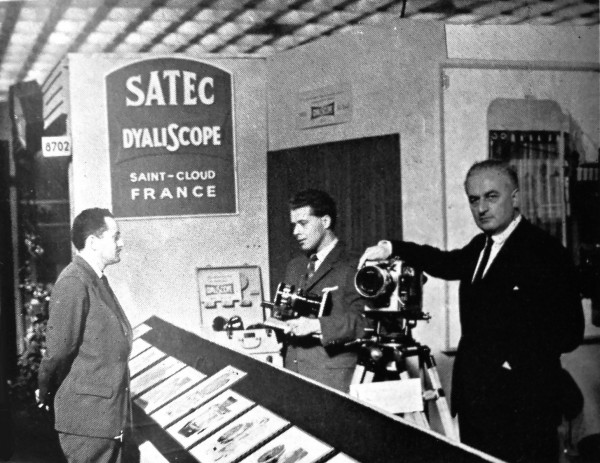
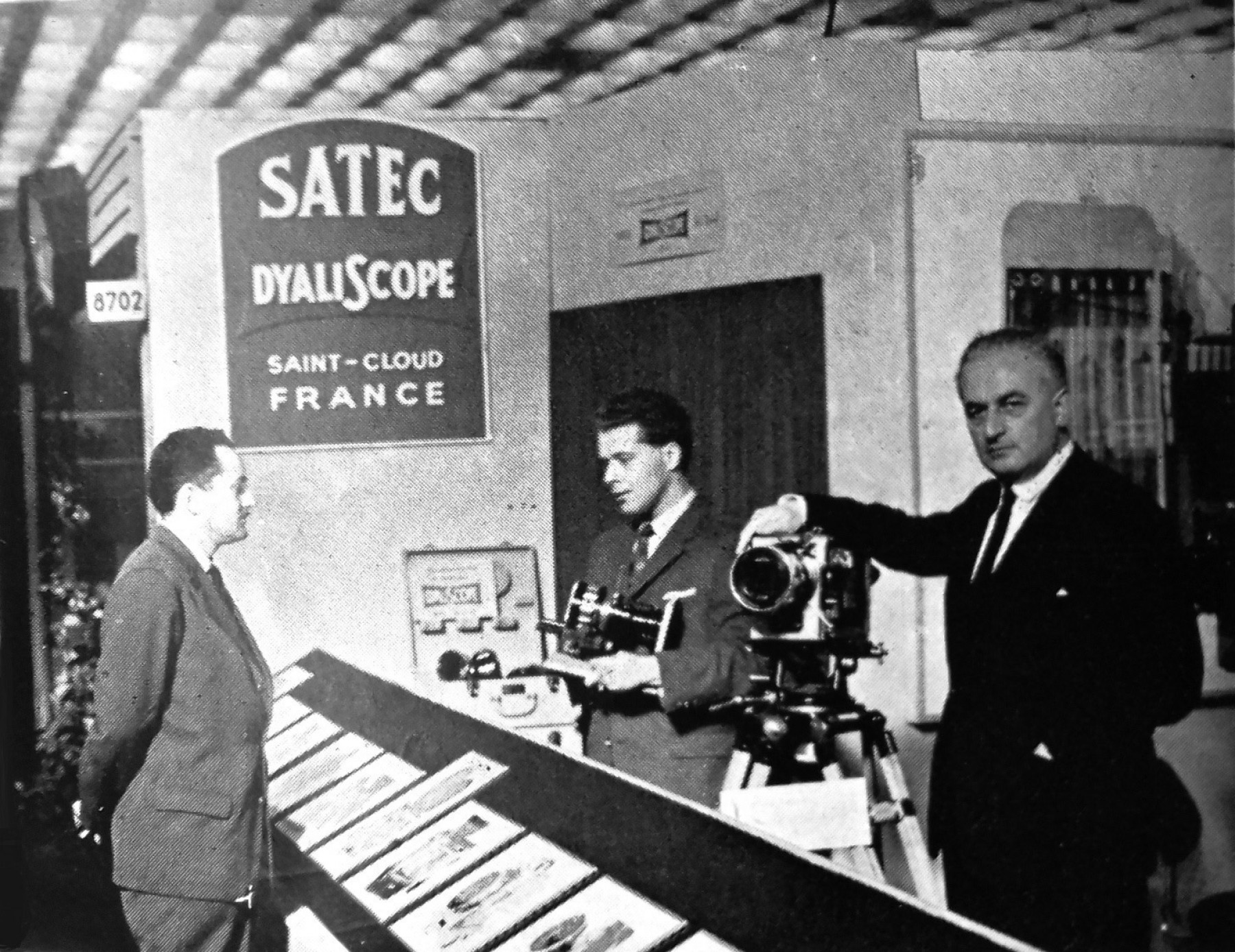
The SATEC booth at the 1956 Photokina fair with Adolphe Landau, on the right.
La Technique cinématographique, 169, October 1956.
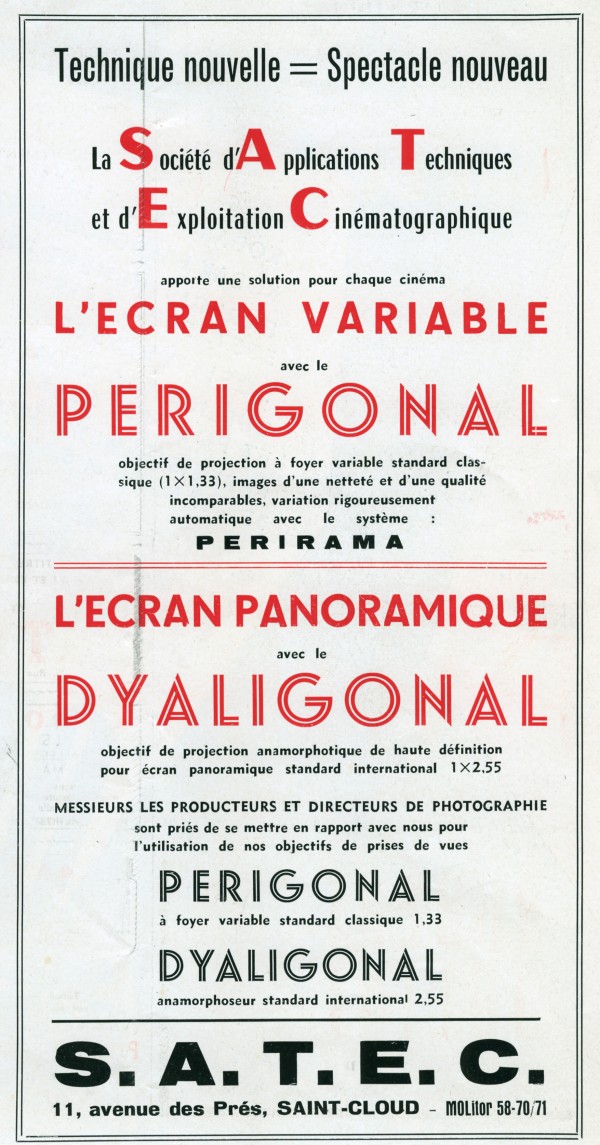
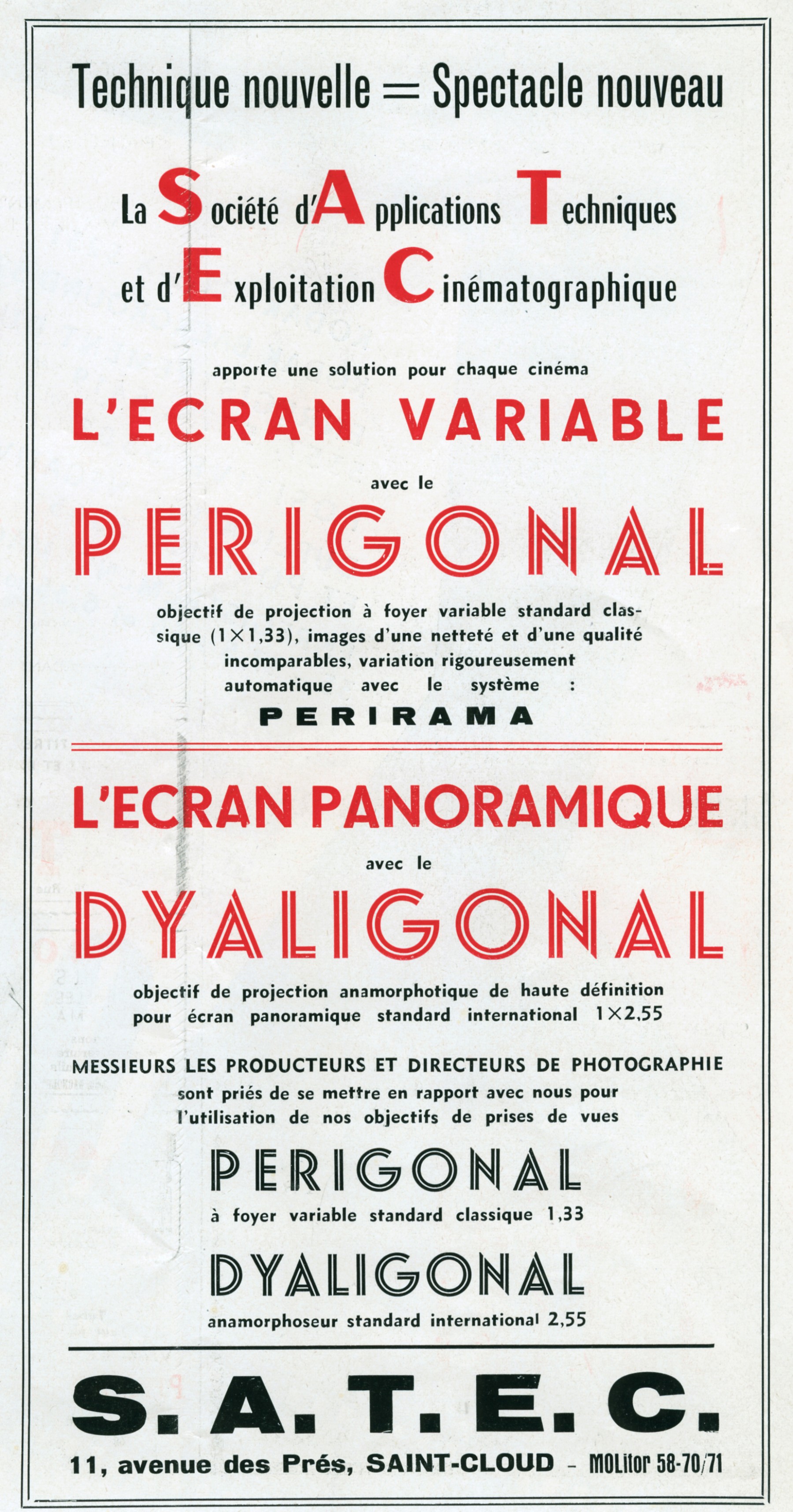
First mention of DyaliScope under its original trade name Dyaligonal. Here, anamorphic camera and projection lenses for filming in 2.55:1 aspect ratio are presented, alongside the Périgonal, a variable-focus projection lens for variable screen ratios and sizes.
SATEC Advertisement (1954), La Technique cinématographique, 144 (Jun.): p. 158.
Selected Filmography
An iconic film by the young director who launched the French New Wave. In addition to its modern subject matter and treatment, this production is particularly noteworthy for its depiction of the cramped apartments of working-class Paris, filmed by Henri Decaë in B/W DyaliScope. Awarded the Prix de la mise en scène at the 1959 Cannes Film Festival, it was released in France on June 3, 1959.
An iconic film by the young director who launched the French New Wave. In addition to its modern subject matter and treatment, this production is particularly noteworthy for its depiction of the cramped apartments of working-class Paris, filmed by Henri Decaë in B/W DyaliScope. Awarded the Prix de la mise en scène at the 1959 Cannes Film Festival, it was released in France on June 3, 1959.
The first in the successful historical and sentimental film series, based on the fictional character from Anne and Serge Golon’s novels, it was shot in DyaliScope and Eastmancolor by Henri Persin and released on December 9, 1964. It drew an audience of almost 3 million and was followed by four subsequent films in the series, ending in 1968, all in the same widescreen format.
The first in the successful historical and sentimental film series, based on the fictional character from Anne and Serge Golon’s novels, it was shot in DyaliScope and Eastmancolor by Henri Persin and released on December 9, 1964. It drew an audience of almost 3 million and was followed by four subsequent films in the series, ending in 1968, all in the same widescreen format.
Agfacolor. Shot April–May 1956, this was the first French film in DyaliScope to hit theaters, released June 15, 1956. The film’s cinematographer, Roger Fellous, who was close to J.-P. Mauclaire (and his rival Franscope lenses) nevertheless turned to DyaliScope, as it offered him the long focal lengths he wanted for this picture – his first film in anamorphic widescreen. Fellous also used DyaliScope for his second feature, Les Lavandières du Portugal (1957), directed by Pierre Gaspard-Huit. A sentimental comedy.
Agfacolor. Shot April–May 1956, this was the first French film in DyaliScope to hit theaters, released June 15, 1956. The film’s cinematographer, Roger Fellous, who was close to J.-P. Mauclaire (and his rival Franscope lenses) nevertheless turned to DyaliScope, as it offered him the long focal lengths he wanted for this picture – his first film in anamorphic widescreen. Fellous also used DyaliScope for his second feature, Les Lavandières du Portugal (1957), directed by Pierre Gaspard-Huit. A sentimental comedy.
Shot in DyaliScope, despite the overwhelming presence of competing anamorphic lenses in Italy. The film starred Steve Reeves (“Mr Universe 1950”) and was an international hit – the movie provided a boost for the historical sword-and-sandal peplum genre in Europe.
Shot in DyaliScope, despite the overwhelming presence of competing anamorphic lenses in Italy. The film starred Steve Reeves (“Mr Universe 1950”) and was an international hit – the movie provided a boost for the historical sword-and-sandal peplum genre in Europe.
The first Soviet widescreen film and one of the first non-French films shot with DyaliScope lenses (with 4-track magnetic stereo sound). DyaliScope lenses were soon renamed Sovscope in the Soviet Union, although it is not known if the lenses used were modified, or reverse-engineered copies of DyaliScope. The film recounts the deeds of a character from a well-known Russian folk legend – a dramatic treatment of his heroic and fantastic adventures.
The first Soviet widescreen film and one of the first non-French films shot with DyaliScope lenses (with 4-track magnetic stereo sound). DyaliScope lenses were soon renamed Sovscope in the Soviet Union, although it is not known if the lenses used were modified, or reverse-engineered copies of DyaliScope. The film recounts the deeds of a character from a well-known Russian folk legend – a dramatic treatment of his heroic and fantastic adventures.
The first successful leading role for martial artist Bruce Lee, shot in DyaliScope and Eastmancolor. One of the most famous feature films shot with DyaliScope lenses in Hong Kong by Golden Harvest Studios, which continued to use these lenses until about 1975.
The first successful leading role for martial artist Bruce Lee, shot in DyaliScope and Eastmancolor. One of the most famous feature films shot with DyaliScope lenses in Hong Kong by Golden Harvest Studios, which continued to use these lenses until about 1975.
This contemporary drama starring Simone Signoret, adapted from a novel by Roger Vailland, was filmed in B/W “Cinégraphiscope”, according to the logo in the opening credits and on the film poster. However, other sources refer to DyaliScope lenses being used. The film was released on May 17, 1961.
This contemporary drama starring Simone Signoret, adapted from a novel by Roger Vailland, was filmed in B/W “Cinégraphiscope”, according to the logo in the opening credits and on the film poster. However, other sources refer to DyaliScope lenses being used. The film was released on May 17, 1961.
The first spy film featuring the hero of Jean Bruce’s series of novels. It was shot by Marcel Weiss in B/W DyaliScope with the addition of fixed masking to the sides of the image, reducing the aspect ratio to 1.66:1 for scenes shot on small interior sets. Industry screening, January 11, 1957; released, August 14, 1957.
The first spy film featuring the hero of Jean Bruce’s series of novels. It was shot by Marcel Weiss in B/W DyaliScope with the addition of fixed masking to the sides of the image, reducing the aspect ratio to 1.66:1 for scenes shot on small interior sets. Industry screening, January 11, 1957; released, August 14, 1957.
B/W. The first French feature film shot in DyaliScope at the director’s Bordeaux studios in January and February of 1956. Despite an industry screening of the film on May 18, 1956, it was not released until January 21, 1959. A melodrama.
B/W. The first French feature film shot in DyaliScope at the director’s Bordeaux studios in January and February of 1956. Despite an industry screening of the film on May 18, 1956, it was not released until January 21, 1959. A melodrama.
A feature-length fiction film about the journey of an aeronaut and his stowaway grandson through the skies of France. Shot in DyaliScope and Eastmancolor by Maurice Fellous and Guy Tabary, which also used Hélivision, a system invented by Lamorisse to fix and stabilize the camera while filming from a helicopter. The fiction is a pretext to show scenic aerial views of France, in the style of a “travelogue” documentary.
A feature-length fiction film about the journey of an aeronaut and his stowaway grandson through the skies of France. Shot in DyaliScope and Eastmancolor by Maurice Fellous and Guy Tabary, which also used Hélivision, a system invented by Lamorisse to fix and stabilize the camera while filming from a helicopter. The fiction is a pretext to show scenic aerial views of France, in the style of a “travelogue” documentary.
Technology
During a time of strong demand for anamorphic widescreen lenses in France – linked to 20th Century-Fox’s emerging CinemaScope monopoly – multiple French alternatives appeared: Cinépanoramic from J.-P. Mauclaire’s D.I.C. (June 1953), DyaliScope from SATEC (June 1954) and Georges Bonnerot’s Totalvision/TotalScope (from 1956, mainly used in Italy). These anamorphic lenses were all based on the same principle: the camera lens squeezed a wide-ratio image horizontally onto a standard strip of 35mm film, while the projection lens “unsqueezed” the image onto an extra-wide screen in the cinema. Typically, the anamorphic (squeezing) factor was 2 to 1 – when projected, an image with an aspect ratio of 2.35:1 was produced, the same ratio as CinemaScope.
Faced with criticism from professionals about the “generalized blurring” of CinemaScope film projection, SATEC engineers M. Ledu and André Fougerat looked for a solution to reduce image distortions: notably, aberrations at the extreme edges of the frame, particularly in close-up shots. The chosen approach was to calculate the extent of the anamorphic compression according to the focal length of the primary spherical lens used – in other words, to design an all-in-one anamorphic lens for each focal length by combining spherical and anamorphic lens elements in a single assembly, a non-adjustable “block”. (Early anamorphic CinemaScope lenses were attachments on existing lenses). The “spherical-cylindrical block” (commonly referred to today as a “monoblock”) thus comprised a primary lens (made by Kinoptik) combined with an anamorphic lens composed of two groups of cylindrical lenses. A third achromatized lens was added between the two cylindrical groups to keep the anamorphic coefficient constant during focusing.
While monoblock lens units were lighter and took up less space than using a primary lens and an anamorphic attachment, they were a more expensive option because cinematographers were required to rent a complete monoblock unit for each focal length desired, from 35mm to 100mm, rather than a single anamorphic attachment that could pair with their existing lenses. Two series of DyaliScope lenses were produced: the “classic series” from 1954 (although it was not until January 1955 that cinematographer Marcel Grignon carried out the first tests), then the “new series” from summer 1958.
However, in response to a strong industry demand for anamorphic lenses, and because of certain operators’ desire to use a greater range of focal lengths, or specific brands of primary lenses, from November 1956 SATEC also manufactured additional anamorphic lens attachments known as “Type multifocus”, which could be paired with any spherical lens made by other manufacturers. Then, from summer 1957, the range was expanded with the “Type A” series, which consisted of an anamorphic lens specific to each spherical lens focal length.
Starting in November 1963, a Dyaliscope zoom lens (40–120mm) was marketed, followed by other monoblocks specifically designed for title boxes, inserts or animation.
Last but not least, the DyaliScope catalog included, in addition to successful projection lenses, de-anamorphosing magnifier lenses for optical printers, and an auto-collimator or a de-anamorphic lens for making “flat” copies with narrower aspect ratios like 1.66:1.
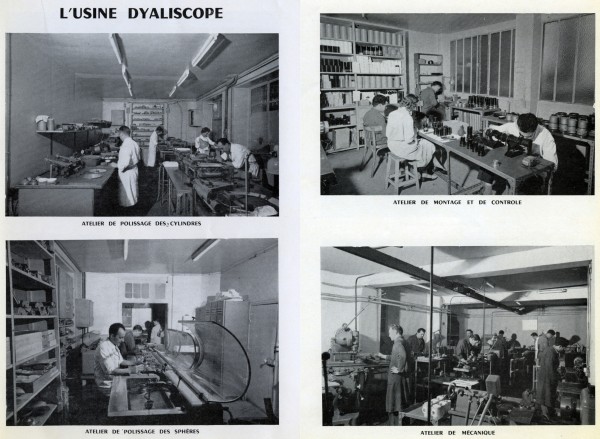
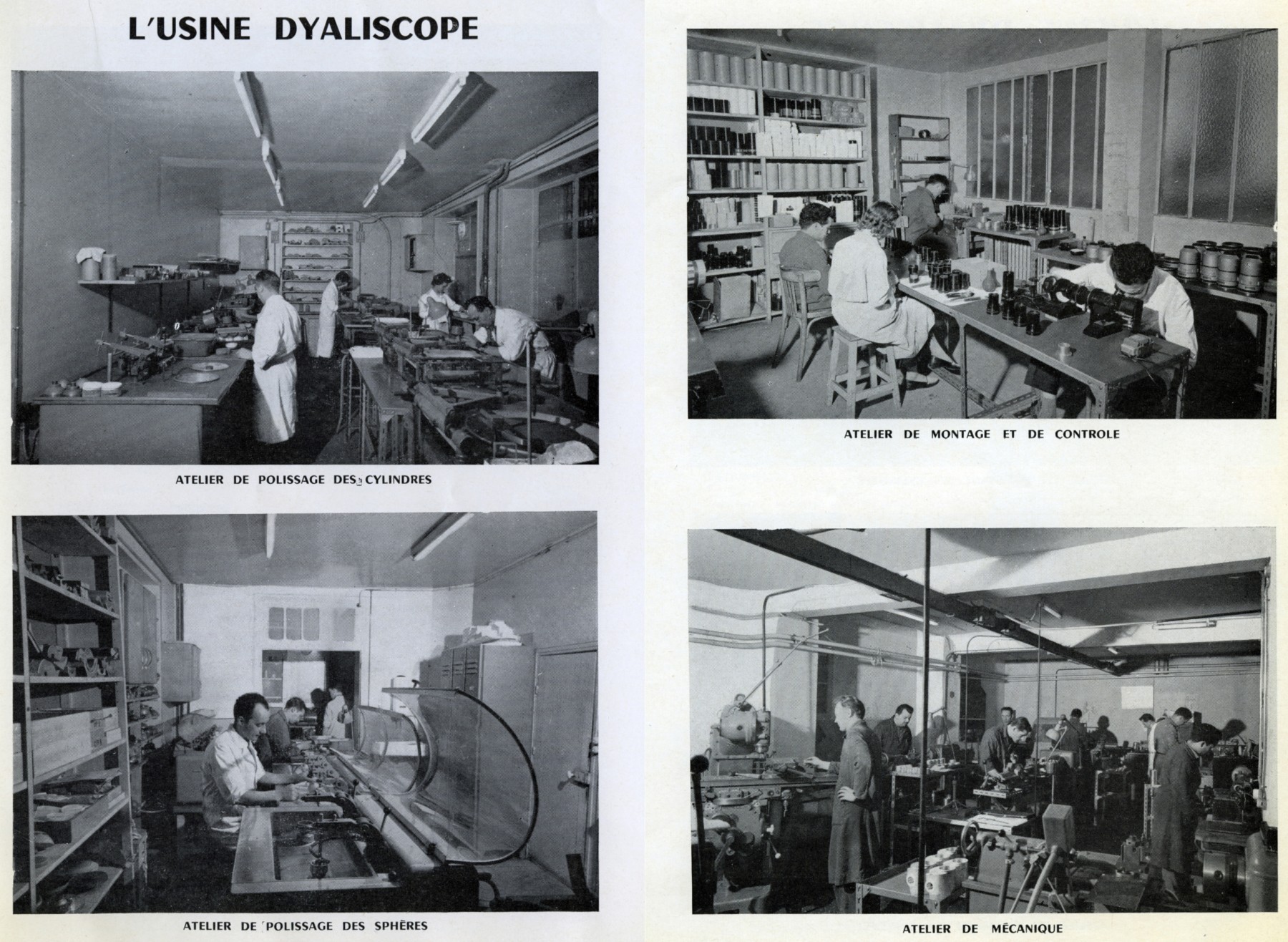
The manufacturing facilities for DyaliScope, showing workshops for cylinder polishing (top left), lens polishing (bottom left), assembly and control (top right), and mechanics (bottom right).
SATEC advertisement brochure, 1959, Cinémathèque française, Paris, France.
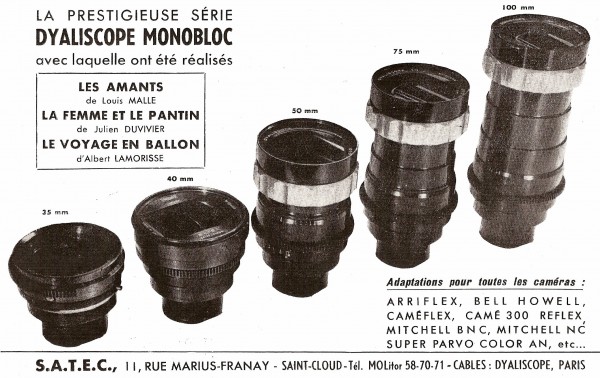
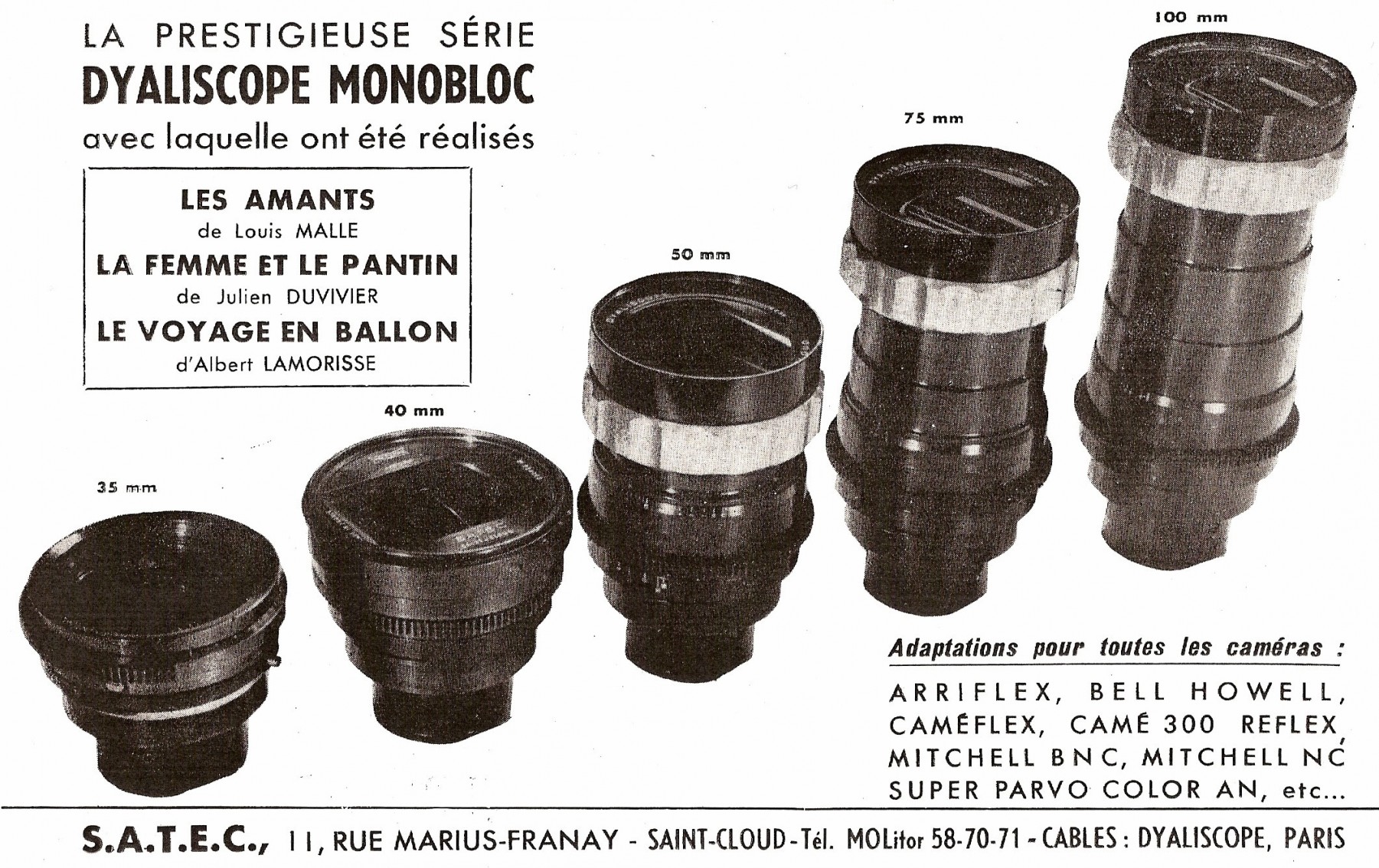
SATEC advertisement showing the “new series” DyaliScope anamorphic monoblock camera lenses (1958–59).
La Technique cinématographique, 194, January 1959, p. 8.
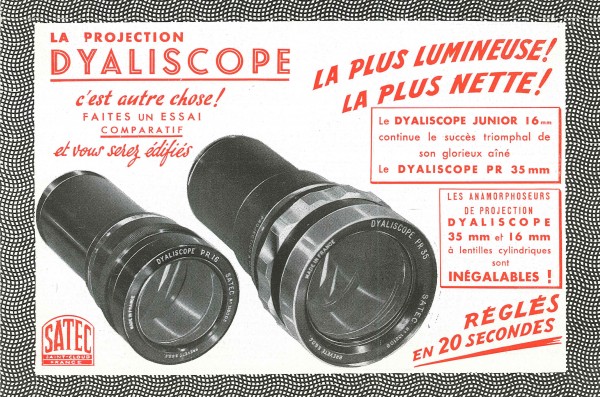
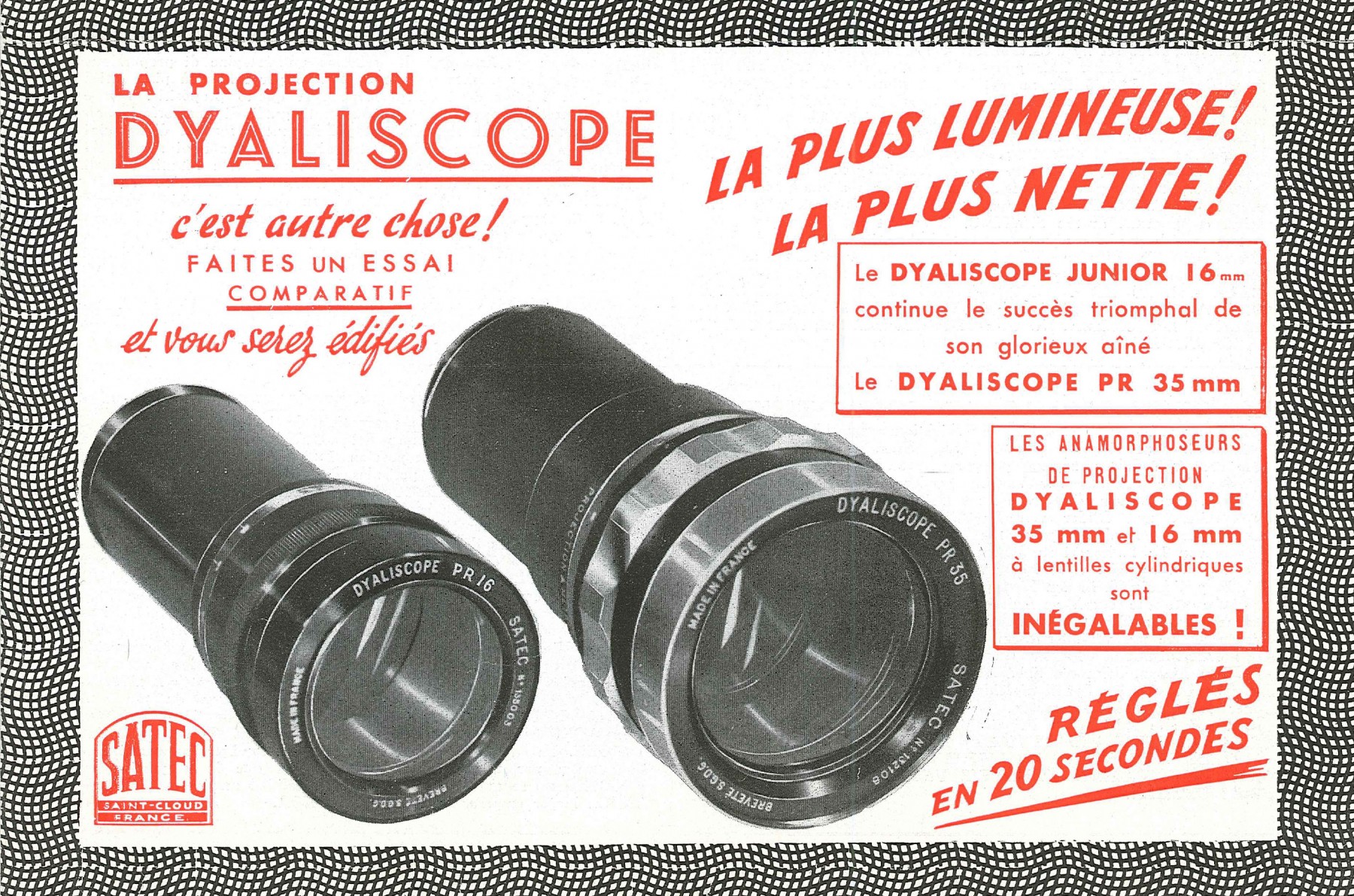
SATEC brochure showing the DyaliScope anamorphic attachment lenses for 35mm and 16mm projection, c. 1957.
American Widescreen Museum (website). https://www.widescreenmuseum.com/widescreen/dyaliscope_lenses.pdf
References
American Widescreen Museum (n.d.). “Dyaliscope Lenses”. www.widescreenmuseum.com (website). https://www.widescreenmuseum.com/widescreen/dyaliscope_lenses.pdf (accessed Apr. 27, 2026).
Cinémathèque française (2014). “Objectif anamorphoseur de projection: Dyaliscope Champion SATEC no. 227 410 A (1964)”, La Cinémathèque française, Catalogue des appareils cinématographiques. https://www.cinematheque.fr/fr/catalogues/appareils/collection/objectif-anamorphoseur-de-projectionap-14-2953.html (accessed Apr. 27, 2026).
Fougerat, André (1958), ‘Art et Normalisation’, La Technique cinématographique, 186 (Apr.): pp. 129–130.
Fougerat, André (1963), “Un nouvel instrument optique : le Dyaliscope-zoom”, La Technique cinématographique, 247 (Nov.): pp. 299–301
Rousseau, Olivier (2007) “Les Formats larges dans le cinéma français de fiction (1953–2000): histoire des techniques, production, exploitation, esthétique”. Doctoral thesis under the supervision of Jean A. Gili, Université Paris 1 Panthéon-Sorbonne. https://theses.hal.science/tel-04184041 (accessed Apr. 27, 2026).
Rousseau, Olivier (2014), ‘Histoire technique des formats larges en France (1953-1969) : stratégies nationales face à l’innovation américaine du CinémaScope’, www.academia.edu (website), https://www.academia.edu/9721471/_Histoire_technique_des_formats_larges_en_France_1953_1969_strat%C3%A9gies_nationales_face_%C3%A0_linnovation_am%C3%A9ricaine_du_Cin%C3%A9maScope (accessed Apr. 27, 2026).
Rousseau, Olivier (2017), ‘CinemaScope, DyaliScope, Franscope : l’aventure du scope français dans les années 1950 et 1960’ (lecture presented Nov. 17), La Cinémathèque française, Le conservatoire des techniques cinématographiques. https://www.cinematheque.fr/video/1146.html (accessed Apr. 27, 2026).
Sacha, Jean (1957), ‘L’alliance des différents formats d’images’, La Technique cinématographique (Bulletin du Festival international du Film, Cannes), 3, (May): p. 7.
SATEC (1954). Advertisement for the Périgonal and the Dyaligonal [DyaliScope], La Technique cinématographique, 144, (Jun.): p. 158.
SATEC (1955). Advertisement for the Périrama, L’Exploitation cinématographique, 140 (Feb. 25), back cover.
SATEC (1955). Advertisement for le DyaliScope (filming and projection), La Technique cinématographique, 154 (May).
Patents
SATEC. Perfectionnements au cinématographe. French patent 1,105,467, filed December 16, 1953.
SATEC. Perfectionnements aux appareils d’optique à distance focale variable. French patent 1,123,471, filed January 19, 1955.
SATEC. Anamorphoseur. French patent 1,517,654, filed April 30, 1960.
Compare
Related entries
Author
Olivier Rousseau holds a PhD from the Université Paris 1 Panthéon-Sorbonne, and wrote a thesis entitled Les Formats larges dans le cinéma français de fiction (1953-2000) : histoire des techniques, production, exploitation, esthétique, under the supervision of Jean A. Gili, defended in 2007. Senior teacher of modern literature, he has taught literature, expression-communication and cinema for over 20 years. He is currently editor-lexicographer at the Dictionary Department of the Académie française in Paris. He has published several articles on the history and aesthetics of wide formats in France (including “Le Format large en France (1953-2000): de la modernité à la cinématographicité de l’image”, Cahiers du CIRCAV, 2010; “Les procédés anamorphiques concurrents du CinémaScope (1953-1971), Le CinémaScope entre art et industrie, 2002) or on the peplum (“In CinemaScope. Péplum américain et format large : le spectacle total”, Positif, 2000). He has also taken part in several conferences (including ‘Le format large en France (1953-2009): statut singulier d’une innovation pérenne’, Impact Conference, Cinémathèque québécoise,Montréal, 2011; “Statistiques des genres des films larges en France (1953-2000). Spécificité française et interaction entre genre et valeurs de production”, Colloque IRCAV/Studies in French Cinema, Paris, 2010). He was also a lecturer at the Cinémathèque française as part of the Conservatoire des techniques cinématographiques in 2008 (“Technique et esthétique du CinemaScope”), and again in 2017 (“CinemaScope, DyaliScope, Franscope: l’aventure du scope français dans les années 1950 et 1960.” ). He is a member of the C.S.T. (Commission supérieure technique de l’image et du son). (https://independent.academia.edu/OlivierRousseau)
Laurent Mannoni, Margaux Chalançon, James Layton.
Rousseau, Olivier (2026). “Dyaliscope”. In James Layton (ed.), Film Atlas. www.filmatlas.com. Brussels: International Federation of Film Archives / Rochester, NY: George Eastman Museum.
Margaux Chalançon