Technicolor 16mm imbibition prints(1943–1974)
A dye-transfer process used by Technicolor to print and slit 16mm prints.
Film Explorer
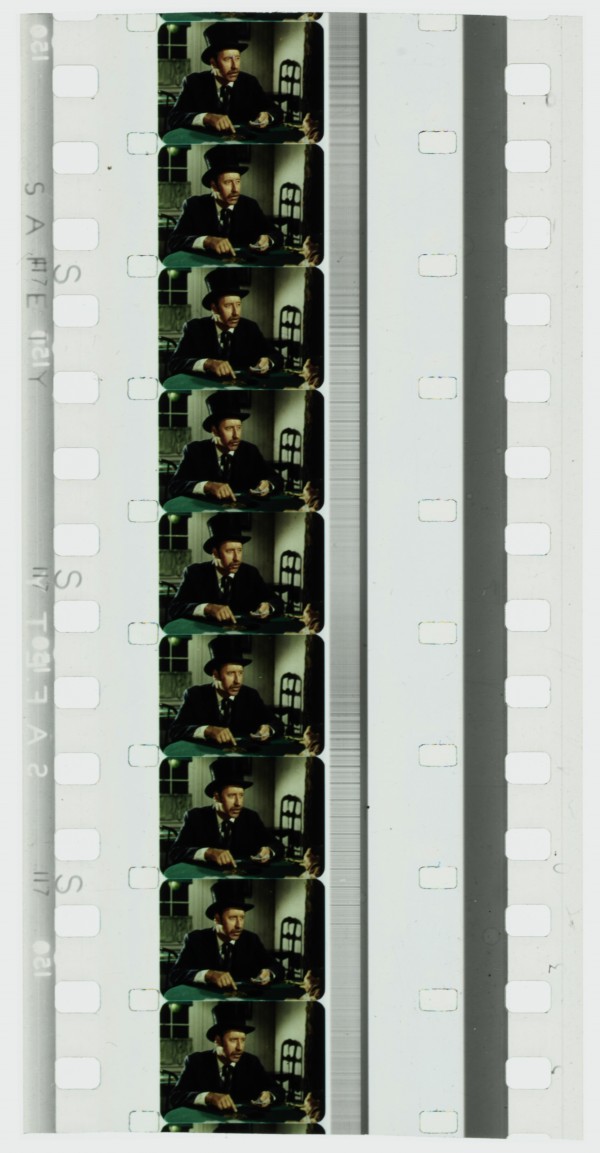
A 16mm single-rank, Technicolor dye-transfer print of Anthony Mann’s Bend of the River (1952) on 35mm film. After printing, the edges would have been slit to produce a single 16mm print.
Kodak Collection, National Science and Media Museum, Bradford, United Kingdom.
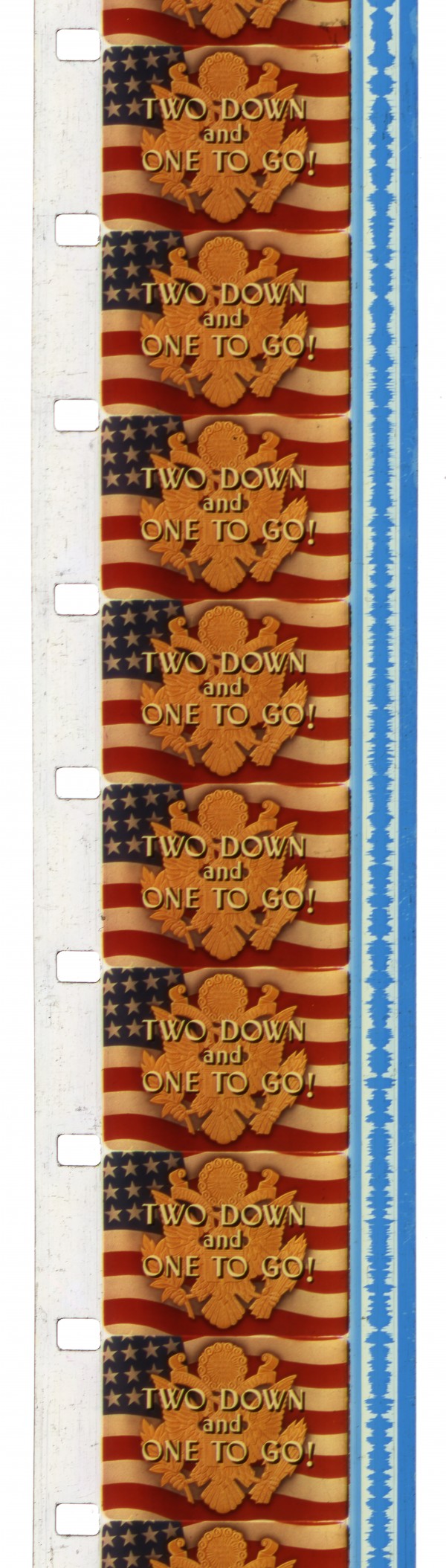
A 16mm single-rank, Technicolor dye-transfer print of Frank Capra’s Two Down and One to Go! (1945), after being slit. The print includes a blue dye-transfer track, used by Technicolor pre-1952.
The Museum of Modern Art, New York, NY, United States.
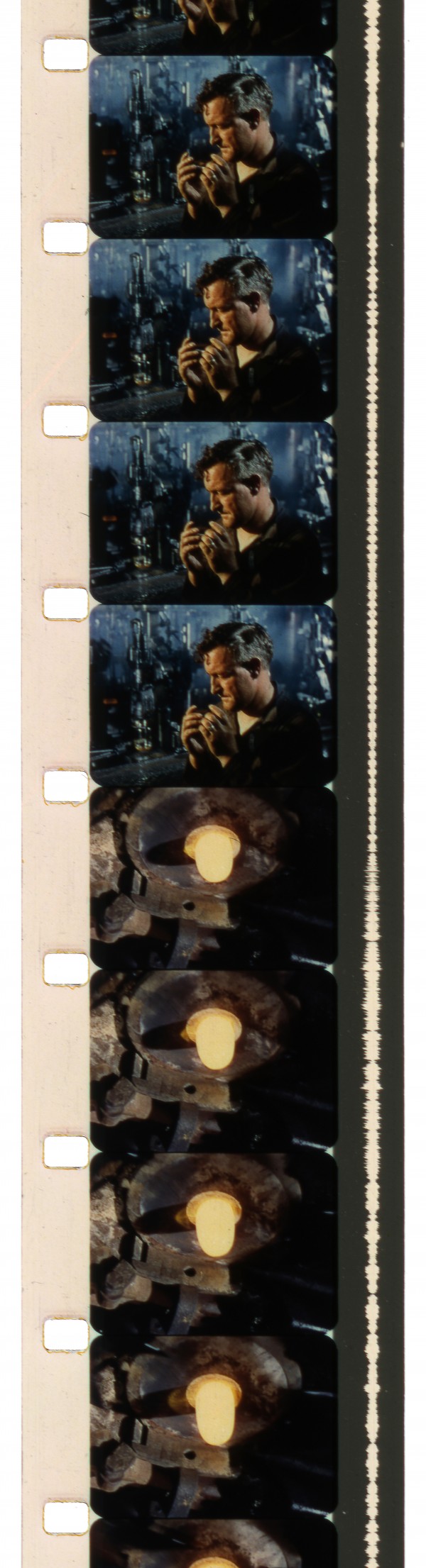
A 16mm single-rank, Technicolor dye-transfer print of Bert Haanstra’s Glas (1958), with silver soundtrack. The “TECHNICOLOR SAFETY” edge marking may indicate British manufacture.
The Museum of Modern Art, New York, NY, United States.
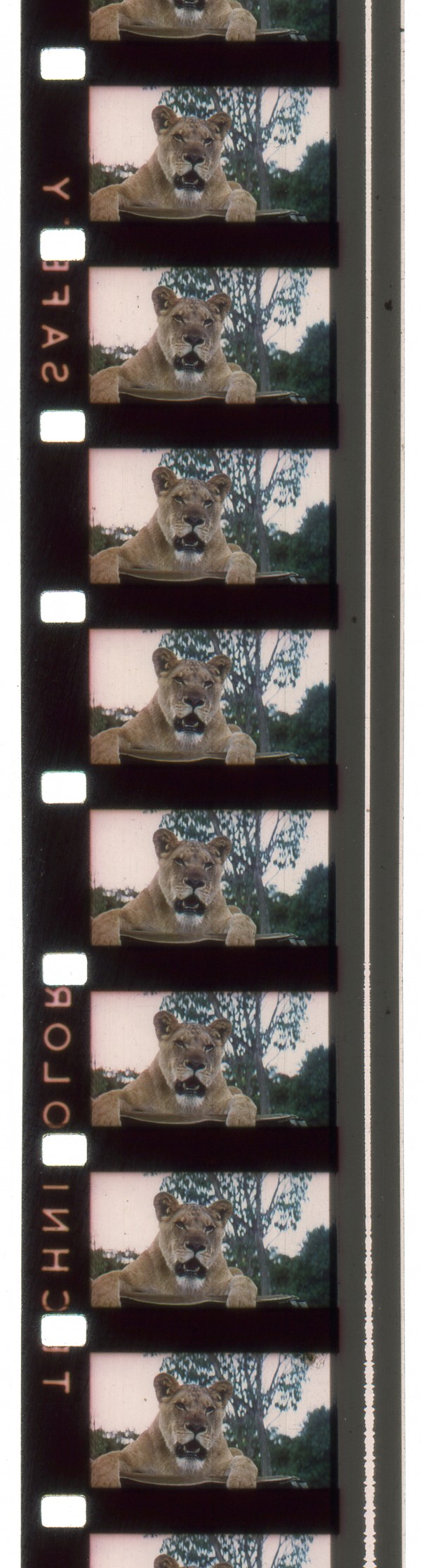
Born Free (1966). British 16mm dye-transfer prints typically had black edges and were marked “TECHNICOLOR SAFETY” along one edge.
Paul Ivester collection, Seattle, WA, United States.
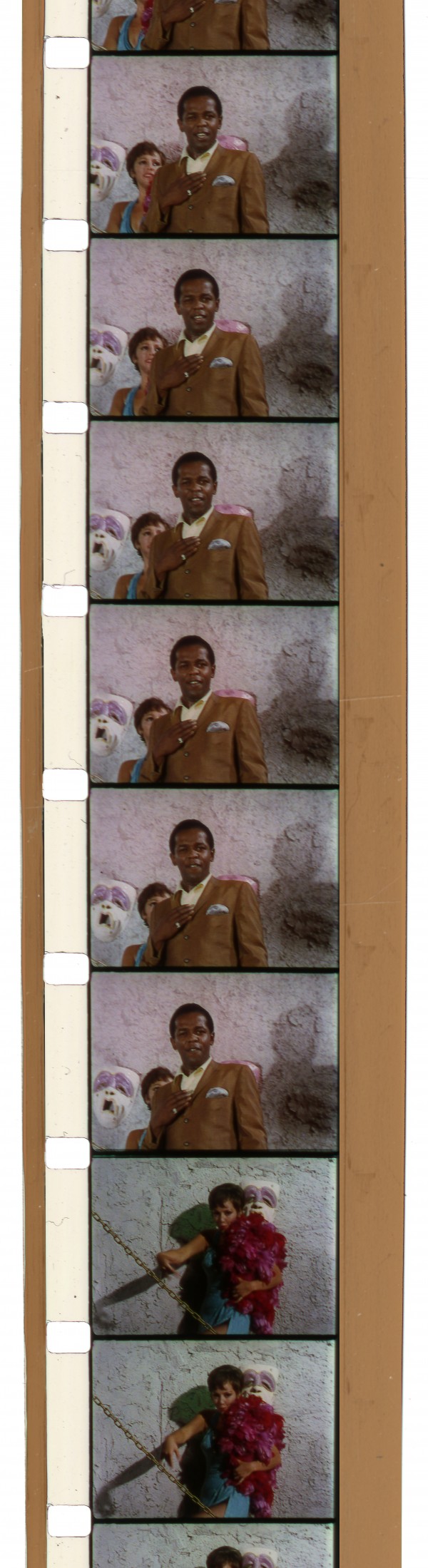
A 16mm double-rank, magnetic-striped Technicolor dye-transfer print of the 1967 Scopitone musical short St. Louis Blues, featuring Lou Rawls.
The Museum of Modern Art, New York, NY, United States.
Identification
(after slitting)
16mm frame dimensions. Approximately 10.26mm x 7.49mm (0.403 in x 0.295 in).
1.33:1 (flat) or 2.66:1 (anamorphic).
For single-rank prints, the pre-slit stock had 35mm perforations on outside edges and 16mm standard perforations along the image in the center. Technicolor switched from using BH 35mm perforations to KS 35mm perforations in 1951. For double-rank prints, the pre-slit stock had either two sets of 16mm perforations, set 32mm apart, or three sets of 16mm perforations, set at both edges and down the center of the film. The final, slit prints were 16mm single-perforated (1R).
(after slitting)
Color, Technicolor imbibition.
For single-rank US-manufactured prints, there are either cropped edge markings, or none present. All edge codes (either belonging to the 35mm blank, or print-through from the negative) were on the edge of the 35mm stock and slit off. For double-rank US-manufactured prints, the specialized stock does not have edge markings. One source claims all single-rank prints created from 1963 until 1974, exhibit print-through black perforations from the track negative, though this is yet to be confirmed as a universal rule (Spilker, n.d.). Another source also claims British Technicolor prints have “TECHNICOLOR SAFETY” printed on the edges, though this is yet to be confirmed as a universal rule (Ivester, n.d.).
1
A color image was created using Technicolor’s three-color dye imbibition printing process. Yellow, cyan, and magenta matrices were transferred successively in perfect registration onto a “blank” receiving stock.
Color by Technicolor.
From 1943 to 1951, prints featured a blue dye track; from 1952 to 1974, prints had a silver track. Depending on the original sound, either variable-density, or variable area.
The 35mm printing matrices contained images with standard 16mm frame dimensions, approximately 10.26mm x 7.49mm (0.403 in x 0.295 in) each. These 16mm images were reduced from 35mm elements and arranged one of two ways: “single-rank” with one column of images printed on 35mm film, or “double-rank” with two columns of images printed on 35mm.
Depending on the source element for the prints, the camera films include B/W color separations made in the 3-strip Technicolor camera, or chromogenic negative stock, most commonly Eastman Color negative.
Standard Kodak edge markings.
History
Looking to bring release prints of their films to overseas, home, and educational markets where small-gauge projectors were far more common, Technicolor first began production of 16mm prints in the late 1930s. The company initially released Kodachrome reduction prints of their films originally shot on 35mm, an endeavor sanctioned by Kodak through a non-exclusive license granted in 1938. Titles printed using this process included Victor Schertzinger’s The Mikado (1939), Warner Bros. “Merry Melodies” cartoon I Love to Singa (1936), and Joseph Losey’s industrial short Pete Roleum and His Cousins (1939). According to Technicolor testimony, however, “the monopack method of reduction printing has never been completely satisfactory for the manufacture of 16mm motion picture color prints in quantity,” and, beginning in 1943, the company used a converted printer to make their first 16mm imbibition prints (Technicolor, 1949).
Technicolor imbibition printing equipment had been built to accommodate 35mm sprocket advancement. To respond to the wartime demand for 16mm prints without completely overhauling their systems, Technicolor’s London laboratory repurposed their facility’s transfer machine to reperforate 35mm stock with 16mm perforations, after the reduced image had been transferred. Technicolor 16mm elements were initially printed “single-rank,” meaning with one column of 16mm frames printed down the center of a 35mm strip of film. Additionally, these early prints featured a blue-dye sound track, until persistent inconsistencies in density, with resulting lost sound definition, led to a transition to silver sound tracks in 1952.
While Technicolor explored the possibility of “double-rank” printing (i.e. two columns of 16mm images printed on a 35mm strip of film; see 35/32 and 32/16 perforated film) as early as 1948, difficulty modifying their equipment, while maintaining adequate dye registration, led to the company reporting the abandonment of this method in 1951.
The late 1940s, into the 1950s, were Technicolor’s most profitable and prolific years for 16mm print production, and the company reported printing more than 135,000,000 ft (41.15km) of 16mm film by 1953 (Anon, 1955). The company received large-scale projects from industrial clients during this period. For example, Wilding Picture Productions ordered the production of 1,480 prints of its commercial Ford in Your Future, for domestic distribution, in 1948. Major studios also relied on Technicolor 16mm production during this period, with Warner Bros. using the process to produce upwards of 5,205 prints of various features, shorts, and trailers for domestic and international release between the years 1948 and 1951. There was also demand for release prints for television broadcast. Some film collectors have reported increased sharpness in prints made after 1955, with unverified attribution assigned to slower transfer speed during the imbibition process, as well as increased competition for sharpness among the various widescreen formats that took off in the 1950s (Spilker, n.d.).
In 1963, Technicolor manufactured specialized printers to enable a return to double-rank printing. Working with an improved emulsion on their blank stock, as well as a slower transfer speed, to maintain dye registration, the company introduced production of double-rank prints, while maintaining the manufacturing of single-rank prints. The double-rank method allowed for less waste of film, discarded in the slitting process, plus the ability to produce multiple prints at a time.
By the 1970s, however, the exponentially more streamlined chromogenic printing process, particularly Eastman Color, had become the industry standard. While 35mm imbibition prints continued to be made in limited quantities until 1978, Technicolor’s specialized double-rank equipment in their Hollywood plant was dismantled in 1971 and the company ended production of single-rank 16mm prints in 1974.
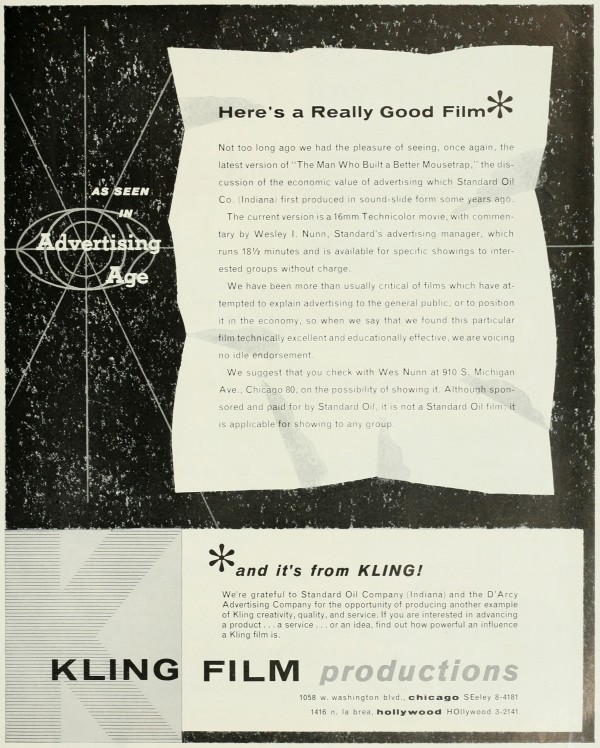
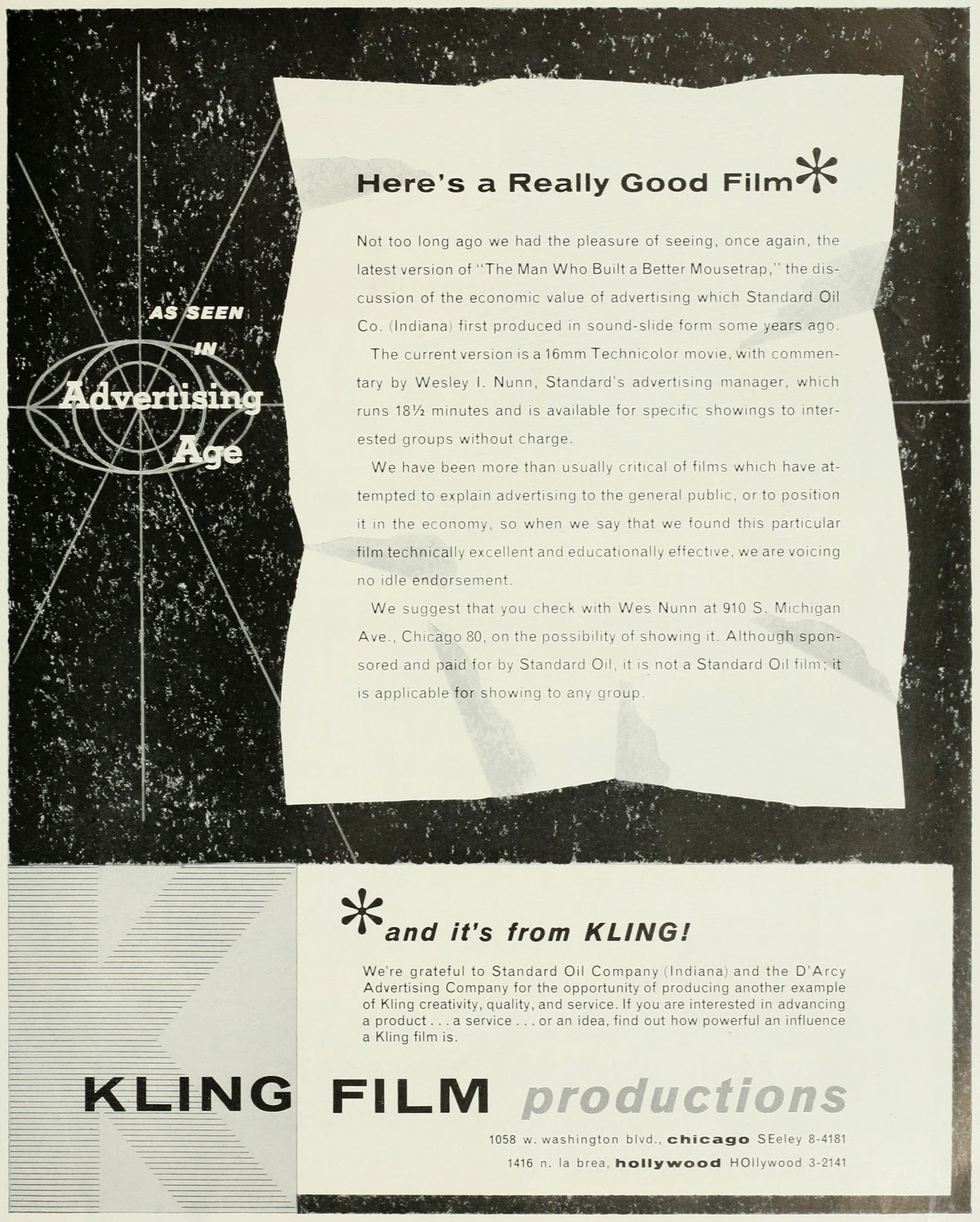
An advertisement in a 1957 issue of Business Screen Magazine that promotes the latest 16mm Technicolor prints of the Standard Oil-sponsored film The Man Who Built a Better Mousetrap.
Business Screen Magazine (1957), 18:7 (Nov.): p. 9.
Selected Filmography
One of the Technicolor Cinemascope features that received a run of 16mm anamorphic dye-transfer prints.
One of the Technicolor Cinemascope features that received a run of 16mm anamorphic dye-transfer prints.
One of many three-color Technicolor advertising shorts produced in the 1950s.
One of many three-color Technicolor advertising shorts produced in the 1950s.
An early three-color Technicolor film, which had a run of 16mm prints produced in the early 1970s, just before Technicolor’s Hollywood lab ceased imbibition printing operations.
An early three-color Technicolor film, which had a run of 16mm prints produced in the early 1970s, just before Technicolor’s Hollywood lab ceased imbibition printing operations.
Scopitone reel featuring Lou Rawls – one of many Scopitone musical shorts printed using Technicolor dye-transfer.
Scopitone reel featuring Lou Rawls – one of many Scopitone musical shorts printed using Technicolor dye-transfer.
Short propaganda film to rally the American war effort against Japan. Relatively early 16mm imbibition print with blue-dye sound track.
Short propaganda film to rally the American war effort against Japan. Relatively early 16mm imbibition print with blue-dye sound track.
Lineage
Technology
Technicolor 16mm imbibition prints required many steps during production in the lab. For the audio, a reduced soundtrack was printed onto a 35mm “blank” receiving stock, at a specific distance from the stock’s edges (which varied depending on whether the prints were being produced as single-rank or double-rank). Working from 35mm elements including color separations, successive exposure negatives, and chromogenic color negatives, Technicolor then separately printed three-color dye matrices on 35mm stock with the reduced 16mm image. These color separations were then pressed onto the same 35mm blank receiving stock in perfect registration (see Three-Color Technicolor and Technicolor prints from color negatives), before being cut down to yield a full-color 16mm print. The prints created were either “single-rank” (one column of 16mm images present on the stock) or “double-rank” (two columns of images present).
For single-rank prints, the reduced dye matrices were each printed down the center of the 35mm stock. Technicolor also used an RCA continuous optical printer, to reduce a film’s 35mm track to a 16mm track, situated on the 35mm stock so that the track would align with the image’s position upon printing. To make the final print, the lab outfitted their dye transfer printers with a rotary perforator toward the end of the film path. Once the 35mm film passed through the gate where the reduced dye matrices were transferred, the print was reperforated with 16mm perforations, alongside the transferred image. The excess stock on both sides (including all 35mm perforations) was then slit away, to finalize the 16mm print.
Technicolor’s double-rank process, on the other hand, featured more technological evolution during its few years in existence. At first, Technicolor followed the common practice of 35/32 reduction printing, using 35mm film perforated only with two sets of 16mm perforations set 32mm apart. The lab then slit the stock down the center, as well as the slight margins on each side, to yield two 16mm prints. In order to maintain proprietary control, however, Technicolor later switched to a new format of double-rank printing that was unique to their lab. In this new process, the 35mm stock had three rows of 16mm perforations, one on each side and one in the center. The 16mm print was then transferred in between these sets of perforations, the right-hand set was slit away, and the remaining material slit in half to form the final 16mm prints.
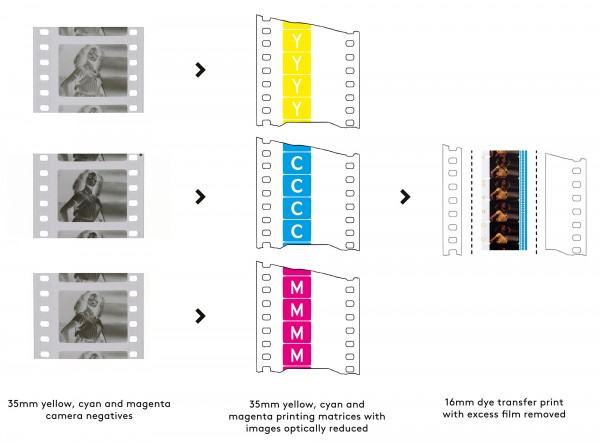
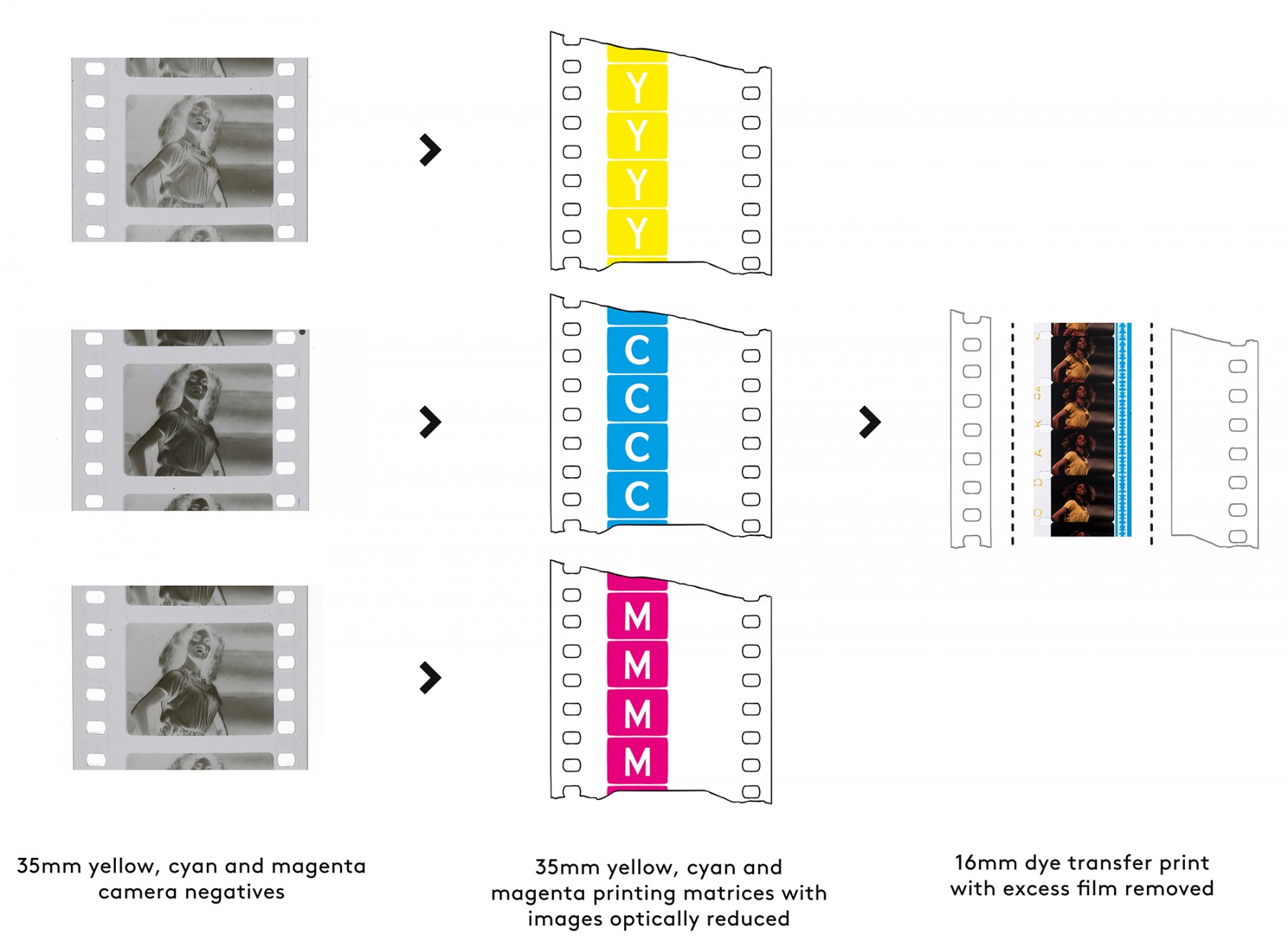
Duel in the Sun (1946). Technicolor 16mm prints were typically reduction-printed from the 35mm separation camera negatives. Special 35mm matrices with 16mm-sized images transferred the dyes onto 35mm blank film. After printing of the image and soundtrack was complete, the edges were removed to create a 16mm-wide print.
The Museum of Modern Art, New York, NY, United States (35mm negatives); Christian Zavanaiu (matrix designs); Martin Scorsese collection, George Eastman Museum, Rochester, NY, United States (16mm print). Diagram by Crystal Kui. Special thanks to Martin Scorsese, Marianne Bower, Sophia Lorent and Beth Rennie.
References
Andreas, John M. (1948–52). “8mm and 16mm IB prints, Memo and Correspondence”. John M. Andreas Collection, Box 149, Folder 35, George Eastman Museum, Rochester, NY, United States.
Anon. (1955). "Technicolor Report Traces Upswing in 16mm Color Printing to Increasing Use by Business and Industry". Technicolor News and Views, 17:1 (April): p. 3.
Coote, Jack H. & Philip Jenkins (1949). “The Laboratory and 16mm Colour”. British Kinematography, 14: 1 (Jan.): pp. 15–20. https://archive.org/details/britishk1415brit/page/n59/mode/2up?view=theater.
Happé, Barnard (1984). 80 Years of Colour Cinematography. London: British Kinematograph Sound & Television Society.
Ivester, Paul. (n.d.). “Guide to identifying color movie film stocks”. Paul’s 16mm Film Collecting Pages. https://www.paulivester.com/films/filmstock/guide.htm.
Lofquist, A. P. [n.d.]. “Technicolor Limited Continuous Matrix Printers”. John M. Andreas Collection, Box 4, George Eastman Museum, Rochester, NY, United States.
Pritchard, Brian (n.d.). “Multi-perforation Formats”. Brian R. Pritchard - Motion Picture and Film Archive Consultant. https://www.brianpritchard.com/Multi-perforation%20Formats.htm
Rundle, H. C. & P. J. Warren (1956). "Fundamentals of Track and Gray Printers". Technicolor Educational Program (Sep., 1956, p. 13), RG-26. Dr. Richard Goldberg Research Collection, George Eastman Museum, Rochester, NY, United States.
Schmit, Joseph W. (1991). History of the Technicolor Imbibition Process for Color Motion Pictures: A Technical Review (Sep.). Unpublished, edited version of paper presented to the Hollywood Section of the SMPTE, Jun. 25, 1991.
Spilker, Eric [n.d.]. “History of 16mm technicolor printing”. Paul’s 16mm Film Collecting Pages. https://www.paulivester.com/films/filmstock/tech.htm
Technicolor (1949a). “Second Supplement to Agreed Statement of Facts” (Nov. 14, 1949: p. 8). United States v. Technicolor, Inc., Technicolor Motion Picture Corp., and Eastman Kodak Co., Civil Action No. 7507-WM (S.D. CA 1947). Department of Justice (DOJ) File 7507-1-4 Technicolor. National Archives at Riverside, Perris, CA, United States.
Technicolor (1949b). “Technicolor Statement of Facts” (Nov. 22, 1949). United States v. Technicolor, Inc., Technicolor Motion Picture Corp., and Eastman Kodak Co., Civil Action No. 7507-WM (S.D. CA 1947). Department of Justice (DOJ) File 7507-1-4 Technicolor, National Archives at Riverside, Perris, CA, United States.
Technicolor (1951). "16mm Print Shipments to December 31, 1951". Release Shipments 1924 to 1951 Incl., Technicolor Corporate Archive, George Eastman Museum, Rochester, NY, United States.
Patents
Technicolor Motion Picture Corporation. Improvements in or relating to the production of kinematograph films, GB569426A, filed August 3, 1943, and issued May 23, 1945. https://patents.google.com/patent/GB569426A/
Rackett, Gerald F. Cinematographic optical printer having a toothed register belt, US2444786A, filed November 2, 1945, and issued July 6, 1948. https://patents.google.com/patent/US2444786A/
Olds Jr., Earl M. Cinematographic apparatus, US2453031A, filed August 2, 1946, and issued November 2, 1948. https://patents.google.com/patent/US2453031A
Technicolor Motion Picture Corporation. Improvements in projection printing, GB616179A, filed May 22, 1946, and issued January 18, 1949. https://patents.google.com/patent/GB616179A/
Klemola, Harold H. Film treating apparatus, US2551329A, filed August 15, 1946, and issued May 1, 1951. https://patents.google.com/patent/US2551329A
Andreas, John M. Cinematographic apparatus, US2553841A, filed November 20, 1948, and issued May 22, 1951. https://patents.google.com/patent/US2553841A
Griffith Jr., Everette E. Method and apparatus for striping film, US2569755A, filed June 23, 1949, and issued October 2, 1951. https://patents.google.com/patent/US2569755A/
Preceded by
Compare
Related entries
Author
Alma Macbride is an archivist at The Museum of Modern Art’s Celeste Bartos Film Preservation Center. A graduate of the L. Jeffrey Selznick School of Film Preservation, they received the 2023 Haghefilm Fellowship that allowed them to work at the Haghefilm Laboratory in Waddinxveen, Netherlands. There, Macbride helped restore a previously unpreserved silent film from the George Eastman Museum’s collection and presented the film at Le Giornate del Cinema Muto silent film festival in Pordenone, Italy. Prior to working at MoMA, Macbride studied film production at Harvard University with a specialization in 16mm and worked in various cinemas around the world.
James Layton, Crystal Kui, the anonymous peer reviewers, Sophia Lorent, the George Eastman Museum.
Macbride, Alma (2025). “Technicolor 16mm imbibition prints”. In James Layton (ed.), Film Atlas. www.filmatlas.com. Brussels: International Federation of Film Archives / Rochester, NY: George Eastman Museum.