Anschütz Electrical Schnellseher(1887–1891)
A public viewing device for the presentation of photographic moving pictures using a series of photographs, mounted on a ring fitted to the rim of a large revolving disc, which was in use, both in Europe and North America, from 1887.
Film Explorer
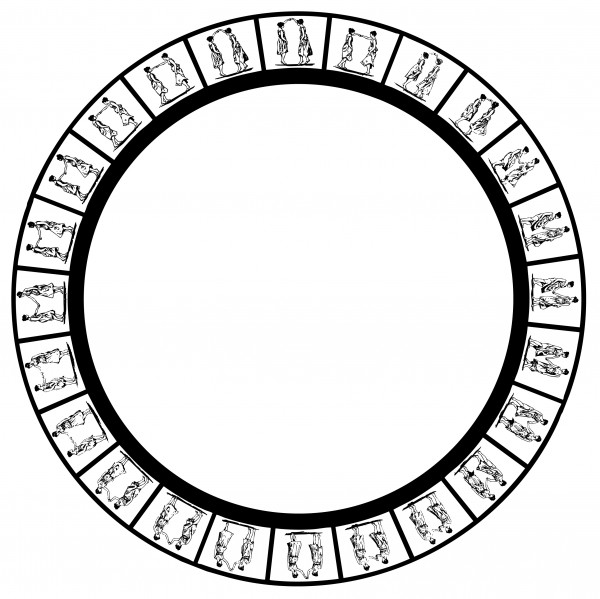
A recreation of an Anschütz Electrical Schnellseher disc. This later iteration of the technology featured a motion image sequence consisting of photographic glass transparencies mounted on a metal ring.
Design by Christian Zavanaiu.
Identification
Initially, circular images 10cm (3.937 in) diameter printed close to the circumference of a glass disc. Later, rectangular glass transparencies, 10cm (3.937 in) high, mounted on a metal retaining ring fitted to the circumference of a metal disc.
Approx.
B/W
Varies with number of phases in series, but approx. 16 fps.
1
B/W
History
When Ottomar Anschütz began to develop his Schnellseher viewing device for his series chronophotographs in 1886, he was already internationally prominent as an “instantaneous” photographer through his images of animals, military manoeuvres, and, especially, storks flying in and out of their nests. The son of a regional decorative painter in Lissa, East Prussia (now Leszno, Poland), who took up photography late in his career, Ottomar Anschütz was apprenticed to photographers in Munich and Warsaw before beginning his own career in photography. His growing reputation resulted from the technological advances he made, in designing cameras and accessories, particularly his design of the first practical focal-plane shutter, which he kept a secret from early 1883 until April 1889. What could be overlooked during this period, dominated by still photography, was his obsession with using his camera to follow a complete cycle of motion, such that the beginning and the end of the cycle of motion was recorded in as few as two, and as many as 26 or more, consecutive individual images. In 1885, Anschütz began to take chronophotographs with 12 phases using a new camera he designed with a neighbouring organ builder named Schneider, who had also worked with him on his focal-plane shutter. By autumn 1886, the two men had constructed a prototype Schnellseher for the display of movement recorded by series chronophotographs.
The Anschütz chronophotographic camera is often considered similar to the one developed by Eadweard Muybridge at Palo Alto, California, where 24 individual cameras were lined up in a shed. But although the first Anschütz chronophotographic camera – in use for under a year, from July 1885 – had similarities with Muybridge’s device, the second Anschütz chronophotographic camera was an entirely different beast. And, a beast of a camera it was: some 2.5m (8.20 ft) long, with six fully adjustable units, each holding four lenses, built on a solid iron foundation and enclosed in a walk-in light-tight box, so that an operator inside could change plates and fine-tune its operation between series exposures. Anschütz was a leading figure in the development of camera technology during his generation, and his chronophotographic camera stood as the crowning achievement of his work in camera design. From the beginning, the intention was to produce series photographs that could be reconstituted into the record of a complete movement, where the first and last images matched, providing an unbroken cycle of movement to the viewer. Anschütz was not primarily interested in the photographic analysis of movement, but in its synthesis.
The second chronophotographic camera was in use from autumn 1886, through to the end of 1891. Primarily located at the Anschütz studio in Lissa, the camera was portable enough to travel to Hannover and photograph over 100 series at the Military Riding School, in 1886, and to photograph the daily activities of the German postal service in Berlin, in 1890. The majority of its series seem to have been made in Lissa, however, including many series of dancers, along with more traditional chronophotographic subjects, such as animal locomotion and athletes displaying their skills. Altogether the camera made around 350 to 400 chronophotographic series with a varying number of phases, only a few of which survive. In order to view these series, Anschütz devised his Schnellseher.
The original model Schnellseher – a word invented by Anschütz, which translates as “speed-viewer” or “quick-viewer”, and that Anschütz also applied to three subsequent models of his moving picture apparatus, as well as all four models of his zoetropes – debuted in Berlin on March 19, 20 and 21, 1887, on the mezzanine of the Culture Ministry, where it was presented daily, from noon to 3 pm, to an invited audience of scientists, photographers, government officials and other leading Berlin figures (Photographisches Wochenblatt, 1887). The Schnellseher with its 120 cm (47.24 in) ring of images, heavy iron stand, batteries, Rühmkorff coil and operator, was positioned behind a false wall on the mezzanine so that only the viewing port could be observed by the guests. Moving picture discs consisting of 18, 20 or 24 consecutive images (each known as a phase), were shown to groups of four to seven persons at a time.
By early June 1887, the Schnellseher was installed in a railroad arch across the street from the Berlin Exhibition Park where four rings entertained paying audiences at the outset, supplemented by an additional five rings in early August before the exhibition ceased at the end of the month. (Allgemeine Norddeutsche Zeitung, 1887) The Schnellseher next appeared in Wiesbaden in September, demonstrated by Anschütz himself for a convention of natural scientists (Die Vedette, 1887), then at the photographic association in Frankfurt am Main in October (Photographische Correspondenz, 1887), followed by an exhibition at the Arts and Crafts Hall in Dresden for the full month of November (Dresdener Journal, 1887), with a public installation on Augustusplatz in Leipzig from the end of December until January 15, 1888 (Weiske, 1887).
Anschütz had made modest changes to his Schnellseher during this period, with an improved iron stand providing greater stability for the disc, and other modifications that made the apparatus more portable, as it moved around the country. The Schnellseher was still run by an operator turning a crank, who also changed the rings on the machine – electricity was only used to provide the intermittent illumination for the series photographs.
In February 1888, the Schnellseher was permanently installed in a new building on the corner of Mohrenstrasse and Charlottenstrasse in Berlin, for which there were 23 display advertisements in the Allgemeine Norddeutsche Zeitung between August 1888 and April 1896, plus a further 186 notices in the newspaper’s “Daily Calendar”, between January 1889 and May 1891. A long exhibition of the Schnellseher between May and October 1888, at a photographic exhibition in Brussels (Bulletin de l’Association Belge de Photographie, 1888), where Anschütz received an Honourable Mention medal from the jury, precipitated the making of at least the third copy of the apparatus, with the Schnellseher reaching New York City on November 15, 1889 at the premises of C. B. Richards and Company, 3 East 14th Street (Scientific American, 1889), quickly moving to the United States Photographic Supply Company at the same address, from where it was exhibited at trade shows in both Philadelphia and Boston. The New York Times reported from a press demonstration of several chronophotographs that the apparatus would be shown “to those interested” at US Photographic Supply (April 16, 1890).
Back in Europe, the original model of the Schnellseher was demonstrated privately for the Kaiser and the Kaiserin at the New Palace in Berlin on December 18,1889, where new chronophotographs of “Speaking Portraits” were shown (the Schnellseher was combined with a phonograph). Another private show for the Kaiser and his family on April 10, 1890, introduced both new moving images and a new, smaller model of the apparatus for schools and “general use” sometimes later called the “home model” Schnellseher, still hand cranked. In these public and private exhibitions the Schnellseher was regularly praised for the sharpness and clarity of the movements presented: “…we see the movements of the feet and the hands of the rider, the flutter of the mane and the tail of the horse, the sand flying up from under the hooves…” (Allgemeine Norddeutsche Zeitung, 1887); or, images that were “surprisingly true to nature” (Photographisches Archiv [Düsseldorf], 1887), as Anschütz “handed down to us works that are as laborious in the making as they are downright astonishing” (Berliner Tageblatt, 1889). The original model continued to tour both photographic societies and public venues during 1890 and 1891, as it was exhibited in Vienna, St. Petersburg, Graz, Pest, Warsaw, and had a long run at Earl’s Court in London; but, Anschütz was now beginning to develop his system as a commercial enterprise that would exhibit photographic moving pictures as a public entertainment, and the original Schnellseher was about to be briefly replaced by the Drum Schnellseher, and then more permanently by the Automat Schnellseher. No examples of the original model Schnellseher are known to survive.
[This essay is followed by Anschütz Drum Schnellseher.]
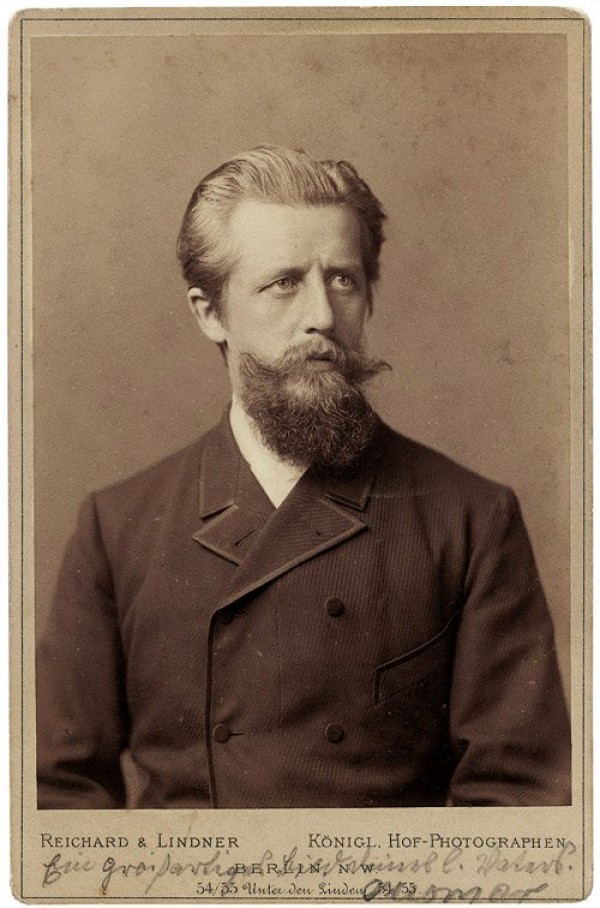
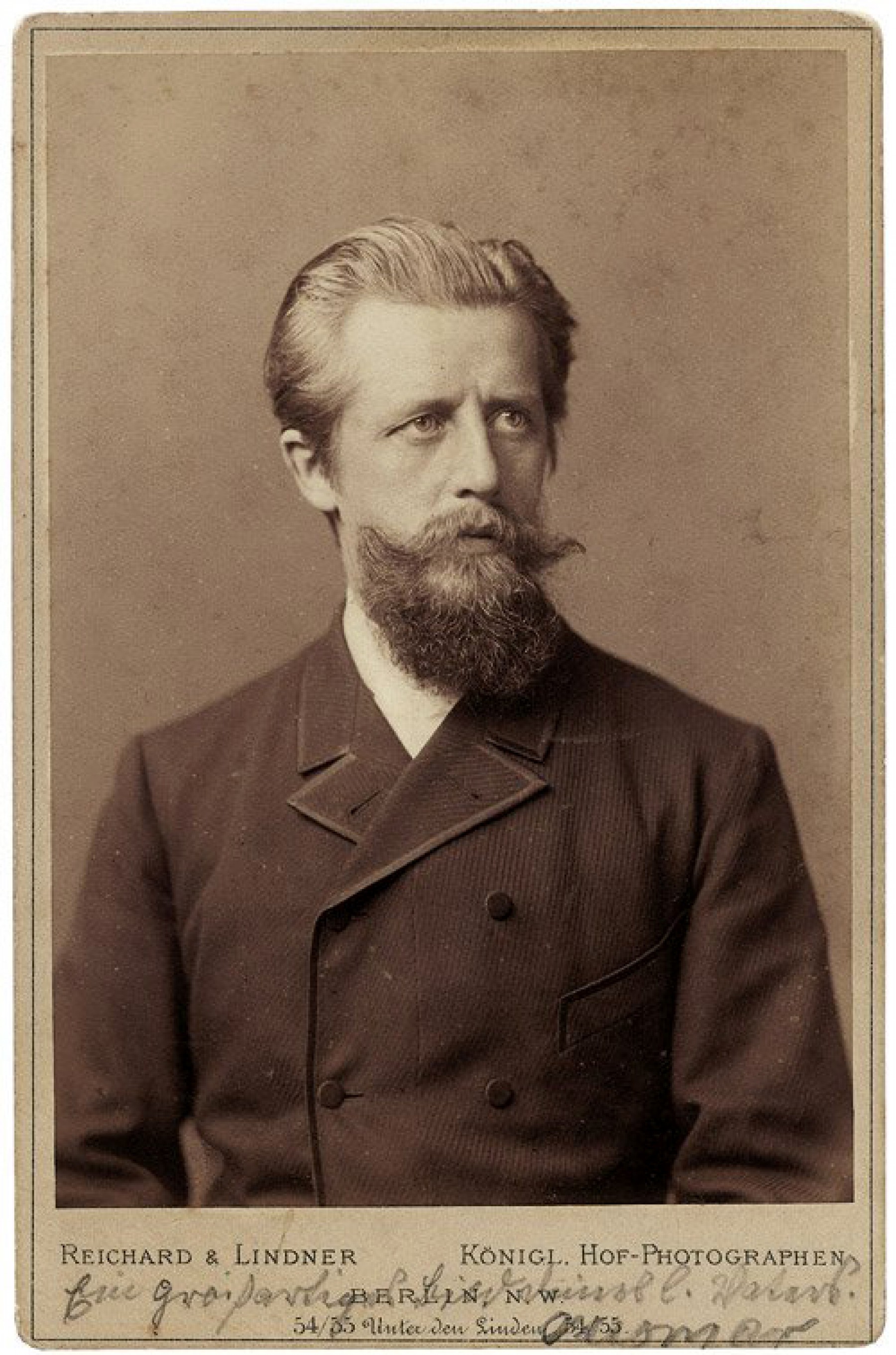
A rare photograph of Ottomar Anschütz from 1886, from the studio of Reichard & Lindner, Berlin.
Wikimedia Commons.
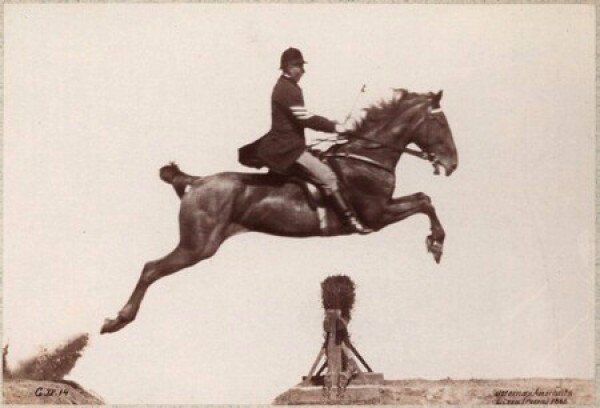
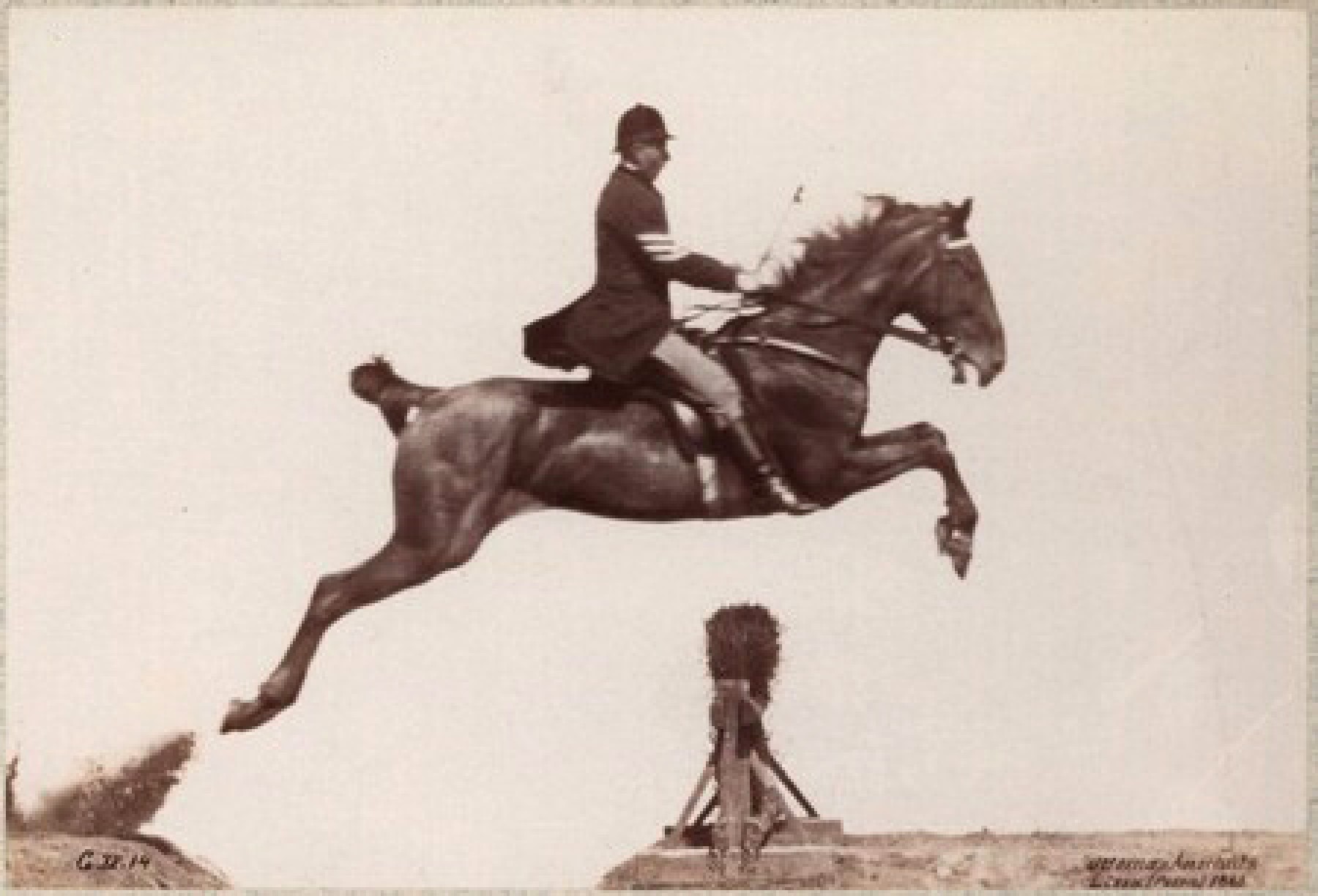
Phase 12 from a chronophotograph of a horse and rider jumping a hurdle and a ditch, often called Barriersprung eines Pferdes [Horse Jumping a Hurdle], a signature series for Anschütz, made in 1886, with his second chronophotographic camera.
Albertina Museum, Vienna, collection of Dr. Erich Maria Eder.
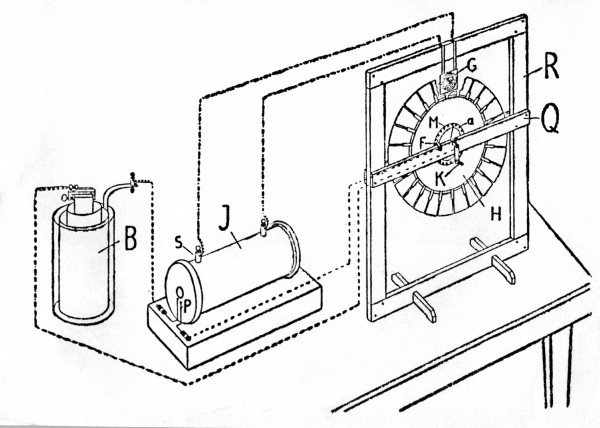
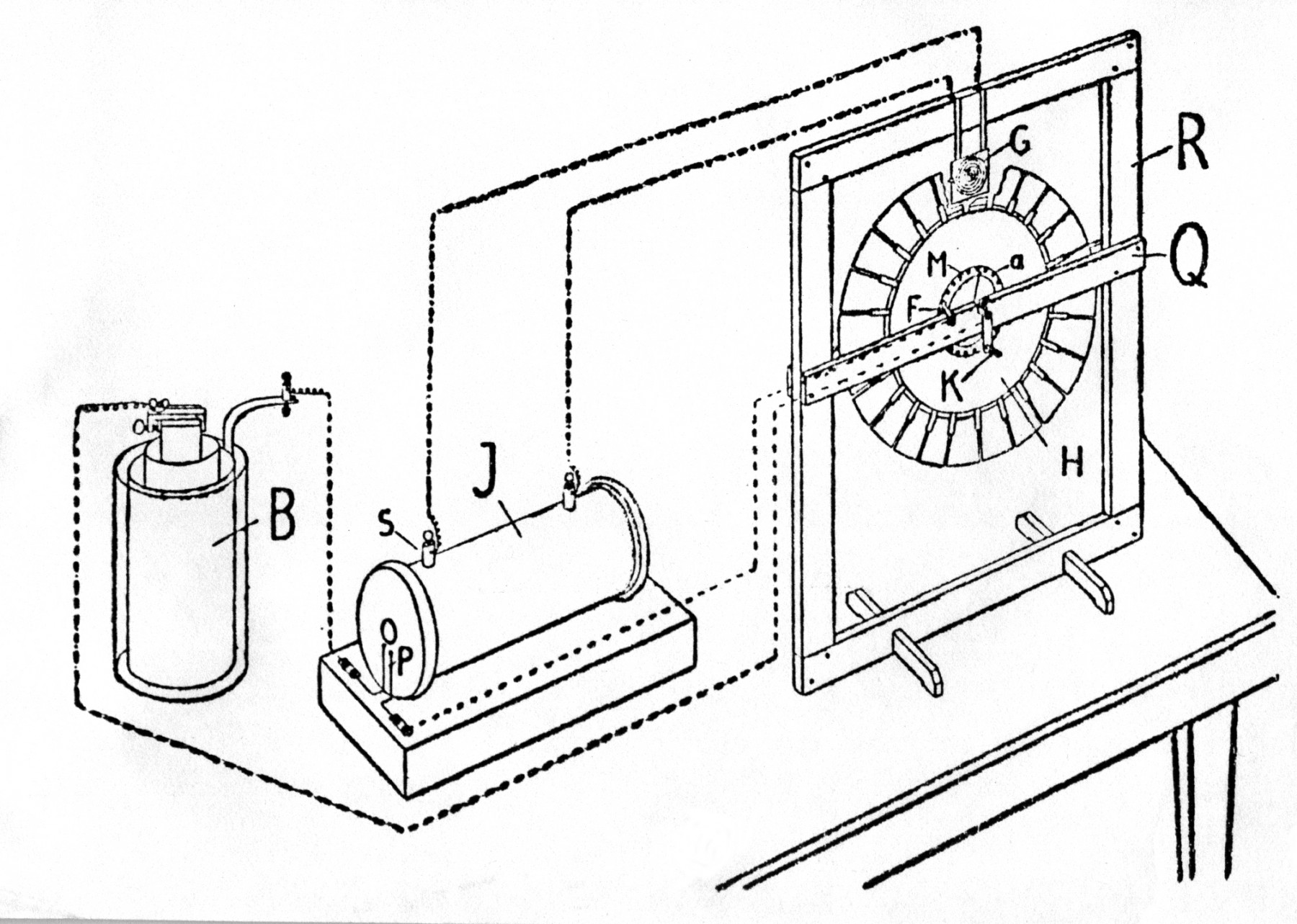
Prototype Schnellseher of 1886, in a sketch from Guido Anschütz.
Allgemeine Deutsche Zeitung, August 29, 1935.
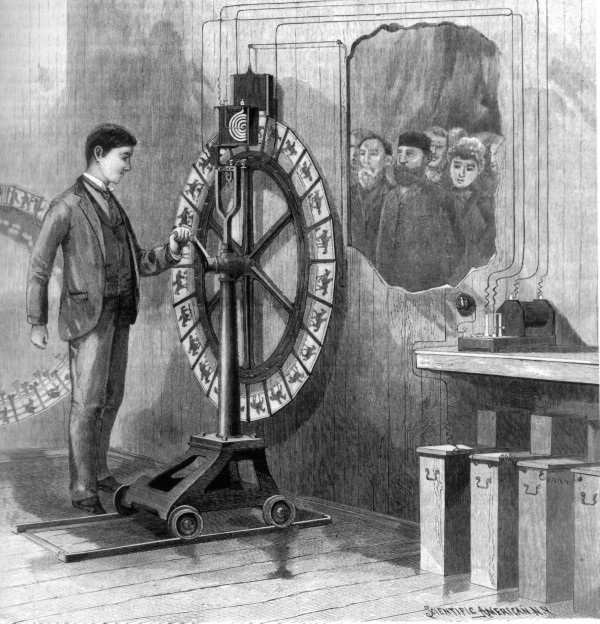
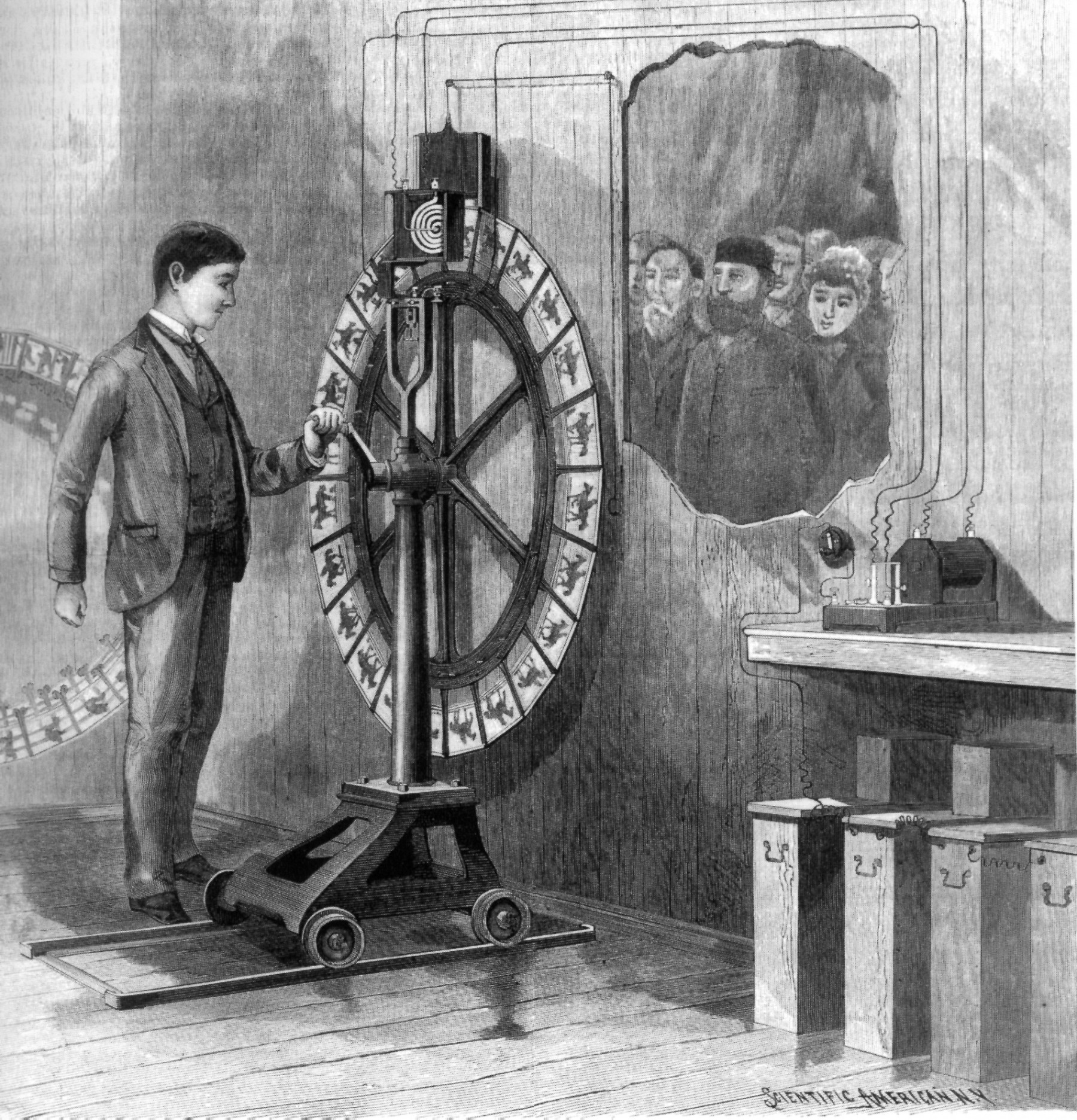
The only known illustration of the original model Schnellseher. On the shelf at the right is a Rühmkorff coil for a low-voltage input and a high-voltage output, fed by batteries on the floor below. The upper wires on the wall leading across the room carry the high-voltage electricity to the Geissler tube, to produce the illuminating spark. The apparatus is on wheels on a short track, to allow clearance for removing one ring and mounting another. Note at the top of the image disc, above the coil of the Geissler tube, the suspended hatch to the viewing area, which would be opened by the operator once the heavy disc had reached a sufficient speed for the fusion of the images into a continuous, moving photographic image.
Scientific American, November 16, 1889.
Selected Filmography
10 phases. Photographed in July 1885.
10 phases. Photographed in July 1885.
23 phases. Photographed in mid-1886.
23 phases. Photographed in mid-1886.
12 phases. Photographed July 1885.
12 phases. Photographed July 1885.
22 phases. Photographed before July 1887.
22 phases. Photographed before July 1887.
9 phases. Photographed in mid-1886.
9 phases. Photographed in mid-1886.
18 phases. Photographed before July 1887.
18 phases. Photographed before July 1887.
12 phases.
12 phases.
16 phases. Photographed before August 1887.
16 phases. Photographed before August 1887.
Lineage
Technology
The original model Schnellseher used a continuously rotating glass disc 130cm (51.18 in) in diameter turned by a hand crank, initially with circular photographic images 10cm (3.94 in) in diameter printed directly on the disc. Later, rectangular glass transparencies were mounted in wooden frames in a large ring that was attached to a rotating metal disc. Intermittency to produce the illusion of motion was provided by the spark from a spiral Geissler tube set off by contacts on the rotating ring as each image passed a viewing port. In both early cases, the photographic image passed immediately at the viewing aperture in the wall, illuminated by the Geissler tube spark from behind, so the images were not projected or enlarged for viewing.
The apparatus and its electrical components were partitioned from the viewing area by a false wall with audiences watching a viewing port, in groups of around 4 to 7, for each chronophotograph exhibited. The attendant at the apparatus not only rotated the disc with the hand crank, but also swapped out the discs on the machine. The speed of rotation was important, as the necessary speed for viewing an individual disc varied with the number of phases in the disc being exhibited, as well as nature of the movement being reproduced; rings with chronophotographs of 12 to 24 phases were available, but Anschütz himself remarked that for some movements with 14 or fewer phases, “by slower rotation of the disc one could see the movement perfectly clearly, but that by faster rotation two separate images of the horse appeared to be on top of one another.” (Photographisches Wochenblatt, 1887: p. 95).
References
Allgemeine Norddeutsche Zeitung (1887). “Der Schnellseher”, Allgemeine Norddeutsche Zeitung, June 4, 1887, p. 2
Allgemeine Norddeutsche Zeitung (1889). “Aus Berlin. Der elektrische Schnellseher”, Allgemeine Norddeutsche Zeitung, December 20, 1889, p. 2.
Coe, Brian (1978). Cameras. Gothenburg: Nordbok.
Die Vedette (1887). [data required/article title/section?] Die Vedette (Sep. 14): p. 6.
Dresdener Journal (1887). “Dresdener Nachrichten. In der Kunstgewerbehalle”. Dresdener Journal, 273 (First Supplement, Nov. 25): p. 5.
Liesegang, F. Paul (1940). Ottomar Anschütz. Meister der Augenblicks- und Reihenphotographie. Meister der Reihenwiedergabe. Sein Leben. Sein Werk. Seine Bedeutung. Unpublished mss., Agfa-Photohistorama, Cologne.
New York Times (1890). “Seen in the Tachyscope”, The New York Times, 16 March 1890.
Photographische Correspondenz (1887). “Sitzungsprotocoll vom 3 Oktober 1887, Frankfurt am Main, Ottomar Anschütz, ‘…die Einführung des Schnellsehers…’”. Photographische Correspondenz, 326: pp. 472–3.
Photographisches Archiv (1887). Photographisches Archiv [Berlin], 28:570 (16 Mar.): pp. 82–3.
Photographisches Wochenblatt (1887). Photographisches Wochenblatt [Düsseldorf], 13:12: pp. 94–6.
Rossell, Deac (1997). Ottomar Anschütz and his Electrical Wonder. London: The Projection Box.
Rossell, Deac (1998). “The Anschütz Zoetropes”, in: The New Magic Lantern Journal, 8:3 (Dec.): pp. 2–3.
Rossell, Deac (2001). Faszination der Bewegung. Ottomar Anschütz zwischen Photographie und Kino. Basel & Frankfurt am Main: Stroemfeld/Roter Stern.
Rossell, Deac (2021). “The Anschütz camera and its chronophotographs”. In Stephen Herbert, The Optilogue, at: theoptilogue.wordpress.com/2021/11/03/the-anschutz-camera-and-its-chronophotographs/
Scientific American (1889). “The Electric Tachyscope’. Scientific American, 20:16 (16 Nov.).
Weiske Adolf (1887). “Ottomar Anschütz’ Augenblicksphotographie-Ausstellung und elektrischer Schnellseher”, Leipzig Tageblatt und Anzeiger (Nov. 30): p. 18.
Weitz, Dr. Max (1889). “Naturwissenschaftlicher Plaudereien. Die Entwicklung der Photographie”, Berliner Tageblatt, 432 (Evening Edition, Aug. 27): pp. 1–2.
Followed by
Compare
Related entries
Author
A student of David Shepard and James Card in the 1960s, Deac Rossell is an active independent historian of early cinema, magic lantern culture and chronophotography. Now retired from Goldsmith’s College, University of London, he has published five books – most recently Chronology of the Birth of Cinema 1833–1896 (2022) – and contributes frequently to encyclopedias, anthologies, exhibition catalogues and academic journals. He was the Curator of the Ottomar Anschütz exhibition seen at the Düsseldorf Filmmuseum and the Deutsches Filmmuseum, Frankfurt, in 2000 and 2001. His most recent book, Finding Birt Acres. The Rediscovery of a Film Pioneer, written with Barry Anthony and Peter Domankiewicz, will be published in 2025.
Prof. Dr. Martin Loiperdinger, Trier University; Stephen Herbert; Cornelia Kemp; and especially James Layton and Crystal Kui for guidance and advice.
Rossell, Deac (2026). “Anschütz Electrical Schnellseher”. In James Layton (ed.), Film Atlas. www.filmatlas.com. Brussels: International Federation of Film Archives / Rochester, NY: George Eastman Museum.