Anschütz Drum Schnellseher(1890–1890)
A transitional apparatus for exhibiting photographic moving pictures, used in 1890, in Austria and Germany.
Film Explorer
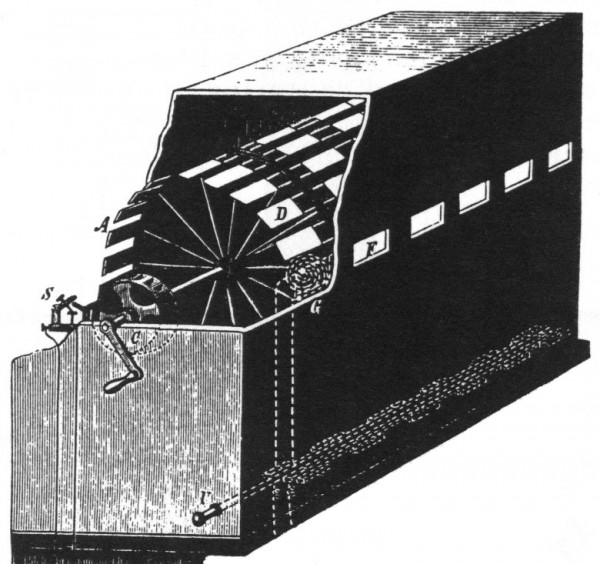
The Anschütz Drum Schnellseher was a viewing cabinet containing six viewing ports, each displaying its own short sequence of chronophotograph moving images.
David, Ludwig. (1897). Die Moment-Photographie, p.155.
Identification
120mm x 90mm (4.724 in x 3.543 in).
B/W
Approx. 16 fps.
6. Six separate series of chronophotographs were mounted in each Drum Schnellseher, to be watched through separate viewing ports.
B/W
History
[This entry is a continuation of Anschütz Electrical Schnellseher.]
In 1890, as Ottomar Anschütz began work on turning photographic moving pictures into a public entertainment, he constructed a new version of his Schnellseher in the form of a long semi-circular cylinder with six viewing ports, each served by a single set of chronophotographs depicting a recognizable movement. This was a transitional device, between the Electrical Schnellseher with its 130cm (51.18 in) ring and the Automat Schnellseher with its 90cm (35.43 in) disc, and was exhibited only four or five times in 1890, before it was fully superseded by the Automat Schnellseher.
This model did away with the need for the partitioned and darkened room for viewers that was required with the original model Schnellseher – it was a fully self-contained, transportable unit that could be exhibited anywhere. Further improvements towards commercial exhibition included lower personnel costs, and six viewing ports for simultaneous use, with each accommodating 4–7 viewers, so that audience throughput was faster and more efficient than with the original model. The disadvantages of the Drum Schnellseher included its inflexibility in showing movements of varying numbers of phases (sequences of different lengths) and its large physical footprint, which required significant space for operation.
When Anschütz began commercial development of this new apparatus, he also increased his production of entertainment chronophotographs that were not related to either physiological subjects, or the prior chronophotographic work of Étienne-Jules Marey and Eadweard Muybridge. Several of the new entertainment series were small narrative scenes involving assembled properties and personnel, such as Einseifen beim Barbier (Lathering up at the Barber’s), Zwei Zimmerleute früstückend (Two Carpenters Breakfasting), or Lustige fahrt (Funny Journey).
The drum-form Schnellseher would most likely have quickly disappeared from history if it had not been exhibited to photographic chemist Josef Maria Eder, and a distinguished audience, at his k.k. Graphischer Lehr- und Versuchsanstalt (Imperial and Royal Graphic Teaching and Research Institute) in Vienna, on April 21 & 22, 1890, which ensured its documentation in the photographic literature of the time. After the demonstration for Eder, the apparatus moved to a tavern at Parkring 2, at the corner of the Wollzeile in Vienna, where it ran for a month from July 1, 1890, open every day from 10 am through to 8 pm for an admission price of 30 Kreutzer, and was advertised regularly in both the Neue Freie Presse and the Neues Wiener Tagblatt. The Drum Schnellseher was also seen at a meeting of the German Photographic Association in Weimar (Photographische Correspondenz, 1890), before ending its days in late September as a brief ancillary exhibition in the permanent Kaiserpanorama installation in Leipzig at Grimmaische Strasse 24 (Leipziger Tageblatt, 1890).
With the advent of the Automat Schnellseher in July 1891, Anschütz finally achieved his goal of finding a way to exhibit moving pictures as a public entertainment, and the Drum Schnellseher was fully retired. There was probably only ever a single example constructed, which is not known to survive.
[This entry is followed by Anschütz Automat Schnellseher.]
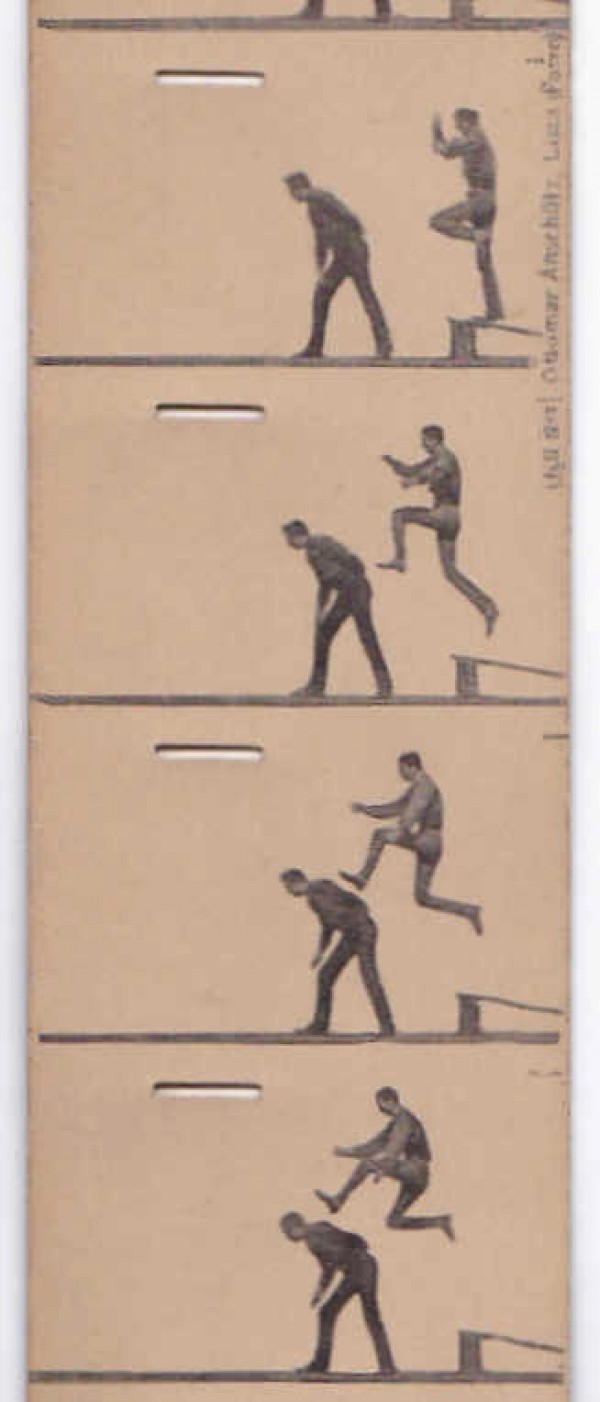
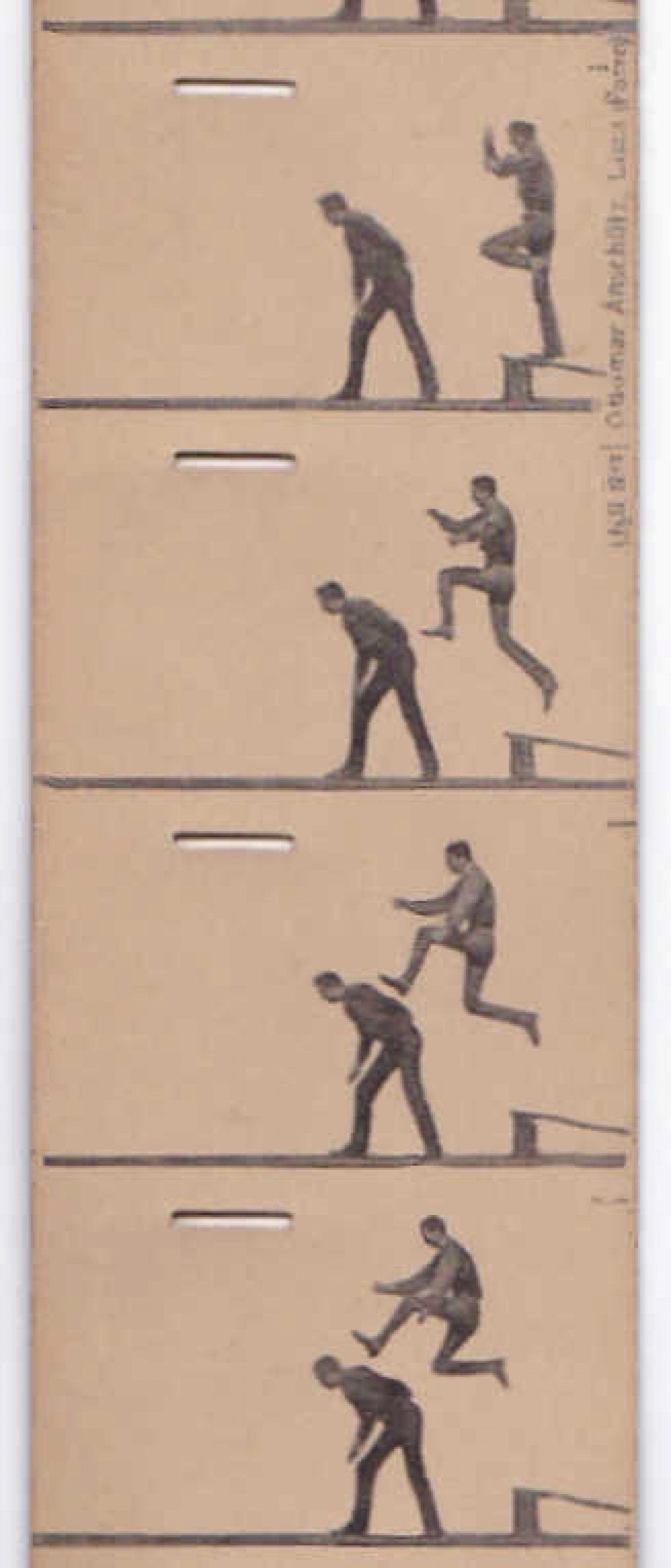
Four frames of the zoetrope band of Turnersprung (1887), a chronophotographic series also used in the Drum Schnellseher in 1890.
Deac Rossell Collection.
Selected Filmography
Unknown number of phases. Taken before April 1890.
Unknown number of phases. Taken before April 1890.
Unknown number of phases. Taken before April 1890.
Unknown number of phases. Taken before April 1890.
17 phases. Taken before April 1890.
17 phases. Taken before April 1890.
Unknown number of phases. Taken before April 1890.
Unknown number of phases. Taken before April 1890.
Unknown number of phases. Taken before April 1890.
Unknown number of phases. Taken before April 1890.
Unknown number of phases. Taken before April 1890.
Unknown number of phases. Taken before April 1890.
Unknown number of phases. Taken before April 1890.
Unknown number of phases. Taken before April 1890.
23 phases. Taken in mid-1886.
23 phases. Taken in mid-1886.
Lineage
Technology
The Drum Schnellseher used the same technology as both the Electrical Schnellseher and its successor Automat model, albeit housed in a different viewing device. A spiral Geissler tube, set off by a high-voltage current from a Ruhmkorff coil, illuminated a 12 cm x 9 cm (4.724 in x 3.543 in) bromide-silver glass transparency as it passed a viewing port of the same size, providing the intermittency needed to resolve chronophotographic series into an unbroken movement for viewers with flashes of light.
In this model, six viewing ports (each showing different photographic series) were supported by a Geissler tube at each station, with the transparencies mounted in a drum-shaped housing perpendicular to long arms fixed to a single axle, turned by a crank, which rotated the images in a circle 65 cm (25.59 in) in diameter. Adjacent to the crank that drove the apparatus, was mounted a small contact wheel with deep depressions, so that a Y-shaped toggle made of horn would alternately fall into the depressions and skim across the wheel’s surface; when in the higher position, the other end of the toggle would briefly touch an electrical switch that would close a low-voltage circuit to the Ruhmkorff coil, initiating the high-voltage release of the Geissler tube illumination.
A clear commercial motive can be seen in the design of this apparatus, but for Anschütz its limitations were also clear since it limited the number of phases that could be displayed across all six ports and Anschütz was determined that there would be no ‘jump’ between the first and last images of his cycles so that the movement depicted was complete and unbroken, with different motions needing different numbers of phases to be complete.
[For discussion of Ottomar Anschütz’s chronophotographic camera, see Anschütz Electrical Schnellseher.]
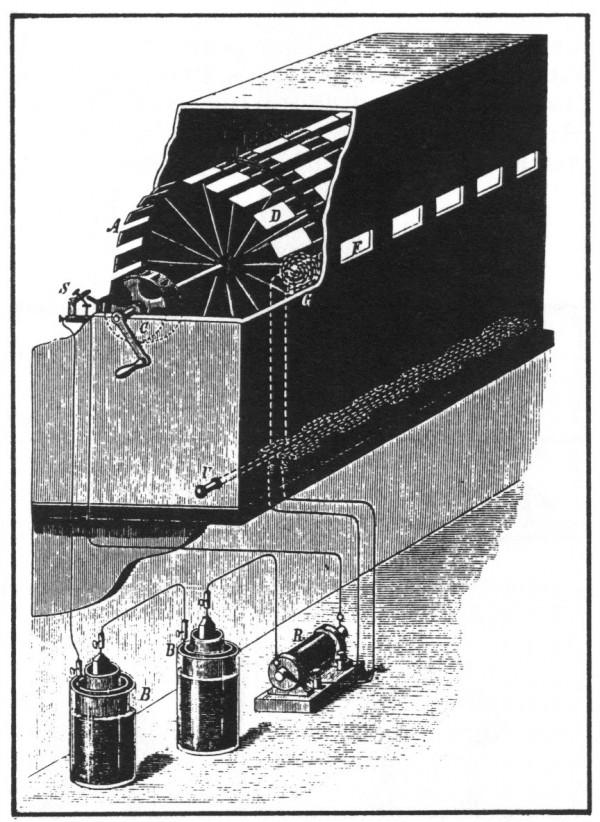
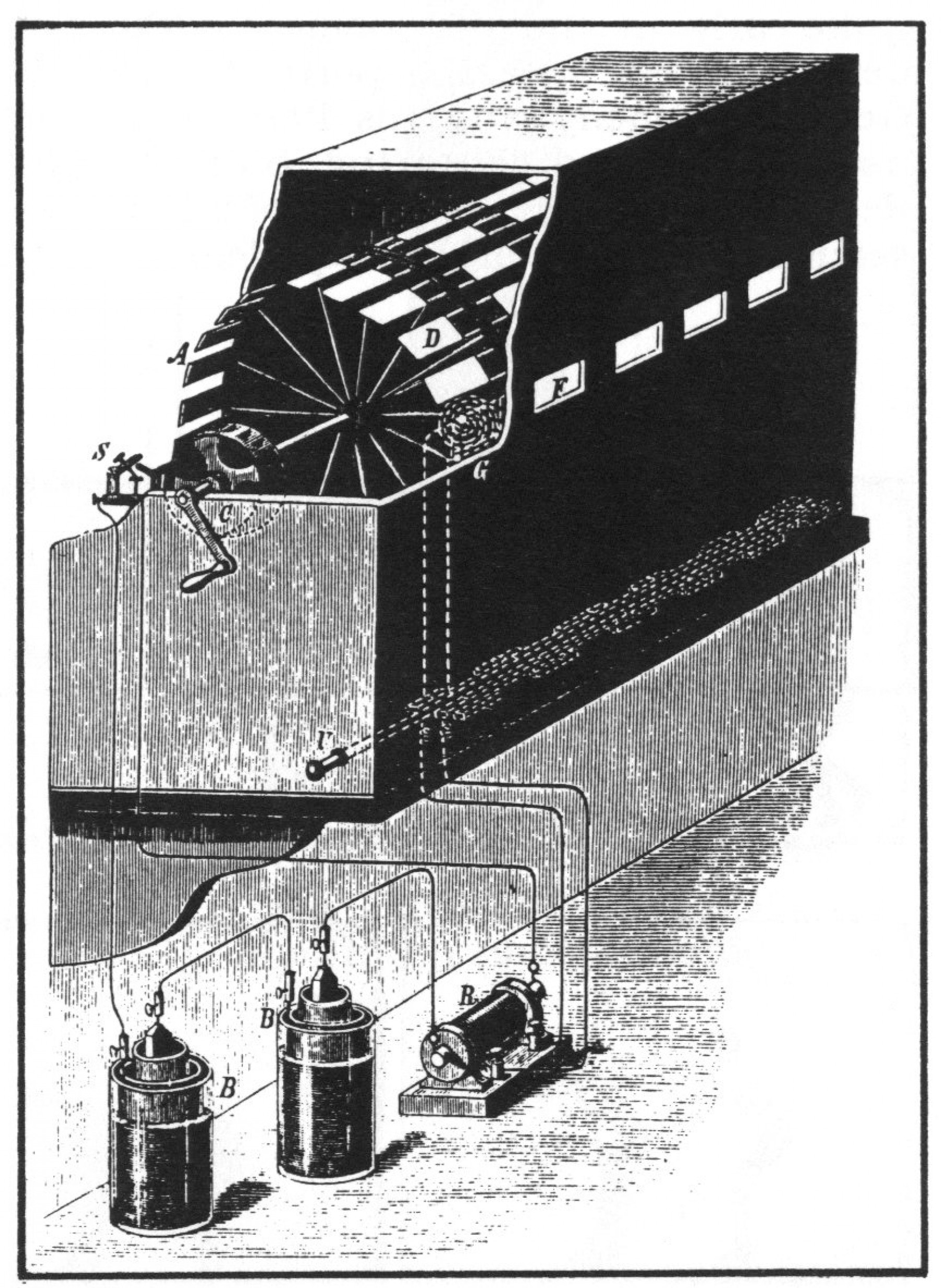
Engraving of the Drum Schnellseher, showing the viewing ports (F), the single timing ring (C) activating the switch (S), for the low-voltage battery circuit (B) transformed into a high-voltage circuit for the Geissler tube (G) by a Ruhmkorff coil (R).
David, Ludwig. (1897). Die Moment-Photographie, p.155.
References
David, Ludwig (1897). Die Moment-Photographie. Halle a. S.: Verlag von Wilhelm Knapp.
Leipziger Tageblatt (1890). “Kaiserpanorama. Der Elektrotachyskop”. Leipziger Tageblatt, 28 September 1890, p. 30.
Liesegang, F. Paul (1940). Ottomar Anschütz. Meister der Augenblicks- und Reihenphotographie. Meister der Reihenwiedergabe. Sein Leben. Sein Werk. Seine Bedeutung. Unpublished mss., Agfa-Photohistorama, Cologne.
Neue Freie Presse (1890). Advertisements, Neue Freie Presse (3–31 Jul.).
Neues Wiener Tagblatt (1890). Advertisements, Neues Wiener Tagblatt (2–31 Jul.).
Photographische Correspondenz (1890). “Elektrotachyskop”. Photographische Correspondenz, p. 242.
Rossell, Deac (1997). Ottomar Anschütz and his Electrical Wonder. London: The Projection Box.
Rossell, Deac (2001). Faszination der Bewegung. Ottomar Anschütz zwischen Photographie und Kino. Basel & Frankfurt am Main: Stroemfeld/Roter Stern.
Preceded by
Followed by
Compare
Related entries
Author
A student of David Shepard and James Card in the 1960s, Deac Rossell is an active independent historian of early cinema, magic lantern culture and chronophotography. Now retired from Goldsmith’s College, University of London, he has published five books – most recently Chronology of the Birth of Cinema 1833–1896 (2022) – and contributes frequently to encyclopedias, anthologies, exhibition catalogues and academic journals. He was the Curator of the Ottomar Anschütz exhibition seen at the Düsseldorf Filmmuseum and the Deutsches Filmmuseum, Frankfurt, in 2000 and 2001. His most recent book, Finding Birt Acres. The Rediscovery of a Film Pioneer, written with Barry Anthony and Peter Domankiewicz, will be published in 2025.
Prof. Dr. Martin Loiperdinger, Trier University; Stephen Herbert; and especially James Layton and Crystal Kui for guidance and advice.
Rossell, Deac (2026). “Anschütz Drum Schnellseher”. In James Layton (ed.), Film Atlas. www.filmatlas.com. Brussels: International Federation of Film Archives / Rochester, NY: George Eastman Museum.