Anschütz Projecting Schnellseher(1894–1895)
An apparatus for projecting photographic moving pictures, briefly used for public displays in Europe in 1894.An apparatus for projecting photographic moving pictures, briefly used for public displays in Europe in 1894.
Film Explorer
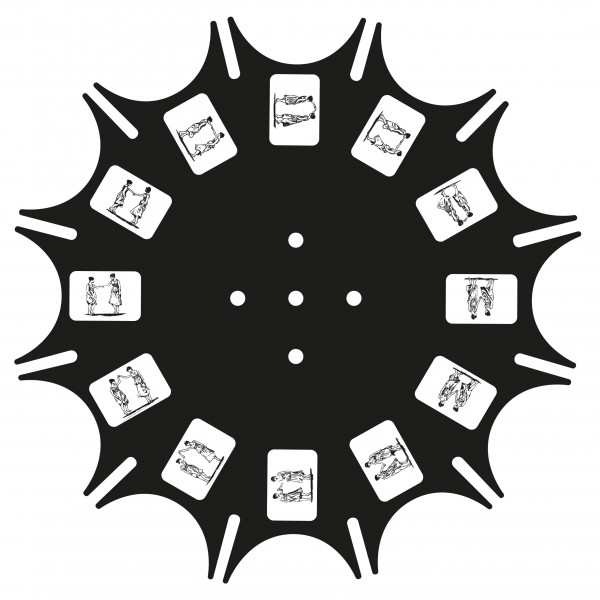
A recreation of an Anschütz Projecting Schnellseher disc. Two such discs were mounted side-by-side in the projector and were rotated alternately by a Maltese cross mechanism that advanced each image disc and then held it steady while each image was projected on the screen. Each disc moved intermittently, 8 times per second, giving a combined projection rate of 16 fps.
Design by Christian Zavanaiu.
Identification
Unknown
B/W
Glass transparencies mounted on metal discs.
2. Two discs simultaneously played back alternate frames in a sequence.
Unknown
B/W
History
[This entry is a continuation of Anschütz Automat Schnellseher.]
In November 1893, with the Electrical Wonder Company (London) undercapitalized and unable to pay its outstanding debts, Ottomar Anschütz produced one last invention that attempted to demonstrate the viability of photographic moving pictures – the Projecting Schnellseher, also sometimes called the Projecting Electrotachyscope.
The apparatus had its premiere over three days (Nov. 26, 27 & 28, 1894) in the Grand Lecture Hall of the Post Office building on Artilleriestrasse in Berlin, projecting mostly “entertainment” series onto a screen 6m (19.68 ft) high and 8m (26.25ft) wide (Photographisches Wochenblatt, 1894: pp. 424–5). Accompanied by lectures by Prof. Dr. Mullenhoff (Nov. 26 & 28) and Captain Tanera (Nov. 27), the full programme ran to about 90 minutes and was run three times each day, with the morning sessions for invited guests of Culture Minister von Goslar, the afternoon sessions reserved for members of the Berlin Photographic Association, and the evening sessions open to the public at an admission fee of 2 marks (reduced to 1.50 marks on the last day). Those who witnessed the impressive large-screen projections noted the equally impressive noise the machine made, in advancing its weighty image-carrying discs. Observers also noted considerable image jitter on the screen, resulting from the extreme magnification of the transparencies, even though a full Maltese cross mechanism was used to stabilize their movement.
Anschütz had borrowed the powerful 40-amp carbon arc lamps from the electrical engineering company Siemens & Halske, to provide the necessary illumination for such a large-screen presentation – he was assisted in the projection by the Siemens & Halske engineer Anton Verständig. The Projecting Schnellseher was next seen at the 300-seat auditorium of the old Reichstag building on Leipzigerstrasse in Berlin, from February 22 through to March 30, 1895 (Traub, 1940: p. 34), for public screenings with almost exclusively entertainment series such as Skatspieler, Einseifen beim Barbier and Zwei Zimmerleute früstückend (respectively: Card Players, Lathering Up at the Barber’s and Two Carpenters Breakfasting). Anschütz reported a total income of 5,400 marks from this show, but also 3,400 marks in expenses. In addition to its high running costs, the illumination was only on loan, and the Projecting Schnellseher made only two further public outings: the first at Carl Heckel’s Concert Hall in Hamburg, from May 29 to June 12, 1895, where it was again accompanied by lectures (Wagner, 1972); and the last at the Hotel Stadt Nürnberg in Leipzig, during April 1896 (Leipziger Tageblatt, 1896). This marked the end of Anschütz’s public exhibition of his moving picture work, although he kept an earlier model Schnellseher, for occasional use by visitors to his photographic studio in Berlin, up until his death in 1907.
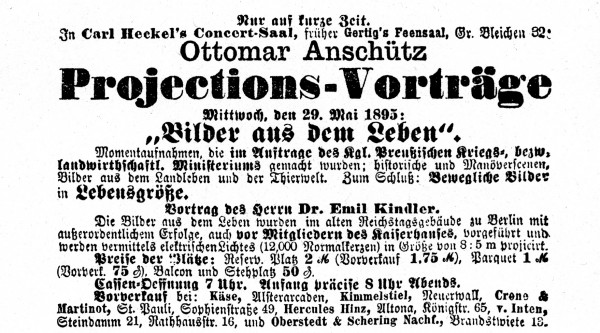
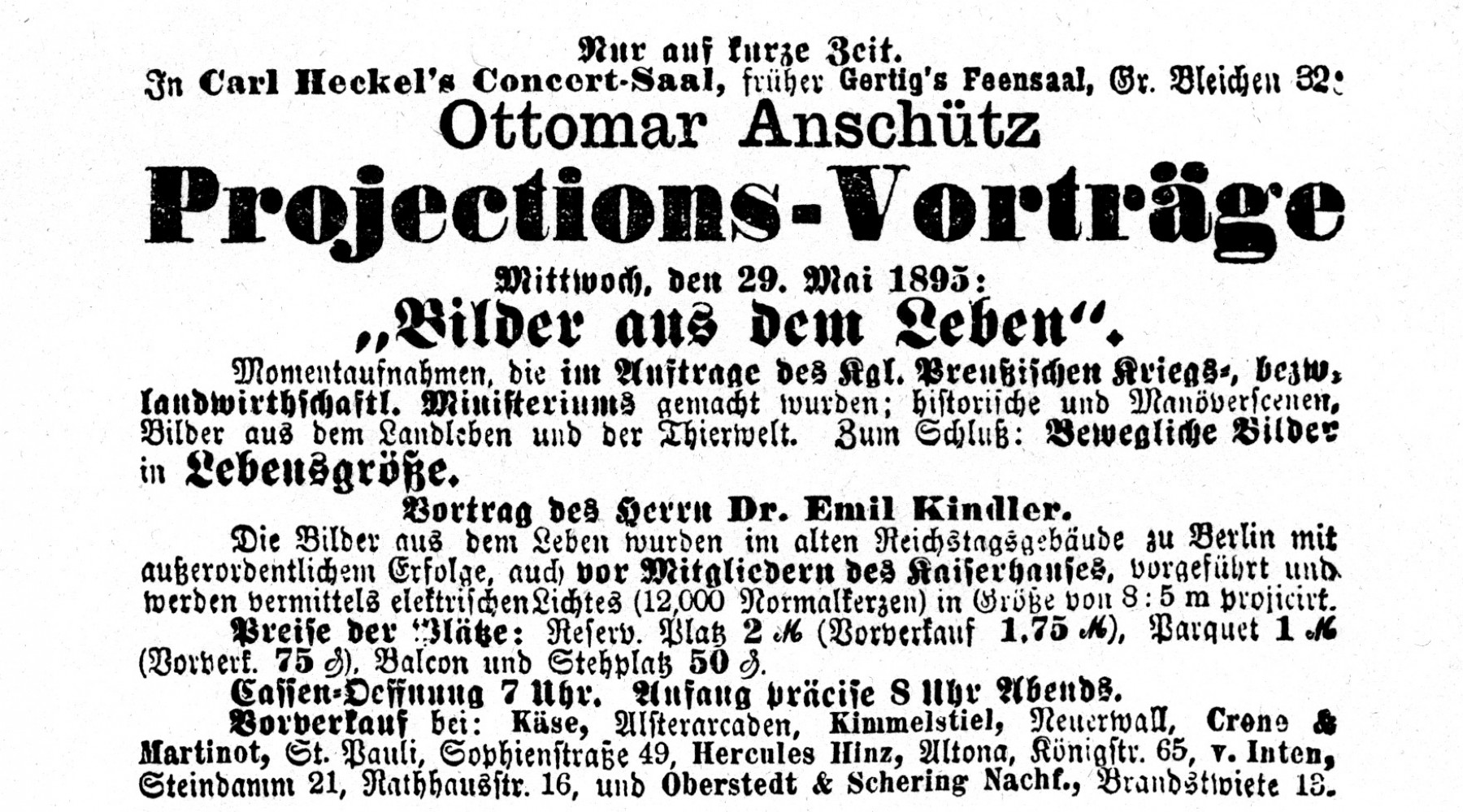
“Moving Pictures in Life-size”: an advertisement for the Projecting Schnellseher.
Hamburger Fremdenblatt, May 29, 1895.
Selected Filmography
Taken before 1891.
Taken before 1891.
Taken before 1891.
Taken before 1891.
Taken before 1888.
Taken before 1888.
Taken before April 1890.
Taken before April 1890.
Taken before 1891.
Taken before 1891.
Taken before 1891.
Taken before 1891.
Taken before November 1890.
Taken before November 1890.
Taken before April 1890.
Taken before April 1890.
Taken before 1891.
Taken before 1891.
Lineage
Technology
The Projecting Schnellseher used a different technology than the previous Anschütz exhibition devices. Using glass transparencies arranged around the circumference of a large disc, here two vertical discs, holding 12 images each, were mounted side-by-side and moved alternately by a proper Maltese cross mechanism that advanced each image disc and then held it steady in the optical axis of the projector, while it was projected on the screen. Each disc moved intermittently, 8 times per second, giving a combined projection rate of 16 fps. In this apparatus two 40-amp carbon arc lamps steadily illuminated the active frame from each disc as it was brought before one of the two lenses in the projector, while a single-bladed shutter with deep saw-teeth rotated in front of the two lenses to blend the successive images together on the screen.
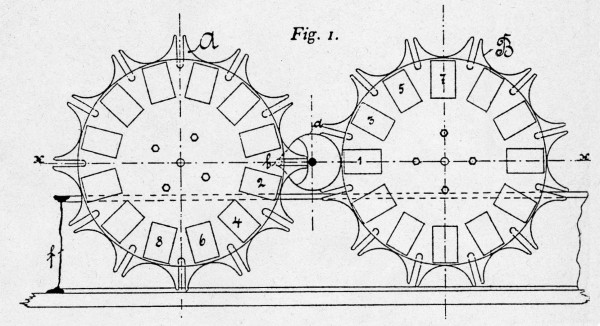
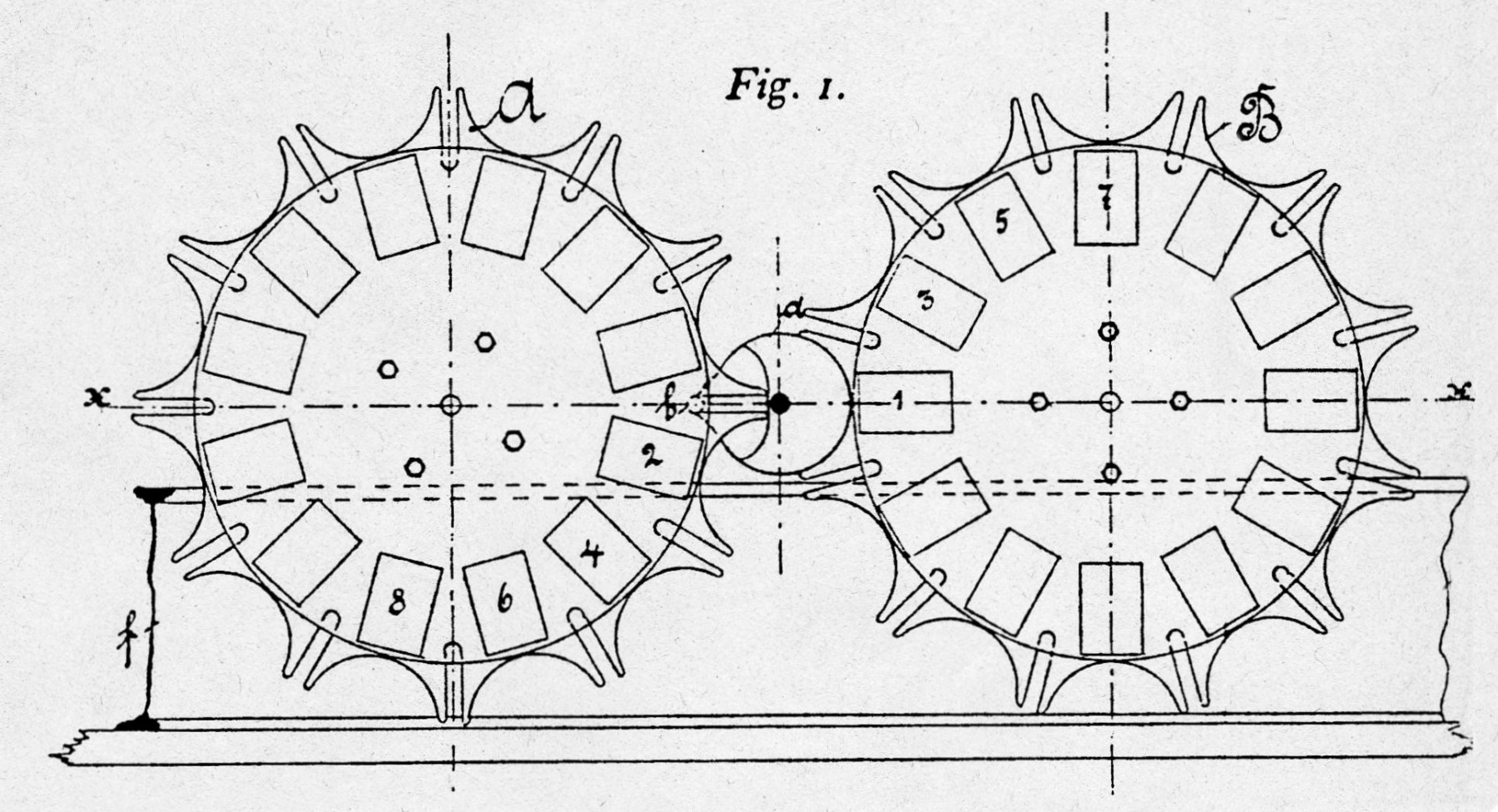
Patent drawing showing the two picture discs of the projecting Schnellseher, linked by a full Maltese cross intermittent.
Anschütz, Ottomar. Projektionsapparat für stroboskopisch bewegte Bilder. German Patent 85791, filed November 6, 1894, and issued March 7, 1896.
References
Leipziger Tageblatt (1896). “Volkswirthschaftliches” [Business page]. Leipziger Tageblatt (24 Apr.): p. 6
Liesegang, F. Paul. 1940. Ottomar Anschütz. Meister der Augenblicks- und Reihenphotographie. Meister der Reihenwiedergabe. Sein Leben. Sein Werk. Seine Bedeutung. Unpublished mss., Agfa-Photohistorama, Cologne. (Copy with the author)
Photographisches Wochenblatt (1894). Photographisches Wochenblatt (n.d.): pp. 424–5.
Rossell, Deac (1997). Ottomar Anschütz and his Electrical Wonder. London: The Projection Box.
Rossell, Deac (2001). Faszination der Bewegung. Ottomar Anschütz zwischen Photographie und Kino. Basel & Frankfurt am Main: Stroemfeld/Roter Stern.
Traub. Hans (1940). Als man anfing zu filmen. Berlin: UFA Buchverlag [=Schriften der Ufa-Lehrschau, Band 2]
Wagner, Rüdiger (1972). “Die Anfänge der Kinematographie in Hamburg”. Hamburger Filmgespräche IV. Hamburg: Hamburger Gesellschaft für Filmkunde: pp.12–15.
Patents
Anschütz, Ottomar. Projektionsapparat für stroboskopisch bewegte Bilder. German Patent 85791, filed November 6, 1894, and issued March 7, 1896.
Anschütz, Ottomar. Procédéde projection d’images à mouvement stroboscopiques. French Patent 242,866, filed November 15, 1894.
Preceded by
Compare
Related entries
Author
A student of David Shepard and James Card in the 1960s, Deac Rossell is an active independent historian of early cinema, magic lantern culture and chronophotography. Now retired from Goldsmith’s College, University of London, he has published five books – most recently Chronology of the Birth of Cinema 1833–1896 (2022) – and contributes frequently to encyclopedias, anthologies, exhibition catalogues and academic journals. He was the Curator of the Ottomar Anschütz exhibition seen at the Düsseldorf Filmmuseum and the Deutsches Filmmuseum, Frankfurt, in 2000 and 2001. His most recent book, Finding Birt Acres. The Rediscovery of a Film Pioneer, written with Barry Anthony and Peter Domankiewicz, will be published in 2025.
Prof. Dr. Martin Loiperdinger (Trier University); Stephen Herbert; for advice and guidance James Layton and Crystal Kui.
Rossell, Deac (2026). “Anschütz Projecting Schnellseher”. In James Layton (ed.), Film Atlas. www.filmatlas.com. Brussels: International Federation of Film Archives / Rochester, NY: George Eastman Museum.