Superscope(1954–c.1960)
A widescreen format that extracted a flat, spherically photographed image and reformatted it into a squeezed anamorphic frame. Initially extracting a 2:1 aspect ratio, the format was later adapted to offer a 2.35:1 extracted aspect ratio.
Film Explorer
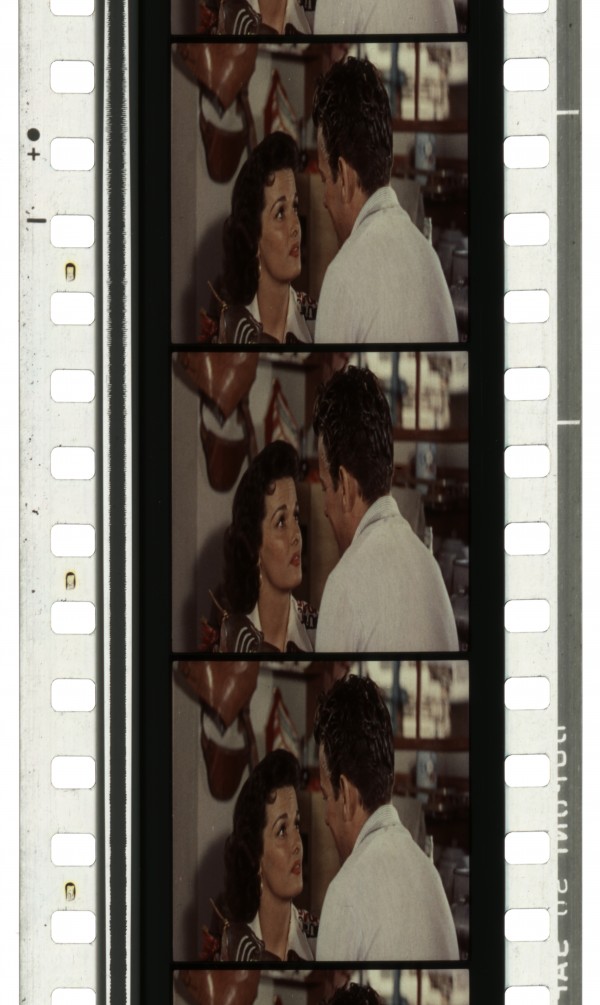
An anamorphically squeezed Technicolor release print of Underwater (1955), the first RKO film released in Superscope. The image was pillar-boxed to maintain the 2:1 aspect ratio.
The Museum of Modern Art, New York, NY, United States.
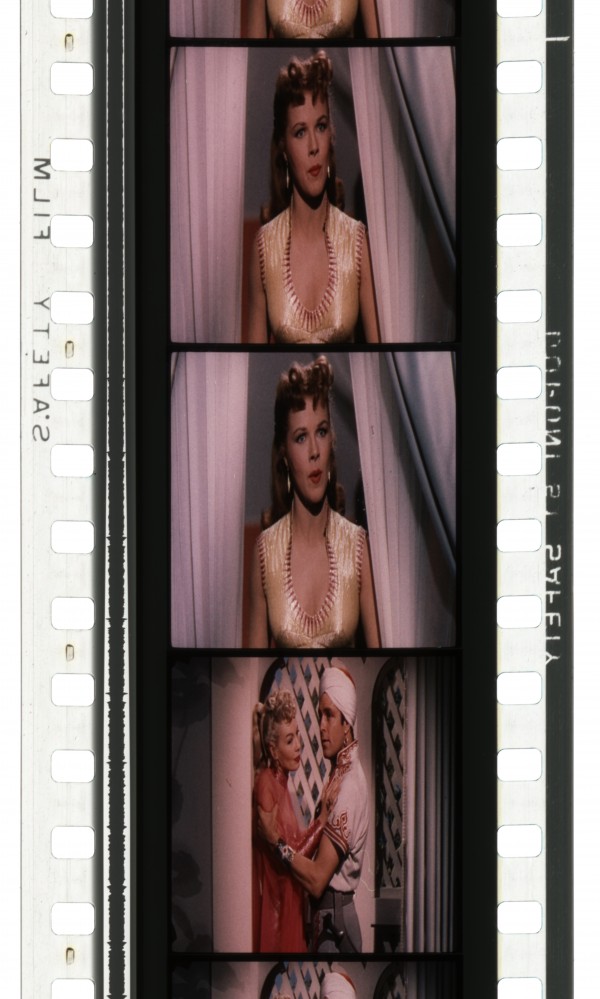
Superscope was used on both B/W and color features. Color releases, like this original 35mm print of Ted Tetzlaff’s Son of Sinbad (1955), were printed using Technicolor’s dye transfer process.
The Museum of Modern Art, New York, NY, United States.
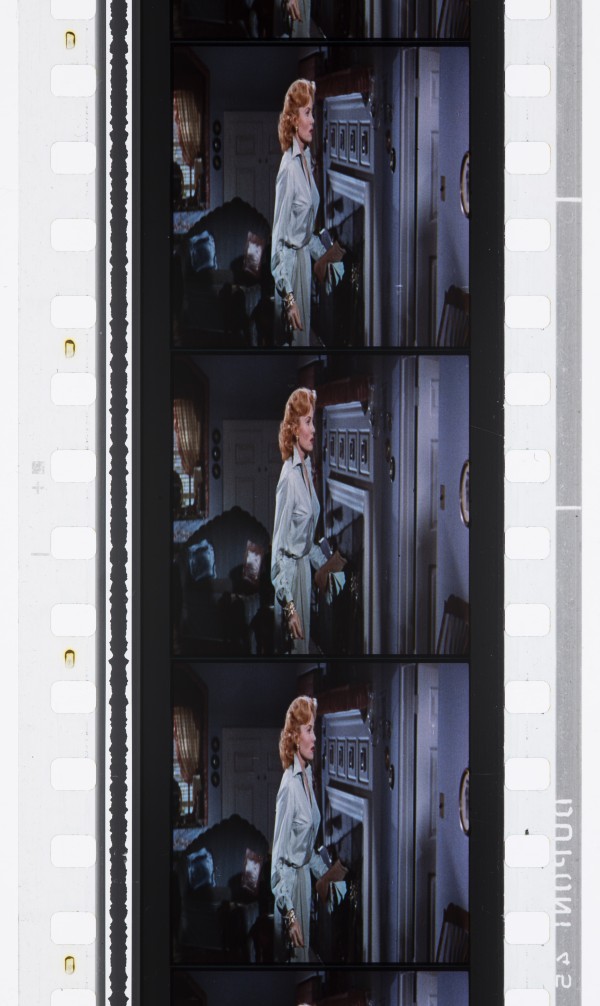
An original 35mm Technicolor print of Allan Dwan’s Slightly Scarlet (1956). The black bars or pillar-boxing on the left and right edges of the frame were added when the Technicolor printing matrices were made.
Martin Scorsese collection, George Eastman Museum, Rochester, NY, United States.
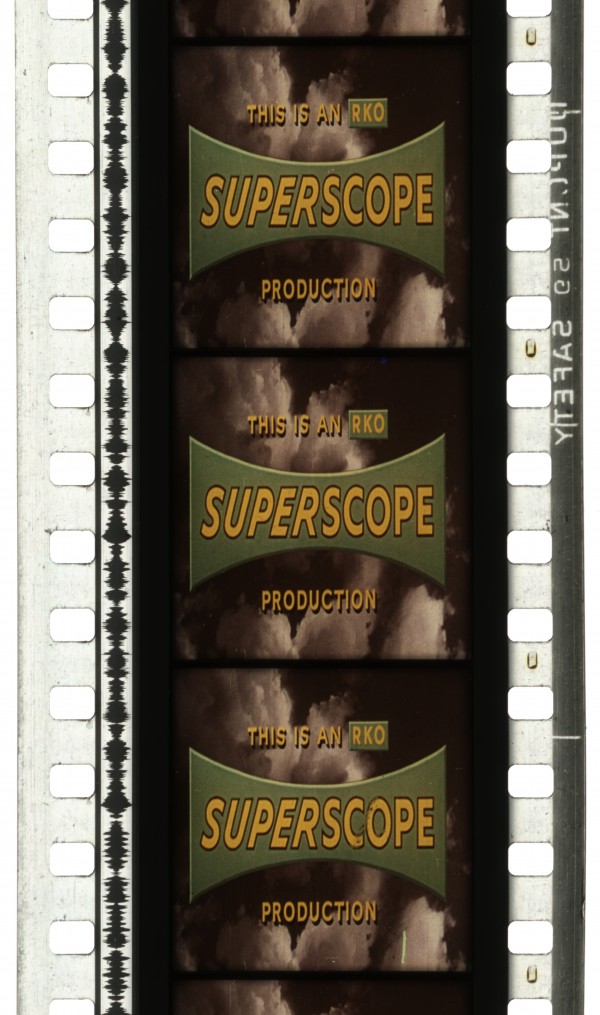
The Superscope logo was displayed prominently in the opening credits of Underwater (1955).
The Museum of Modern Art, New York, NY, United States.
Identification
It is likely that all Superscope prints were projected at the standard anamorphic frame size of 21.31mm x 18.16mm (0.839 in x 0.715 in). The pillar-boxing on the print itself would have further masked the edges of the frame on screen.
Principally Technicolor dye transfer prints, but also B/W.
Standard Eastman Kodak edge markings. Occasional Dupont print-through markings from soundtrack negatives.
1
Most Superscope releases were in color with some notable exceptions, and those color titles were all photographed on color negative. Technicolor was the lab of choice, and as such, release prints were made using the indelible dye transfer process and do not typically suffer from color fading today.
Superscope, Superscope-235
Compatible with standard variable area optical tracks. However, the original Superscope 2:1 aspect ratio could accommodate 4-channel magnetic stripe sound, although only one release used it: Walt Disney Productions’ 1956 re-release of Fantasia.
The Superscope uncropped full aperture frame was 25.32mm x 18.97mm (0.996 in x 0.747 in). From this source frame, Technicolor’s optical department extracted the following:
2:1: 23.85mm x 12.31mm (0.939 in x 0.484 in)
2.35:1: 24.89mm x 10.56mm (0.980 in x 0.416 in)
Eastman Color or B/W.
Standard Eastman Kodak edge markings.
History
The brothers Irving and Joseph Tushinsky invented their Tushinsky Superscope Variable Anamorphic Projection Lens in 1953 and formally introduced it to the industry in March 1954 amid Hollywood’s rapid embrace of widescreen technologies. It was developed in collaboration with RKO Radio Pictures and was distributed to interested theater owners by National Screen Service Corp.
The principal feature of the Superscope projection lens was that it could easily be adjusted to change the amount of anamorphic squeeze of an image to accommodate aspect ratios from 1.33:1 all the way to 3.0:1, and any variation in between.
This was introduced at a time when CinemaScope used a 2-to-1 horizontal squeeze ratio of the image, while a 1.5-to-1 squeeze ratio was being considered by Paramount for VistaVision and Technicolor later committed to 1.5-to-1 for Technirama. Because it was looking like there would be several different anamorphic ratios of pictures delivered to movie theaters, the Tushinsky Superscope Variable Anamorphic Projection Lens was seen as a way to save exhibitors money, since they would need to purchase only a single lens to accommodate the various anamorphic squeezes forecast (theaters eventually standardized on the 2-to-1 squeeze of CinemaScope).
The Tushinsky brothers also offered a version of the Superscope projection lens to be used on laboratory optical printers. This led to what they branded as the Superscope film format for photographing motion pictures, which was first used on Vera Cruz (1954) and Underwater (1955).
The Superscope format, as originally envisioned, was a 2:1 aspect ratio captured by making use of the full aperture 35mm frame (also called the silent film aperture), making use of the area of the frame usually reserved for the optical soundtrack. Since all 35mm cameras normally expose the full aperture area of the frame, it was believed that Superscope could be photographed with no special adaptation to camera packages other than a new ground glass for composing to the 2:1 aspect ratio. It also allowed filmmakers to photograph in widescreen without having to pay any CinemaScope royalties to 20th Century-Fox.
35mm Superscope release prints were made by optically blowing up and then anamorphically squeezing the image so that release prints could use existing CinemaScope projection lenses already installed in theaters.
It is assumed that the Tushinskys chose the 2:1 aspect ratio in order to use more area of the original negative and mitigate the graininess introduced by the optical printing steps. It is also said that RKO (an early studio adopter and financial supporter of the format) had surveyed theaters across the country and felt the 2:1 aspect ratio was a better fit for the architecture of most theaters, although noticeably narrower than CinemaScope’s original 2.55:1 and subsequent 2.35:1 aspect ratios. [See also 2:1 (aspect ratio)].
Superscope 235
In 1956, the Tushinsky brothers introduced the Superscope 235 variant of Superscope. From a photographic standpoint, nothing changed from Superscope, except that the images were now composed with less height to match the 2.35:1 aspect ratio of CinemaScope release prints with an optical soundtrack, which had effectively become the anamorphic projection standard by 1956.
While no documentation exists as to the impetus for this decision, it appears to have been the Tushinsky brothers’ response to the more widely adopted 2.35:1 aspect ratio of CinemaScope.
Release prints for Superscope 235 were identical to those for CinemaScope with a 2.35:1 aspect ratio and standard optical soundtrack, with the anamorphic image centered on Academy center.
Run for the Sun (1956) is the only motion picture credited as being photographed in the Superscope 235 format. Warner Bros. photographed or adapted several films to the Superscope 235 format (including Up Periscope from 1959), but credited the process as being photographed “in WarnerScope.” (Not to be confused with the brief mention of WarnerSuperScope in July 1953 trade journals when Warner Bros. announced they had an anamorphic format identical to CinemaScope.)
Ultimately, Superscope never achieved widespread adoption, limited for the most part to use by RKO, Warner Bros. and several independent producers releasing through United Artists. It was viewed as a low-budget method to achieve a widescreen motion picture without having to pay rental fees for anamorphic lenses from 20th Century-Fox. Because the format used substantially less negative area than CinemaScope originals, and because of the limitations of 1950s color negative stocks and the optical printing step, the images were inherently grainy when projected. In the 1980s, Super 35 used similar principles and met with wider adoption. By this time, improvements in color film grain structure made this approach more acceptable.
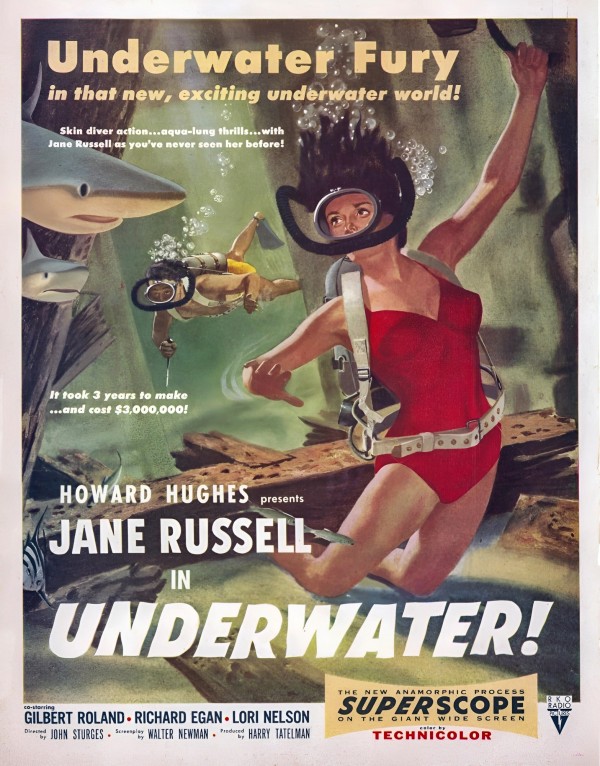
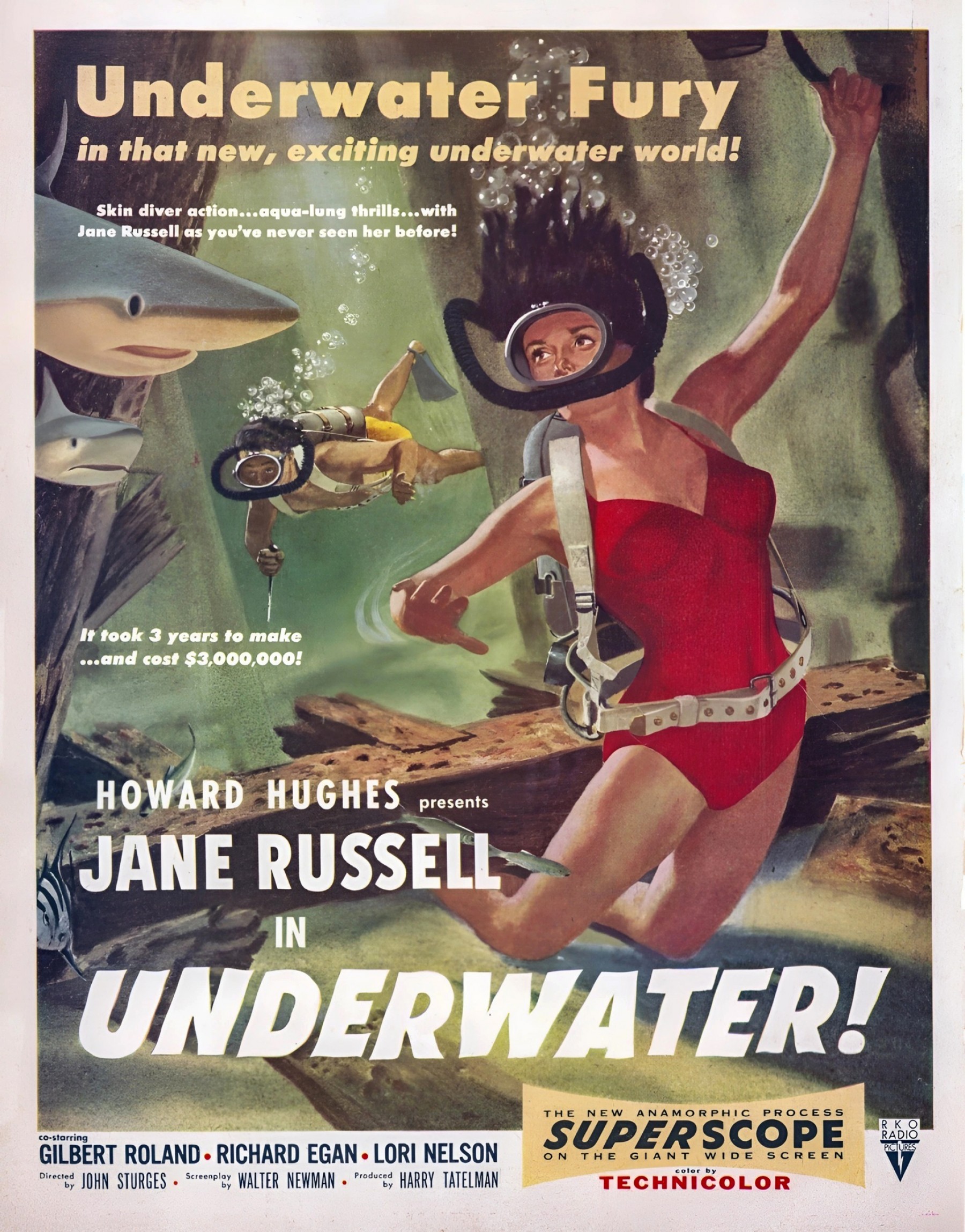
US one-sheet poster for RKO Radio Pictures’ first release in Superscope, Underwater (1955).
Courtesy of Rob Hummel.
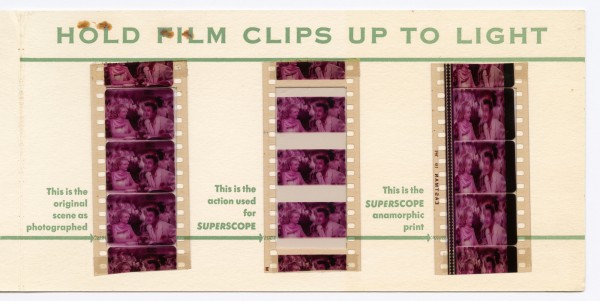
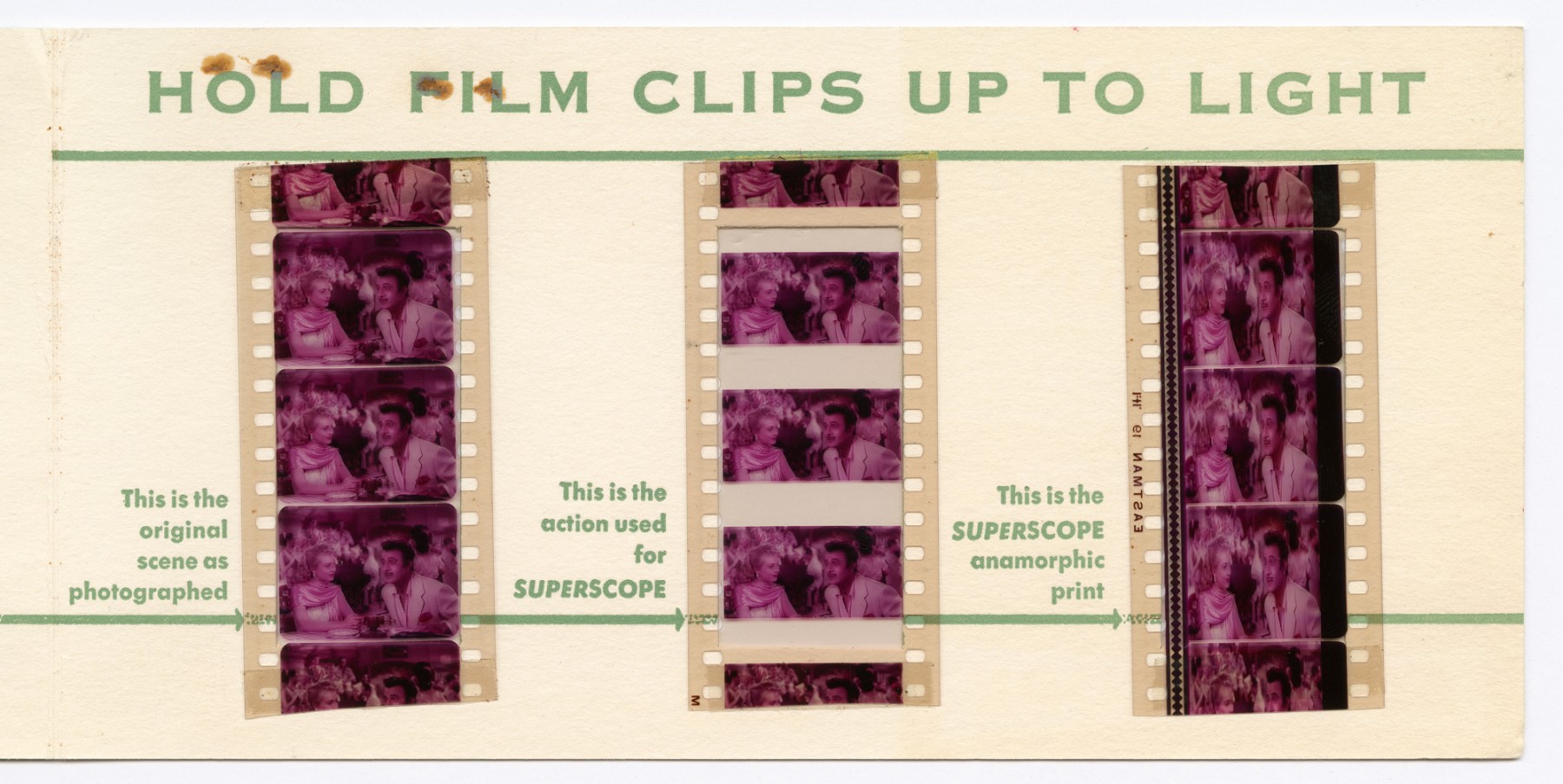
Exhibitors' promotional card explaining the steps required to extract a widescreen image from a full aperture negative. Note that only the right edge of the sample print is masked in this example. In reality, both left and right edges of the image were pillar-boxed to achieve a 2:1 aspect ratio.
Earl I. Sponable papers, Rare Book & Manuscript Library, Columbia University Libraries, New York, NY, United States.
Selected Filmography
The 1956 re-issue of Fantasia contained select scenes cropped for widescreen and released in Superscope. The remainder of the film was presented in 1.37:1 Academy aspect ratio. The projector featured an automatic control mechanism designed by Disney engineers that was coupled to a variable anamorphic lens, which allowed the picture to switch between the two aspect ratios.
The 1956 re-issue of Fantasia contained select scenes cropped for widescreen and released in Superscope. The remainder of the film was presented in 1.37:1 Academy aspect ratio. The projector featured an automatic control mechanism designed by Disney engineers that was coupled to a variable anamorphic lens, which allowed the picture to switch between the two aspect ratios.
B/W Superscope.
B/W Superscope.
Credited as WarnerScope.
Credited as WarnerScope.
The first film released in Superscope 235.
The first film released in Superscope 235.
Superscope.
Superscope.
Credited as RKO-Scope.
Credited as RKO-Scope.
Credited as WarnerScope.
Credited as WarnerScope.
The first film released in Superscope. “The scenery might look pretty if the fuzziness of Superscope and the blobbiness of the color were not offensive to the eye.” (Crowther, 1954). Not an auspicious beginning for a film format.
The first film released in Superscope. “The scenery might look pretty if the fuzziness of Superscope and the blobbiness of the color were not offensive to the eye.” (Crowther, 1954). Not an auspicious beginning for a film format.
B/W Superscope. Released in both anamorphic and flat uncropped Academy aspect ratio prints.
B/W Superscope. Released in both anamorphic and flat uncropped Academy aspect ratio prints.
Technology
The Superscope process started with the image composed to fit a 2:1 aspect ratio within the full aperture optical center of the camera negative.
Utilizing the standard workflow of the Technicolor dye transfer process, the first step involved creating anamorphic copies of the frame on the 35mm yellow, cyan and magenta printing matrices for dye transfer printing. The workflow employed an optical printer that would initially enlarge the 2:1 area so the height of the composition matched the height of the 35mm full aperture frame. This stretched the height of the frame by a factor of 1.65x.
Simultaneously with that enlargement, the optical printer also anamorphically squeezed the 2:1 composition so that it could then be “unsqueezed” by a standard CinemaScope anamorphic projection lens. The frame was also repositioned to the sound aperture optical center.
Also at this stage, an overlay mask or matte was flashed onto the matrices to pillarbox the frame with black borders on the left and right edges to maintain the 2:1 aspect ratio when projected.
Although some early marketing materials for Superscope show the frame with pillar-boxing on the right edge only, it is presumed that this method was not used in practice. All original prints consulted for this essay show pillar-boxing on both edges.
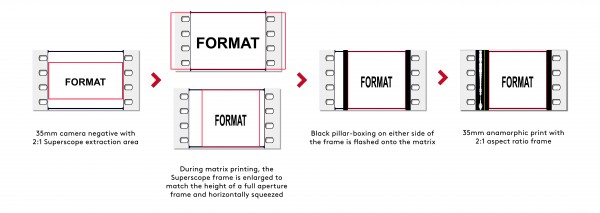
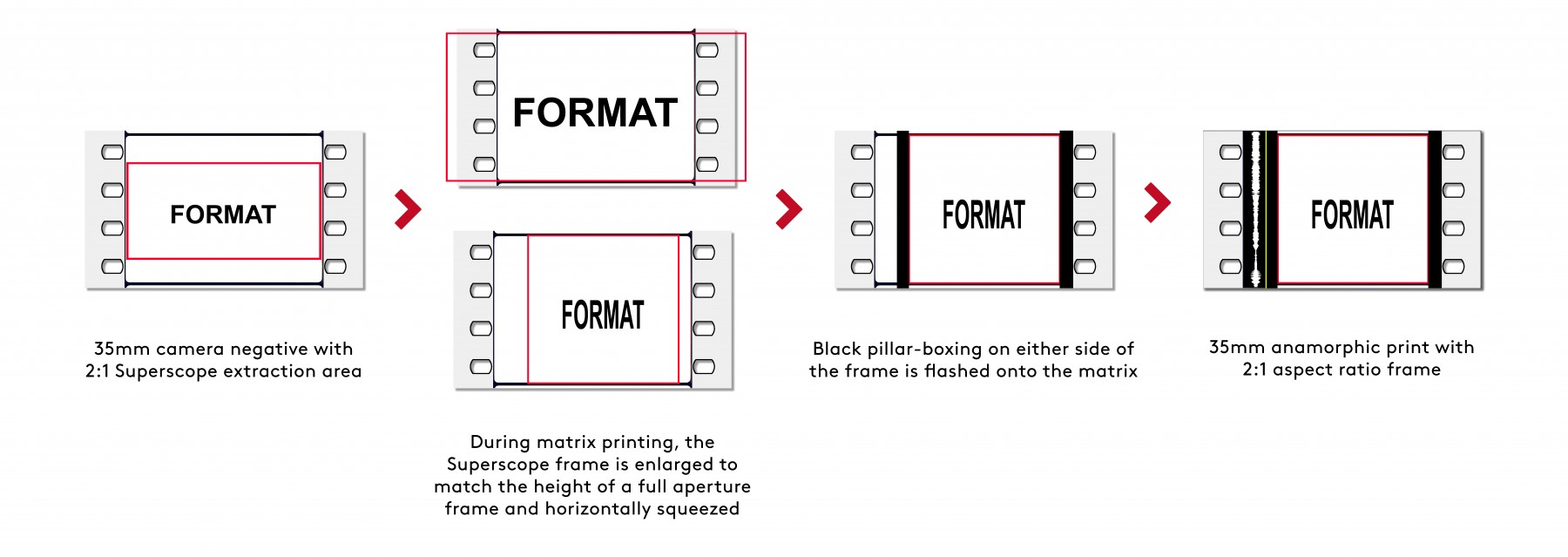
The printing workflow to make Technicolor printing matrices and the resulting dye transfer print from the original uncropped negative.
Diagram by Rob Hummel.
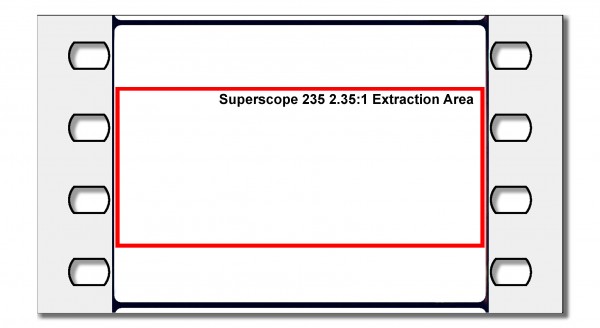
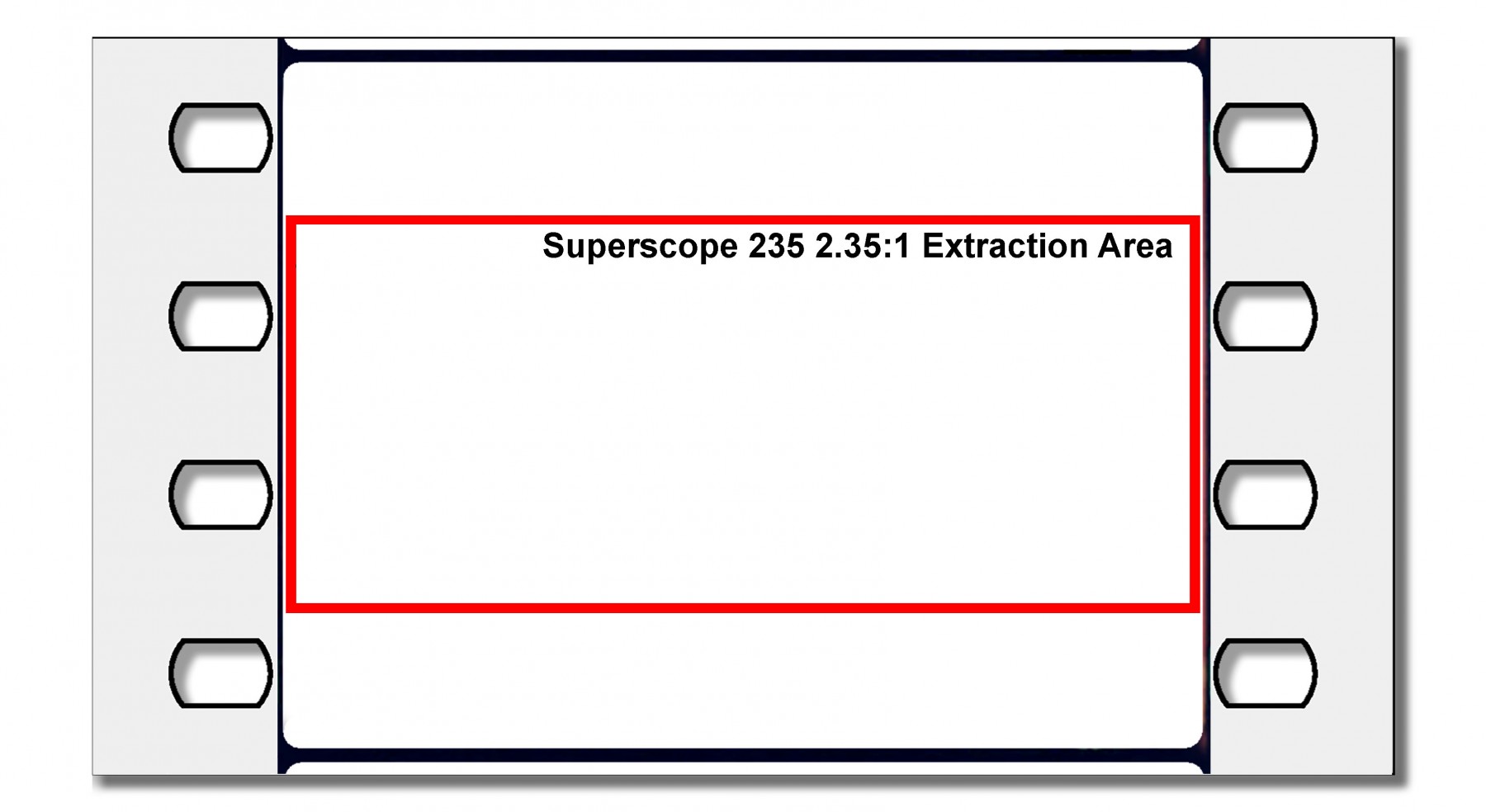
The Superscope-235 extraction area from the 35mm original negative.
Diagram by Rob Hummel.
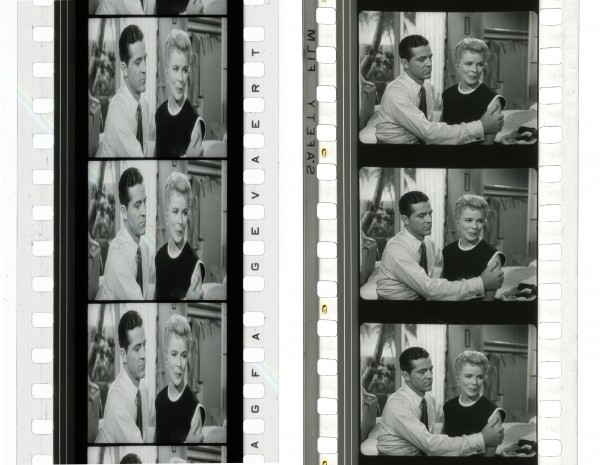
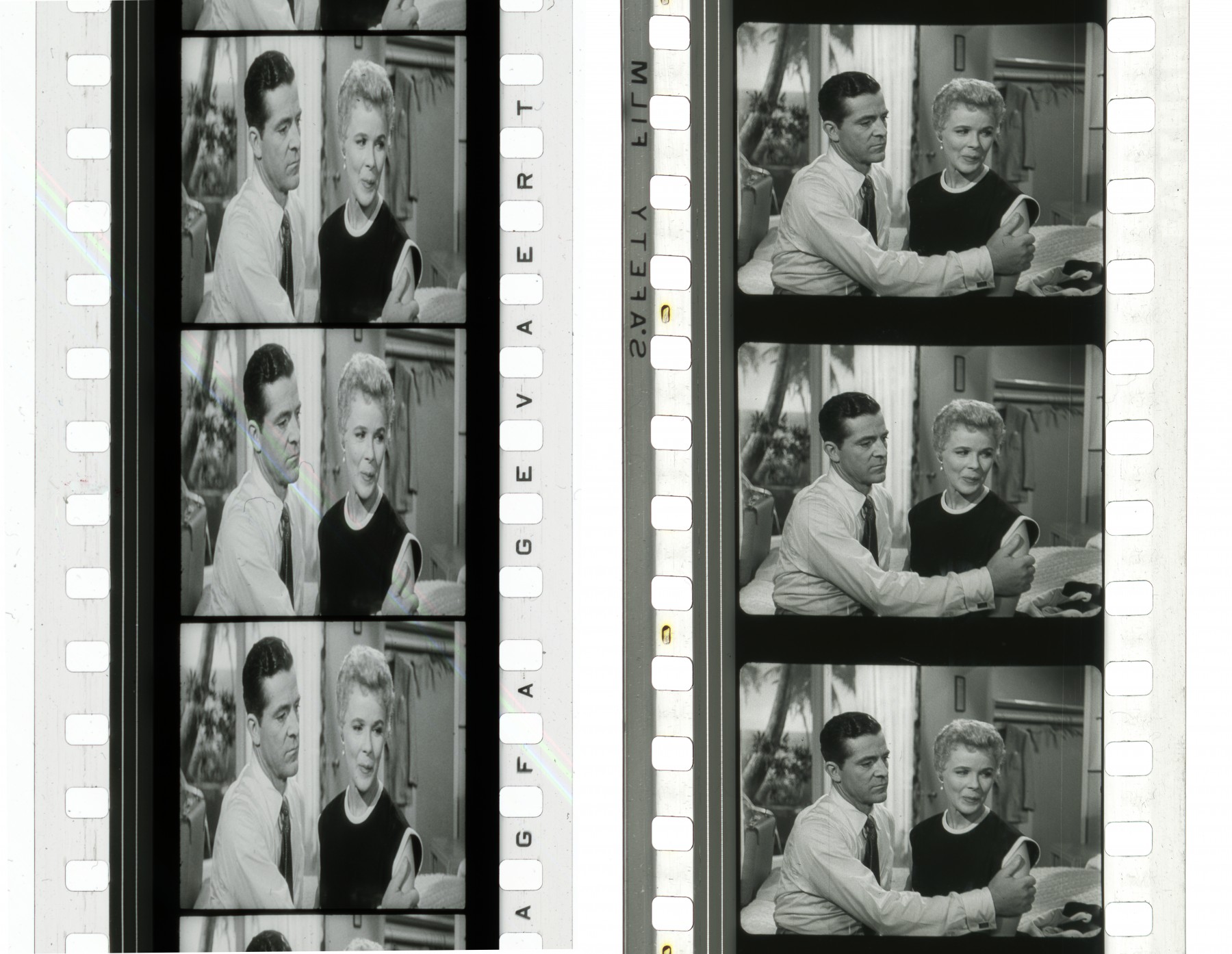
Fritz Lang’s While the City Sleeps (1956) was released in two versions: anamorphic Superscope (left) and uncropped flat Academy (right).
Left: Library of Congress, Culpeper, VA, United States. Right: The Museum of Modern Art, New York, NY, United States.
References
Crowther, Bosley (1954). “Gary Cooper and Burt Lancaster star in 'Vera Cruz' at the Capitol”. The New York Times (Dec. 27), p. 19.
Dunton, Joe (2022). Personal interviews with Robert Hummel (Dec. 8, 2022 & Nov. 26, 2024).
Goi, Michael & American Society of Cinematographers (2013). American Cinematographer Manual. 10th ed. Hollywood, CA: American Society of Cinematographers.
Mullen, M. David, Rob Hummel & American Society of Cinematographers (2022). American Cinematographer Manual. 11th ed. Hollywood, CA: American Society of Cinematographers.
Technicolor (c. 1954). “New Anamorphic Process on Your Giant Screen: Superscope is Compatible with CinemaScope Projection”. Fred Basten tub #2, Box 1 (July 2019), Robert Hoffman files, Technicolor Corporate Archive, George Eastman Museum, Rochester, NY, United States.
Technicolor (1973). “Print Systems from 35mm Full Aperture (FA) Negative”. Folder 6, Box 3, Optical Printing Department, Technicolor Corporate Archive, George Eastman Museum, Rochester, NY, United States.
SMPTE Progress Committee (1958). “Superscope 235”. SMPTE Progress Committee Report, 67:5 (May): p. 290.
Superscope (c. 1954). “Your Picture Size Changes … with the Turn of a Dial” [Superscope Variable Anamorphic Projection Lens promotional booklet]. Folder 26, AT-137, John M. Andreas Collection, George Eastman Museum, Rochester, NY, United States.
Followed by
Compare
Related entries
Author
Rob Hummel’s career has revolved around cinematography, film labs, film formats, film restoration, preservation, animation, post-production, digital cinema, visual effects, and stereoscopic 3-D. He has been an Associate member of the American Society of Cinematographers (ASC) since he was 32 and is a Life Fellow of the Society of Motion Picture and Television Engineers. He was the editor of the 8th edition (2002) of the American Cinematographer Manual and co-editor of the 11th edition (2022).
He started at Technicolor in 1979, working closely with filmmakers, where he oversaw dailies processing for all feature films and shepherded films in post-production up to answer print. He worked in post-production, animation and Imagineering at Walt Disney Studios, headed animation technology at DreamWorks and helped launch digital cinema units at Technicolor and Sony. During the 2006 restoration of Blade Runner, he single-handedly found the 65mm visual effects elements, which had been lost for over 20 years.
At Warner Bros. he oversaw digital restoration work on The Wizard of Oz, Casablanca and Gone With the Wind, among other titles. Hummel spearheaded tests and seminars on the pros and cons of different film formats.
He has served as chair and co-chair of the Public Programs Committee of the Academy’s Sci and Tech Council and served over 15 years on the Sci Tech Awards Committee. Rob has hosted several programs at the Academy on the history of Film Formats, Film Technology and 3D Stereoscopic Imaging, as well as given presentations in New York, London, Rome and Tokyo on the use of motion picture technologies in service of storytelling.
Joe Dunton, BSC, for clarifying the origins of his Super 35 format, and to the patient Technicolor Hollywood and London technicians who shared their knowledge with me: Joe Schmidt, Bud Castelli, Robert Buckley, Les Ostenelli, Skip Nicholson and Bob Crowdey.
Hummel, Rob (2026). “Superscope”. In James Layton (ed.), Film Atlas. www.filmatlas.com. Brussels: International Federation of Film Archives / Rochester, NY: George Eastman Museum.